
Publishing thousands of URLs is easy. Building thousands of pages that deserve to rank is the difficult part.
Programmatic SEO can create meaningful organic growth when a site has repeatable search demand, dependable data, and a clear way to help visitors make a decision. Without those ingredients, it usually creates thin pages, crawl waste, and an inflated page count that nobody benefits from.
When programmatic SEO is the right growth strategy
Programmatic SEO is the practice of using structured data, reusable templates, and publishing rules to create useful pages for many related searches. The goal is not to automate content for its own sake. It is to answer a large set of consistent, specific queries that would be impractical to cover one page at a time.
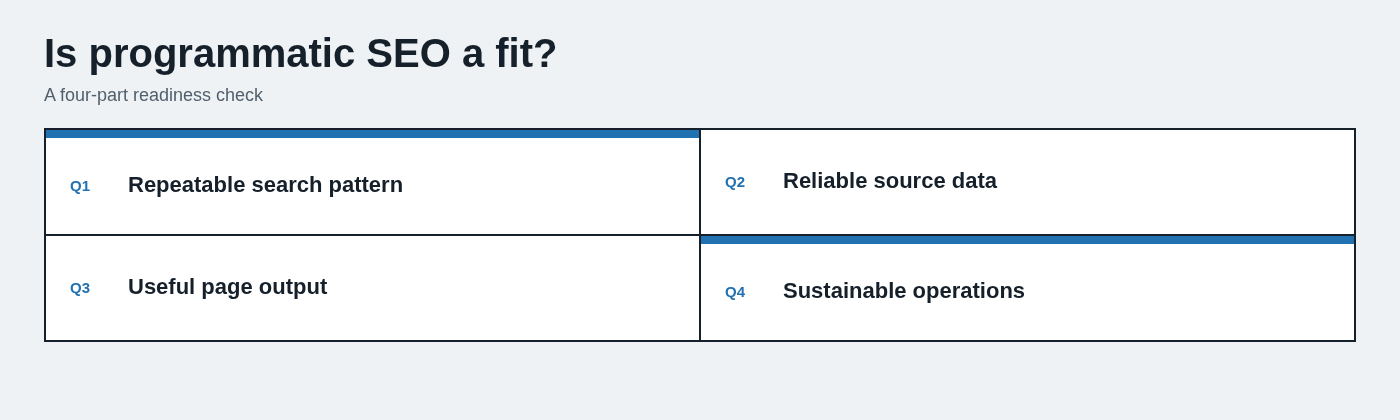
It works best when four conditions are true: there is a large and repeatable keyword pattern, the underlying data is reliable, each page supports a real user task, and your team can maintain what it publishes. A marketplace may build pages for products, brands, and categories. A SaaS company may create integration, use-case, comparison, or location pages. A local service business may build useful coverage pages when service details actually vary by area.
Do not confuse this with generating AI-written pages in bulk. A hundred pages with different city names but identical advice are not a programmatic SEO strategy. They are likely index bloat. The pages need distinct information that helps someone compare, find, calculate, evaluate, or take the next step.
1. Start with a keyword pattern, not a giant keyword list
A spreadsheet full of keywords is not a strategy. Look for a recurring structure behind those terms: a core topic plus modifiers such as location, category, integration, audience, feature, price, use case, or comparison.
For example, a project management platform may see demand around "[tool] integrations," "[tool A] and [tool B] integration," "best project management integrations," and "[tool] alternatives." Those are related topics, but they do not necessarily deserve the same page type. The searcher's task changes between finding a compatible integration, comparing options, and replacing a product.
Use keyword research tools such as Semrush to validate demand, assess ranking competition, and inspect whether the search results look similar across a keyword cluster. Search volume is useful context, but it should never be the only publishing signal. A low-volume query with strong commercial relevance and a clear intent can be more valuable than a broad term that produces vague, mixed results.
Map one page type to one search intent
A practical rule is simple: consolidate terms when the searcher would be satisfied by the same answer. Create a new template only when the visitor needs meaningfully different information or a different action.
- Directories work for patterns such as "email marketing tools for ecommerce" or "accounting software for freelancers," where users want a filtered set of options and comparable details.
- Marketplaces can target product, category, brand, and attribute combinations when inventory, availability, pricing, or specifications genuinely change.
- SaaS integration pages fit searches such as "HubSpot Slack integration" when the page can explain triggers, actions, setup requirements, and limitations.
- Local service pages are appropriate when service areas have real differences in availability, turnaround time, regulations, pricing factors, or local proof.
Do not create separate URLs for superficial wording changes. If "best CRM for startups" and "startup CRM software" return nearly identical results and require the same recommendation framework, one strong page is usually better than two competing pages.
2. Build pages around data that answers the query
In programmatic SEO, the dataset is part of the product. Every field should help the visitor decide something: whether a product is compatible, whether a provider serves their area, what an option costs, or how alternatives differ.
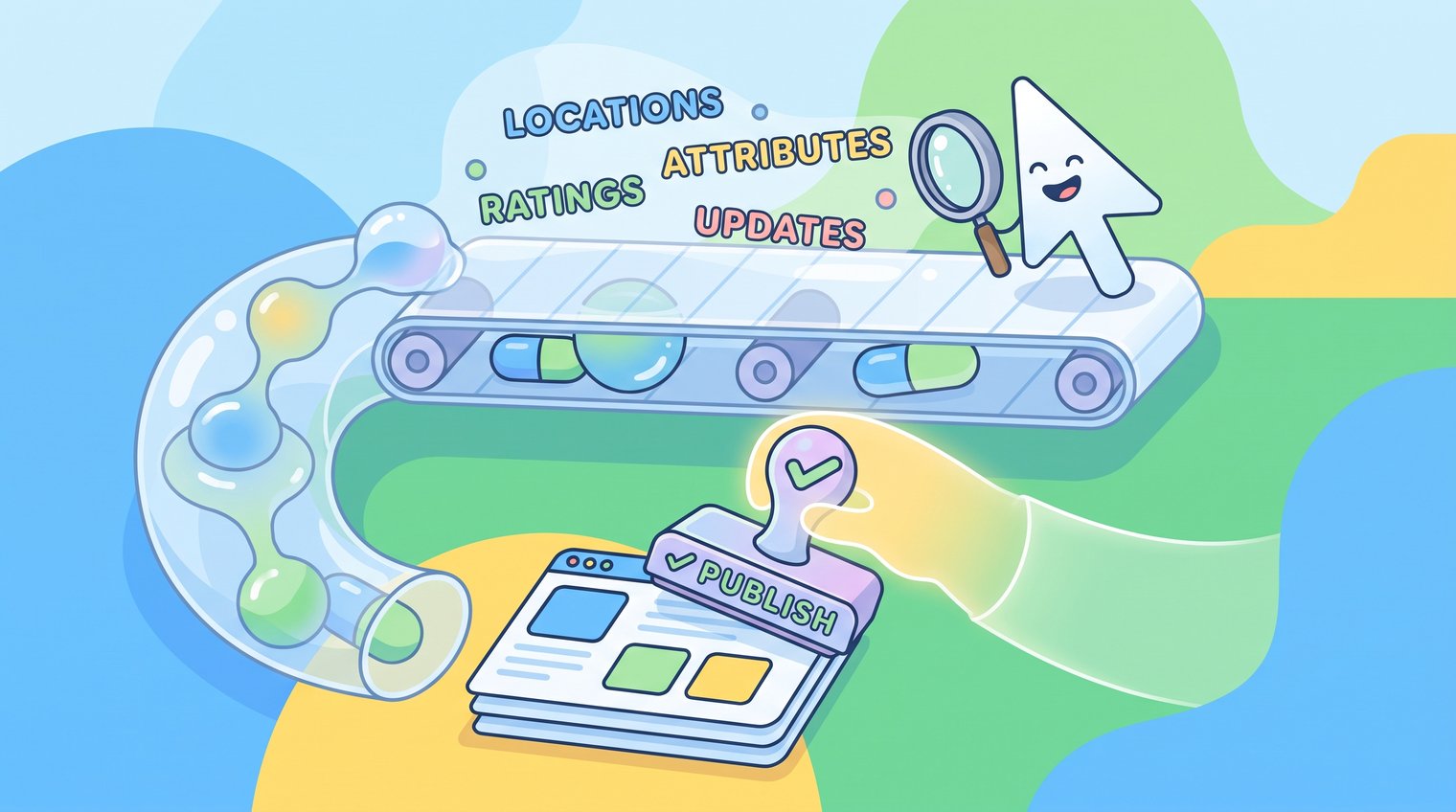
Before building templates, validate where data comes from, whether you have permission to use it, how often it changes, and who owns updates. Normalize inconsistent labels, define how missing values appear, and keep a record of provenance for important claims. A field called "rating" is not useful unless users can understand where it came from and when it was updated.
Set a minimum publication threshold. For an integration page, that might require verified compatibility, setup information, at least one supported workflow, and an updated date. For a directory listing, it may require a complete description, primary category, location or service coverage, and evidence the entity is active. Anything below the threshold should be held, merged into a broader page, or excluded from indexing.
3. Design one reusable template with meaningful variation
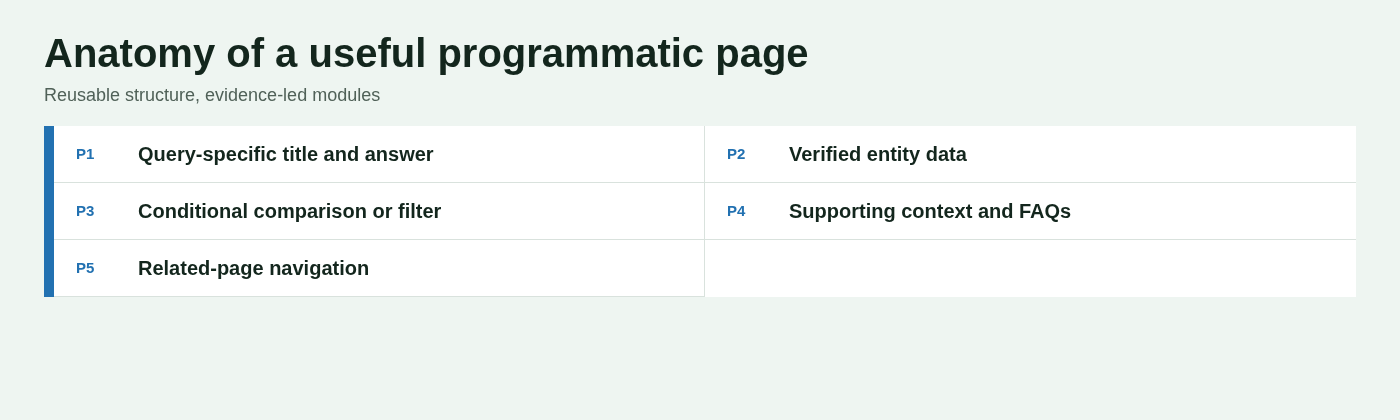
A strong template provides a consistent experience without making every page feel interchangeable. Start with an intent-led title and page heading, followed by a concise answer to the query. Then give readers the entity-specific facts they came for.
A useful programmatic page often includes verified data, comparisons or filters where relevant, explanatory context, related entities, and a clear next action. The variation should come from the data and the user's situation, not from swapping keywords into the same paragraph.
- A product comparison page may conditionally show feature differences, price ranges, and a "best for" recommendation.
- An integration page may include setup steps only when the connection is supported, plus an alternative workflow when direct integration is unavailable.
- A location page may include service-specific details, operating coverage, and local requirements rather than generic city copy.
Get the technical foundations right as well: use consistent URL rules, correct self-referencing or canonical tags, metadata guardrails, accessible headings, fast mobile rendering, and clean pagination. A polished template cannot overcome poor page performance or confusing duplication signals.
4. Create a small proof-of-concept before scaling
Do not launch 20,000 URLs because the template technically works. Start with a representative pilot that includes high-demand terms, lower-demand long-tail terms, rich records, and records with borderline data quality. That sample will expose flaws much faster than a broad rollout.
Track valid indexed pages, impressions by template, click-through rate, engagement, conversions, crawl behavior, and duplication warnings. Search Console is especially useful for spotting which page groups are actually being discovered and indexed, while analytics can show whether visitors find the pages useful after they arrive.
The pilot is where you fix missing data fields, weak title rules, cannibalization, poor internal links, and misleading template assumptions. Once the pattern works across a small cohort, scaling becomes a controlled operational decision rather than a gamble.
5. Use AI for production support, not as the page strategy
ChatGPT can help with SEO work. It can draft schema markup, suggest content briefs, identify data-cleaning rules, produce controlled copy variations, and support QA checklists. It cannot independently determine whether a query deserves a page, whether a factual claim is current, or whether a template helps your customers.
SEO is not dead because of AI. It is still worth doing in 2026 because people and systems still need to discover crawlable, credible, useful information. AI has changed the production environment and raised expectations, but it has not removed the need for technical SEO, sound information architecture, editorial judgment, or authority.
AI will not replace capable SEO experts; it will reduce the value of repetitive work that can be automated without judgment. The people who remain valuable are the ones who can connect search intent, content, data, development, analytics, and business outcomes.
For programmatic SEO AI workflows, put safeguards in place before publishing:
- Use approved, attributable source data for all factual fields.
- Require human review for claims, recommendations, and sensitive categories.
- Set tone, formatting, and prohibited-claim rules in advance.
- Run duplicate-content and broken-data checks before release.
- Keep rollback capability so flawed pages can be corrected or removed quickly.
6. Publish selectively and control indexation
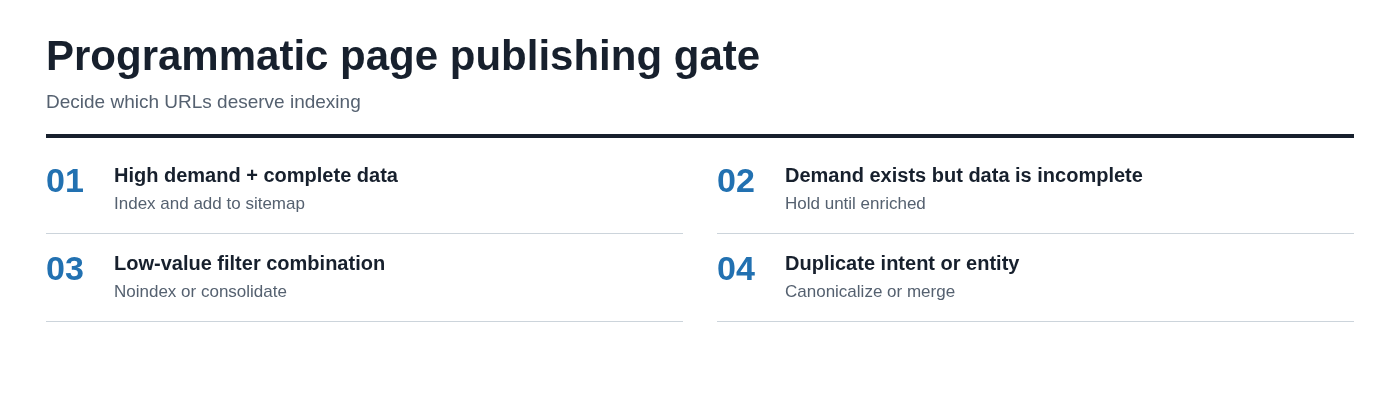
Not every generated URL deserves to be indexed. Filter states, weak combinations, empty categories, duplicate entities, and paginated variants can all create unnecessary crawl demand if left unmanaged.
Use noindex directives, canonicalization, pagination rules, and robots controls deliberately. A low-value filter URL may still be useful for site navigation without being a search landing page. A duplicate entity page may need consolidation or a canonical signal. The right choice depends on whether the URL offers distinct search value, not on whether it can be generated.
Keep XML sitemaps segmented by page type so problems are easier to diagnose. Monitor for soft 404s, duplicate pages, orphan pages, rendering failures, and unexpected indexation trends. Submitting a URL in a sitemap does not make it worthy of an index; quality and demand do.
7. Build internal links that help users and crawlers find the pages
Programmatic pages need a logical route through the site. A hub-and-spoke structure usually works well: broad category hubs lead to use-case, location, or product groups; those groups lead to individual entity pages; entity pages link to genuinely relevant alternatives and adjacent choices.
Internal links should help a visitor continue their research. Contextual anchors such as "accounting integrations for Shopify stores" are more useful than repeated "learn more" links, and they send clearer topical signals than a giant footer-style block of automated links.
Audit the structure regularly. Important pages should be reachable through normal navigation, receive links from authoritative category hubs, and have more than an XML sitemap supporting discovery. If a high-value page is effectively hidden three layers deep behind filters, it is less likely to perform as well as it could.
8. Strengthen the pages with editorial expertise and earned authority
A reliable template is necessary, but competitive queries often require more. Original methodology, expert commentary, proprietary data, real examples, and carefully selected citations can turn a functional page into one people trust and reference.
That is also where whitehat link building has a role. Rather than trying to acquire links to every generated page, focus on category hubs, original data studies, and resources with broad value. Those priority assets can pass authority through a sensible internal-linking system to the relevant programmatic clusters.
Teams that need support with contextual link insertions, editorial guest posts, or content partnerships can consider LinkHandy for priority assets. The placement should be relevant and editorially defensible; mass links to thin generated URLs are not a durable authority strategy.
9. Measure performance by template and improve the weakest component
Programmatic SEO becomes manageable when reporting follows the structure of the site. Segment Search Console and analytics data by template, entity type, indexability status, and publication cohort. Looking only at sitewide traffic hides the pages and rules that need attention.
Prioritize improvements in a sensible order: indexation blockers first, then intent mismatch, incomplete data, weak search snippets, low-value page modules, internal-linking gaps, and finally authority gaps. There is little value in pursuing backlinks for a page group that Google has not indexed because the records are incomplete.
Keep a change log with the date, affected template or cohort, what changed, and the expected outcome. It makes it easier to connect technical fixes and editorial improvements to changes in crawling, rankings, traffic, and conversions instead of reacting to isolated keyword movement.
Semrush
Semrush is useful when a programmatic SEO team needs to assess authority gaps around priority hubs and content clusters. Backlink analysis can help identify which pages earn referring domains, where competitors have stronger editorial coverage, and which link opportunities are relevant to a high-value category rather than an individual low-value URL.
Its strength is the breadth of competitive research it can support alongside link analysis. The limitation is that tool data still needs interpretation: a list of referring domains is not a link-building plan, and not every competitor link is worth replicating. It is best suited to teams that already have clear page priorities and need evidence for where authority work may have the greatest impact.
A programmatic SEO example: a software integration directory
Imagine a software company building an integration directory. Its keyword patterns might include "[tool A] + [tool B] integration," "best [category] integrations," and "[tool] alternatives." These should not all use one template.
The site could build a directory template for broad integration discovery, a pair-page template for specific software combinations, and category templates for searches such as "best CRM integrations" or "best ecommerce integrations." Alternative pages would need a separate comparison structure because the visitor is evaluating replacement options, not simply checking compatibility.
Each integration record should contain useful fields: supported triggers and actions, pricing notes, setup steps, limitations, verification criteria or ratings, last-updated date, and related integrations. Those fields give visitors concrete answers instead of a generic statement that two products "work together."
The publishing decision is equally important. Index pages for verified integrations with enough unique data to explain how the connection works. Hold sparse pair pages until they are enriched, and consolidate combinations that do not represent distinct demand. Direct internal authority through well-maintained category hubs, which can rank for broader discovery queries and send visitors toward specific pair pages.
What makes the example useful instead of templated filler
Every module should answer a visitor question. Compatibility details answer "Will this work?" Setup steps answer "How difficult is implementation?" Triggers and actions answer "What can it do?" Pricing and limitations answer "What will it cost and where are the tradeoffs?" Related integrations and alternatives answer "What should I consider next?"
Editorial review prevents inaccurate claims, dated data tells readers whether information is current, and conditional sections ensure pages change when the underlying integration changes. A pair page with no supported workflow should not pretend to be equal to a page with complete setup instructions and verified capabilities.
Programmatic SEO is a quality system, not a page-count tactic
The operating principle is straightforward: validate a repeatable intent, use dependable data, build templates that solve a real task, index selectively, and improve based on performance evidence. If any of those parts are weak, publishing at scale magnifies the weakness.
SEO can be self-taught, and it remains a strong career skill for people willing to learn how search, content, technical systems, and analytics work together. It is not usually difficult to understand the basics in a few weeks, but becoming effective takes ongoing practice. The highest-paid digital skills tend to combine strategic judgment with technical or commercial impact, and programmatic SEO is a good example of that blend.
SEO work can be stressful when teams chase rankings without clear priorities, but a disciplined process reduces that pressure. For businesses with valuable category hubs or original resources that need authoritative editorial links, explore LinkHandy's whitehat backlink services.