
AI optimization is attracting plenty of bad advice: add a few buzzwords, publish AI-generated pages at scale, and expect your brand to appear in every answer. That is not how durable visibility works.
For organic growth, AI optimization means making your website, content, and brand signals easy for AI-powered search systems to retrieve, understand, verify, and, where appropriate, cite or recommend. It builds on sound SEO rather than replacing it.
AI optimization: what it means for organic growth
AI optimization, often shortened to AIO, has two common meanings. One is using artificial intelligence to improve a business process, such as forecasting demand, automating support, or prioritizing leads. The other is optimizing digital content for AI-driven discovery. This guide focuses on the second meaning.
In practice, AI optimization is the work of improving the signals that help search engines and AI answer systems understand what your business does, who it serves, what claims it can support, and when its pages are useful as a source. The goal is not merely to rank for a keyword. It is to become eligible to appear when a system synthesizes an answer to a real question.
That includes traditional organic search, AI-generated summaries, conversational search experiences, recommendation queries, and research workflows where users ask a tool to compare providers or explain an unfamiliar topic. Visibility in these environments is never guaranteed, but a site with accessible pages, precise information, original proof, and credible external references has a much stronger foundation.
Quick start: the five actions that matter first
- Protect technical crawlability. Important pages need stable URLs, indexable HTML, sensible internal links, and reliable mobile rendering.
- Answer high-intent questions directly. Put the useful answer near the top of the page, then explain the context, tradeoffs, and evidence.
- Publish original evidence. First-hand experience, research, documented methods, case evidence, and expert review give a page substance that generic summaries lack.
- Strengthen entity consistency. Use the same accurate brand, product, author, and company details across your website and reputable third-party profiles.
- Measure outcomes, not just appearances. Track qualified referrals, assisted conversions, leads, branded demand, and observed mentions alongside rankings.
These actions improve eligibility, not certainty. No responsible provider can promise an AI Overview placement, a citation in a chatbot response, or a recommendation for every query. Systems change, answers vary by user and location, and many results do not show source links at all.
AIO vs. SEO: where they overlap and where they differ
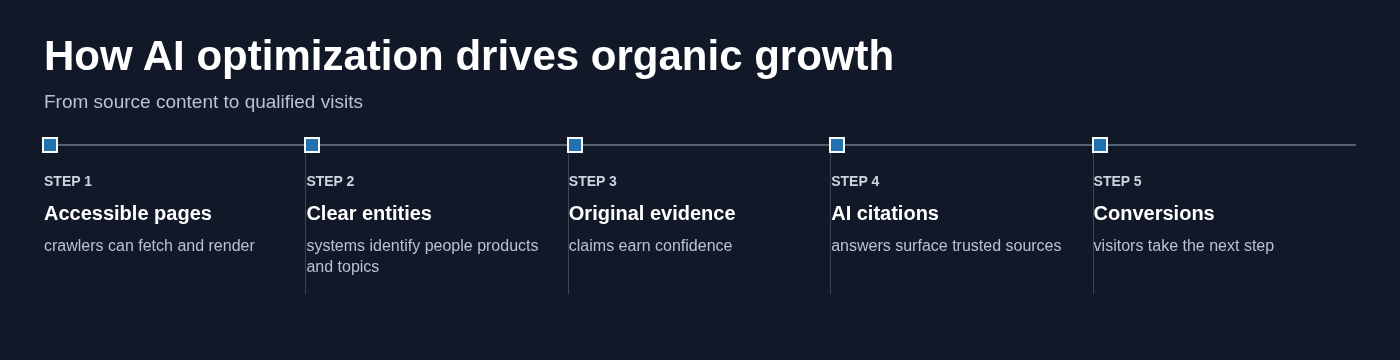
AIO versus SEO is not an either-or choice. SEO is the foundation: it helps search engines crawl, index, interpret, rank, and send visitors to pages. AIO extends that work toward retrieval, synthesis, citation, and conversational journeys where a user may receive an answer before deciding whether to click.
SEO traditionally emphasizes rankings, impressions, clicks, and organic conversions. AIO asks additional questions: Can a system isolate a useful passage from this page? Is the source clear enough to ground a factual answer? Does the page explain its scope and limitations? Are the brand's claims supported elsewhere on the web?
Google's public guidance around generative search generally reinforces durable SEO practices. There is no secret AI-only markup, hidden block of text, or prompt-stuffing technique that reliably creates visibility. The same fundamentals still matter: helpful content, sound technical implementation, clear intent matching, and earned authority.
Do not confuse AIO with using AI to automate SEO tasks. AI can help cluster keywords, summarize a crawl, suggest content gaps, or speed up a draft. That is workflow optimization. AIO is the strategic work of making your published information trustworthy and retrievable in AI-assisted search experiences.
How AI search systems decide what to use
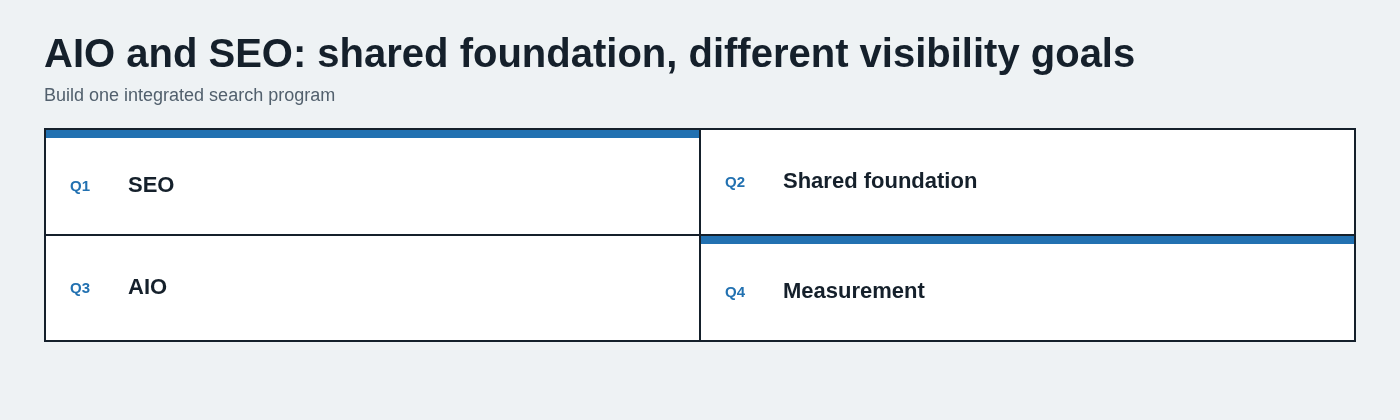
No one outside a platform can map every proprietary ranking or answer-generation signal. Still, the practical sequence is understandable. A system must first access a page, assess whether it is relevant to a query, retrieve useful passages, evaluate source quality and freshness, and synthesize an answer. It may then show citations, links, or no visible attribution at all.
The inputs you can influence are straightforward: indexability, topical relevance, clear entities, useful page structure, original information, up-to-date claims, corroboration, and a good user experience. A technically accessible page with vague, unsupported copy is not a strong source. Neither is a detailed page that a crawler cannot reliably render.
Avoid tactics built on myths. Hidden "AI-readable" text, keyword stuffing, fake FAQs, and structured data that does not match the visible page are poor long-term bets. They may create quality, trust, or compliance problems while doing nothing to improve the actual value of your content.
Retrieval, grounding, and citation eligibility
Retrieval is the process of finding potentially relevant material. Grounding is using that material to support a generated answer. A page may rank in conventional search and still fail to become a cited source because its relevant passage is too vague, buried, inaccessible, outdated, or less useful than a competing page.
Make the page easier to use at the passage level. Use descriptive headings, lead with a concise answer, define important terms, support factual statements with visible evidence, and identify the source of any statistic or methodology. This does not mean stripping away nuance. It means ensuring that the nuance follows a clear conclusion rather than obscuring it.
For example, a page answering "How long does a contextual link-building campaign take?" should not lead with a slogan. It should state that timelines vary by publisher review, content requirements, and campaign scope; explain the process; and avoid promising a ranking outcome. That is more useful to a buyer and more defensible as a source.
Entities and corroboration beyond your own website
An entity is a distinct, recognizable thing: a company, person, product, place, or concept. Your brand becomes easier to understand when the name, description, leadership details, services, and author credentials are accurate and consistent across your own site and reputable third-party sources.
For recommendation and comparison questions, systems may look beyond a company's homepage. Editorial coverage, credible business profiles, expert contributions, quality reviews, and relevant publications can help confirm that the organization exists, operates in a particular category, and has real expertise. They do not guarantee a citation, but they strengthen the information environment around your brand.
This is where white-hat digital PR, content partnerships, and relevant editorial links can serve a legitimate role. The objective is not to manufacture signals. It is to earn contextually relevant coverage that gives readers and search systems additional information to evaluate.

Build the technical foundation for AI optimization
AI optimization starts with technical SEO because a useful page cannot help if it is unavailable, incorrectly canonicalized, or difficult to render. Audit your highest-value pages before expanding the content calendar.
- Keep important pages available in indexable HTML, with stable URLs and appropriate canonical tags.
- Review robots directives so you are not accidentally blocking pages, assets, or sections needed for rendering.
- Make mobile rendering reliable and reduce performance issues that interrupt access to primary content.
- Use internal links to connect service pages, supporting guides, case evidence, and conversion pages.
- Maintain a clean XML sitemap that reflects the pages you want discovered and indexed.
- Resolve duplicate content, broken redirects, soft 404s, and orphaned high-value pages.
Structured data can reinforce machine-readable context when it accurately reflects visible content. Organization, product, author, article, review, and FAQ-related markup may be appropriate depending on the page. It is validation, not a shortcut to being cited by an AI system.
AI crawler policies deserve a separate decision. Search visibility and model-training access are not identical questions. Review crawler controls with your legal, editorial, and commercial teams based on your intellectual-property position, content-reuse preferences, and traffic goals. Do not make a blanket change simply because a competitor did.
Make your most valuable information accessible and extractable
Put important information where people and crawlers can access it. Product specifications, eligibility requirements, pricing qualifiers, policy details, methodology, and proof should not exist only in an image, a gated PDF, a video transcript that is never published, or a JavaScript interaction that fails to load consistently.
Tables are useful for comparisons. Definition blocks help when terminology is confusing. Step-by-step sections work well for implementation questions. FAQ-style content can clarify genuine follow-up questions, but do not add a bloated FAQ to every page merely because it once seemed like an SEO tactic.
Create content AI systems can confidently cite
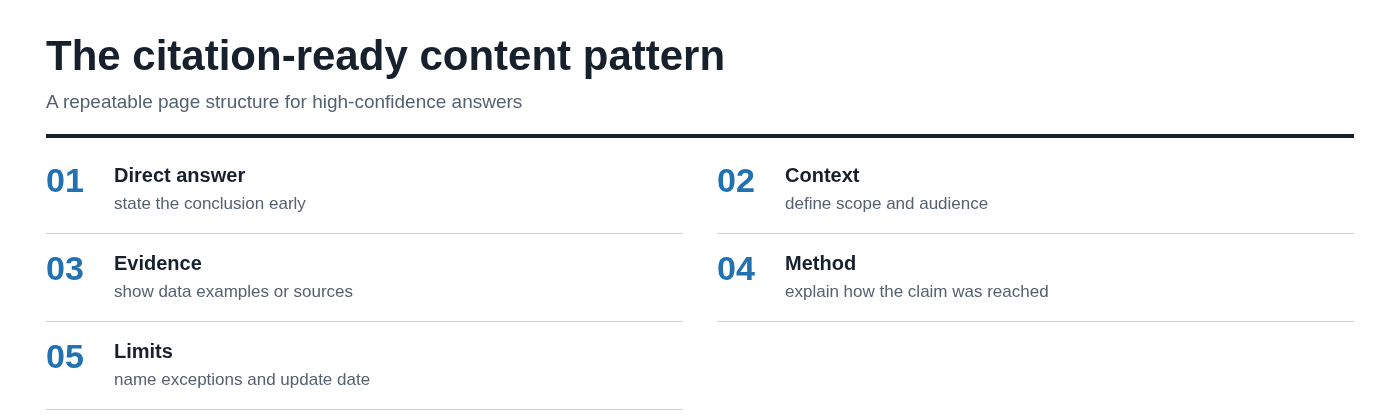
The strongest content does not just state an answer. It shows why the answer is credible. A practical editorial pattern is to answer first, define the scope, provide evidence, explain the method, state meaningful limitations, and date claims that may change.
Prioritize information your competitors cannot easily reproduce: first-hand experience, original research, proprietary data, expert analysis, documented processes, customer evidence with permission, and transparent authorship. A generic AI-generated summary may cover the same keywords, but it rarely gives a system or a buyer a reason to trust it over established sources.
Conventional SEO optimization tips remain useful here. Match the real search intent, update decaying pages, improve internal linking, remove thin duplicates, and earn relevant links from sites with actual editorial standards. AIO is not an excuse to abandon proven organic-search fundamentals.
Design pages around decisions, not just keywords
Every important query reflects a decision. A person searching a definition wants orientation. Someone comparing solutions wants criteria and tradeoffs. A buyer searching cost, implementation, risks, or alternatives needs specifics that help them move forward.
Choose one primary intent per page. A service page can answer "Who is this for?" and "How does it work?" while supporting related questions about timing, process, and limitations. It should not try to become a sprawling encyclopedia of every phrase in the category.
Consider a B2B analytics platform targeting the query "best dashboard software for multi-location retail." A weak page lists generic benefits. A useful page defines the target customer, explains required integrations, compares rollout approaches, identifies common data-quality risks, and gives a concrete implementation example. That page helps a buyer decide, whether they find it through a search result or an AI-assisted answer.
Use structured formats without writing for robots
Readers value clear formats, and retrieval systems benefit from clear structure. Use concise definitions, numbered steps where sequence matters, comparison tables for meaningful differences, visible product specifications, author bios, dated statistics, and named sources.
The point is not to sound robotic. Direct language can coexist with expert judgment. If a claim has exceptions, say so. If a comparison depends on company size or implementation complexity, explain the condition instead of declaring one universal winner.
Optimize your brand as an entity, not only a website
Your website is essential, but it is not the only place where your brand is interpreted. AI-assisted answers about companies, products, and recommendations often rely on signals across the web. Inconsistent naming, vague product descriptions, stale leadership details, or conflicting service claims make it harder to establish confidence.
Start with the basics: consistent business name, concise category description, accurate contact and location details where relevant, clear product terminology, current author credentials, and organization or author schema when it truthfully matches the page. Then review reputable industry profiles, reviews, and third-party references for accuracy.
Quality backlinks and editorial placements can support discovery and topical authority when they are relevant, earned, and aligned with an actual audience. They are not tokens to collect. A link from a useful industry resource or an expert contribution with real context is more durable than a large volume of irrelevant placements.
Earn third-party proof that adds information
Look for coverage that gives the reader something new: a contributed expert perspective, a data partnership, a useful resource mention, a product evaluation, or a relevant editorial story. Avoid manipulative link schemes that exist only to pass authority and add no value to the host publication.
Evaluate opportunities against consistent criteria:
- Does the publication have editorial standards and a real audience?
- Is the topic genuinely related to your expertise or offering?
- Will the mention appear in relevant contextual content?
- Is attribution transparent and accurate?
- Is the placement likely to remain useful and indexable over time?
LinkHandy
LinkHandy is best suited to businesses and SEO teams that need ongoing, white-hat support for contextual link insertions, editorial guest posts, and content partnerships. Its approval-oriented approach is especially useful when relevance and placement quality matter more than buying links at volume.
The meaningful limitation is that editorial link-building is not an instant visibility lever. Quality placements require prospecting, review, editorial coordination, and content that deserves a relevant mention. Organizations looking for overnight rankings or guaranteed AI citations should not expect those outcomes from any legitimate link-building service.
Choose this option when you have a clear authority strategy, useful pages worth promoting, and a need to build credible third-party signals without relying on opaque or manipulative tactics.
A 90-day AI optimization plan for an existing website
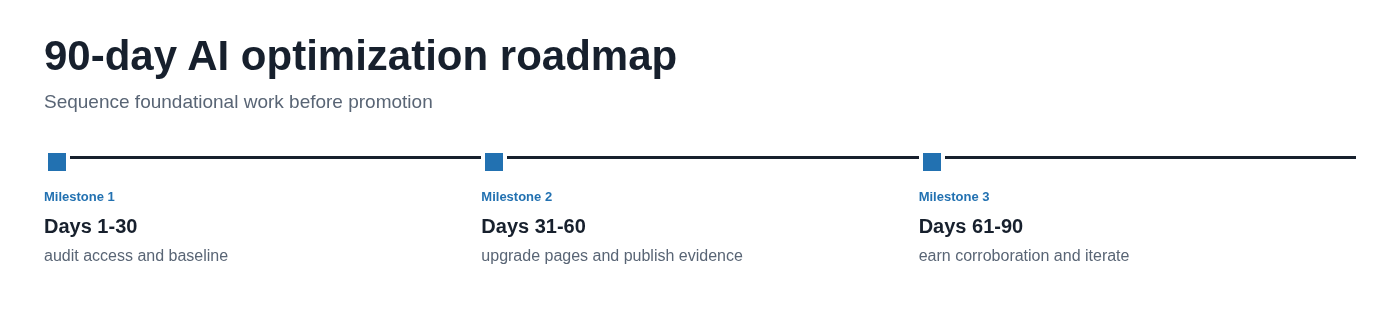
AIO becomes manageable when it is sequenced. Small teams should fix access and clarity before investing heavily in promotion. The following 90-day plan connects technical work, content upgrades, entity building, and measurement without assuming unlimited resources.
Days 1-30: establish the baseline and fix blockers
Begin with an audit of indexability, rendering, key conversion pages, canonicalization, duplicate content, and internal linking. Review whether the pages that generate or influence revenue actually contain clear answers, proof, and a visible next step.
At the same time, check entity consistency. Compare your website's brand description, service language, author bios, and company details with the information presented in important third-party profiles. Correct factual discrepancies before trying to amplify your brand elsewhere.
Create a baseline dashboard that includes organic traffic, rankings, branded search demand, referral traffic, conversions, qualified leads, and any observed AI citations or mentions. The goal is not perfect attribution. It is a starting point for identifying meaningful change.
Days 31-60: upgrade priority pages and publish proof
Select a small group of pages close to revenue or strategic demand. These might include core service pages, high-intent comparisons, implementation guides, and pages already receiving impressions but producing weak engagement.
Rewrite them using the citation-ready pattern covered earlier: direct answer, context, evidence, method, and limitations. Then publish one or two original assets that can earn references, such as a benchmark study, a detailed process guide, a dataset, an expert interview, or a well-documented case example.
Use internal links deliberately. A pillar guide should connect to relevant service pages, use cases, methodology pages, supporting evidence, and conversion paths. This helps visitors navigate and clarifies the relationship between your content.
Days 61-90: build corroboration and iterate from real queries
With priority pages upgraded, pursue earned mentions, editorial contributions, and partnerships that fit your topic and audience. Refresh important company and author profiles, and ensure external references describe the business accurately.
Use search data, referral patterns, sales-call notes, and customer questions to identify weak passages or unanswered needs. If prospects repeatedly ask about pricing variables, implementation time, security, eligibility, or alternatives, those questions likely deserve a well-supported on-page answer.
Set a recurring review cadence. Monthly checks are appropriate for many teams, with more frequent reviews for fast-changing industries. Review factual accuracy, page freshness, conversion quality, technical health, and emerging visibility opportunities.
A worked example: turning a generic service page into an AI-ready answer source
Consider a hypothetical B2B cybersecurity consultancy with a page titled "Managed Security Services." It has polished design and plenty of claims, but it does little to help someone deciding whether managed detection and response is appropriate for a 200-person company.
The team identifies a high-intent question: "Is managed detection and response worth it for a midsize business?" They review sales-call notes and find that prospects consistently want to understand staffing requirements, response coverage, onboarding time, and the difference between monitoring and active response.
Before: broad claims with little decision support
The original page says the firm delivers "next-generation protection" and "peace of mind." It has a long benefits list, no defined audience, no explanation of its service model, and no useful proof. Important implementation details are buried behind tabs and presented in a graphic rather than accessible text.
This is a common failure pattern. The page may contain the target phrase, but it does not answer the buyer's question. It gives an AI system little precise information to retrieve, and it gives a human prospect little reason to trust the service.
After: a scoped answer with evidence and next steps
The revised page opens with a qualified answer: managed detection and response can be worthwhile for midsize organizations that need continuous monitoring and incident-response support but cannot staff an in-house security operations center. It then explains when the service is not the right fit, such as organizations that only need periodic compliance assessments.
Next, the page provides a plain-language process: onboarding and asset discovery, monitoring coverage, alert triage, escalation, response responsibilities, reporting, and review cadence. It includes a comparison table explaining the difference between basic monitoring, managed detection and response, and a fully outsourced security operations model.
The evidence section names the service methodology, documents the expertise of the review team, and adds a dated anonymized example with clear limits. Instead of claiming to "eliminate risk," it explains the operational outcomes the service is designed to support. The page finishes with an appropriate conversion action: request an assessment to determine whether the company's coverage needs match the service scope.
Before publishing, use an editorial QA checklist:
- Are all factual claims accurate and approved by a qualified subject-matter expert?
- Are statistics, sources, methods, and dates visible where needed?
- Does the author or reviewer have relevant, transparent credentials?
- Do internal links lead to supporting proof, related services, and next-step pages?
- Is the conversion path relevant to the page's decision stage?
- Can crawlers and users access the core information without relying on images, tabs, or fragile scripts?
That process applies to nearly any category. The objective is not to write for a machine. It is to create the best documented answer for the person making the decision.
Measure AI optimization without chasing vanity metrics
Measurement is imperfect because AI answers change frequently, can be personalized, may not display sources, and often create indirect journeys. A visitor may see your brand in an answer, search for it later, and convert through a different channel. Treat AI visibility as part of a broader organic-growth system, not a single clean attribution line.
Use a layered scorecard:
- Technical health: crawl errors, indexability, rendering issues, canonical consistency, and page performance.
- Content coverage: indexed priority pages, content gaps closed, freshness, and supporting internal links.
- Search visibility: non-brand and branded impressions, rankings, clicks, and query trends.
- AI-related observations: recurring citations or references across a monitored query set, referral visits where identifiable, and source-page patterns.
- Business impact: qualified traffic, assisted conversions, lead quality, pipeline influence, and revenue where attribution supports it.
- External validation: relevant earned mentions, editorial placements, reviews, and authoritative references.
Use Search Console for search performance, web analytics for referral and conversion behavior, server logs where available for crawler activity, manual query sampling for visible answer patterns, and CRM feedback to understand how prospects first heard about you. No single platform captures every AI interaction, so triangulation is more useful than false precision.
Create a query set that reflects your real market
Build a monitored query set from the questions your buyers actually ask. Include informational questions, comparisons, solution-aware searches, implementation concerns, alternatives, and branded queries. Segment by country, device, audience, or buyer stage when those differences affect results.
For each query, note the pages and sources that recur, the type of evidence they offer, and the gap your own content needs to close. Do not treat every answer as a traditional ranking. The practical question is whether your brand is becoming more useful and more visible in the decisions that matter.
Use AI to improve optimization work responsibly
An AI optimization tool can speed up research clustering, content-gap analysis, structured briefs, quality assurance, log analysis, and prioritization. It cannot replace subject-matter expertise, original evidence, or editorial accountability.
Set clear guardrails. Do not publish unverified claims. Do not upload confidential customer data into tools without approval. Review copyright risks, check sources, preserve brand voice, and prevent scaled low-value content from entering the site. Human review should increase as the topic becomes more regulated, consequential, or commercially sensitive.
Some searchers also use "AI optimization" to mean mathematical optimization within artificial intelligence or operations research. Linear optimization, convex optimization, constrained optimization, stochastic optimization, Bayesian optimization, and optimization algorithms are legitimate technical disciplines. They are distinct from optimizing a website for AI-assisted discovery.
What is the 30% rule in AI?
There is no universal, authoritative "30% rule" in AI optimization, SEO, or AIO. The phrase is used inconsistently by organizations, consultants, and social posts, often to describe an internal workflow preference rather than a recognized standard.
Do not base publishing decisions on a fixed percentage of AI-written text, automated work, or predicted traffic. Set quality thresholds based on verified accuracy, human review, originality, risk level, and business impact. A heavily AI-assisted draft can be poor if it lacks evidence, while a small amount of AI support can be useful when an expert validates the final work.
AI concepts often confused with AI optimization
AI optimization for search may also be called AI search optimization, generative engine optimization (GEO), answer engine optimization (AEO), or AIO. The labels vary, but the practical work is similar: improve accessibility, clarity, evidence, entity signals, and third-party credibility.
ChatGPT is a generative AI system built around a large language model. It is designed to generate and transform language, though it can also work with other input and output formats depending on the version and features available.
Questions about the "seven types of AI," the "big five" in AI, the "big three AI tools," or the "five main AI tools" do not have one accepted answer. Different courses and frameworks classify AI by capability, functionality, model type, application, or vendor category. Check the definition behind the list before relying on it.
John McCarthy coined the term "artificial intelligence" and is often called the father of AI. Naming a single biggest AI company is less useful because leadership changes depending on the metric: research capability, model usage, revenue, cloud infrastructure, chips, investment, or market value.
The same caution applies to lists of jobs that will "survive AI." No honest list can guarantee safety. Work involving judgment, accountability, relationships, physical-world complexity, and deep domain expertise is being reshaped, not exempted. The sensible response is to identify which tasks in a role can be improved by AI and which require human responsibility.
Make AI optimization a durable part of your organic growth system
Durable AI optimization is evidence-led SEO with a broader view of how people discover and evaluate information. It combines accessible content, clear entities, useful answers, original proof, and credible third-party validation. It is not a one-time technical fix, and it is not a shortcut around the work of earning trust.
Start with the pages closest to customer decisions, make their claims specific and supportable, then build the authority signals that help your brand stand up beyond its own domain. Businesses that need help earning relevant editorial placements can explore LinkHandy's white-hat backlink and content-partnership services.