
Most B2B link-building campaigns fail before the first email is sent. The team starts with a monthly link quota, buys placements from a generic list, and discovers too late that the publications have little audience overlap, weak editorial standards, or no reason to mention the business in the first place.
Good blogger outreach services work differently. They turn a clear SEO or brand objective into credible editorial opportunities on publications your prospective customers actually read. That takes research, judgment, useful content, and a willingness to let relevance matter more than a spreadsheet metric.
What blogger outreach services are and what they deliver
Blogger outreach services handle the work of finding relevant independent blogs, niche publications, newsletters, and editorial sites; identifying the right contact; developing a useful pitch; coordinating content; and securing earned contextual mentions or contributed articles. For B2B companies, the outcome should be a relevant editorial opportunity, not simply a backlink attached to a domain metric.
A proper service includes prospect research, relationship building, personalized outreach, editorial coordination, placement quality assurance, and reporting. Depending on the campaign, the resulting placement may be a guest article, a contextual reference in an existing article, an expert quote, a content partnership, or a PR-style brand mention.
It helps to separate several terms that are often bundled together:
- Outreach marketing is the broad practice of contacting publishers, creators, partners, or communities to create awareness and collaboration opportunities.
- Guest posting services focus specifically on contributed articles published on another site's editorial platform.
- Influencer outreach services generally prioritize creators and their social audiences, often for campaigns, reviews, or product promotion rather than durable search visibility.
- Blogger outreach services usually focus on editorial publishers and can include guest articles, resource mentions, partnerships, and other contextual placements.
- Prebuilt site-list link buying is a transaction around inventory. It may be fast, but it is not automatically outreach, relationship building, or quality editorial work.
The distinction matters. A worthwhile placement should make sense to the publication's readers even if search engines did not exist. When it does, it can support SEO while also creating referral traffic, brand recognition, and a useful relationship with an editor or publisher.
Quick start: the criteria for quality blogger outreach
If you need a fast way to evaluate an opportunity, use this checklist:
- Topical fit: The publication covers subjects genuinely connected to your product, expertise, or target audience.
- Real readership: The site has evidence of an active audience, not just pages designed to attract search traffic.
- Editorial standards: Articles have clear authorship, substance, consistency, and a reasonable review process.
- Natural anchor use: The link text fits the sentence and helps readers understand what they will find after clicking.
- Transparent details: You know the intended URL, format, publication conditions, disclosure requirements, and link attributes before treating the placement as complete.
- Realistic timelines: Independent editors have schedules. A credible service does not promise instant publication across every niche.
A quality placement can help a target page earn stronger visibility over time, but the immediate value is often easier to see: a relevant reader clicks through, recognizes the brand, or later recalls it during a buying process.
Why blogger outreach still matters for B2B link building in 2026
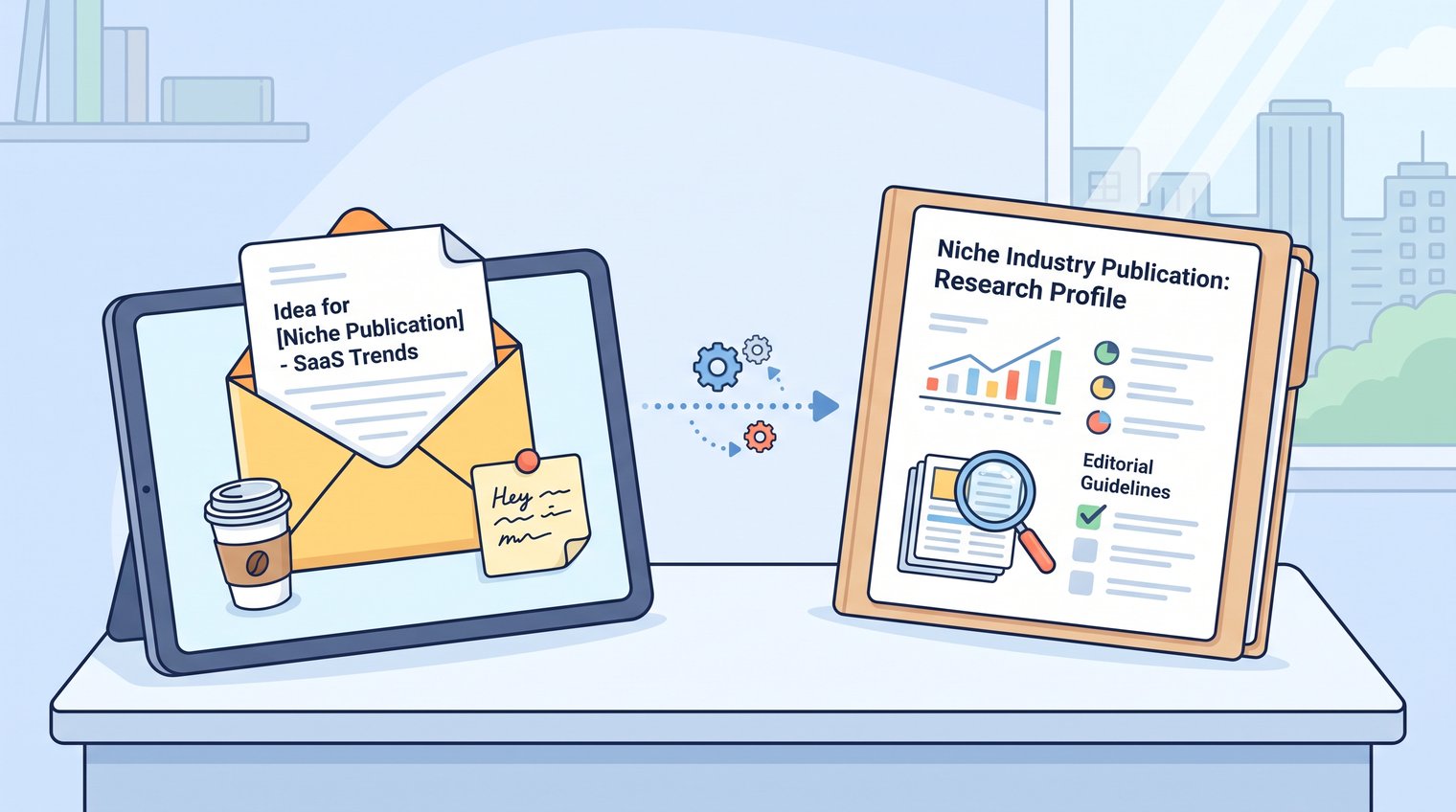
Blogs are still very much a thing in 2026, although the format is no longer limited to one person publishing diary-style posts. Modern editorial publishing includes specialist sites, company publications, industry newsletters, expert-led resource hubs, podcasts with supporting articles, and communities that turn conversations into searchable content.
Video, short-form social media, AI answers, webinars, and private communities have changed how people discover information. They have not replaced the need for credible, searchable pages that explain a complex topic, compare approaches, document research, or recommend a useful resource. That is especially true in SaaS and B2B, where buyers often need evidence before they book a demo.
For B2B companies, contextual editorial mentions can contribute to several goals at once: topical authority, discoverability for adjacent searches, referral visits from qualified audiences, demand generation, and greater confidence in the brand. A placement in an operations publication, for example, can introduce a workflow platform to the people responsible for fixing operational bottlenecks. That is more meaningful than a random link from a broad lifestyle site with a high-looking metric.
The dark side of blogging and outreach
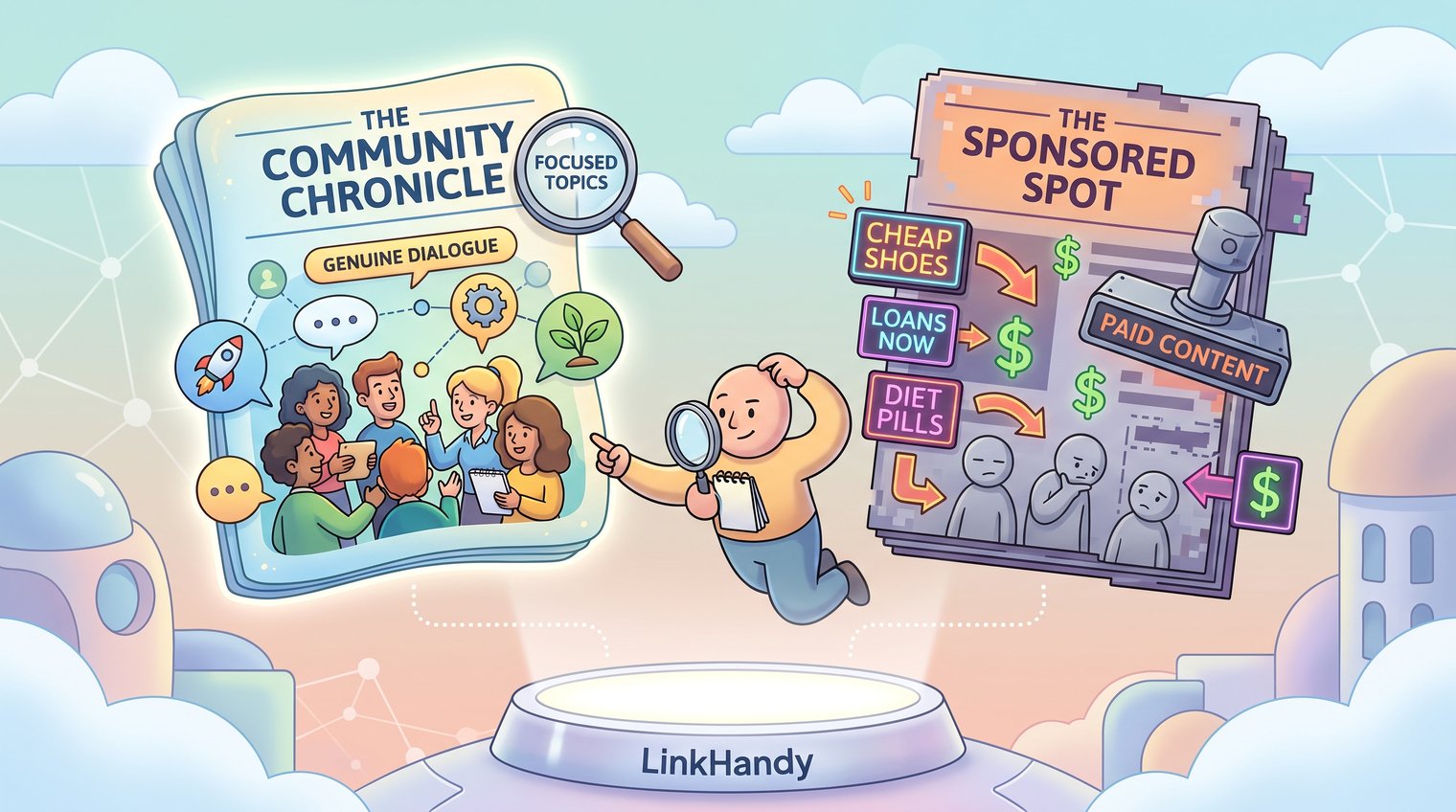
The dark side of blogger outreach is easy to recognize once you know what to look for: spammed guest articles, paid links presented as independent editorial coverage, fake or low-quality traffic, contributor networks publishing nearly identical articles, and placements on sites that cover every topic from crypto to pet care to enterprise software.
These tactics can create a short-term appearance of activity while adding little business value. They can also leave brands associated with low-trust sites and manipulative linking patterns. A live URL is not proof that a campaign worked.
Risk management comes down to relevance, transparency, and restraint. Avoid placements that are clearly built to sell links at scale, insist on honest disclosure where compensation is involved, and do not force a product page into an article where it cannot help the reader. Editorial standards are not an obstacle to outreach; they are the reason a placement is worth pursuing.
When blogger outreach is the right channel - and when it is not
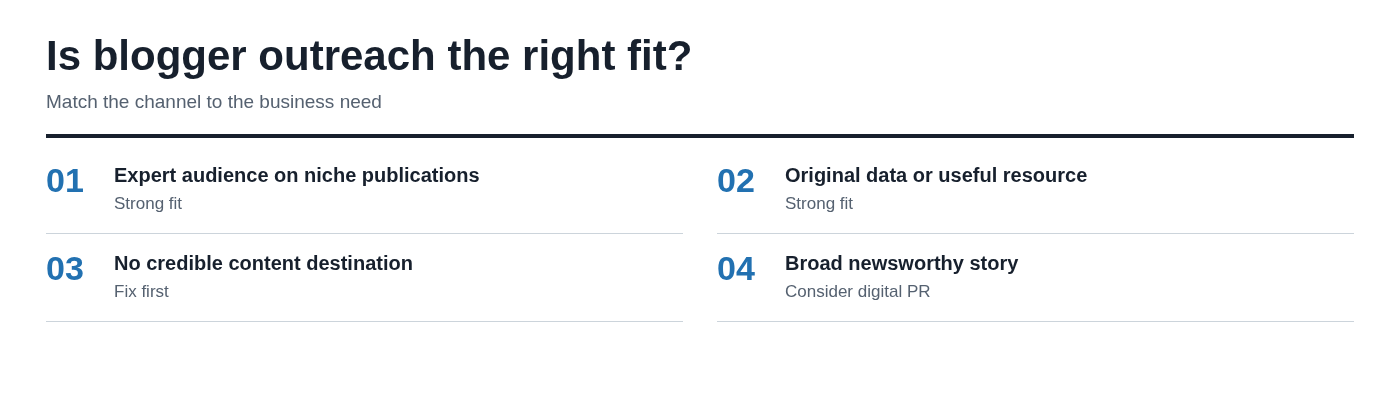
Blogger outreach is a strong channel when your buyers gather around specialist publications, your company has something useful to contribute, and you have pages worth sending readers to. It is not a substitute for weak positioning, thin content, or a website that fails to explain the product once visitors arrive.
Start with five questions. Do you have a clear target audience? Is there a credible resource, product page, research asset, or expert perspective that a publisher could reasonably reference? Are relevant publications active? Is organic visibility important to the business? Can you support outreach with enough subject-matter expertise and content quality?
Outreach is usually a good fit for SaaS and B2B companies with long or considered sales cycles. A procurement lead may encounter a brand through an expert article months before entering a buying process. The same campaign can support a priority product page while building familiarity in the category.
There are cases where another investment should come first. A broadly newsworthy story may be better suited to digital PR. A product with strong integrations may benefit more from partner marketing. A new company with no credible content destination should improve its own site before seeking external mentions. And a business with an engaged user community may get more from community-led distribution or product-led sharing than from cold publisher outreach alone.
The building blocks of a high-quality blogger outreach campaign
A durable outreach campaign begins with a business goal and a page-level plan, not a generic promise of a certain number of links every month. Link volume can be a delivery measure, but it should not be the strategy.
The core stages are straightforward: define objectives, select target pages, research prospects, qualify publications, develop appropriate content angles, conduct outreach, coordinate editorial production, verify live placements, and report on delivery and performance. The hard part is making sound decisions at each stage.
Set goals that go beyond a link count
Useful goals may include improving the visibility of a commercially important page, closing a topical coverage gap, driving qualified referral visits, earning recognition in a specific buyer community, or building relationships with publishers you can work with again.
Those goals determine the right asset and outreach format. A high-value guide that is already ranking just outside the first page may benefit from relevant contextual mentions. A founder with deep expertise may be better positioned for guest articles. Original benchmark data may justify expert contributions, PR mentions, and partnership content.
For example, a cybersecurity SaaS company trying to reach IT leaders might focus on security operations publications, compliance communities, and technology newsletters. It should not treat every general business blog as equally valuable simply because it accepts guest articles.
Choose pages and anchors without over-optimizing
Prioritize pages based on commercial value, ranking opportunity, content quality, and topical relevance. A page that is helpful, current, and aligned with the prospect's audience is much easier to pitch than a thin landing page built only to capture a keyword.
Anchor text is the clickable wording of a link. In editorial outreach, it should read naturally in context. Exact-match commercial anchors repeated at scale are an obvious sign that a placement was designed for search engines rather than readers.
Use a natural mix of branded references, descriptive phrases, topical partial matches, and plain URLs where appropriate. Let the editorial context guide the wording. A link to a workflow automation guide may sensibly appear as "a practical workflow automation guide," while forcing a rigid commercial phrase into every article usually makes the content worse.
How to find and qualify bloggers, publishers, and guest-post opportunities
Finding opportunities is more than downloading a blog post site list. Lists of guest posting sites, including lists focused on education or other verticals, can be useful starting points for discovery. They are not proof that the listed publications have editorial quality, genuine readers, or relevance to your business.
A better research process combines several inputs: topical search footprints, author bylines, industry publications, contributor pages, competitor backlink analysis, conference speaker lists, newsletter mentions, association resources, podcast guests, and active professional communities. The goal is to identify where your audience already learns, not where a site owner happens to sell placements.
Competitor link analysis can reveal publications that cover your market, but do not copy every referring domain blindly. Look at why the competitor was mentioned. Was it a product review, a data citation, a founder interview, an integration partnership, or a guest article? The reason points to the pitch angle you need.
Use relevance before authority metrics
Authority and traffic estimates can help screen a large list, but they are not the final decision. A narrow publication with a committed audience of operations leaders may be more useful to a workflow SaaS business than a much larger site with no connection to operational work.
Assess topical fit, audience alignment, article depth, author credibility, publishing frequency, organic visibility, and the way the site handles external references. Look for a coherent editorial identity. Do its articles answer real questions? Are experts named? Are older pieces updated? Do links appear as reader-helpful citations rather than awkward additions?
Tools such as Ahrefs and Semrush can help investigate backlink patterns and visibility signals, while outreach platforms such as BuzzStream or Pitchbox can support prospect management. The tools do not replace editorial judgment.
Spot sites that are risky or unlikely to create value
Some warning signs deserve immediate scrutiny:
- An unrelated topic mix with no clear readership or editorial focus.
- Large volumes of sponsored content with minimal labeling or review.
- Repeated contributor bios and near-identical article structures across many sites.
- Shallow, unedited pages that appear generated to target search terms rather than help readers.
- An unusually high density of outbound commercial links within nearly every article.
- Traffic patterns that do not match the site's age, content quality, or apparent audience engagement.
- Articles that are never updated, receive no visible readership signals, and exist primarily to host links.
A site can be technically live and still be a poor placement. The question is not "Can we get a link here?" It is "Would a relevant buyer, editor, or searcher find this publication credible enough for the mention to mean something?"
How to reach out to bloggers without sounding like mass outreach
To reach out to bloggers effectively, first identify the person who can actually evaluate your idea. That may be the site owner, managing editor, section editor, contributor manager, or author of a relevant article. Sending a generic request to every address you can find is the fastest way to sound like mass outreach.
Use the publisher's preferred contact path. Check the contributor page, editorial guidelines, contact form, newsletter footer, LinkedIn profile, or relevant social account. If the site states that pitches must go through a form or specifies a particular editor, follow that instruction. Ignoring clear submission policies signals that you have not read the publication.
Email is usually the most practical channel for B2B outreach, but it is not the only one. LinkedIn can be useful for establishing context with a writer or editor, while social channels can help with relationship building over time. Keep the initial message short, specific, and centered on the audience rather than your need for a link.
Write a pitch that gives the editor a reason to care
A strong pitch contains five things: an observation that proves you know the publication, an angle that matters to its readers, evidence that you can deliver value, a low-friction next step, and clear disclosure when a commercial relationship is involved.
Here is a concise template for a B2B guest article pitch:
Subject: Contributor idea for [Publication]: [specific reader outcome]
Hi [Name],
I enjoyed your recent piece on [specific article or topic], especially the point about [genuine observation]. I work with [company or role], where we see [relevant expertise, data point, or operating experience].
Would a practical article on "[proposed title]" be useful for your [audience] readers? It would cover [two or three concrete takeaways], with examples from [credible source of expertise]. We would write it to your guidelines and keep it educational rather than promotional.
If helpful, I can send a short outline first.
Best,
[Name]
Every bracket must be customized. The publication reference should be real, the angle should fit its readers, and the expertise claim should be supportable. A template is a structure, not a license to send the same message hundreds of times.
Follow up, negotiate, and keep the relationship useful
A single polite follow-up after several business days is usually reasonable. A second can be appropriate for a strong fit, but repeated messages after silence rarely improve the outcome. Editors are busy, and no response is often a decision.
If a publisher discusses an editorial fee, clarify exactly what it covers and how the relationship will be disclosed. Confirm whether the link will be followed, nofollowed, or marked sponsored; whether the publisher controls the final anchor wording; what revisions are expected; and when the content might be published. These are editorial and compliance details, not minor afterthoughts.
Keep records of previous pitches, contacts, guidelines, published work, and preferences. The best outreach programs compound over time because future conversations begin with a known relationship instead of a cold email.
Which outreach asset should you pitch?
Guest articles are useful, but they are not the only outreach asset and they are often not the best one. The right format is the one that gives the publisher a credible reason to include your contribution while matching the business objective you set earlier.
Editorial guest posts and guest articles
A contributed article works when you have real expertise that can solve a reader problem. The article should be valuable even if every promotional reference is removed. Good guest articles offer practical frameworks, original examples, informed opinions, or hard-won operational lessons.
Expect the publisher to retain editorial ownership. They may revise the article, change the title, limit links, add disclosure, or reject a draft that feels promotional. That is not necessarily a bad experience; it is evidence that the publication takes its audience seriously.
For B2B brands, author credibility matters. A subject-matter expert, product leader, customer success leader, analyst, or founder can often contribute a more credible perspective than an anonymous marketing byline.
Contextual link insertions
A contextual link insertion is a relevant addition to an existing article, usually where a reference, tool, guide, or source would genuinely improve the reader's experience. It can be effective when your target page is a strong resource and the publisher already has a closely related article.
The standard should be high. Do not request irrelevant additions, force a keyword-heavy anchor, or suggest edits that distort the original article's meaning. If the reference does not make the article better, it is not a defensible placement.
Contextual placements are often well suited to guides, templates, research pages, glossaries, and comparison resources. They are less suitable for a hard-sell landing page with no educational value.
Data-led content, expert contributions, and content partnerships
Original data, product benchmarks, expert quotes, co-marketing resources, and partner content can earn stronger and more defensible mentions because they give publishers something distinct to reference. A survey of finance leaders, anonymized workflow trends, or a well-designed benchmark report may create opportunities that a standard guest article cannot.
Content partnerships can also be valuable when two companies serve adjacent audiences. A payroll platform and an HR operations tool, for instance, might create a joint guide on onboarding processes. Each partner contributes expertise, distributes the resource, and reaches an audience that has a logical reason to care.
These formats demand more work, but they can produce more lasting results. As covered in the section on setting campaign goals, that additional effort is justified when the asset supports a meaningful target page, topic cluster, or market position.
How to evaluate blogger outreach agencies and companies
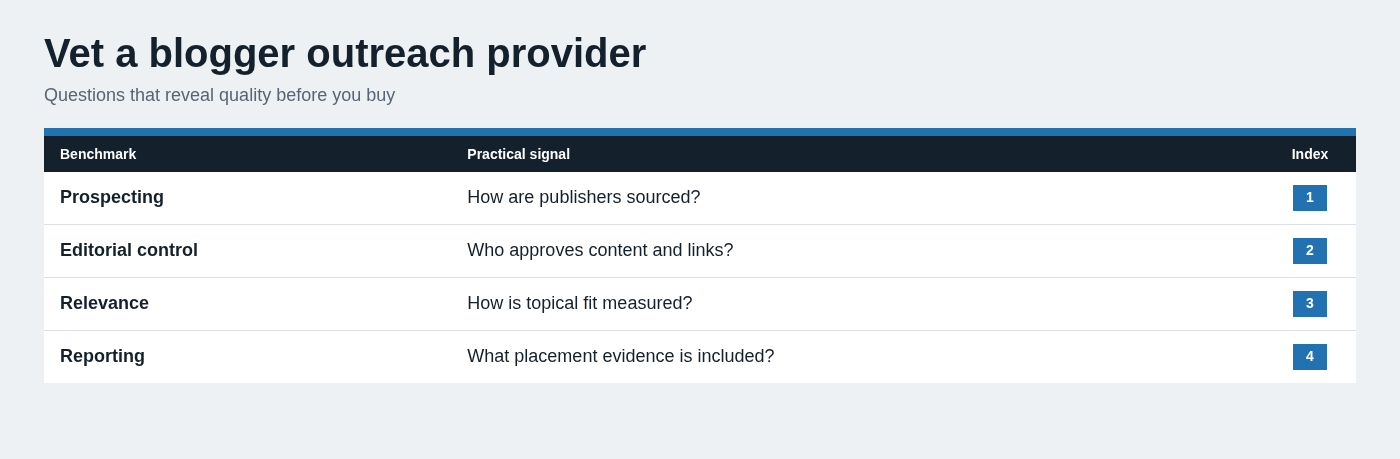
There is no universal best blogger outreach agency, and location is not a reliable quality signal. A blogger outreach agency UK, US, or elsewhere should be evaluated on the same operational criteria: how it sources publishers, how it verifies relevance, how much control you have before publication, how it handles disclosure, and what evidence it provides after delivery.
Some providers operate primarily from inventory lists. Others conduct genuine prospecting and relationship-led outreach. Neither label alone tells the full story, but the second approach is generally better suited to B2B businesses that need niche relevance and approval over where their brand appears.
For SaaS link building services, this distinction is especially important. A SaaS product may need mentions on a limited set of credible publications serving technical, operations, finance, HR, or security audiences. Generic volume is rarely the answer.
Questions to ask before signing a contract
- Are placements approved by the publisher, and how is that approval documented?
- How do you source prospects: existing inventory, manual research, relationship outreach, or a mix?
- Can we review and approve publications before outreach or publication?
- How do you assess topical fit and audience relevance?
- Who writes the content, and can our subject-matter experts review it?
- How are paid relationships and link attributes handled?
- What happens if a link is removed, content is materially changed, or a placement does not meet agreed standards?
- Can you show examples relevant to our niche and commercial pages, not only recognizable publisher logos?
- What does reporting include beyond a live URL?
The answers should be specific. Vague assurances about "premium sites" or "high authority placements" are not enough without clarity on relevance, process, and verification.
Signals of transparent delivery
Transparent delivery may include prospect lists where feasible, publication URLs, approved content workflows, live-link verification, publication dates, link attributes, target pages, and candid notes on constraints or rejections. An agency should explain why a proposed publication is suitable rather than expect clients to trust a score alone.
Independent editors control their publications, so no ethical provider can guarantee every exact placement or ranking outcome. A responsible agency can guarantee its process, communication, vetting standards, and reporting discipline. It should also be honest when a particular target page or anchor request is not editorially realistic.
LinkHandy follows a review-led model for SaaS and B2B outreach: relevant prospects and outreach pitches are shared with clients for review, with approval obtained before links or placements go live. That level of visibility is useful when brand reputation and topical relevance matter as much as delivery volume.
Pricing blogger outreach services: what you are actually paying for
Outreach pricing reflects far more than the number of links delivered. Cost drivers include niche difficulty, publication quality, audience relevance, editorial standards, content production, research time, relationship-building effort, approval requirements, and campaign volume.
A tightly focused B2B security publication with a genuine editorial process is harder to earn a mention from than a broad site that accepts nearly any sponsored post. That difficulty is part of the value. Comparing packages only by cost per link or a third-party domain score encourages the wrong buying decision.
Ask what is included: prospecting, pitch development, writing, editorial revisions, client approvals, publication fees where applicable, quality assurance, replacement terms, and reporting. A low headline price can conceal weak site quality, generic content, or little oversight of what ultimately goes live.
A worked example: building a SaaS blogger outreach campaign from scratch
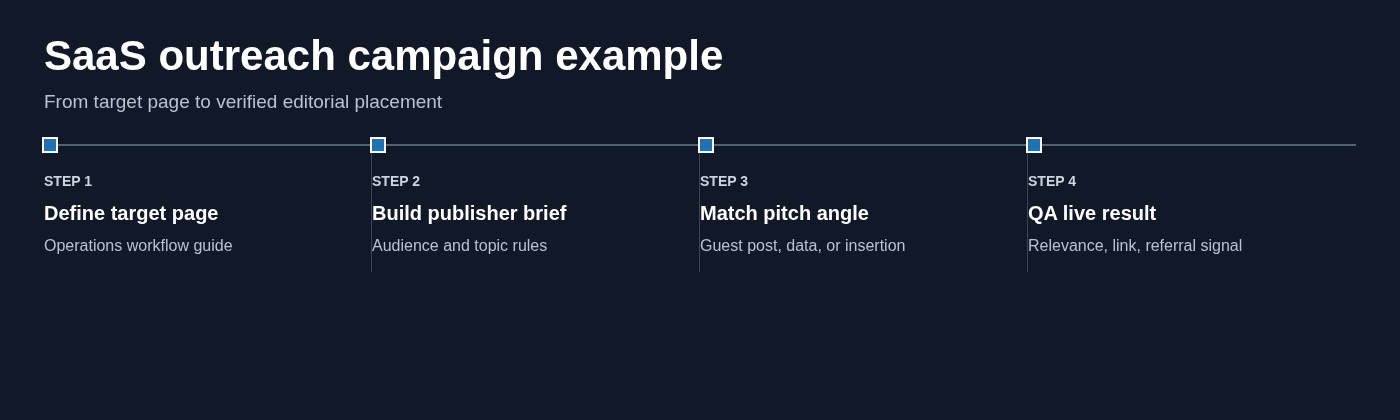
Consider a hypothetical workflow automation SaaS platform that helps operations leaders standardize recurring processes across departments. The company wants to improve visibility for its in-depth "Operations Workflow Guide," while also reaching operations managers, chief operating officers, and process improvement consultants.
The wrong approach would be to buy a batch of generic software links. The right approach is to build a publisher brief, select appropriate outreach assets, and verify that each placement supports the broader goal.
Step 1: turn a ranking goal into a publisher brief
The team begins with the Operations Workflow Guide because it is a substantial, useful resource with clear commercial relevance. It is not purely a product page, but it naturally introduces the problems the software solves.
Next, the team identifies adjacent topics: process documentation, cross-functional handoffs, standard operating procedures, workflow bottlenecks, automation governance, and operations metrics. The reader personas are operations managers at growing B2B companies, process consultants, and department leaders responsible for repeatable work.
Exclusion rules matter. General software blogs with no operations audience are deprioritized. So are sites that publish mainly vendor roundups or unrelated sponsored content. The anchor map includes branded references, descriptive anchors such as "operations workflow guide," and context-specific phrasing like "a framework for documenting recurring processes." It does not require the same exact phrase everywhere.
Step 2: score prospects and match a pitch angle
The team scores prospects across five practical factors: topical relevance, audience fit, editorial quality, organic visibility, and realistic opportunity to contribute. Each can be rated from one to five, but a low relevance score should disqualify a site even if its other numbers are high.
| Prospect type | Best outreach angle | Why it fits |
|---|---|---|
| Operations management publication | Expert guest article | The platform's operations lead can contribute a practical article on reducing handoff failures. |
| Industry analyst newsletter | Data contribution or expert quote | A small benchmark on process documentation gives the editor an original point to cite. |
| Existing article on SOP templates | Contextual resource recommendation | The Workflow Guide offers a relevant next step if it genuinely improves the article. |
For the guest article, the pitch might be "Why process documentation fails after the kickoff: five operating habits that keep SOPs usable." For the data contribution, it might be an anonymized finding about common handoff bottlenecks. For the contextual recommendation, the team asks whether the existing article has a genuine gap that the guide can fill.
Notice the trade-off: the contextual placement may be quicker if the resource is an excellent fit, but the guest article can establish deeper expert credibility. The data contribution may produce the strongest citation but requires credible evidence. There is no universal best format.
Step 3: verify the live placement and learn from it
Once a placement is published, the team checks the final URL, whether the page is indexable, the topical context around the link, anchor naturalness, attribution, link attribute, content quality, and publication date. It also adds tracking parameters where appropriate to monitor referral activity.
The live URL is then connected to the target page and topic cluster in reporting. If a placement generates qualified referrals or a positive response from a publisher, that is a reason to explore similar publications and future collaboration. If a category of sites produces no meaningful fit or engagement, the next prospecting wave should change accordingly.
This is why reporting links as an endpoint is too shallow. The campaign should get smarter with every completed placement.
Measure results without relying on vanity metrics
A long list of published URLs can look impressive while saying little about business impact. Measure outreach through both leading indicators and lagging outcomes.
Leading indicators include qualified prospects found, positive replies, editorial conversations, accepted pitches, content approvals, and placements meeting quality criteria. These metrics reveal whether the campaign is targeting the right publications and communicating a worthwhile value proposition.
Lagging indicators include indexation, referral traffic, assisted conversions, brand searches, target-page ranking movement, organic traffic growth, and publisher relationships reused for future work. SEO outcomes often take time, especially in competitive B2B categories, so do not judge a strategic campaign after a few weeks.
Attribution has limits. A buyer may read a guest article, return through a branded search later, and convert after seeing a product comparison. That does not make the editorial placement unimportant; it means B2B journeys are rarely linear.
Build a reporting dashboard that stakeholders can use
A useful dashboard should let stakeholders understand both what was delivered and what it is contributing. Track placements by target page, topic cluster, publication, placement type, date, link attribute, audience fit, referral activity, and qualitative observations.
Separate delivery reporting from performance reporting. Delivery reporting answers whether the agency or team completed the promised work to standard. Performance reporting answers whether the work is supporting visibility, traffic, and commercial goals over time.
Include notes that explain decisions. For example, a lower-traffic niche publication may deserve a positive assessment because it reaches a concentrated audience of the exact people your sales team wants to influence. Context makes metrics useful.
Build a sustainable outreach program, not a one-off link sprint
The most reliable blogger outreach programs are built on simple principles: publish resources worth citing, target editors and publications with genuine relevance, respect editorial standards, document approvals and decisions, and measure value beyond a link count.
Do not chase every guest posting opportunity, rely on blog post site lists as your strategy, or treat a publisher's metric as a substitute for audience fit. The best placements are credible because they are useful to readers first.
Teams that need transparent, white-hat SaaS and B2B outreach execution can evaluate whether LinkHandy is a fit for their campaign.