
Most B2B outreach fails before the first email is sent. The target page is not useful enough to cite, the prospect list is built around vanity metrics, or the pitch asks a publisher to do the marketer a favor with nothing meaningful in return.
A strong SEO outreach strategy fixes those problems in order. It gives relevant editors, writers, partners, and industry experts a legitimate reason to reference your work, collaborate with your team, or include your perspective in their content.
What SEO outreach means - and where it fits in a B2B link-building strategy
SEO outreach is the process of contacting relevant people and publications to earn editorial links, brand mentions, expert contributions, partnerships, or content placements that support organic visibility. In practical terms, outreaching in SEO means identifying a credible opportunity, offering something useful, and making a clear, appropriate ask.
It is not mass cold email. It is also not sending the same guest-post request to hundreds of sites, nor is it generic "outreach marketing" designed to collect any reply at all. Effective B2B link outreach is targeted relationship-building with an editorial outcome.
Outreach supports one of the three core SEO disciplines:
- Technical SEO: making a site accessible, crawlable, fast, and structurally sound.
- Content and keyword strategy: creating pages that match search intent and demonstrate useful expertise.
- Authority building: earning citations, links, mentions, and signals of trust from relevant sources.
Links cannot rescue poor technical foundations or thin content. But when a useful page competes in a difficult B2B category, authoritative and relevant referring domains can help search engines understand that the page deserves visibility.
SEO is still worth doing in 2026, even as AI-generated search experiences change how people discover information. AI has not made SEO dead; it has made commodity content less valuable. Original research, firsthand expertise, accurate sources, strong brands, and genuine editorial standards matter more because those are the assets both publishers and AI systems can trust.
Set an outreach goal that can be measured beyond link volume
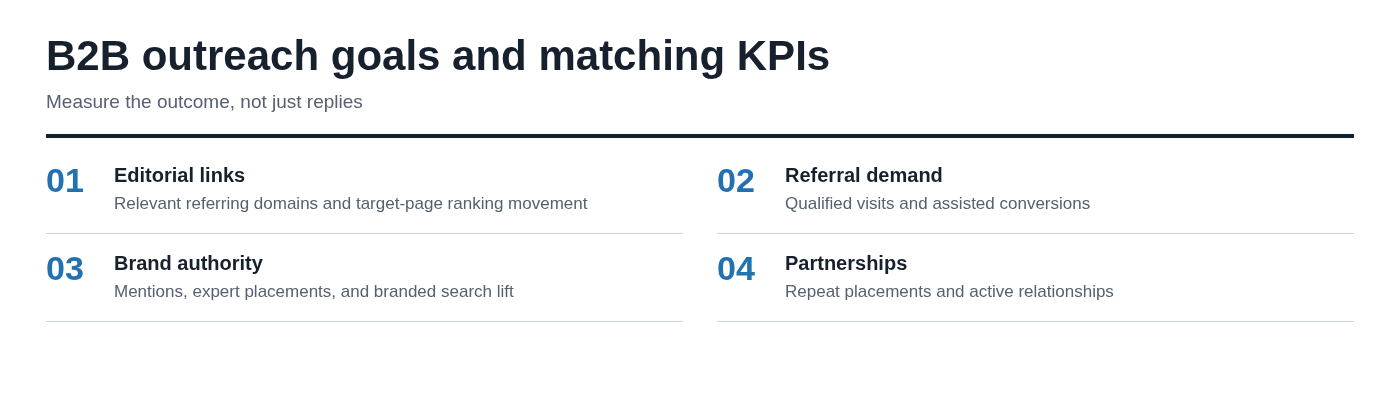
Start each campaign with one primary outcome. "Get more backlinks" is too vague to guide prospecting, messaging, or reporting. A campaign designed to strengthen a commercial solution page should look different from one intended to earn media coverage for original research.
Common B2B outreach goals include earning editorial links to a commercial page or resource, generating qualified referral traffic, increasing expert mentions, securing guest contributions, or opening content-partnership opportunities.
Define quality before you start. A worthwhile placement usually has topical relevance, a real audience, an identifiable editorial process, visible traffic or search presence, a natural page context, and an anchor that makes sense for the reader. The link should also be crawlable when a standard SEO link is the objective.
Raw domain metrics are not enough. A high-scoring domain in an unrelated niche may do little for a B2B SaaS company, while a smaller industry publication can send qualified buyers, establish credibility, and create a valuable relationship. Likewise, sending 500 emails is not progress if they generate low-quality placements or damage your sender reputation.
Choose linkable assets and pages worth promoting
Before building a prospect list, audit the page you want people to link to. Does it meet the searcher's need? Does it offer information gain beyond the first page of Google? Does it show who created the content, where claims came from, and what a reader should do next?
In B2B, the easiest pages to promote are usually not feature pages. They are assets a publisher can reference because they make the publisher's own content more useful: original research, industry benchmarks, calculators, implementation templates, expert-led guides, and data-backed comparison resources.
For example, a cybersecurity SaaS company may earn more relevant links with an annual incident-response benchmark than with a page that simply says its platform is faster or easier to use. The benchmark gives writers a statistic, analysts a reference point, and partners a discussion topic.
Warning: outreach cannot reliably compensate for thin, undifferentiated, or aggressively promotional content. Improve the asset first. A polished email only gets a publisher to inspect the page; it does not make the page citation-worthy.
Match the asset to the outreach angle
The asset should determine the outreach angle. Original research is useful for journalists, analysts, and writers covering a trend. A subject-matter expert's perspective is better suited to guest contributions, interviews, webinars, and podcast pitches. Templates and tools fit resource pages, while an updated guide can support content-refresh or broken-link outreach.
Influencer outreach and social media outreach can help amplify a strong asset, especially when niche practitioners are likely to share it. They are not substitutes for relevant editorial placements. A social post from an unrelated creator may create a temporary spike in attention, but it rarely delivers the authority or qualified referral value of a trusted industry publication.

Build a prospect list based on relevance and a real reason to contact each site
Do not begin with a giant database. Begin with places where your asset fits naturally. Useful prospect sources include keyword search results, backlink profiles of competing content, resource pages, trade publications, newsletters, podcasts, partner ecosystems, and authors who have cited similar research.
Build three tiers. Your first tier should contain priority editorial targets: publications or authors with strong audience overlap and a specific, high-quality opportunity. The second tier can include scalable but still relevant sites. The third tier should focus on relationship targets, such as partners, communities, customers, and experts who could become repeat collaborators.
Competitor backlinks are useful clues, not a list to copy blindly. If a competitor has a link from a page about an adjacent topic, ask whether your asset adds equal or greater value there. Copying every target often leads to irrelevant pitches and sites that exist primarily to sell placements.
Score prospects before finding contact details
Use a lightweight scoring system so your team spends time where it matters. Score each prospect from 1 to 5 for topical fit, audience overlap, page-level opportunity, editorial legitimacy, estimated search visibility or traffic, and the likelihood of a mutually useful pitch.
A high-scoring prospect might be a respected RevOps newsletter whose recent article cites old pipeline benchmarks, while your company has fresh survey data on the same issue. A low-scoring prospect might have a strong-looking domain metric but publish unrelated, low-effort articles with dozens of suspicious outbound links.
Disqualify irrelevant niches, link farms, pages built mainly for paid links, obvious AI-spam sites, and sites with no identifiable editor, owner, or purpose. This filter protects both your link profile and your team's time.
Find the right person and research a specific pitch trigger
Contact the person most likely to understand the opportunity. That is often the article author, section editor, partnerships lead, podcast producer, or owner of a resource page. A generic inbox is a fallback, not the first choice.
Verify that the person still works with the publication and has a relevant role. Then find one concrete trigger for your message: a recent article, an outdated data point, a missing resource, a quote that needs support, a podcast theme, a product launch, or a shared audience problem.
Keep research ethical and proportionate. Use publicly available information, record it accurately, and do not pretend to know someone because you saw a profile or social post. Give recipients a simple way to decline future contact, and honor it immediately.
Write a value-first SEO outreach email
A useful outreach email is short because it respects the recipient's workload, not because brevity alone improves response rates. It should include a relevant subject line, proof that you understand the page or publication, one specific value proposition, a low-friction ask, clear asset context, and a human sign-off.
Use this SEO outreach strategy template as a structure, not a script to send unchanged:
Subject: Possible update for [article/page title]
Hi [Name],
I was reading your [specific article or issue] on [topic], especially the section on [specific detail].
We recently published [asset] based on [credible source, method, or expertise]. It may be useful for readers because [specific gap it fills].
If you are updating that section, would you consider reviewing it as a possible resource? Here is the link: [URL].
Either way, thank you for the useful coverage of [topic].
[Name]
The 80/20 rule in SEO is best treated as a prioritization heuristic. Put most of your effort into the strongest assets and highest-fit prospects, where real editorial value exists. Use systems for repeatable work such as tracking, contact verification, and first-draft research, but do not automate away the judgment that makes a pitch relevant.
A concise B2B resource-pitch template
Subject: Updated benchmark for your SaaS onboarding guide
Hi Maya,
I found your guide to SaaS customer onboarding while researching activation benchmarks. The section on time-to-value is particularly useful, though the cited survey is from 2021.
Our team has published a [year] benchmark report based on [actual sample size and research method], including [two findings supported by your data]. The report may be a useful current source for that section: [URL]. Replace these placeholders with verified details from research you actually conducted before sending.
If you update the guide, would you be open to considering it as a reference? No problem if it is not a fit.
Best,
[Name]
This works because it identifies a real editorial reason to look at the asset. It does not exaggerate, flatter excessively, or demand a link.
A guest-contribution or expert-comment template
Subject: Expert contribution idea: measuring AI-search visibility in B2B
Hi Daniel,
Your recent piece on AI search and demand generation raised an important question: how should B2B teams measure visibility when a click does not always happen?
Our SEO strategist can contribute a practical 800-word perspective on tracking branded mentions, citation patterns, referral quality, and assisted conversions, with examples from SaaS content programs. We can provide original commentary and a draft tailored to your editorial guidelines.
Would that angle be useful for an upcoming issue?
Regards,
[Name]
A proper editorial guest contribution gives the host publication a credible, publication-ready idea. It should meet the publication's standards and should never be used to force keyword-rich anchors into an article.
Use the outreach tactics that fit B2B editorial opportunities
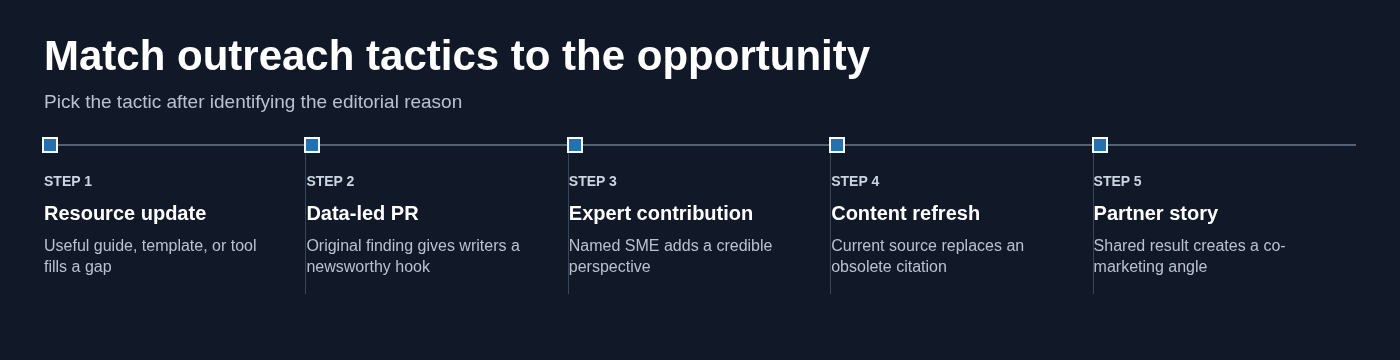
The best SEO outreach strategy is not one tactic applied everywhere. Pick the tactic after identifying the editorial reason a prospect would care.
- Resource-page and link-insertion outreach: Best when a relevant page has a genuine gap and your guide, template, tool, or research asset improves it. The natural outcome is a contextual citation within existing content.
- Digital PR and data outreach: Best when you have original findings, timely analysis, or a contrarian but supportable insight. Writers need a newsworthy hook, not a generic company announcement.
- Expert commentary: Best when an editor is covering a subject your team knows firsthand. Offer a named expert, a precise viewpoint, and evidence that supports it.
- Editorial guest contributions: Best when you can teach the publication's audience something specific. Lead with the proposed article's usefulness, not with your preferred anchor text.
- Broken-link and content-refresh outreach: Best when an existing article points to a dead, outdated, or weaker source and your content is a valid replacement. Do not claim a link is broken unless you checked it.
- Partner and customer outreach: Best when there is a real shared story, integration, event, case study, or research project. A customer story can earn credible links because both organizations have something substantive to say.
Customer outreach is different from ordinary link outreach. The goal is not to pressure a customer into linking to you. It is to identify a legitimate co-marketing opportunity, such as a measurable implementation result, joint webinar, integration guide, or shared industry report.
Run outreach in small, controlled batches and follow up professionally
Send your first outreach in small batches, such as 20 to 40 closely matched prospects. That gives you enough volume to spot patterns without burning through your best targets with an untested message.
Track deliverability, reply quality, positive-response rate, placements, and time to placement by prospect segment and pitch angle. A low reply rate may indicate weak targeting; positive replies without placements may reveal an asset or approval problem; poor deliverability usually points to list quality or sender practices.
Send one or two concise follow-ups. The first can add useful context, such as a new data point or a shorter summary. The second can close the loop: "I will leave this here in case it is useful for a future update." Then stop.
A common mistake is building an automated chain that keeps sending after a recipient has ignored three or four messages. That damages your brand and sender reputation. Relationship-led B2B outreach should feel like professional correspondence, not a sequence designed to outlast someone's patience.
Use AI as a research assistant, not an impersonation engine
Can ChatGPT do SEO? It can assist with parts of SEO, including keyword clustering, content outlines, prospect classification, spreadsheet cleanup, draft messaging, and quality-assurance checklists. It cannot replace strategic judgment, factual verification, editorial relationships, or the experience needed to understand whether a link opportunity is genuinely valuable.
What many teams call AI SEO is now often described as generative engine optimization, GEO, or AI-search optimization. The label matters less than the work: create accurate, well-structured, source-supported content that is useful to readers and recognizable as credible by search and AI systems.
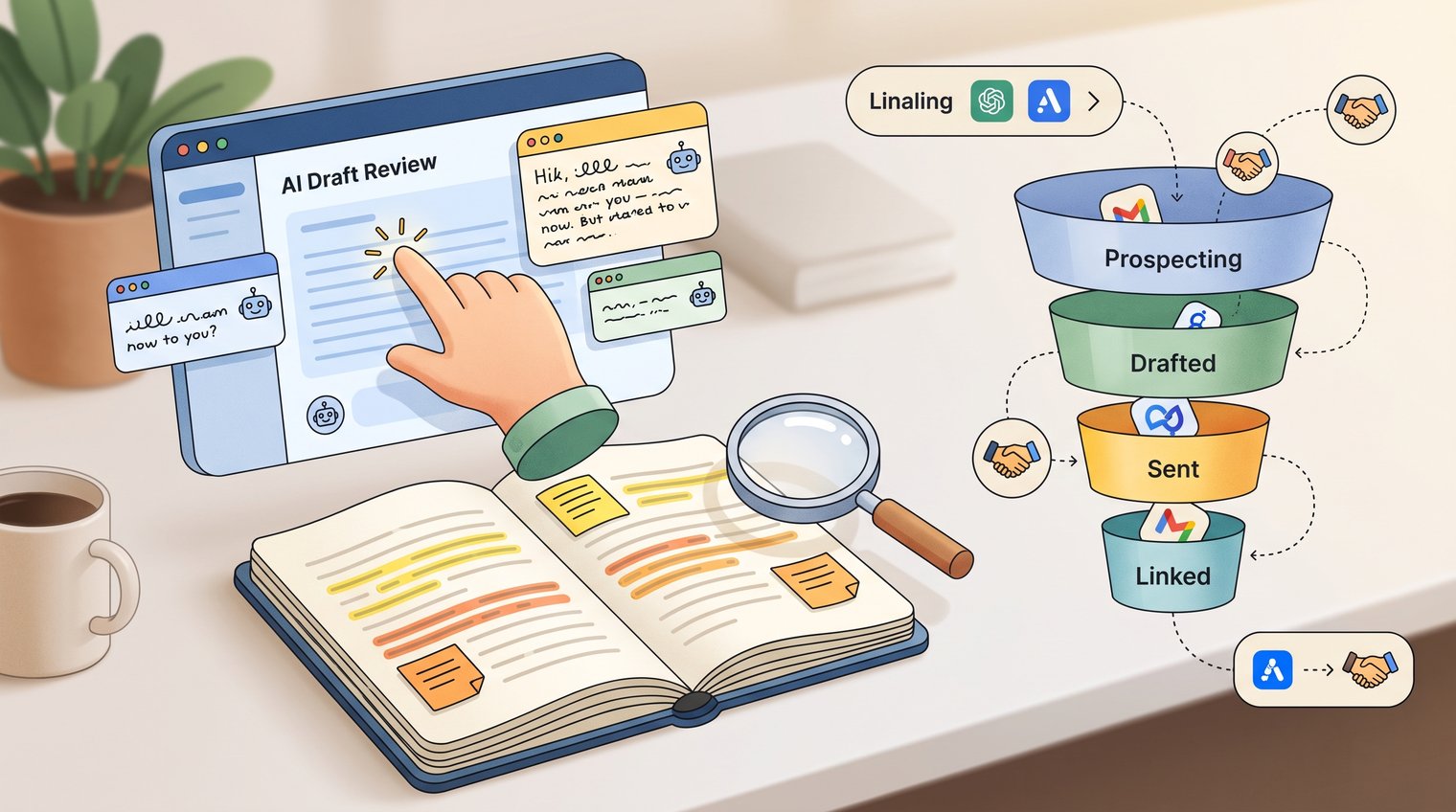
Use AI to summarize public articles, generate research questions, and create first drafts. Require human review for factual claims, prospect relevance, personalization, and every final send. Never use it to invent familiarity, fake customer results, or manufacture a quote from an executive who did not approve it.
Track placements, protect link quality, and turn wins into relationships
Track every campaign from prospect to outcome. At minimum, record the site, contact, pitch angle, send dates, replies, follow-ups, placement URL, target URL, link attributes, anchor context, publication status, and relationship notes.
When a placement goes live, verify it. Confirm that the link appears in relevant editorial copy, points to the intended destination, is not blocked from crawling when that matters, and has not been changed into an unrelated or misleading context. Record the live date so you can monitor results over time.
Then do the part many teams skip: thank the contributor or editor, share their work where appropriate, notify them if the cited asset receives a meaningful update, and look for future opportunities. A publisher who knows your team delivers accurate, useful material is far more valuable than a one-off placement.
Know when to build outreach in-house or use an SEO outreach agency
You can do SEO yourself as a beginner, particularly if you have a clear niche, access to subject-matter experts, one strong asset, and enough time to research and follow up thoughtfully. Start small. A campaign to 30 highly relevant prospects will teach you more than a rushed campaign to 500.
In-house outreach becomes harder when the team lacks capacity for prospecting, editorial evaluation, contact research, relationship management, and placement verification. That is where blogger outreach services or an SEO outreach agency can help, especially for teams pursuing sustained authority growth, complex editorial campaigns, or specialized B2B publications.
When evaluating an agency, ask direct questions:
- How are prospects found and qualified?
- What relevance standards are applied at the page and audience level?
- Will you see proposed sites, pitches, placements, and costs before publication?
- Who controls editorial decisions and final content quality?
- What reporting will you receive on links, attributes, context, and outcomes?
- How do you avoid link farms, deceptive placements, and risky tactics?
- Who owns the publisher relationship after the campaign ends?
There is no single best SEO tool in 2026, and no backlink database is perfectly accurate. Tools such as Ahrefs and Semrush can be useful for researching backlink patterns, but their data should inform judgment rather than replace it. Free AI tools can help brainstorm, summarize, and organize work, yet they do not validate link quality or build trusted relationships for you.
Teams that need managed, transparent B2B link building can also explore LinkHandy's approach to prospect review, editorial placements, and white-hat authority strategy.
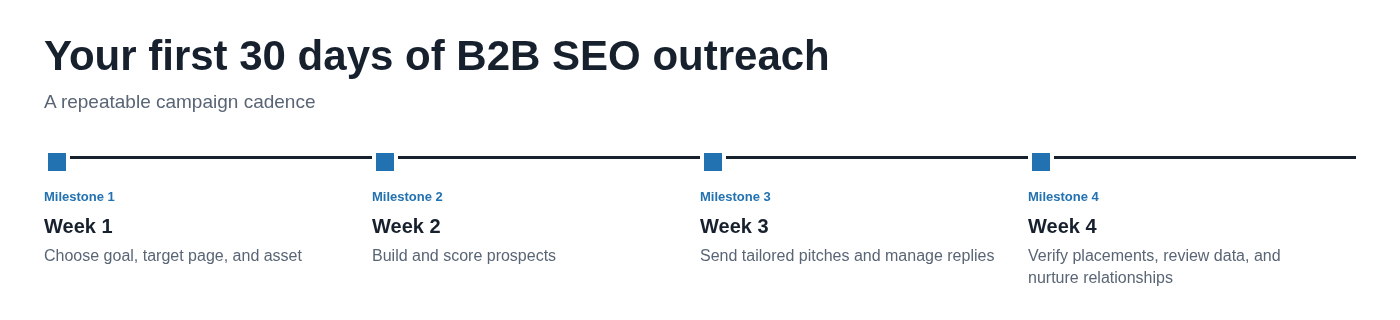
A practical 30-day SEO outreach strategy launch plan
A month is enough to launch a controlled campaign and establish an initial baseline. It is not enough to guarantee rankings or a fixed number of placements, so measure learning as well as outcomes.
Week 1: Set the goal and prepare the asset
Choose one goal, one target page, and one audience segment. Audit the page for search intent, credibility, usefulness, and conversion path. Define the quality criteria for a placement, then gather the proof points your outreach message will need: source methodology, expert credentials, examples, and publication date.
Week 2: Build and score the prospect list
Find 60 to 100 prospects from search results, competing citations, industry publishers, newsletters, podcasts, and relevant partner ecosystems. Score each one before researching contacts. Select 20 to 40 high-fit prospects for the first batch and document a specific pitch trigger for each.
Week 3: Send tailored pitches and manage replies
Write messages around the recipient's page and the value of your asset. Send in controlled batches, monitor deliverability, and reply quickly when someone asks a question or requests more detail. Send one follow-up after four to seven business days if there is a legitimate reason to do so.
Week 4: Verify placements and review performance
Check every live placement, record the final URL and context, and thank the person involved. Review results by segment: which prospect type replied, which asset angle earned interest, and which messages produced qualified conversations? Use those findings to refine the next month's list rather than simply increasing send volume.
Early numbers are directional, not promises. Your baseline will vary by niche, asset quality, audience fit, sender reputation, and whether the pitch asks for a simple resource review or a deeper editorial collaboration. The goal of the first 30 days is to build a repeatable process that improves with evidence.
Build an outreach program around relevance, usefulness, and repeatable learning
The best SEO outreach strategy gives a relevant publisher a credible reason to care. It does not treat a link as a transaction or assume a template can compensate for weak content, poor targeting, or an irrelevant ask.
Start with one genuinely useful asset and a tightly defined prospect segment. Measure the quality of placements and conversations, not just sends and links. Then use what you learn to improve the asset, targeting, and message before scaling.
For B2B teams that need transparent, white-hat support with this process, LinkHandy offers managed link-building services centered on relevant prospects, client review, and editorial-quality placements.