
Most link building disappointments start before the first email is sent. A company buys a monthly package, receives a spreadsheet of URLs and domain metrics, then waits for rankings that never move. The problem is rarely that links do not matter. It is that the work was never connected to the right pages, the right publications, or a clear commercial goal.
A managed link building service should solve that problem. It gives your team an accountable partner for planning, finding, earning, reviewing, and measuring backlinks - not simply a supplier of anonymous placements.
What a Managed Link Building Service Actually Does
A managed link building service is an outsourced program that handles the full process of acquiring relevant backlinks. This typically includes strategy, prospect research, qualification, outreach, editorial coordination, content support, placement quality assurance, and reporting.
Link building itself is the practice of earning or acquiring links from other websites to your own pages. When a reputable, relevant publication links to a useful page on your site, that link can help search engines discover the page, understand its topical context, and assess signals of trust or authority. It can also send real referral traffic.
A link building agency manages this process on behalf of a client. The best agencies do more than chase a monthly link count. They determine which pages need authority, identify realistic publications that serve a related audience, create an outreach angle that benefits the publisher, and verify that each completed placement matches the agreed standard.
That is different from buying a database of sites, subscribing to outreach software, hiring a freelancer for a one-off campaign, or purchasing cheap links in bulk. Those options may have a role in a mature internal program, but they do not provide the strategic ownership and editorial judgment of a properly managed service.
The quick-start checklist for evaluating a provider
Before comparing proposals, establish a few non-negotiables. A credible provider should be able to show how it evaluates relevance, explain its editorial standards, share representative placement examples, define what is delivered each month, and give you meaningful approval rights before placements go live.
- Relevance: The publisher, article, and destination page should share a genuine topic or audience connection.
- Transparency: You should know where links are being pursued and why those sites qualify.
- Defined deliverables: The scope should clarify strategy, content, outreach, placements, reporting, and any pass-through costs.
- Approval process: You should be able to review prospects, target pages, and proposed placements.
- Business reporting: Reports should connect links to priority pages, visibility, traffic, and commercial objectives.
Be cautious with guaranteed rankings, vague claims about "high authority" sites, no prospect visibility, or large quantities of unusually cheap links. Those signals usually point to a volume model rather than deliberate editorial work.
Are Backlinks Still Relevant in 2026?
Yes, backlinks are still relevant in 2026, especially in competitive B2B and SaaS search results. They remain one of several ways search systems assess whether a page and website have earned trust, visibility, and topical recognition beyond their own claims.
But raw link totals are a poor proxy for success. Modern search systems can identify and discount many manipulative patterns, which means an irrelevant dofollow link is not automatically valuable just because it comes from a site with a high third-party metric. Relevance, editorial context, source quality, placement quality, and the strength of the linked page matter far more.
Does link building work? It works when it supports pages that deserve to rank: pages with clear search intent, useful information, solid technical foundations, and a credible product or service behind them. It does not rescue thin content, confusing positioning, poor internal linking, or a page that fails to satisfy the query.
Think of link building as an authority amplifier. It helps good pages compete; it is not a substitute for building good pages in the first place.
When Managed Link Building Is the Right Investment
Managed link building is usually a strong fit for SaaS and B2B companies that have valuable commercial pages, a base of useful content, and limited internal capacity for sustained outreach. It becomes particularly valuable when competitors already have a meaningful authority advantage and organic growth depends on improving visibility for category, solution, comparison, integration, or high-intent resource pages.
A realistic runway matters. Link acquisition, crawling, indexation, and search performance take time. Teams expecting immediate revenue from a handful of links will often make poor decisions; teams prepared to run a disciplined program over several months can learn which topics, publishers, and assets create durable momentum.
It may be better to wait if your site has major technical problems, unstable URLs, unclear product positioning, no worthwhile target pages, or no operational capacity to handle more organic demand. Fixing page fundamentals first makes every future placement more useful.
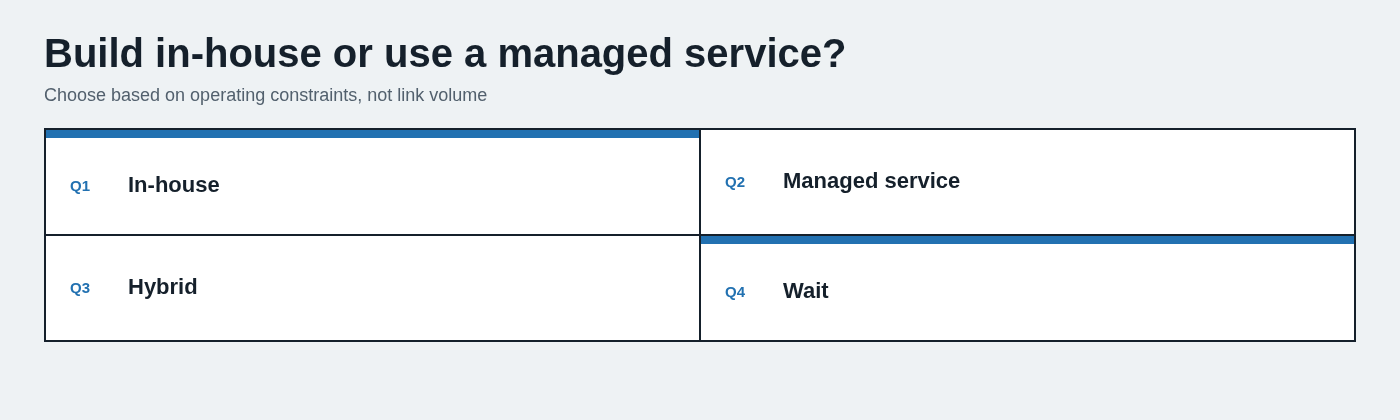
Use a simple operating lens when deciding between in-house and external delivery. Build in-house when you already have outreach expertise, editorial resources, prospecting processes, and enough volume to justify them. Choose a managed service when speed and specialist execution matter more than owning every task. A hybrid model works well when an internal SEO lead owns strategy while an agency supplies research, outreach, and placement capacity.
How a High-Quality Managed Link Building Program Works
A strong program follows an operating model, not a vending-machine model. The work starts with discovery and target-page priorities, then moves through competitor and link-gap analysis, prospecting, qualification, outreach, editorial production, placement verification, and ongoing iteration.
The point is to build authority where it can influence meaningful outcomes. That means tying work to revenue pages and topical clusters instead of delivering a generic monthly batch of backlinks to whichever URL is easiest to place.
Strategy begins with pages, topics, and link gaps
An agency should first map keyword clusters, commercial intent, existing page authority, internal linking, and competitor backlink gaps. This determines where a new link can have the most strategic value and where a page needs improvement before promotion.
Consider a B2B SaaS company that sells subscription management software. Its category page struggles against established competitors, while its comparison pages and integration guides are useful but underlinked. A sensible program might pursue relevant citations in finance operations resources, integration-focused articles, subscription analytics guides, and expert contributions about reducing churn. Each placement would point to the page most relevant to the host article, while internal links help distribute that gained authority across the product cluster.
That is a practical link building example: the campaign is organized around a commercial topic and supporting assets, not around a single arbitrary number of links.
Prospecting and qualification protect relevance
Domain Rating and Domain Authority can be useful directional metrics, but neither should decide whether a placement is worth pursuing. A qualified prospect should also be assessed for topical alignment, real organic visibility, editorial quality, audience fit, outbound-link patterns, indexation, and opportunities for a natural citation.
A mid-authority publication read by your buyers can be more valuable than a high-metric site with no connection to your category. If the host article genuinely helps a prospect understand the problem your product solves, the link has a clearer reason to exist.
Outreach, content, and placement should look editorial
Managed programs commonly use contextual link insertions, editorial guest posts, content partnerships, digital PR mentions, and resource-page opportunities. These are different methods, not interchangeable products. The right choice depends on the target page, the publisher, the asset available, and the level of editorial value you can offer.
The editorial line is simple: a placement should improve the host page rather than merely insert a commercial URL into it. If payment or another commercial relationship is involved, the publisher should handle disclosure and link attributes appropriately. A responsible agency will not blur compliance for the sake of a dofollow link.
The Top 3 Link Building Strategies Managed Services Use
There is no universally best tactic. The best strategy depends on the page you are promoting, the assets you can offer, the audience you need to reach, and the competitiveness of the search results. Still, three approaches consistently form the backbone of durable managed campaigns.
1. Contextual editorial link insertions
A contextual insertion adds a relevant citation to an existing, indexed article where the destination page legitimately expands on the subject. For example, an article about SaaS onboarding may benefit from linking to a detailed onboarding checklist, a data-backed guide, or a product resource that solves a specific workflow problem.
This approach can be efficient because the host page already exists and may already receive traffic. Its limitation is equally important: genuine topical fit is non-negotiable. A pattern of low-value paid insertions across unrelated articles is not a sustainable authority strategy.
2. Editorial guest posts and expert contributions
Editorial guest posts and expert contributions allow a company to contribute original, useful knowledge to a relevant publication. In return, the article may include a contextual reference to an appropriate resource or company page.
Quality standards matter here. The topic should fit the publication, the contribution should contain real expertise, and the publisher should retain editorial review. Avoid spun content, generic contributor posts, and boilerplate articles written only to carry a link.
3. Content partnerships and digital PR
Content partnerships and digital PR create opportunities for earned mentions by giving writers and publishers something genuinely worth citing. Useful assets include proprietary data, benchmark reports, expert commentary, integration studies, interactive tools, and carefully researched templates.
This route is often slower and less predictable on a per-placement basis, but it can deliver stronger brand exposure, referral traffic, and broader authority signals. It is particularly useful when a company has original information or a distinctive point of view that editors cannot easily get elsewhere.
What Good Links Look Like - and What Toxic Backlinks Look Like
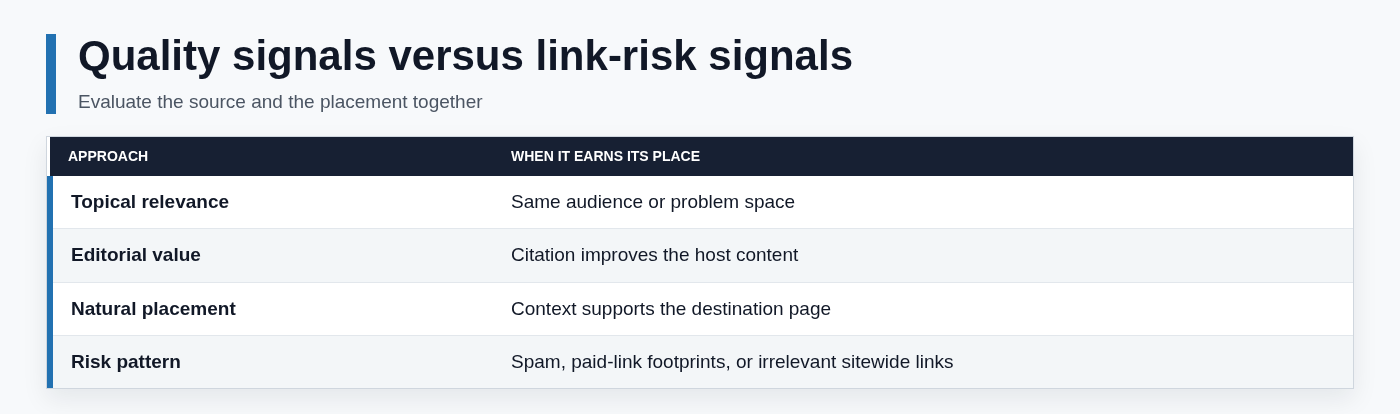
A good backlink is relevant to the destination page, editorially defensible, placed in useful context, and published on a source page that can be indexed and discovered. It uses natural anchor text, comes from a site with reasonable editorial standards, and ideally has the potential to send interested readers to your site.
A toxic backlink is typically manipulative, spammy, irrelevant, or part of an unnatural scheme. Common examples include hacked links, automated comment spam, mass-produced directory pages, obvious private blog networks, sitewide links with no context, and placements surrounded by unrelated commercial anchors.
Do not panic over every low-metric or strange-looking link. The web naturally produces imperfect links, and not every weak backlink needs removal or a disavow action. Focus on patterns: coordinated spam, clear manipulation, or a volume of irrelevant links that suggests an intentional scheme.
Dofollow links can pass ranking signals, but dofollow link building should not become a single-metric obsession. Nofollow and sponsored attributes have legitimate uses, including disclosure and publisher policy. The important question is whether the mention is authentic, relevant, and valuable - not whether a checkbox promises an SEO outcome.
How Much Does Managed Link Building Cost?
Managed link building cost varies widely. Pricing is shaped by niche difficulty, publisher quality, target geography, content requirements, turnaround expectations, placement type, and the amount of strategy and account management included. Some providers charge monthly retainers, while others quote per placement or use a blended model.
How much does a backlink cost? There is no meaningful universal price because a backlink is not a standardized product. A contextual citation on a relevant, well-edited B2B publication is not comparable to a link from a low-quality site built to sell placements. Lower-cost offers often trade away relevance, transparency, editorial standards, or durability.
For competitive B2B categories, a serious program generally requires a meaningful monthly budget and patience. Evaluate cost per qualified placement rather than cost per backlink alone. Then connect that number to target-page progress, potential referral traffic, assisted conversions, and the opportunity cost of leaving competitors unchallenged.
What should be included in the monthly fee
A managed fee should make the underlying work visible. Depending on the model, it may include strategy, target-page planning, prospecting, qualification, outreach, editorial coordination, content creation or support, placement fees where applicable, quality assurance, reporting, and account management.
Ask which costs are included, which are passed through separately, and whether the agency marks up publisher fees. Also ask what happens when a live placement is removed, changed materially, or deindexed. A written replacement policy prevents avoidable disputes later.
Why unusually cheap backlinks cost more later
Cheap links are not automatically fraudulent, but extremely low pricing should trigger due diligence. The economics may depend on irrelevant sites, private networks, automated outreach, recycled content, opaque reselling, or anchor patterns that are difficult to defend.
The cost later can appear as wasted budget, cleanup work, lost trust in a vendor relationship, or links that simply fail to improve the pages that matter. The solution is not to buy only expensive links; it is to demand evidence of how the provider qualifies, approves, and verifies each placement.
How to Hire a Link Building Agency: A Due-Diligence Framework
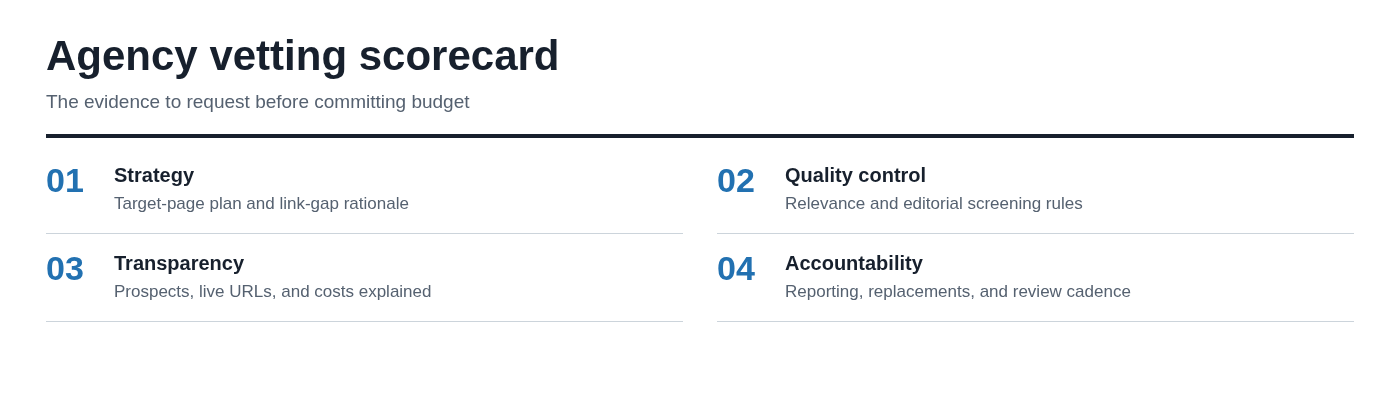
Hiring a link building agency is a procurement decision as much as an SEO decision. Case studies and authority metrics matter, but they do not tell you whether the agency will work transparently, handle problems well, or protect your brand.
Assess four areas: strategy, quality control, transparency, and accountability. The agency should explain why a target page needs links, how it screens publishers, what you can review before publication, and how it manages replacements or disputes.
Questions to ask before signing
- Can we approve prospects and proposed target pages before outreach or publication?
- How do you evaluate topical relevance, editorial quality, organic visibility, and outbound-link patterns?
- Who owns the outreach process and the relationships developed during the campaign?
- How do you handle paid placements, sponsored disclosures, and link attributes?
- What is your anchor-text process, and how do you avoid over-optimization?
- What content standards apply to guest posts, expert contributions, and insertions?
- Will you place competitors on the same sites, and do you offer category exclusivity?
- What is the reporting cadence and who joins performance reviews?
- What replacement terms apply if a link is removed, noindexed, or materially changed?
- Can you share anonymized but verifiable examples from our industry and explain why each placement was selected?
Contract terms deserve the same scrutiny as examples. Clarify minimum commitments, cancellation terms, approval turnaround expectations, ownership of created content, escalation paths, and how unspent placement budgets are handled.
What a transparent report should show
A useful report includes the live URL, source-page topic, destination URL, anchor text, link attribute, publication date, indexation check, placement type, rationale, and the current status of any removals or replacements. It should also identify which placements are pending approval, in outreach, published, or being remediated.
A bare spreadsheet of domain metrics and URLs is insufficient. It tells you little about why the placement exists, whether it supports the right page, or whether it remains live and crawlable.
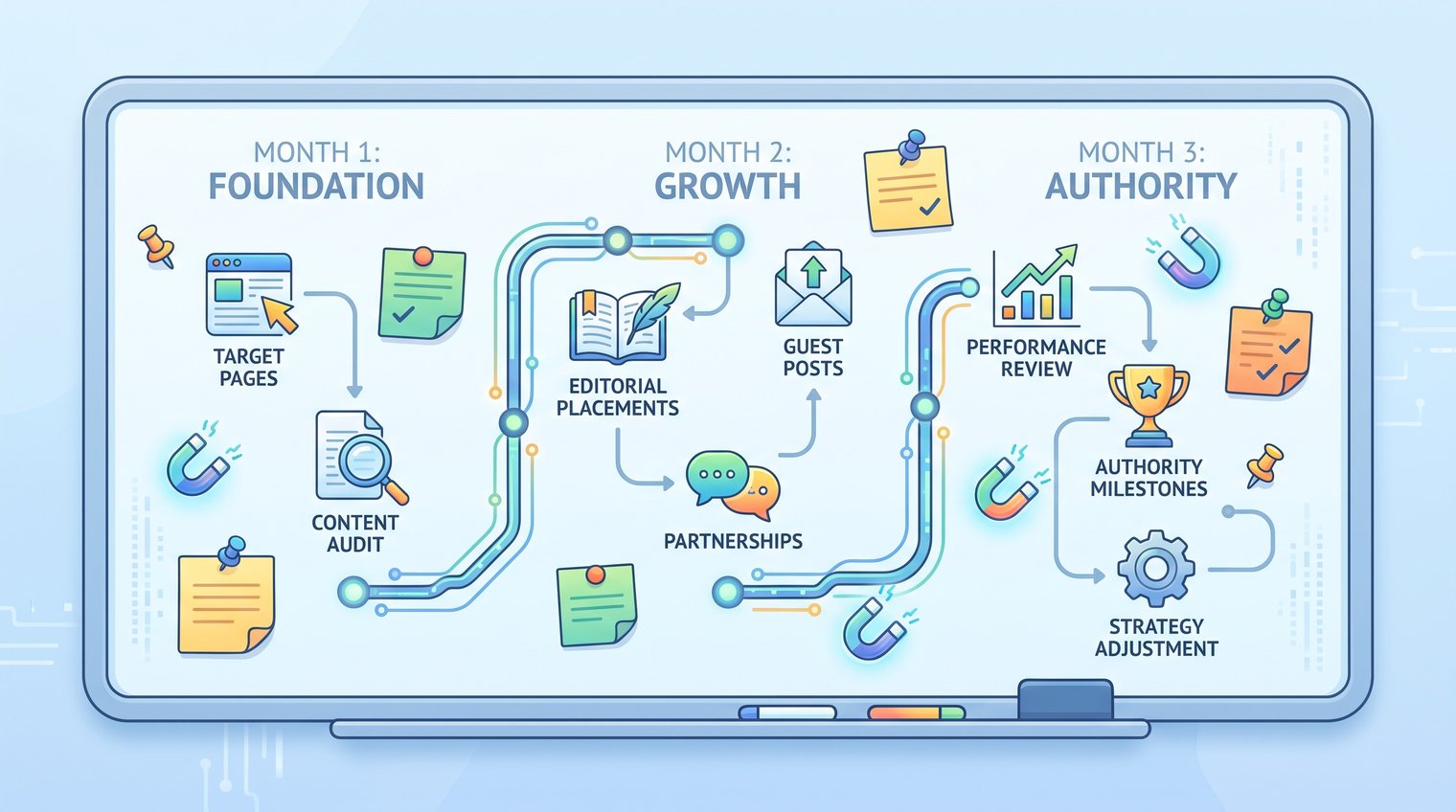
A Worked Example: Planning a 90-Day SaaS Link Building Campaign
Imagine a B2B SaaS company with a competitive category page, several comparison pages, and a library of helpful guides. The category page earns impressions but sits outside the top results. The comparison pages convert well when they rank, but have few referring domains. The goal is not to buy a fixed number of links; it is to strengthen a set of connected pages with relevant authority.
Days 1-30: Audit, prioritization, and asset preparation
Start by reviewing the category page, comparison pages, supporting guides, internal links, current backlink profile, and competitor gaps. The team might prioritize the category page as the primary commercial target, two comparison pages as secondary targets, and a benchmark guide as the linkable asset that supports outreach.
Next, prepare proof points: original customer insights, anonymized benchmark data, a practical template, subject-matter expert commentary, or an integration workflow that publishers can reference. Leading indicators in this phase include approved prospects, outreach quality, asset readiness, and baseline rankings, impressions, and organic traffic for each target page.
Days 31-60: Launch placements across a deliberate mix
With targets approved, the campaign launches a balanced mix. A relevant operations publication may add a contextual citation to the benchmark guide. A SaaS-focused outlet may accept an expert contribution about evaluation criteria for the category. A partner ecosystem article may reference the integration workflow and link to the relevant product page.
Anchor text should stay natural. Branded terms, URLs, partial-match phrases, and descriptive contextual anchors usually create a more defensible profile than repeatedly forcing an exact-match commercial keyword. As covered in the section on quality signals, the surrounding copy should explain why a reader would benefit from visiting the linked page.
Days 61-90: Verify, learn, and reallocate
Every placement should be checked for a live, crawlable URL, appropriate context, approved destination, correct attribute, and stable indexation. The team can then review early search movement, referral visits, publisher segments, and content formats that generated the strongest opportunities.
If integration-focused publishers consistently deliver better relevance and referral traffic than broad SaaS blogs, shift effort toward that segment. If comparison pages gain impressions but do not improve clicks, revisit titles, on-page intent match, and internal linking rather than assuming more links are the only answer.
Managed Link Building vs Link Building Automation, Platforms, and Free Methods
Different models solve different problems. A managed service supplies strategic judgment and execution. Software supplies data and workflow infrastructure. Automation reduces repetitive work. Free methods can help earn early citations, but they require time, expertise, and useful assets.
Can AI create backlinks? AI can help with ideation, prospect research, brief creation, content drafts, personalization support, and reporting. It cannot legitimately manufacture editorial endorsement. A publisher still needs a credible reason to cite your page, and human quality assurance remains essential for relevance, accuracy, brand safety, and compliance.
What free websites and unpaid outreach can accomplish
It is possible to get backlinks without paying a publisher or agency. Create genuinely useful resources, contribute expert insight where editorially appropriate, reclaim unlinked brand mentions, seek partner and integration listings, pitch original research, and contact relevant writers with a specific reason your resource improves their article.
Free websites for link building can include legitimate partner directories, integration marketplaces, professional association listings, and editorial resource pages where your company actually qualifies. The key distinction is that a free listing or free tool does not mean free high-quality links. Staff time, research, content production, and relationship building still cost money.
Do not substitute profile links, comment spam, mass directory submissions, or self-created pages for editorial links. Those tactics are easy to scale precisely because they offer little meaningful endorsement.
When backlink tools and outreach platforms are enough
There is no single best backlink tool. Choose tools based on the job: backlink intelligence, competitor analysis, prospecting, outreach operations, relationship management, or reporting. For example, Ahrefs and Semrush are commonly used for backlink research, while BuzzStream and Pitchbox are examples of platforms built around outreach workflows.
Tools are often enough when your team already has the strategy, writing ability, outreach experience, and capacity to manage relationships. They provide data and operational structure; they do not guarantee a quality placement or decide whether a link makes editorial sense.
Ahrefs is especially useful for examining referring domains, reviewing competitor backlink profiles, and finding pages that attract links in your market. That makes it valuable during the link-gap analysis described earlier, when you are deciding which target pages and content assets deserve attention.
Its limitation is fundamental: backlink intelligence is not outreach execution. The tool can reveal opportunities and patterns, but a team still needs to assess relevance, develop a credible pitch, secure editorial approval, and validate the completed placement. It is best suited to in-house SEO teams and agencies that need robust research data, not to businesses expecting software alone to generate earned links.
Is Link Building Illegal? The Rules, Risks, and Ethical Line
Link building is not illegal. Legitimate outreach, relationship building, public relations, expert contributions, and earned editorial citations are normal business activities.
The risk comes from violating search-engine guidelines, deceiving users or publishers, infringing intellectual property, using hacked or scraped content, or failing to meet advertising-disclosure obligations when compensation is involved. Link schemes and undisclosed sponsored arrangements may create search, reputational, and regulatory problems depending on the circumstances and jurisdiction.
A responsible agency should have clear standards for original content, publisher quality, disclosure, approvals, and link attributes. It should also refuse tactics that depend on deception, hacked sites, fabricated identities, or content that does not provide genuine value to the host audience.
How to Measure Whether a Managed Link Building Service Is Working
Do not judge a link building program only by raw link count or a week of ranking volatility. Performance needs to be measured in layers, from delivery quality to commercial outcomes.
Leading indicators include approved prospects, outreach activity, publication quality, live-link verification, crawlability, indexation, contextual fit, and progress against target-page plans. Lagging indicators include impressions, rankings, organic clicks, referral traffic, qualified visits, assisted conversions, and pipeline influence where tracking allows.
Rankings are affected by competition, content quality, technical health, search intent, internal linking, broader site authority, and changes in the results page. That is why an agency should never guarantee rankings. What it can guarantee is a transparent process, agreed quality controls, and a disciplined review of what the program is learning.
Run a monthly operating review that compares completed placements with target-page performance and next-quarter priorities. If a page is not moving, investigate the full system: page quality, intent match, internal links, competition, and the relevance of acquired links.

Common Managed Link Building Mistakes to Avoid
- Buying volume before building a strategy: Start with target pages, competitor gaps, and topic priorities so placements support a coherent goal.
- Optimizing for domain metrics alone: Review the publication, article context, audience, organic visibility, and outbound-link behavior alongside third-party scores.
- Sending every link to the homepage: Direct relevant links toward category, solution, comparison, integration, and resource pages that need authority.
- Overusing exact-match anchors: Favor branded, partial-match, URL, and natural contextual anchors that fit the host copy.
- Giving up approval rights: Require visibility into prospects and placements before publication, especially in regulated or brand-sensitive categories.
- Treating reports as proof of quality: Verify live URLs, context, attributes, indexation, and destination-page alignment.
- Believing fixed SEO outcomes can be promised: Expect accountable execution and clear reporting, not guaranteed rankings in a variable search environment.
The common thread is avoidable detachment: detachment between links and pages, between metrics and real relevance, or between agency activity and client oversight. A managed service should reduce that detachment, not hide it behind a dashboard.
Choosing a Managed Link Building Partner With Confidence
Choose a partner that can explain how each placement supports a specific page, audience, and authority objective. You should be able to audit the process from initial prospect through live placement, understand the commercial terms, and see how the program adapts when evidence changes.
Use relevance, approval rights, editorial quality, reporting, and realistic expectations as the core criteria for comparing providers.
For SaaS and B2B teams that want transparent, white-hat support for authority building, LinkHandy offers a strategy-led managed link building program built around approved prospects, relevant editorial placements, and accountable execution.