
The wrong link building partner can create months of reporting activity with very little commercial value. A dashboard full of new referring domains is not the same as stronger authority in your market, better support for priority pages, or placements that a real buyer might actually read.
That is why there is no single best link building company for every SaaS or B2B team. The right choice depends on whether you need managed editorial placements, digital PR, content assets that attract links, broader SEO support, or software for an in-house outreach team.
This comparison focuses on white-hat providers and practical alternatives for B2B growth teams. It does not treat anonymous link marketplaces or bulk backlink packages as equivalent to an accountable outreach and editorial process.
The short answer: the best link building company depends on your buying model
Provider claims, testimonials, and review-site rankings can help create a shortlist, but they are only the starting point. The evidence that matters is more specific: how a provider sources opportunities, whether you can review targets, what the surrounding content looks like, and how clearly the work is reported.
A lean SaaS team may need a specialist to handle prospecting, outreach, editorial coordination, and placement reporting. A larger company with a strong PR function may be better served by a digital PR partner that can turn proprietary data or executive expertise into broader media coverage. Another business may already have capable people in-house and simply need a system to run outreach consistently.
In other words, the best backlink service is not the provider promising the largest monthly number. It is the one whose acquisition model matches your growth constraint without asking you to accept opaque quality standards.
Quick verdict
- LinkHandy: Best for SaaS and B2B teams that want managed editorial placements, contextual relevance, and visibility into the campaign process.
- uSERP: Best for established brands pursuing enterprise-scale authority, digital PR, and editorial coverage.
- Siege Media: Best for companies that need linkable content assets and promotion working together.
- Sure Oak: Best for teams that want link building coordinated with broader SEO work.
- BuzzStream: Best for in-house SEO, content, or PR teams that need outreach infrastructure rather than an agency.
These are fit-based recommendations, not universal rankings. Before signing, validate current availability, pricing approach, relevant examples, and the precise work included in the proposal.
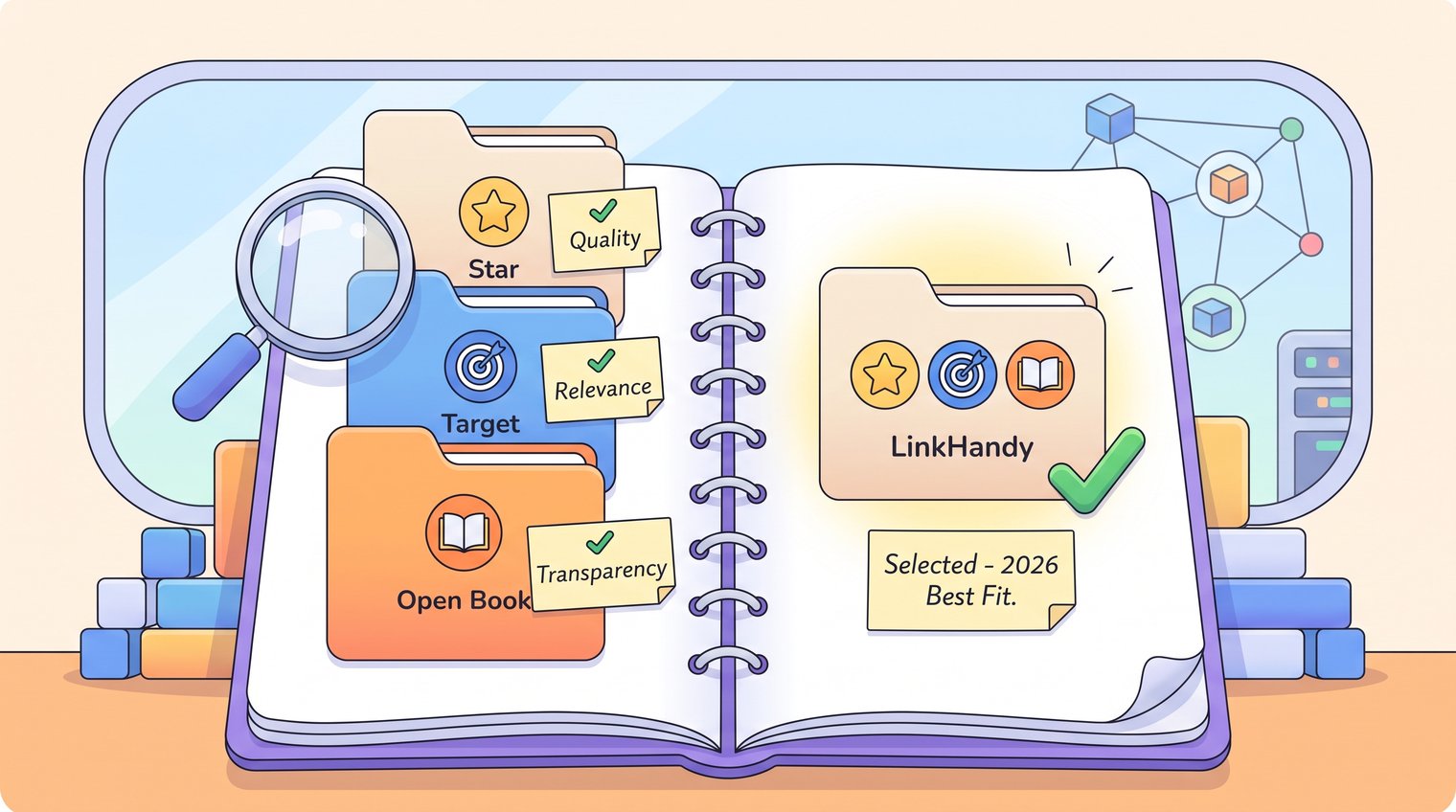
Comparison matrix: which agency model fits your SaaS or B2B team?
The table below compares five distinct approaches. "Buyer workload" refers to how much your own team should expect to contribute beyond direction, approvals, and subject-matter input.
| Option | Best fit | Primary acquisition model | Strategic involvement | Buyer workload | Transparency questions to ask | Likely trade-off |
|---|---|---|---|---|---|---|
| LinkHandy | SaaS and B2B teams needing managed authority growth | Contextual insertions, guest posts, partnerships, PR mentions | Authority strategy and managed execution | Moderate: approve prospects, direction, and content where needed | Can we review prospects? What placement details appear in reports? How are approvals handled? | Availability, turnaround, campaign minimums, and target sites should be confirmed during discovery |
| uSERP | Established brands seeking editorial authority and digital PR | Digital PR, earned coverage, editorial mentions | High, often tied to campaign concepts and content | Moderate to high: subject-matter input and approval can matter | What is the balance of links, mentions, PR, and content production? | May be less suitable for teams focused on low-cost, predictable placement volume |
| Siege Media | Companies needing assets that can earn links over time | Content strategy, linkable assets, promotion | High across content and organic growth | Moderate: collaboration on expertise, data, and brand direction | How are ideas validated? What is included in promotion versus content production? | Content creation can require more lead time than a placement-led program |
| Sure Oak | Businesses with authority and foundational SEO needs | Link building within a broader SEO program | Broad: technical SEO, content, and authority work | Moderate: align on priorities across several SEO workstreams | Which link-building deliverables are included versus separate from the SEO retainer? | A broad provider may not be the right fit for a highly specialized outreach-only brief |
| BuzzStream | In-house teams ready to own outreach | Prospecting, relationship management, outreach operations | Software-supported, internally directed | High: your team owns strategy, copy, follow-up, and relationships | Who will run campaigns? What assets and training already exist internally? | Software does not create a compelling pitch or replace outreach capacity |
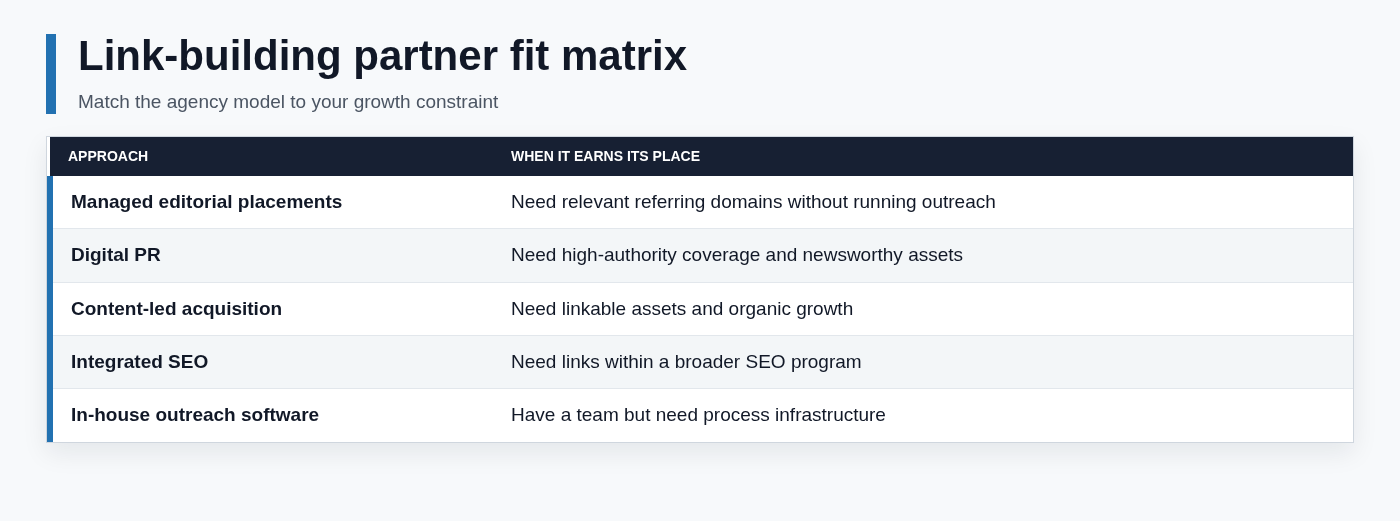
What separates high-quality link building services from risky link volume
Quality link building is not simply about authority metrics. Domain Rating, Domain Authority, traffic estimates, and similar numbers can be useful screening signals, but they do not prove that a site is relevant to your business, carefully edited, or capable of sending meaningful referral traffic.
Stronger programs typically share several characteristics: topical relevance, editorial context, a plausible audience, natural anchor text, transparent sourcing, and a realistic publishing pace. The work should look like marketing and publishing, not an exchange designed solely to manipulate a metric.
Warning signs are equally important. Be cautious with guaranteed authority scores, undisclosed publisher networks, sitewide links, vague descriptions of where links come from, spun or thin content, and a provider that cannot explain why a placement makes sense for your audience.
Evaluate the placement, not just the publisher metric
Ask to see the page where your link would plausibly live, not only a spreadsheet column showing a metric. Review whether the article is relevant, indexed, maintained, and written for a real reader. Check whether the page appears to have organic visibility, whether it is overloaded with commercial outbound links, and whether your mention would be surrounded by useful context.
For example, a SaaS company may benefit more from a contextual mention in a credible article about a workflow, integration, or category decision than from a generic "best software" listicle on a site that links out to dozens of unrelated tools. The former can reinforce topical relevance and put the product in front of a qualified reader. The latter may only create the appearance of authority.
Ask how the agency earns publisher access
There is a meaningful difference between editorial relationships, contributed expert content, content partnerships, PR outreach, and opaque inventory. Each can be legitimate when disclosed and handled responsibly, but they involve different levels of editorial independence, effort, cost, and predictability.
Ask what you are paying for: outreach labor, writing, placement coordination, a content asset, public relations strategy, or a combination. Ask who writes the content, who approves it, whether publishers can reject a placement, and what happens when a preferred site is not available. A clear answer is more valuable than a long list of logos.
1. LinkHandy: best for transparent managed link building for SaaS and B2B
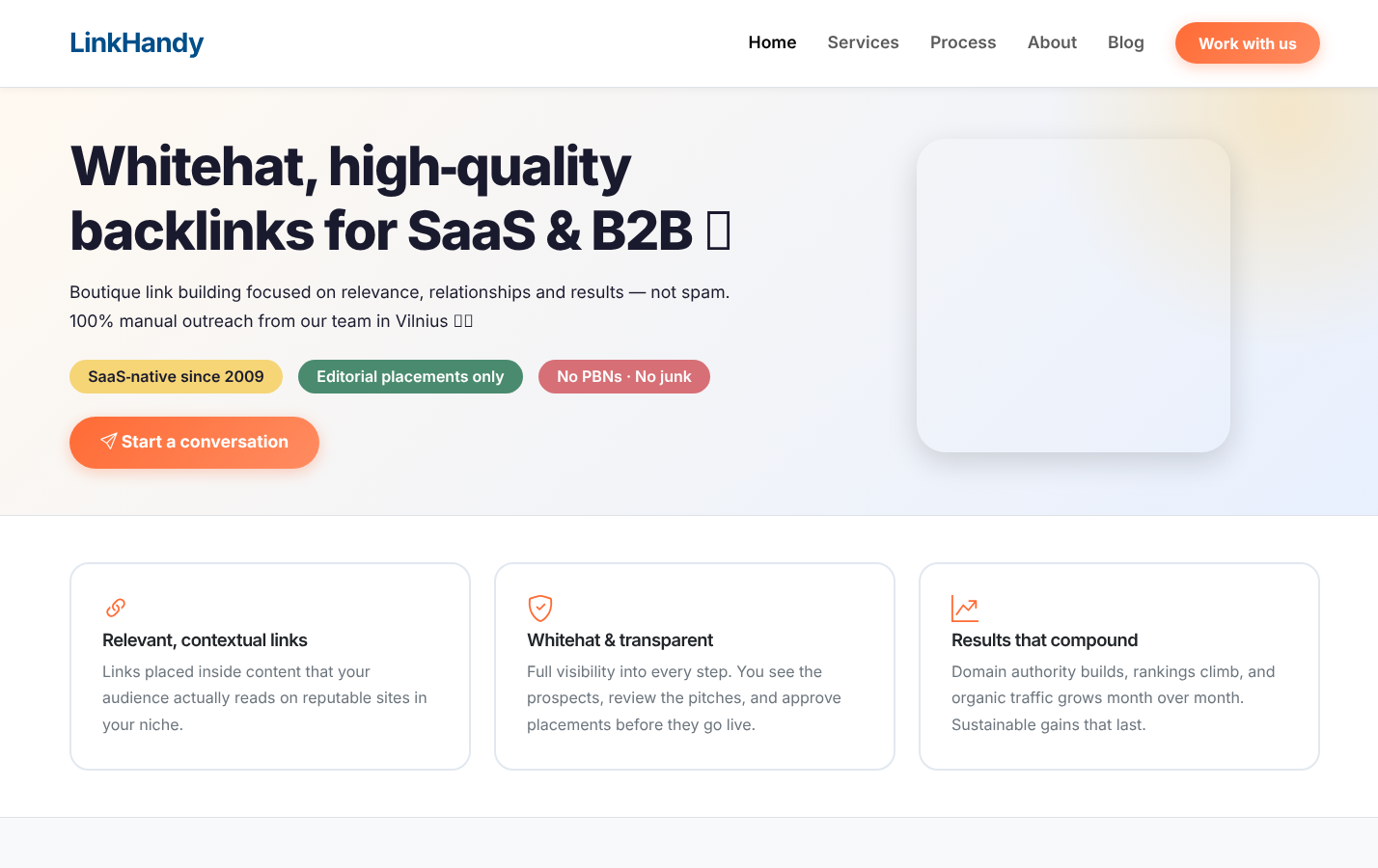
LinkHandy is a boutique link-building agency focused on SaaS and B2B companies that want external execution without handing over all visibility and control. Its service mix includes contextual link insertions, editorial guest posts, content partnerships, PR and brand mentions, and authority strategy.
The strongest fit is a team that wants relevant placements on reputable sites and a managed process that can include prospect and outreach-pitch review before links go live. That model is particularly useful when an in-house SEO lead knows the pages and topics that matter but does not have the time to run prospecting, outreach, negotiation, and placement coordination.
LinkHandy is not positioned as a self-serve publisher database, a link marketplace, or a general-purpose digital marketing retainer. Buyers looking for massive volume with minimal review may prefer a different model, while buyers who care about relevance and campaign visibility should find the boutique approach more aligned.
Where LinkHandy fits
LinkHandy is a sensible shortlist candidate for lean SaaS marketing teams and B2B growth teams that need contextual editorial support but want approval rights over target relevance, anchors, and campaign direction. It also suits companies that want a clearer authority roadmap instead of treating every link as an isolated transaction.
The trade-off is that the right campaign details need to be validated upfront. Discuss target-site availability, current capacity, expected turnaround, approval workflow, campaign minimums, and how the team will handle a prospect that does not meet your standards. Those are productive discovery questions, not objections.
2. uSERP: best for enterprise digital PR and authority-driven campaigns
uSERP is most relevant for companies pursuing high-authority editorial mentions, digital PR, and campaigns that require significant strategic or creative investment. This model can be valuable for established SaaS and B2B brands that have credible subject-matter experts, proprietary data, a distinctive point of view, or genuinely newsworthy angles to bring to publishers.
The appeal is broader than a specified number of contextual referring domains. Digital PR can support brand recognition, category authority, executive visibility, and links from publications that are difficult to access through routine outreach.
Where uSERP fits
Consider uSERP when your constraint is earned media and high-authority coverage rather than simply acquiring more relevant placements. It is especially worth exploring if your team can participate in campaign ideation, supply expertise promptly, and help develop assets with an editorial hook.
The trade-off is that premium-style outreach programs may not fit a buyer looking for low-cost, predictable placement volume. Ask for examples in your vertical, clarify the balance between links and unlinked mentions, understand who owns content responsibilities, and ask how campaign outcomes are reported.
3. Siege Media: best for content-led authority building
Siege Media is a content-led option for organizations that need assets worth citing before outreach can be effective at scale. Research, interactive tools, visual resources, and substantial educational content can create a durable foundation for earning links while also supporting organic traffic and brand visibility.
This approach is valuable when the problem is not merely outreach capacity. If your existing site lacks original material that publications or industry writers would naturally reference, better prospecting alone will not solve the issue.
Where Siege Media fits
Choose this path when your SaaS or B2B company can invest in original research, useful tools, distinctive visual assets, or educational resources that have a reason to exist beyond SEO. The goal is to build assets that can attract attention over time, not to force every campaign into a fixed placement quota.
The honest limitation is speed and scope. Content production requires research, approvals, design, and promotion, so it is not always the most direct answer for a company whose only immediate need is curated contextual placements. Ask how ideas are validated, how promotion is scoped, and whether reporting separates earned-link performance from content-production output.
4. Sure Oak: best for companies that want link building inside a broader SEO program
Sure Oak is worth considering for teams that want link building coordinated with technical SEO, content work, and a wider organic growth plan. That integrated model can be useful when authority is not the only bottleneck holding back performance.
A B2B site with indexation problems, thin commercial pages, unclear keyword priorities, or weak internal linking may not benefit as much from a standalone link quota as it would from a coordinated roadmap. In that situation, having multiple SEO workstreams aligned can be an advantage.
Where Sure Oak fits
Sure Oak can fit companies with foundational SEO gaps alongside a need to build authority. Ask for a roadmap that connects technical fixes, content opportunities, priority keywords, target pages, and link acquisition. A strategic plan should explain why each workstream matters and how they reinforce one another.
The trade-off is specialization. A broader SEO partner may be ideal for an integrated brief but less compelling than a dedicated outreach specialist when link acquisition is the only service you need. Clarify which deliverables belong specifically to the link-building scope and which are part of the wider retainer.
5. BuzzStream: best for in-house teams that need outreach infrastructure, not an agency
BuzzStream belongs in this comparison because outsourcing is not always the best answer. It is outreach and relationship-management software, not a managed link-building agency. For a company with experienced SEO, content, or PR people, the ability to own publisher relationships and campaign execution can be strategically valuable.
The platform category is useful for organizing prospects, managing contacts, personalizing outreach, tracking campaigns, and keeping follow-up disciplined. Those operational basics matter when an internal team is running relationship-based link acquisition across dozens or hundreds of prospects.
Where BuzzStream fits
BuzzStream is a strong fit for mature teams with people who can define a prospecting strategy, create worthwhile assets, write credible outreach, and maintain consistent follow-up. It gives those teams process infrastructure without requiring them to hand over control of relationships.
The limitation is straightforward: software does not replace editorial judgment, sender reputation, a compelling reason for a publisher to respond, or the labor required to run the program. If your team lacks outreach capacity, an agency can be the more practical investment.
How to compare link building agencies beyond case studies and reviews
Case studies and reviews are useful, but neither is enough on its own. A past campaign may have involved a different industry, a better-known brand, a stronger content asset, or publisher opportunities that are no longer available. Historical success is evidence of capability, not a guarantee that the same sites, links, or rankings will be delivered to you.
Use sales calls and proposal reviews to inspect the provider's working model. The goal is not to demand confidential client information. It is to establish whether the agency can explain its standards, show representative work, and operate in a way your team can audit.
Request a representative sample of live placements
Ask for examples that resemble your industry, audience, and target-page goals. Then inspect the context around each link, the topic match, indexability, outbound-link behavior, and the publisher's apparent audience. An agency can often share approved or anonymized examples while still protecting client relationships.
A useful sample should help you answer practical questions: Would we be comfortable being associated with this site? Does this page have a reason to exist for readers? Does the mention feel earned and useful? Is the placement similar to what we are being sold?
Compare reporting and replacement policies
A useful report should include the live URL, destination URL, anchor or mention context, publication date, placement type, relevance rationale, and the quality checks agreed at the start of the campaign. You should not need to infer what was delivered from a vague metric summary.
Also ask how the provider handles lost links, changed attributes, publisher edits, rejected opportunities, and placements that fail agreed standards. A replacement policy is only meaningful if the underlying quality criteria are documented.
Check whether the strategy maps to commercial pages responsibly
Commercial pages need authority, but aggressive direct linking can create an unnatural pattern. A healthy strategy can support product, solution, comparison, and informational pages while varying anchors and using content that makes the destination genuinely relevant.
Ask why specific pages were selected, how anchor distribution will be managed, and where internal linking can help consolidate value across your site. If the answer is simply "we will build exact-match links to your money pages," keep looking.
Pricing and contract questions to ask before you outsource link building services
Meaningful price comparison starts with the unit of work. One proposal may cover a number of placements, while another includes digital PR strategy, content creation, publisher outreach, reporting, and ongoing authority planning. A broader SEO retainer may include link building, but the actual scope could be limited.
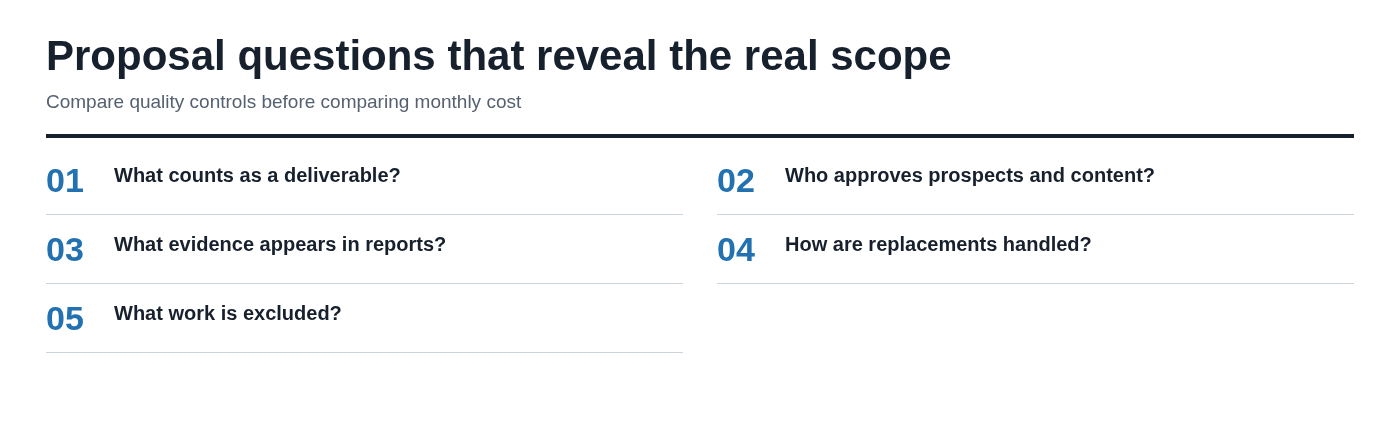
Do not compare monthly cost until you know what counts as a deliverable and what quality controls apply. A low headline price can become expensive if the sites are irrelevant, approvals are impossible, reporting is weak, or content production is excluded.
- What counts as a completed deliverable: a live link, a published article, an earned mention, or a completed outreach campaign?
- Who approves prospects, pitches, anchors, and content before work goes live?
- What standards govern relevance, editorial context, indexability, and publisher quality?
- What is excluded from the scope, including content writing, design, PR assets, or technical SEO work?
- What are the contract length, minimum commitment, cancellation terms, and ownership rules for content assets?
- How are lost links, changed attributes, unavailable target sites, and rejected placements handled?
A 30-day hiring process for a link building outreach agency
You should not judge an agency solely on immediate ranking movement in the first 30 days. Search performance is a lagging outcome influenced by many factors. Early evidence of a good partnership is more concrete: sound strategy, relevant prospects, fast approvals, clear communication, and placements that meet agreed standards.
A structured first month also prevents a common procurement mistake: choosing a provider based on a polished pitch and then discovering that the workflow, quality controls, or content responsibilities do not match your expectations.
Week 1: define the business case and constraints
Identify target pages, primary audiences, markets, competitor landscape, brand restrictions, and the internal experts who can contribute insight. Define what a qualified referring domain means for your business rather than relying on a generic metric threshold.
Then decide the primary objective. Are you trying to strengthen commercial pages, earn digital PR visibility, promote a linkable asset, build topical authority in a category, or combine several goals? The answer shapes the kind of agency you should hire.
Weeks 2-3: validate the shortlist with real evidence
Use the same questions with every provider. Compare how they describe placement quality, prospecting, content responsibilities, approvals, reporting, and contract terms. A consistent SEO outreach strategy makes it much easier to spot a proposal built around a real campaign hypothesis rather than one built around generic package language.
Request comparable placement samples and ask each provider to explain how it would approach your specific market. You do not need a free strategy document, but you do need evidence that the team understands your audience, the pages that matter, and the constraints of your industry.
Week 4: agree on operating rules before launch
Document the approval workflow, excluded sites and topics, anchor-text guardrails, content responsibilities, reporting cadence, replacement policy, and success measures. The more clearly these rules are established before outreach starts, the less likely the campaign is to drift toward easy but poor-fit placements.
Track leading indicators alongside organic results: qualified prospects approved, relevant placements published, progress against priority pages, and the quality of reporting. Rankings and traffic still matter, but they should be assessed over an appropriate time horizon.
Choose the link building partner that matches your growth constraint
Pick a transparent managed specialist such as LinkHandy if your priority is relevant editorial execution, managed outreach, and a process your team can review. Pick a digital PR partner if you need authority through newsworthy campaigns and broader earned coverage. Pick a content-led provider if your main constraint is creating assets people want to cite. Pick an integrated SEO agency if technical, content, and authority gaps need to be addressed together.
Choose outreach software when you already have the people, expertise, assets, and time to own publisher relationships internally. Do not choose software as a substitute for a team, and do not choose an agency merely to avoid setting clear quality standards.
The best link building company is the one that can show a defensible acquisition process, relevant placement standards, and reporting your team can audit. If you need a managed SaaS or B2B authority strategy with transparent execution, talk to LinkHandy about fit.