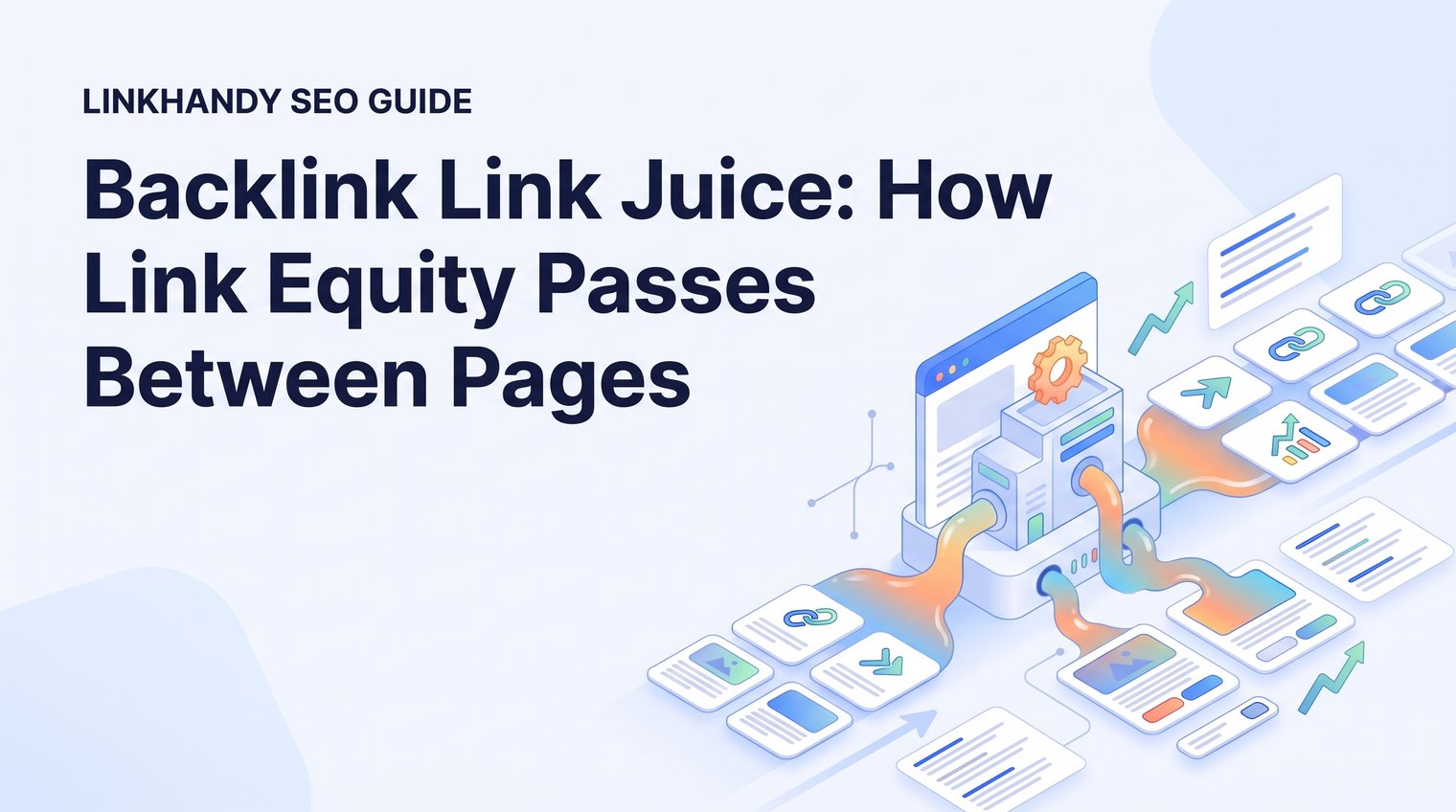

Link juice is the informal SEO term for link equity: the potential value a qualifying hyperlink can convey from one page to another. It still matters, but a backlink is not a magic ranking vote. Its impact depends on who links, why they link, where the link points, and whether the destination actually deserves to rank.
In practice, the goal is not to collect the most links. It is to earn relevant editorial links and make sure your site gives that value somewhere useful to go.
Link juice is the informal name for link equity
What does link juice mean in SEO? It describes the SEO value that may pass through a crawlable hyperlink from a source page to a target page. SEO professionals often say "link juice," but link equity is the more accurate term.
The phrase can be useful shorthand, but it can also create the wrong impression. Link equity is not a measurable liquid poured from one website into another, and no link comes with a guaranteed ranking increase. Search engines evaluate links alongside content quality, search intent, technical accessibility, user experience, and many other signals.
External backlinks and internal links both matter, although they solve different problems. A backlink from another website can help establish outside credibility and discovery. Internal links help distribute that earned value across your own site, guiding visitors and search engines toward related pages.
How SEO value passes between pages
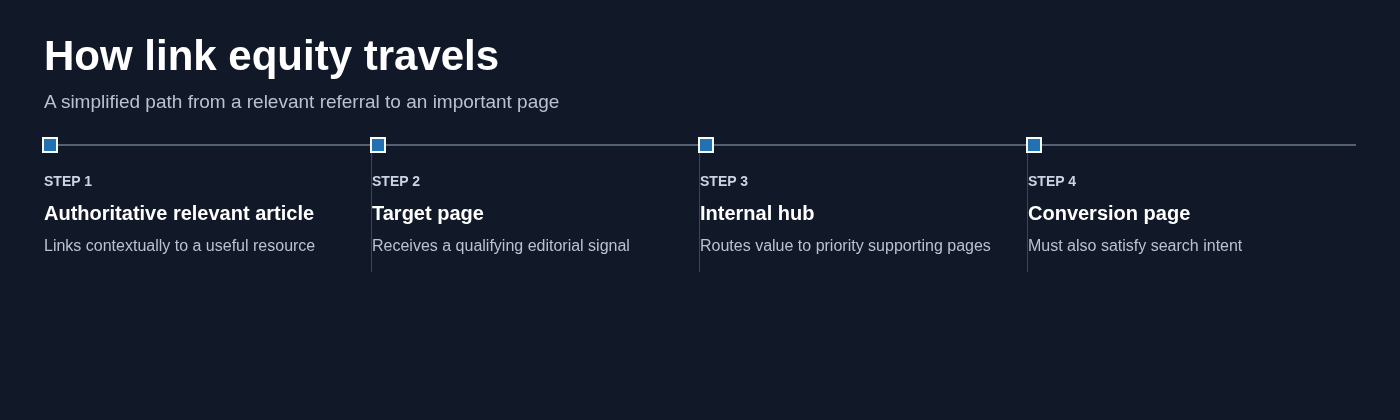
A link can become meaningful when a search engine discovers it, understands the source page and destination, and assesses the relationship between them. A relevant industry article that cites a useful guide sends a much different signal than an unrelated directory page linking to a homepage.
There is no reliable fixed formula such as "this page passes 40 percent of its authority." Search engines do not treat every standard link identically, and third-party metrics cannot reveal an exact amount of equity transferred. Instead, think of links as contextual evidence: does this citation make sense, is the source credible, and does the target help the reader?
Link equity is earned externally, then distributed internally. That second step is where many sites lose opportunities. A strong backlink pointing to an isolated page may help that page, but it will do far less for the wider site than a well-connected resource that routes users toward closely related priority pages.
What determines how much value a backlink can pass
Link equity is a qualitative assessment, not a single score. Domain Authority, Domain Rating, and similar third-party metrics can help with prospecting, but they are not search engine scores and should never be the sole reason to pursue a placement.
The strongest backlink is usually a genuinely earned editorial citation from a trusted, topically relevant page to the destination that best answers the reader's need. That is more valuable than a random link from a site with an impressive domain-level metric but no meaningful topical connection.
Topical relevance and editorial intent
Relevance is one of the clearest indicators of a useful link. A cybersecurity publication citing a SaaS security checklist, for example, is easier for both readers and search engines to understand than the same checklist linked from an unrelated lifestyle blog.
Context matters too. A natural citation within a paragraph discussing the same customer problem, industry, or audience is generally more meaningful than a sitewide sidebar placement. Editorial links exist because the publisher believes the resource improves the page; links placed solely to influence rankings are a weaker and riskier foundation.
The source page matters more than a domain-level metric alone
A respected domain can contain excellent pages, thin pages, stale archives, and pages that are not indexed at all. Review the actual URL where the link would appear, not just the domain's headline metric.
Look for a page that is indexable, useful to a real audience, maintained with reasonable editorial standards, and connected to the rest of its own site. A relevant source page with real visibility and credible signals can be more useful than a neglected page on a larger website.
Placement, anchor text, and surrounding context
An in-content link surrounded by relevant explanation is usually more useful than a boilerplate footer, blogroll, or author-bio link. Placement helps establish why the destination was cited and what the reader should expect to find there.
Anchor text should be descriptive and natural. If a page is a guide to SaaS onboarding, anchors such as "SaaS onboarding guide" or "this onboarding framework" may make sense in the right sentence. Repeating an exact-match commercial anchor across dozens of placements is not a sophisticated strategy; it is an obvious pattern.
Follow status, crawlability, and technical eligibility
"Dofollow" is informal terminology for a normal link without a rel attribute that limits or describes the relationship. Links marked nofollow, sponsored, or ugc give search engines relationship hints, and search engines may decide how to handle those hints in context. For more detail, see Link Rel Attributes: Nofollow, Sponsored, UGC, and SEO Risk.
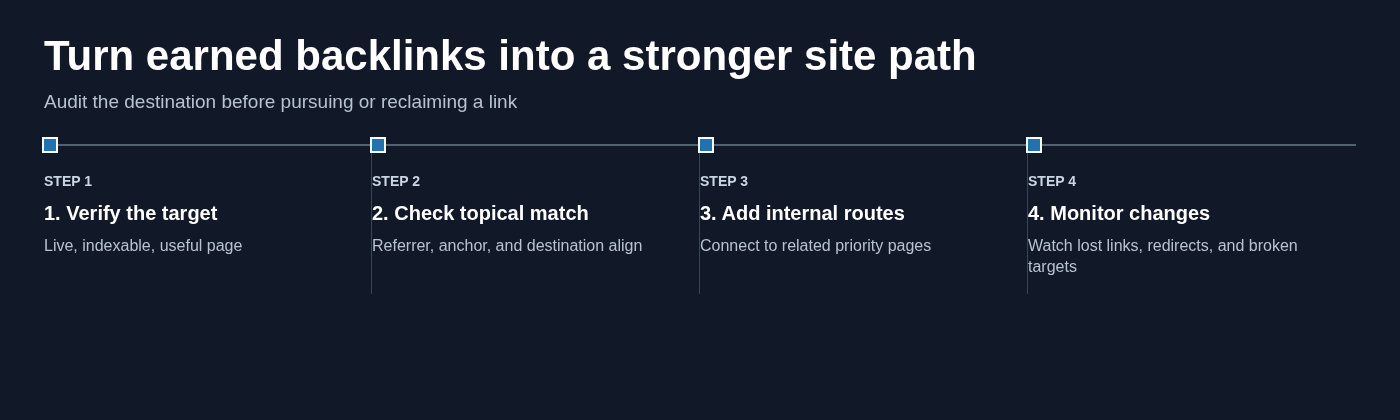
Technical issues can undermine an otherwise strong placement. A broken destination, an inaccessible page, a URL blocked from crawling, a non-indexable target, or an unnecessary redirect chain can prevent the intended SEO outcome. Before pursuing a link, verify that the destination is live, useful, and technically available to search engines.

A practical link juice example: one backlink, three possible outcomes
Imagine an established B2B publication writes about reducing churn and wants to cite a SaaS company's customer-retention resource. The same backlink opportunity can produce very different results depending on the destination page.
Best outcome: link to the resource that fulfills the reader's need
The company links the publication to a comprehensive retention guide with original examples, clear advice, and a direct match to the article's topic. Readers have a reason to click, the citation feels editorially justified, and the guide can internally link to related content such as onboarding, customer health scoring, and retention software evaluation pages.
That creates a useful path. The backlink supports a strong resource, and the resource helps users and crawlers reach other relevant pages without forcing them through an unrelated sales funnel.
Weaker outcome: link to a loosely related commercial page
The company instead asks for a link to a generic product page. That may be appropriate if the publication is specifically comparing retention platforms and the product page answers the reader's question. But if the referring article is educational, a hard commercial destination may be a poor fit.
The issue is not that product pages cannot earn backlinks. They can and should when they are the best destination. The mistake is treating every valuable backlink as an excuse to point directly at a conversion page, regardless of context.
Poor outcome: send value into a dead end
The worst version is a link to a broken URL, a thin outdated asset, a page buried behind redirects, or an orphaned page with no meaningful internal links. Even if the source placement is excellent, the destination gives users and search engines little reason to continue.
During a link audit SEO process, map high-value inbound links to their current destinations. Identify broken targets, redirect chains, outdated pages, and orphan pages, then repair the most important paths first.
How internal links redistribute earned link equity
Internal links help turn isolated wins into a stronger site architecture. Clear hubs, category pages, related-resource modules, and contextual links can connect earned backlinks to the pages that support a broader topic.
This does not mean linking every page to every other page. Overlinking creates clutter and makes the relationship between pages less clear. A better approach is to link from high-value, well-connected pages to closely related priority pages where the connection genuinely helps the reader.
- Use topic hubs to organize supporting guides, comparison pages, and commercial pages around a clear subject.
- Add contextual internal links where one page naturally expands on another.
- Keep navigation logical so important pages are not several unnecessary clicks away.
- Find and repair orphan pages, especially pages that have earned external backlinks.
- Review internal links after major URL changes, redesigns, and content consolidations.
For example, a guide that earns links for "B2B SaaS SEO" might internally point to a technical SEO checklist, a content strategy page, and a relevant service page. Those routes should be useful, not merely inserted to push equity around.
Do nofollow links, redirects, and link exchanges pass link juice?
Nofollow links can still be valuable. Search engines may treat rel attributes as hints rather than absolute commands, but nofollow links should not be pursued on the assumption that they will pass a predictable amount of link equity. They can still drive qualified referral traffic, improve brand visibility, and help search engines discover content.
Redirects can consolidate signals when they are implemented correctly, particularly during a legitimate URL migration or content consolidation. A direct, relevant permanent redirect is generally cleaner than a chain of multiple redirects. Redirecting an old page to an unrelated destination, however, creates a poor user experience and may not preserve the value you expect.
Reciprocal links are not automatically bad. Two companies may naturally cite one another's useful resources, partners, or research. The problem is scaled, transactional link exchange schemes designed primarily to manipulate rankings. For further guidance, see Link Exchange SEO: Risks, Guidelines, and Sustainable Alternatives. If the exchange would make no editorial sense without SEO, it should not be a core link-building tactic.
Are backlinks still relevant in 2026?
Yes, quality backlinks are still relevant in 2026. They remain one of many ways search engines can discover content and assess signals of editorial trust, relevance, and prominence.
They are not a replacement for useful content, sound technical SEO, or a page that matches the searcher's intent. A weak landing page does not become a strong result just because it acquires several links. Likewise, a technically inaccessible site cannot fully benefit from otherwise excellent editorial coverage.
Are backlinks good or bad? Earned, relevant links can be beneficial. Manipulative, low-quality, or irrelevant links can create risk, waste budget, or simply add no meaningful value. The distinction is rarely about raw quantity; it is about the credibility and usefulness of the relationship.
How to earn links that can create real SEO value
The most durable links are earned because a publisher has a reason to reference your work. Create resources worth citing, contribute informed expert commentary, build relationships with relevant publishers, pursue legitimate PR opportunities, and offer editorial guest contributions that genuinely help the publication's readers.
For SaaS and B2B teams, citation-worthy content often includes original research, benchmarks, detailed implementation guides, expert frameworks, data-backed templates, and practical tools. A vague 500-word post rarely earns attention. A well-researched guide that solves a recurring industry problem has a much better chance.
If you use link placement services or SEO link services, apply a simple quality screen:
- Is the publication genuinely relevant to your market, audience, or topic?
- Will the link appear on a real, useful, indexable page with an actual audience?
- Are the prospect, placement standards, and editorial approach transparent?
- Is the anchor text natural for the sentence and destination?
- Does the provider avoid ranking guarantees and volume-first promises?
A managed approach should make the process clearer, not obscure it. For example, LinkHandy works with SaaS and B2B teams on transparent, contextual link acquisition, including prospect review and approval before placements go live.
Treat link equity as a quality-and-connection problem
The right question is not, "How do we get more link juice?" Ask whether a relevant editorial link points to a strong destination and whether that destination is connected to the rest of the site in a useful way.
When topical fit, editorial quality, technical health, and internal linking work together, backlinks can support sustainable authority rather than short-lived ranking tactics. Teams that need transparent contextual SaaS and B2B link acquisition can explore LinkHandy's link-building approach.