
A link exchange is not automatically bad for SEO. Two relevant sites can legitimately link to each other when both references help readers. The risk starts when reciprocal links become a repeatable ranking tactic rather than an editorial decision.
For B2B and SaaS teams, the sensible approach is simple: do not build a link acquisition plan around swaps. Review each proposed placement on its own merits, accept the rare exchanges that genuinely improve a resource, and invest most effort in links you can earn without a one-for-one trade.
What Is a Link Exchange in SEO - and Is It Safe?
A link exchange in SEO is an agreement where two websites link to each other. It may be as informal as two partners adding relevant resource links to their existing articles, or as explicit as an outreach email that says, "Link to our page and we will link back to yours."
Reciprocal links are common on the web because businesses, publishers, associations, and complementary products often have real reasons to recommend one another. A project management platform may reference a time-tracking integration, for example, while the time-tracking company links to the integration guide in return. Neither link is inherently manipulative if each one solves a reader's next question.
The practical dividing line is intent and pattern. An occasional reciprocal link with editorial justification is generally unremarkable. A system of repeated exchanges intended primarily to influence search rankings is a different matter entirely.
Why Reciprocal Links Can Be Valuable
Reciprocal links can be useful because related organizations naturally share audiences and information. The fact that two domains link to each other matters far less than whether the individual links make sense in context.
Common legitimate examples include technology partners, suppliers, professional associations, complementary software tools, industry directories with editorial standards, and recommended-reading pages. A cybersecurity consultant might cite a SaaS vendor's compliance checklist, while that vendor cites the consultant's implementation guidance. Both references can improve the reader's experience.
Look for four qualities: topical relevance, useful surrounding context, genuine editorial judgment, and clear value for the visitor. A link placed inside a detailed article because it adds an answer is fundamentally different from a URL added to a generic "partners" page built mainly to host outbound links.

When Link Exchanges Become an SEO Risk
Google's spam policies address excessive link exchanges and link schemes designed to manipulate rankings. That does not mean every reciprocal link triggers a penalty. It does mean a systematic trading strategy can create a weak, artificial-looking link profile and expose a site to unnecessary risk.
The immediate cost is often more practical than dramatic: outreach teams waste time negotiating low-value swaps, pages accumulate links with no referral potential, and the business ends up associated with poor-quality domains. In more serious cases, manipulative behavior at scale can contribute to manual-action exposure.
Excessive Reciprocal Linking at Scale
A few natural reciprocal links are not the concern. Warning signs appear when a company conducts repeated one-for-one trades, adds sitewide reciprocal links, maintains dedicated exchange pages, or evaluates every opportunity almost entirely by domain metrics.
If an outreach pitch has no explanation beyond "our DR is X, yours is Y," it is usually not an editorial opportunity. It is a transaction trying to borrow credibility from metrics.
Other red flags include a requirement that every partnership include a return link, a spreadsheet of interchangeable sites, and content that appears written mainly to accommodate link placements. These patterns make the exchange look less like a recommendation and more like a scheme.
Irrelevant, Thin, or Low-Quality Sites
Topical mismatch is often more concerning than a modest authority score. A B2B payroll platform receiving a link from an unrelated travel blog may gain little beyond another questionable entry in its backlink profile, even if the domain metric looks attractive.
Inspect the actual site and page. Be wary of pages with little original content, unusually dense outbound linking, vague articles covering unrelated industries, poor editorial quality, or signs that content exists only to sell links. Low-quality sites also tend to deliver negligible referral traffic, which removes one of the few genuine benefits of a placement.
A smaller, focused industry publication can be far more valuable than a broadly themed site with inflated-looking metrics and no credible audience.
Three-Way Exchanges That Only Try to Hide the Trade
Three-way, or ABC, exchanges attempt to avoid a visible two-site swap. Site A links to Site B, Site B links to Site C, and Site C may link back to Site A. The structure itself does not make the arrangement safe or unsafe.
What matters is whether each link independently deserves to exist. If the network is simply disguising a quid pro quo relationship, changing the path between domains does not turn a manipulative placement into an editorial recommendation.
Assess the purpose, quality, relevance, and any disclosure requirements that apply to the relationship. Ask a blunt question: would this publisher still include the link if rankings were not part of the conversation?
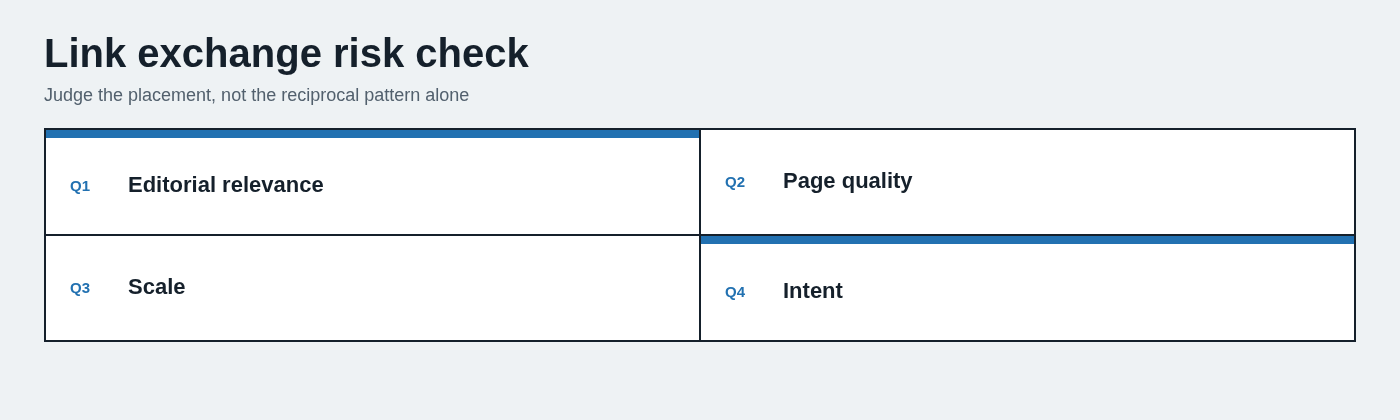
A Practical Review Framework Before You Agree to a Swap
Before agreeing to a link exchange, review the proposed source page and destination page rather than approving based on the other domain's headline metrics. The best decision process is specific enough to reject bad opportunities quickly without dismissing useful relationships.
- Inspect the exact source page. Read the article, resource page, or guide where the link would appear. Does it have a clear topic, a real audience, and useful original content?
- Check audience overlap. The linked resource should serve a plausible next step for the publisher's readers, not merely share a broad business category.
- Assess the editorial rationale. Can the publisher explain why your page belongs there? A relevant reference should not need forced wording to fit.
- Review the outbound-link environment. A few well-chosen citations are normal. A page crowded with commercial links, especially across unrelated niches, is a poor setting.
- Verify basic health. Check whether the site is indexed, publishes consistently, and appears to attract a real audience. Do not treat a third-party metric as proof of quality.
- Read the anchor text aloud. Natural anchor text describes the destination in a way a reader would expect. Exact-match keyword demands are a reason to pause.
Decline requests that require exact-match anchors, guaranteed follow links, publication without editorial review, placement on a link page, or reciprocal linking as a condition of every relationship. Those terms reveal that the exchange is being managed for search manipulation, not reader value.
Check the Page, Not Just the Domain
The page is where the link will live, so it deserves more scrutiny than the domain-level score. A reputable domain can still have an irrelevant or poorly maintained resource page, while a lesser-known niche publication may have a highly useful article that is an excellent contextual fit.
Review the page's purpose, the paragraphs around the proposed link, and the other resources it cites. Ask whether the destination would improve the reader's understanding or help them complete a task. If the answer is unclear, the placement probably is not worth pursuing.
Document the Editorial Reason
Teams handling many partnerships should keep a brief internal record for every approved reciprocal placement. Note the source URL, destination URL, relationship context, editorial reason, reviewer, and approval date.
This is not bureaucracy for its own sake. It helps prevent accidental patterns, gives future team members context, and makes it easier to audit old placements when a partnership or content strategy changes.
How to Handle Link Exchange Requests
Most link exchange requests deserve a quick, disciplined response rather than a lengthy negotiation. Accept only when you can defend the link as a resource recommendation to your own audience, not because the sender offers an attractive metric.
A reasonable acceptance criterion might be: "We will consider a reciprocal reference when both destination pages are relevant to their respective readers, the links fit naturally in editorial content, and neither side dictates manipulative anchor text or placement terms."
When a request is not a fit, decline plainly: "Thanks for reaching out. We only add external links where they directly support the page's topic and reader need, and this opportunity is not aligned with our editorial criteria." That is clear, professional, and does not invite a debate over domain scores.
In some cases, a better alternative is a non-reciprocal editorial opportunity. You might suggest an expert contribution, a joint research project, a partner resource guide, or a relevant product integration page. These options take more effort than a swap, but they can create a stronger asset and a more defensible relationship. Teams building that process can use this SEO outreach strategy as a practical reference.
Sustainable Alternatives to Reciprocal Link Building
The durable alternative to reciprocal link building is to create credible reasons for other sites to cite you. That means earning links through useful content, relevant relationships, and editorial placements that stand on their own.
Create Link-Worthy Assets, Not Generic Link Bait
Generic "ultimate guides" rarely earn attention simply because they are long. Assets earn citations when they provide information or utility that a publisher cannot easily replace with another broad article.
For B2B companies, that can include original research, benchmark data, calculators, implementation templates, comparison frameworks, or detailed operating checklists. A SaaS company that publishes anonymized workflow benchmarks from its customer base has a more compelling citation opportunity than one that produces another generic post about productivity.
The goal is not to manufacture content for arbitrary backlinks. It is to create a genuinely useful reference that supports the publisher's own argument, article, or audience.
Earn Contextual Editorial Placements
Relevant guest contributions, expert commentary, digital PR, and content partnerships can earn contextual editorial links when the work is useful in its own right. A strong contributed article teaches something specific, reflects real expertise, and does not depend on a forced product mention to justify publication.
Managed link building service and link placement services can be appropriate when the provider works transparently, prioritizes topical fit, and uses publishers with meaningful editorial standards. Be cautious with any offer built around guaranteed metrics, pre-packaged inventory, or placements that seem detached from a real publication process.
For example, a B2B software company may contribute expert analysis to an industry publication after releasing relevant research. The resulting citation can make sense because the article contributes expertise, while the research link gives readers access to supporting detail.
Reclaim and Strengthen Existing Brand Signals
Not every SEO link building opportunity requires starting a new relationship. Look for existing signals that can be improved through straightforward outreach and content maintenance.
- Ask publishers to link unlinked brand mentions where a citation would help readers find the referenced company or resource.
- Offer an updated, more useful replacement when a relevant article points to an outdated or broken resource.
- Review genuine partner pages, integrations, association profiles, and supplier resources for missing or outdated references.
- Refresh older assets with current data, clearer examples, and better structure so they remain citeable.
These tactics work best when the request improves the publisher's page as well as your visibility. That shared value is what separates legitimate outreach from a request for a favor with no editorial upside.

Choosing a Link Building Partner Without Replacing One Risk With Another
Businesses comparing link building companies should judge the process, not just the promised number of backlinks. A provider should be able to explain how it finds relevant prospects, what editorial standards it applies, how content and placements are reviewed, and what clients can see before work goes live.
Ask whether the provider shares proposed websites and pitches for approval, whether it evaluates the specific placement page, and how it reports completed work. The right partner will discuss relevance, audience, content context, and long-term authority rather than selling a spreadsheet of authority metrics.
Avoid providers that promote reciprocal-link inventory, undisclosed networks, metric-only placements, or guaranteed follow links with no meaningful editorial review. No credible SEO partner can honestly guarantee rankings, and a guaranteed link on demand often says more about the placement process than the sales page intends.
LinkHandy
LinkHandy is a boutique link-building agency for SaaS and B2B companies that need relevance-led, managed off-page SEO support. Its approach includes contextual link insertions, editorial guest posts, content partnerships, PR and brand mentions, and authority strategy, with prospects and outreach pitches available for client review before placements go live.
That transparent approval process is particularly useful for in-house SEO teams that need to protect brand standards and avoid questionable placements. LinkHandy is best suited to companies seeking a managed, white-hat approach to building authority, rather than teams looking for a self-serve backlink marketplace or a large volume of instant links.
The Sensible Rule for Link Exchange SEO
Do not pursue link swaps as a scalable SEO tactic. Allow reciprocal links only when each placement independently serves readers as a useful editorial recommendation, regardless of whether the other site links back.
If a proposed exchange needs forced anchors, weak pages, irrelevant topics, or a complex trading structure to work, decline it. Build authority through useful assets, real partnerships, and contextual editorial coverage instead.
Teams that need a relevance-led authority strategy can explore LinkHandy's link-building services.