
Link rel attributes are small HTML signals with outsized SEO consequences. For outbound links, the practical rule is simple: use sponsored when compensation influenced the link, ugc for user-created links, and nofollow when you do not want to endorse a destination. A normal editorial link usually needs no special rel value at all.
The confusion comes from treating every backlink as either "dofollow" or "nofollow." Those labels are useful shorthand, but they miss the reason a link exists - and that reason is exactly what modern rel attributes are designed to communicate.
What are link rel attributes, and why do they matter for SEO?
A link rel attribute is HTML markup that describes the relationship between a link on one page and the page it points to. In the context of outbound links, the SEO-relevant values are nofollow, sponsored, and ugc.
These values help search engines interpret the intent behind a link. They are not buttons that guarantee rankings, prevent crawling in every circumstance, or erase every SEO risk. Instead, they provide useful context about whether a publisher is editorially endorsing a destination, disclosing compensation, or allowing a user to post a link.
It is also important to separate the rel attribute in HTML from the broader idea of a backlink type. A backlink is simply an incoming link from another website. The rel value is markup chosen by the linking publisher to qualify that outbound link.
The four link states SEOs need to recognize
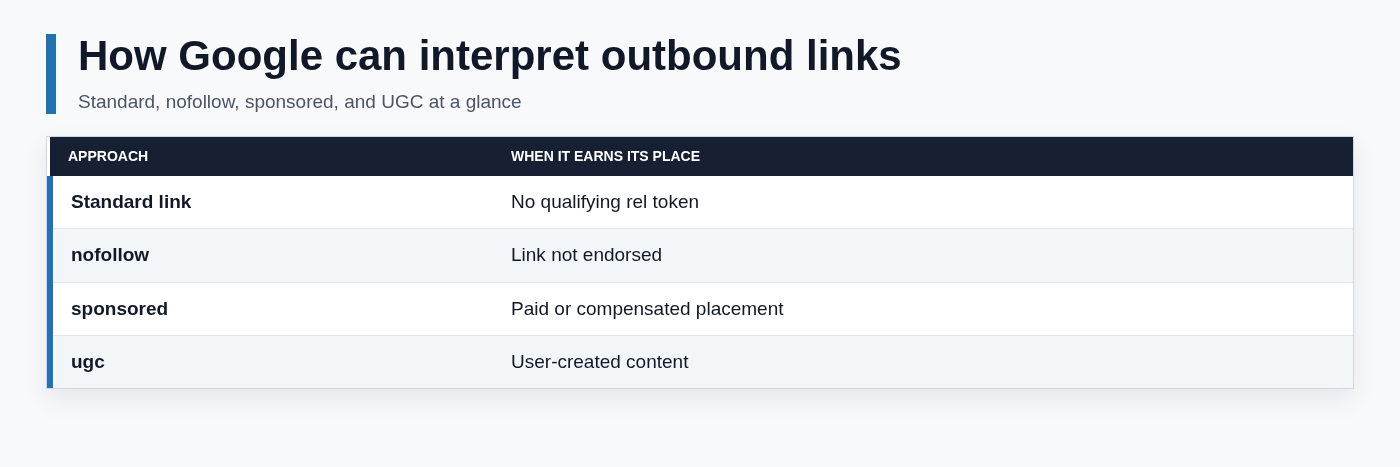
Most outbound links fall into one of four states: standard editorial links, nofollow links, sponsored links, and UGC links. Knowing the difference is more useful than relying on the vague question, "Is this link dofollow?"
A standard link has no nofollow, sponsored, or ugc token. SEO professionals often call this a "dofollow" link, but dofollow is not an official rel attribute. It simply describes an ordinary link that has not been qualified with one of those values.
- Standard link: An editorially chosen, unqualified link.
- Nofollow: A link the publisher does not want to endorse.
- Sponsored: A link connected to payment, sponsorship, affiliate compensation, or another commercial arrangement.
- UGC: A link created by a user, contributor, or community member rather than the publisher.
rel="nofollow": links you do not want to endorse
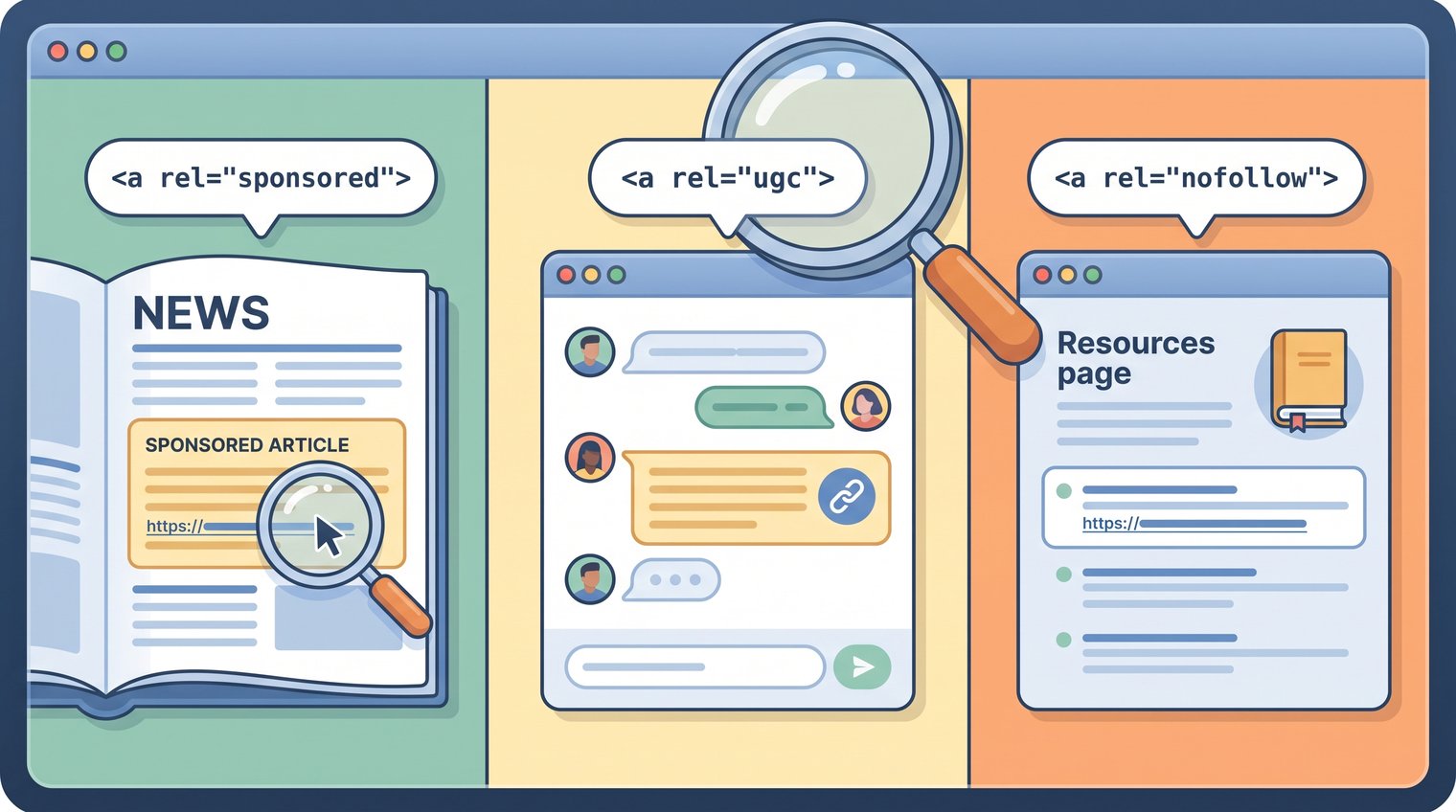
rel="nofollow" tells search engines that the publisher does not want to vouch for or endorse the linked destination. The basic syntax looks like this:
<a href="https://example.com" rel="nofollow">Example</a>
Google treats nofollow as a hint for crawling and ranking purposes, not the strict directive it was once widely understood to be. In plain terms, Google may consider the link in some situations, but the attribute still communicates that the publisher is withholding an editorial recommendation.
Nofollow is appropriate for links to destinations you cannot confidently evaluate, links added in contexts where editorial review is limited, or links that are not clearly better described as sponsored or UGC. If a link is paid, however, sponsored is more precise. If it came from a community user, UGC is usually more accurate.
rel="sponsored": paid links, affiliate links, and compensated placements
Use rel="sponsored" when compensation influenced the presence of a link. That includes advertisements, paid placements, sponsorships, affiliate links, and commercially arranged mentions.
The syntax is straightforward:
<a href="https://example.com" rel="sponsored">Example</a>
A publisher can also use more than one token, such as rel="nofollow sponsored". That is valid, especially when a publication has an older nofollow policy built into its workflow. Still, sponsored is the clearer signal because it explains why the link is qualified.
Disclosure language matters for readers and may be required by applicable advertising rules, but a visible note saying "sponsored" does not replace proper link markup. A paid article with a disclosure at the top and an unqualified editorial-style backlink can still create avoidable SEO risk.
This is particularly relevant in link building. A placement should not be represented as an independent editorial citation if it was purchased or otherwise compensated. Transparent commercial relationships and accurate qualifiers are safer than trying to make a paid placement look organic.
rel="ugc": links created by users rather than the publisher
rel="ugc" is intended for user-generated content: comments, forum posts, community profiles, discussion threads, and contributor-submitted areas where users can add links.
For example, a product community may allow customers to include a website in their profile or share a resource in a discussion. Applying rel="ugc" gives search engines context about the source of that link without requiring the publisher to treat every community contribution as a direct endorsement.
UGC markup is not a substitute for moderation. Forums and comments can quickly become spam targets, particularly on high-authority domains. Site owners should still use rate limits, review queues, abuse reporting, and sensible restrictions on link posting in vulnerable sections.
A guest post is not automatically UGC just because an outside writer created it. If the publisher commissioned, edited, reviewed, and controlled the content as part of its editorial process, the relevant question is whether the link was commercially influenced - not simply whether an external author contributed copy.
How to choose the right rel attribute: a decision framework
The fastest way to choose a rel value is to answer two questions: Was compensation involved? And was the link created by a user rather than the publisher?
If compensation drove the link, use sponsored. If a user added it in a community setting, use UGC. If neither applies, decide whether the publisher genuinely endorses the destination. If not, nofollow is the sensible fallback. If the link is an unpaid, editorially chosen recommendation or citation, leave it unqualified.
| Scenario | Recommended rel treatment |
|---|---|
| Unpaid editorial citation in an article | No qualifying rel value |
| Affiliate product link | rel="sponsored" |
| Paid guest-post placement | rel="sponsored", optionally with nofollow |
| Comment or forum link added by a member | rel="ugc", optionally with nofollow |
| Untrusted external resource link | rel="nofollow" |
| Editorially reviewed expert contributor bio | Depends on compensation and editorial control |
| Syndicated content link back to the original source | Usually unqualified if editorial and not compensated |
Product-review samples are a common edge case. Receiving a free product can be compensation if it affected the review or linked mention, so publishers should evaluate the commercial relationship rather than assuming cash payment is the only trigger. The same principle applies to event access, discounts, retainers, and other benefits tied to coverage.
When a standard link is appropriate
A standard, unqualified link is appropriate when a publisher independently chooses to cite, recommend, or reference a useful resource. It should reflect a real editorial decision, not a link sold under the label of "editorial placement."
For example, a B2B software publication may cite a research report because it supports a claim in the article. If there was no compensation and the publisher would make the same citation regardless of commercial pressure, a standard link is reasonable.
When more than one rel value is valid
Rel values are space-separated tokens, so combinations such as rel="nofollow sponsored" and rel="nofollow ugc" are valid. The first token does not override the second; together, they provide multiple signals about the link.
For implementation, consistency matters more than cleverness. Document the preferred treatment for each scenario, configure templates accordingly, and make sure editors, community managers, developers, and external publishing partners understand the same rules.
SEO risks of using rel attributes incorrectly
Incorrect rel usage does not mean every page will receive an immediate penalty. The more meaningful risk is a pattern of link practices that makes paid links appear to be editorial endorsements or turns community pages into low-quality link farms.
Unqualified compensated links can contribute to paid-link scheme exposure, weaken trust in a site's editorial standards, and in serious cases create manual-action risk. A handful of ambiguous links is different from a repeatable model of selling ranking influence, but treating the distinction casually is still poor practice.
Community sites face a separate problem. If comments, profiles, or forums are left open without moderation or appropriate qualification, they can attract manipulative link spam that damages the quality of the site over time.
There is also an internal-linking mistake worth avoiding: do not blanket nofollow important internal navigation or resource links. Internal links help search engines discover pages and understand site structure. This article is mainly about outbound relationships, but internal nofollow policies are often an unnecessary self-inflicted limitation.
Publishers control the rel markup on their outgoing links. The receiving site cannot force another domain to change a nofollow, sponsored, or UGC attribute. That is why a backlink report alone cannot tell the full story of how a placement was agreed, published, and qualified.
How to tell whether a link is followed, nofollow, sponsored, or UGC
To inspect a link, open the live page and view its source code or use browser developer tools. Find the relevant <a> element, then inspect its rel attribute.
- If there is no rel attribute, the link is normally a standard unqualified link.
- If you see rel="nofollow", it is nofollow.
- If you see rel="sponsored", it is qualified as sponsored.
- If you see rel="ugc", it is qualified as user-generated content.
- If several values appear, such as rel="nofollow sponsored", treat all listed tokens as applicable.
Do not rely solely on what a CMS setting claims to publish. JavaScript rendering, tag-manager scripts, redirects, security tools, and SEO plugins can alter a link after an editor saves a page. Verify the final live output, especially for contracted placements or templates used at scale.
A link rel policy for editorial teams and link-building partners
A simple policy prevents expensive ambiguity. Editorial teams should define how they treat compensated links, configure defaults for comments and community content, document exceptions, audit templates, and verify what actually appears on published pages.
- Define whether affiliate, sponsorship, sample, and paid-placement links require sponsored markup.
- Set sensible defaults for comments, profiles, reviews, and forum posts.
- Document who can approve exceptions and what evidence they need.
- Audit CMS templates after plugin updates or site migrations.
- Check live URLs, not just drafts or outreach agreements.
Link-building partners should be equally clear about the commercial and editorial context of a placement. Teams developing a repeatable process can use this SEO outreach strategy to define prospecting, communication, and placement standards. Ask whether compensation is involved, who controls the content, whether the publisher applies rel qualifiers, and what the partner can realistically deliver. Promises of guaranteed followed links on third-party sites are often a sign that the underlying process deserves closer scrutiny.
For teams that outsource execution, a managed link building service should also explain how it handles commercial relationships, rel attributes, and editorial review. For SaaS and B2B teams, LinkHandy provides transparent, white-hat authority strategy and link acquisition with clear expectations around placement quality and editorial practices. The goal should be sustainable relevance and credibility, not a misleading label attached to a backlink.
Use rel attributes to make link intent clear
Rel attributes are not complicated once you focus on link intent. Leave genuine unpaid editorial citations unqualified, use sponsored for compensated links, use ugc for user-created links, and use nofollow when you cannot or do not want to endorse a destination.
That approach protects editorial integrity, makes commercial relationships clearer to search engines, and gives teams a practical standard they can apply across content, partnerships, and community pages. If your team needs transparent editorial link acquisition as part of a broader authority strategy, talk with LinkHandy.