
Most blogger outreach fails before the first email is sent. The sender has no clear reason to be cited, targets publications that are not a real fit, and asks for a backlink as if it were the product rather than the outcome of useful editorial collaboration.
Effective blogger outreach strategies work differently. They start with a resource worth referencing, a carefully chosen publisher, and an offer that improves the content for that publisher's readers. This guide walks through the process for B2B and SaaS teams that want to earn relevant, durable backlinks without resorting to mass outreach or questionable link schemes.
Define the editorial backlink you are trying to earn
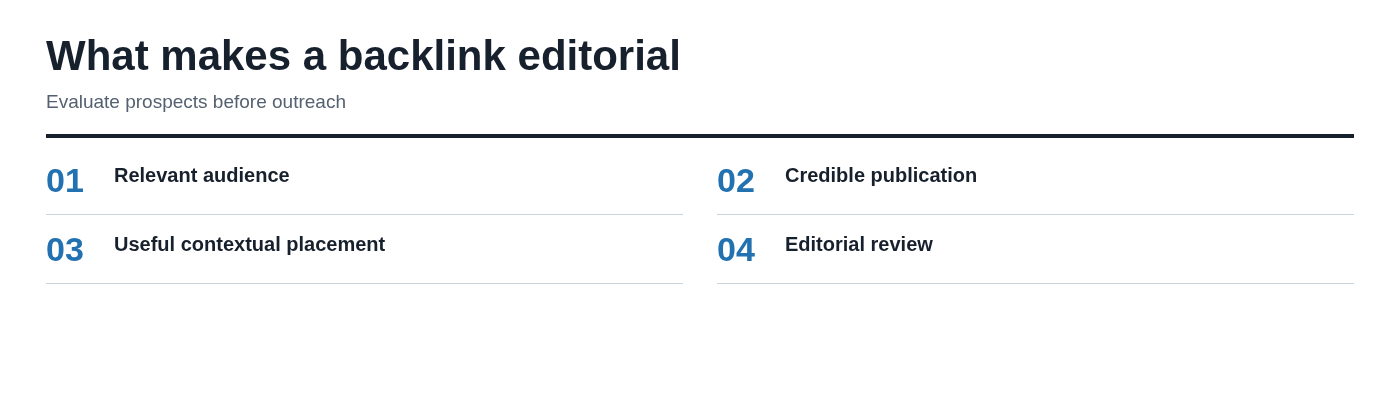
An editorial backlink is a link a publisher includes because it helps readers understand, verify, or act on the content. It is not a link purchased with no disclosure, inserted into a low-quality guest-post farm, or swapped through an irrelevant "you link to me, I link to you" arrangement.
Before contacting anyone, qualify the opportunity against five practical criteria:
- Topical relevance: The publication and specific article should genuinely relate to your subject.
- Real readership: The site should serve an identifiable audience, not merely publish pages for search engines.
- Editorial standards: Look for named authors, useful content, clear publishing practices, and selective contributor requirements.
- Contextual placement: Your link should fit naturally within a relevant paragraph, not sit in a generic author bio or crowded resource list.
- Natural anchor opportunity: The surrounding text should describe the resource honestly without forcing an exact-match keyword.
The central rule is simple: the publisher's audience comes first. If your proposed contribution does not improve a reader's experience, the publication has no good editorial reason to include it.
Set a link acquisition goal before building a prospect list
Do not build a database of 500 blogs because someone said outreach requires scale. Start with the SEO need you are trying to address. You may want to support a commercial page with supporting editorial content, strengthen a topic cluster, build authority around an emerging category, or earn credible brand mentions in publications your buyers already read.
Write down five campaign decisions before prospecting: the target page, the topical context where it belongs, the general direction of a natural anchor, the type of publication you want, and the campaign window. For example, a B2B analytics platform might aim to earn links to an original benchmark report from operations, RevOps, and SaaS publications over the next 90 days.
Domain metrics can help with early screening, but they are not the decision. A highly relevant niche publication with engaged readers and real editorial review can be more valuable than a high-metric site publishing loosely related sponsored articles every day. Relevance and editorial fit are also what make a placement more likely to be retained.
Choose pages with a credible reason to be cited
The best outreach targets are rarely thin product pages. Publishers are more likely to cite original research, useful calculators, definitive guides, case studies, data-backed templates, and expert resources that answer a question already present in their content.
If your target page is a commercial landing page, build a citation-worthy supporting asset around it. Instead of asking a marketing blog to link to a generic "SEO software" page, offer a research-backed guide on measuring organic pipeline or a downloadable reporting framework. The useful asset earns the editorial mention; internal links can then guide readers toward the commercial page.
Build a focused list of publishers and active bloggers
Good prospects are easier to find when you search for existing conversations rather than generic "write for us" pages. Run topical searches for the subjects your target audience reads about, then review the publications consistently publishing useful work in that area.
Useful prospecting paths include competitor backlink analysis, author bylines, resource pages, newsletter archives, podcast guest lists, industry communities, and articles ranking for your target topic. If a writer or publication has covered a problem adjacent to your asset, there may be a legitimate outreach angle.
Segment prospects by content format and relationship path. A resource page owner needs a different message than an editor who publishes expert commentary, and neither should receive the same generic sequence. Keep the list tight enough that you can research each target properly.
A lean tracking sheet should include:
- Publication name and article URL
- Topic fit and audience notes
- Relevant editor, author, or contributor contact
- A recent article or specific observation
- Outreach angle and offer type
- Status, follow-up date, and final outcome
Research each prospect for a specific editorial angle
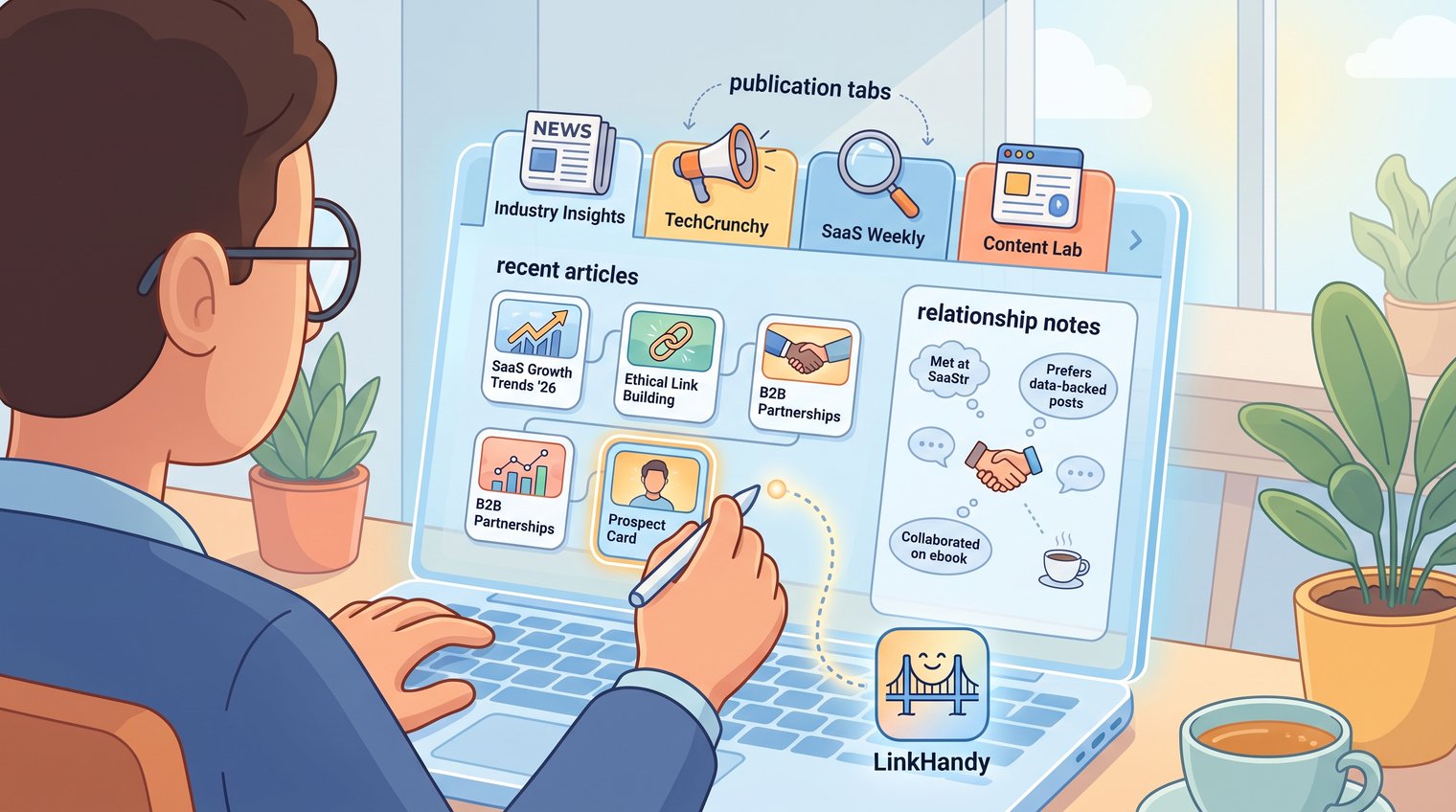
Research is what separates a credible pitch from a mail merge. Read several recent articles, not just the page where you hope to earn a link. Look for recurring themes, the level of detail the publication expects, sources it cites, contributor guidelines, and gaps it has not addressed.
Capture one concrete observation for every prospect. It might be a recent article using an outdated statistic, a guide missing a practical B2B example, a recurring audience question in a newsletter, or a topic the writer has covered from one perspective but not another.
Personalization is not adding a first name to an email. It is evidence that you understand the publication's editorial priorities and have shaped your offer accordingly.
Match the outreach offer to the publisher's content model
Choose an offer based on what the publisher already creates. A well-maintained evergreen guide may be appropriate for a contextual resource update. A publication that regularly accepts expert contributions may be a fit for a contributed article. A journalist or newsletter writer may need original data, a useful quote, or subject-matter commentary instead.
For broader opportunities, a content partnership can make sense: co-produced research, a webinar recap, or a shared expert roundup. Do not force a guest post on a publisher that rarely uses outside contributors, and do not ask for a link insertion when your resource adds nothing to the existing article.
Create an outreach offer that improves the publisher's content
Not all offers have equal editorial value. Start with the strongest contribution you can make: unique data, credible subject-matter expertise, a well-developed contributed outline, a timely expert quote, or a resource update that solves a real gap. A carefully justified contextual addition belongs near the bottom of that hierarchy, not at the top.
The biggest outreach mistake is asking for a link without explaining the reader benefit. Editors are responsible for the usefulness and credibility of their pages. Make it easy for them to see why the addition belongs.
Keep ethical boundaries clear. Do not ask publishers to hide paid relationships, dictate unnatural keyword-rich anchor text, or promise reciprocal links in exchange for placement. Those tactics weaken editorial judgment and can create risk for both parties.
Pitch original insight instead of generic guest-post topics
"10 Tips for Better Marketing" is not a pitch. It is a vague assignment an editor has seen dozens of times. A better idea uses insight your company can credibly provide: anonymized customer patterns, survey findings, implementation lessons, benchmarks, or a contrarian operational point of view.
For instance, a SaaS company could pitch "Why self-reported attribution breaks down in long B2B sales cycles" and support it with aggregated observations from customer implementations. State the angle, two or three practical takeaways, the evidence available, and why the publication's readers would care now.
Write a concise outreach email that earns a reply
The first email should make one useful case, not tell your company's life story. Use a relevant subject line, one specific observation, a clear value proposition, a low-friction ask, and an obvious next step.
Avoid exaggerated praise such as "I am a huge fan of every article you publish." It sounds automated unless you can prove it with a specific observation. Similarly, long credential lists create friction. Mention only the expertise needed to establish why your contribution is credible.
Include a target URL when you are suggesting a precise, genuinely useful update to an existing page. Lead with an idea, data point, or proposed contribution when a direct link request would feel premature or overly transactional.
Contextual link insertion outreach email template
Subject: Possible update for your guide on [topic]
Hi [Name],
I was reading your [specific article title] and noticed the section on [specific point]. The guide currently explains [brief observation], but readers looking for [need] may also benefit from [resource or evidence].
We recently published [one-sentence description and URL], which includes [specific useful element, such as original data, a template, or a step-by-step example]. It may be a helpful citation in the paragraph about [exact section], if you think it improves the guide.
No problem if it is not a fit. Either way, thank you for the useful resource.
Best,
[Name]
The research detail is the article and section you reference. The reader benefit is the specific gap your resource fills. The placement rationale explains why the link belongs in that location, while the low-pressure close gives the editor an easy way to decline.
Warning: Do not send this template to a page simply because it ranks well. If the suggested resource does not materially improve the content, skip the pitch.
Guest post pitch template
Subject: Contributor idea: [specific, publication-relevant angle]
Hi [Name],
Your recent coverage of [topic or article] made me think your readers may find this useful: [proposed article title].
The article would cover:
- [Specific takeaway or framework]
- [Practical example, process, or data point]
- [Common mistake and how readers can avoid it]
I can support the piece with [brief proof of expertise, original data, or firsthand operational experience]. If useful, I would also reference [relevant resource] where it genuinely supports a point, subject to your editorial standards.
Would you like a short outline?
Best,
[Name]
The link is not the centerpiece of this pitch. Acceptance depends on whether the proposed article is useful, timely, and appropriate for the publication's audience.
Send outreach at a sustainable, personalized cadence
Start with small batches of well-researched prospects, such as 15 to 30 contacts in one segment. Review the replies before expanding. If several editors say the topic is too broad, the resource is not differentiated enough, or the pitch is not a fit, fix the offer rather than sending the same message to 500 more people.
Use an identifiable sender, a professional domain, plain-text formatting, honest subject lines, and a short first email. Avoid attachment-heavy outreach, misleading "Re:" subject lines, and aggressive automation. Those choices hurt deliverability and make a legitimate pitch look like spam.
Track sent volume, reply rate, positive replies, accepted pitches, placements, and link quality by segment. A lower reply rate from a highly relevant editorial segment may be more valuable than a higher reply rate from sites that do not serve your buyers.
Follow up without becoming a nuisance
One or two polite follow-ups are usually enough. Send the first follow-up after roughly five to seven business days, then a final note about seven to 10 business days later if there is still no response. Editorial calendars vary, so these are guidelines rather than rules.
Each follow-up should add a reason to re-engage. Clarify the angle, share newly available data, offer an alternate format, or point to a specific section that may be useful. Do not send "Just checking in" three times with no new value.
Stop when you receive a clear refusal, learn that the opportunity is not a fit, reach the end of your planned sequence, or encounter requests that conflict with quality standards. Silence is not permission to keep escalating.
Make collaboration easy after a publisher says yes
A positive reply is the start of the relationship, not the finish line. Confirm the angle, word count, editorial requirements, timeline, author attribution, citation rules, and any disclosure expectations before producing content or supplying materials.
Provide clean copy, accurate sources, verifiable data, and prompt responses to editorial questions. Respect edits. Trying to force an exact anchor phrase into a sentence that does not support it is a common mistake; let the editor use language that reads naturally and serves readers.
Fast, accurate collaboration makes editors more likely to work with you again. If compensation, a formal partnership, or contributed content is involved, follow the publication's disclosure and attribution rules rather than trying to obscure the relationship.
Evaluate backlink quality and campaign results beyond domain metrics
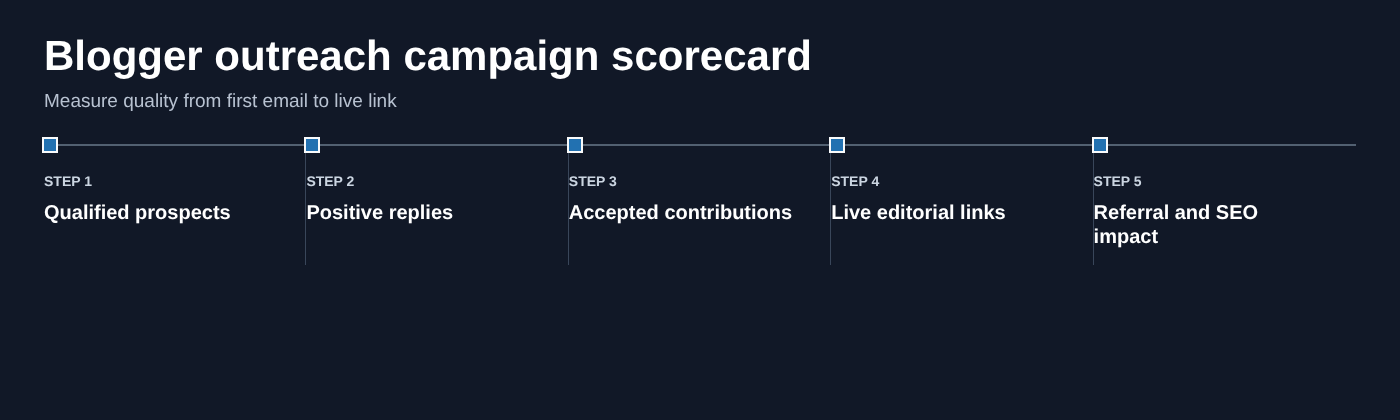
A live link is not automatically a successful placement. Assess whether it appears in a relevant article, sits in meaningful editorial context, can be indexed, uses natural anchor language, has realistic referral potential, and is likely to remain live as the page evolves.
Separate leading indicators from final outcomes. Positive replies, requests for outlines, and accepted contributions tell you whether your targeting and offer are resonating. Live editorial links, qualified referral traffic, brand mentions, and improvements in topic-level visibility show whether the campaign is producing business value.
Use the results to refine your process. If one publication segment accepts data-led pitches but ignores guest-post offers, shift your effort. If a resource attracts interest but not placements, strengthen the evidence or make its purpose clearer. Increasing email volume is not a substitute for improving fit.
Know when to use blogger outreach services or an agency
Outsourcing can be useful when your team lacks the capacity to research prospects, develop pitches, manage follow-ups, and coordinate editorial deliverables consistently. It can also help when your subject matter is complex, when you need experienced support in SaaS or B2B publications, or when outreach must connect to a broader authority strategy.
Evaluate any blogger outreach agency with a practical buyer's checklist:
- Clear, transparent prospecting and relevance criteria
- Examples of the editorial standards it pursues
- Controls that prevent irrelevant or low-quality placements
- Honest disclosure practices and no hidden paid-link arrangements
- Detailed reporting on prospects, outreach, placements, and outcomes
- No promises of guaranteed placement on specific publishers
LinkHandy may be a fit for SaaS and B2B teams that need transparent, white-hat support with editorial link building, contextual placements, guest posts, content partnerships, and authority strategy. The right partner should show how it evaluates opportunities and keep you informed before placements go live.
Turn blogger outreach into a repeatable editorial relationship program
Lasting backlinks are earned through relevant ideas, selective prospecting, respectful follow-up, and reliable collaboration. The goal is not to collect links from as many sites as possible. It is to become a useful source for publishers whose audiences overlap with your buyers.
Begin with one high-value asset and one tightly defined prospect segment. Send a small, researched batch, study the response, and improve your offer before expanding. Over time, the strongest blogger outreach strategies create more than individual placements: they create editorial relationships that can support brand visibility, authority, and organic growth.
If your team needs help building and executing a transparent editorial backlink strategy, LinkHandy can support the outreach process while keeping relevance, quality, and publisher fit at the center of the work.