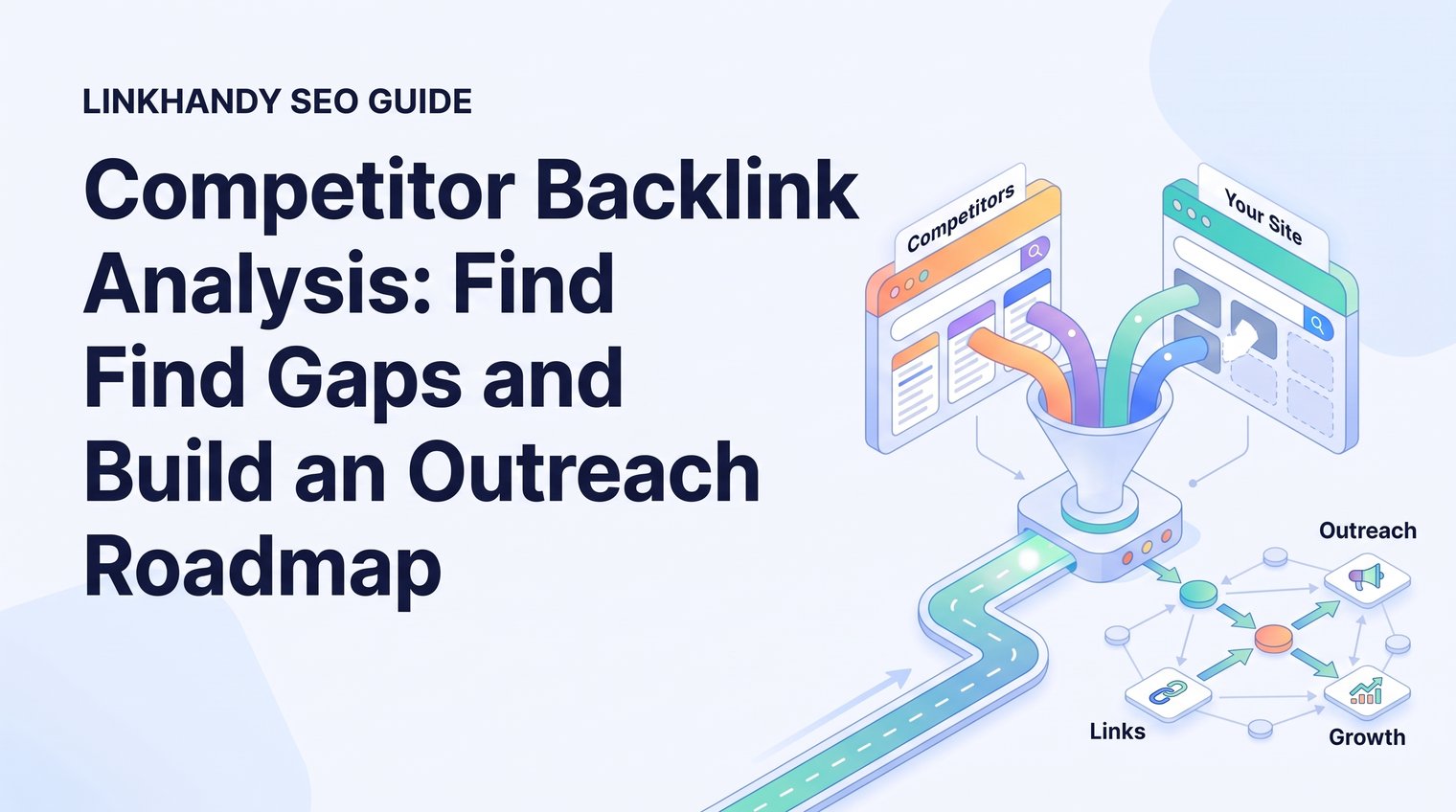

Most competitor backlink analysis fails for a simple reason: teams export thousands of links, sort by authority, and start emailing. The result is a bloated prospect list, weak pitches, and links that do little for the page they actually want to rank.
A useful analysis works in the other direction. Start with the search results you need to compete in, identify the pages earning relevant citations, and turn only credible patterns into an outreach roadmap. This guide shows how to do that without confusing a raw backlink gap with a real opportunity.
Define the competitors and pages worth comparing
Your business competitors are not automatically your SEO competitors. A company may sell a similar product yet never rank for the topics that matter to your growth plan. For competitor backlink analysis, prioritize the sites that repeatedly appear in search results for the same commercial and informational keyword clusters you want to win.
Choose three to five direct SERP competitors. Then build a focused page set that includes your target page, the competing pages ranking for the cluster, and any closely related content hubs that consistently earn links. If you are improving a SaaS integration page, for example, compare it with other integration guides, workflow pages, and relevant resource hubs - not every URL on a competitor's domain.
Domain-wide comparisons are useful for broad direction, but they create too much noise when you are planning outreach. A competitor may have earned links through funding news, a viral report, or an old campaign that has no connection to your target topic. The question is not "Where does this domain get links?" It is "Which sources cite the kind of page we need to improve?"
Build a simple comparison sheet before opening a backlink tool
Create a spreadsheet before you collect data. It keeps your research tied to a decision instead of becoming a competitor backlink spy exercise with no next step.
Use one row per potential placement and include these fields:
- Competitor domain and URL
- Competing page
- Target keyword cluster
- Referring domain
- Linking page URL
- Link type or placement type
- Anchor text
- Destination URL on the competitor site
- Date first seen
- Outreach status
Add columns later for contact, pitch angle, target page, and priority. At this stage, the point is to preserve the connection between a backlink and the page it supports. That connection is what turns research into an outreach roadmap.

Collect competitor backlink data with the right level of detail
You can run competitor backlink analysis online with several SEO platforms, including tools with limited free views and paid exports. The best option depends on the size of your campaign, but the evidence you collect should be consistent: which page receives the link, where the link appears, what the surrounding content says, and whether the source could plausibly cite your page.
Do not treat any backlink database as a final record. Its data is a starting point for discovery; the live linking page is where you validate quality and outreach fit.
Ahrefs: find referring domains, linked pages, and anchor patterns
In Ahrefs, start with Site Explorer for a competitor domain or a specific competitor URL. Review referring domains, backlinks, linked pages, and anchors, then narrow your export to the pages relevant to your target topic. The Ahrefs Backlink Checker can also help with an initial review when you need a fast snapshot.
Filter for recent discoveries, followed links where that distinction matters to your reporting, and pages that link directly to the competitor asset you are studying. Then inspect the source pages manually. A third-party authority metric can help you sort a large list, but it does not prove that a page is useful, indexed, editorially maintained, or relevant to your audience.
Semrush: compare profiles and find link-gap candidates
Semrush Backlink Analytics is useful for reviewing a site's profile, while its Backlink Gap workflow can identify domains that link to one or more competitors but not to your site. This is often the quickest way to generate an initial prospect pool, particularly when several ranking competitors are earning citations from the same publications or resource pages.
Use the Semrush backlink tools to compare your domain with your selected competitors, then export only candidates connected to relevant topics and pages. A gap is not a prospect by default. It becomes one only after you confirm relevance, editorial fit, and the current condition of the linking page.
Find the gaps that can realistically earn links
The central task is not finding domains that link to competitors. It is understanding why those domains linked and whether your target page can offer comparable or better value to their readers.
Most actionable gaps fall into three groups:
- Shared resource pages: Curated guides, tool lists, libraries, and roundups that cite several useful resources on a topic.
- Editorial mentions and content partnerships: Articles, expert contributions, integration pages, or partner content where the publication has a genuine reason to mention a relevant company or resource.
- Topic or asset gaps: Links pointing to a competitor's calculator, implementation guide, original study, template, or comparison that you do not yet have an equivalent for.
The third category is important because it may not be an outreach problem at all. If competitors are attracting links to a genuinely better asset, build the asset before contacting anyone.
Prioritize page-level gaps over domain-level gaps
Match each competitor's linked URL to your equivalent target URL or the page you plan to create. Then ask whether the source page's context supports a similar citation. This makes the analysis specific enough to guide action.
Imagine a B2B SaaS competitor's integration guide earns links from workflow roundups for RevOps teams. Those links reveal more than a list of publications. They show that the audience values implementation help, and they may expose an asset gap if your site has only a brief integration landing page with no setup guidance, use cases, or examples.
In that case, do not pitch your thin landing page to every roundup. Improve it into a practical integration guide, then prioritize roundups that already cite comparable workflow resources. That is a realistic page-level opportunity; a random link from the same domain is not.
Use anchor text as evidence, not a script
Map competitor anchors into broad groups: branded, topical, partial-match, URL, and generic. This helps you understand why a page is cited. A cluster of anchors such as "customer onboarding checklist," "SaaS onboarding guide," and "this implementation framework" suggests the resource earned links because it solved a recognizable reader problem.
Do not copy exact-match anchors or build an anchor-text plan around keyword density. That is a common mistake, and it produces awkward editorial requests. Natural anchors should follow the sentence, the publication's voice, and the destination page's actual content. A credible editor chooses language that helps readers understand where they are going.
Validate prospects before adding them to outreach
Backlink tools are excellent for discovery, but qualification happens on the live site. Review the actual page, its intended audience, its standards, and the way it uses outbound links. A relevant citation from a maintained industry guide can be valuable even if the domain is not the largest in your export; a high-metric page built mainly to sell links is not a strong target. For a broader process, see this SEO link audit guide.
Look for topical alignment, visible signs of real readership where available, clear authorship or editorial standards, and a natural reason for the page to cite a source like yours. Review the topical neighborhood too. A strong B2B operations article surrounded by credible related content is very different from a site publishing unrelated casino, crypto, health, and SaaS posts for link buyers.
Check whether the linking page is indexed and still useful
Open the exact URL. Confirm that it loads, has not been redirected, and still contains the relevant content. Search the exact URL in Google or use a site: query to see whether the page appears indexed. Review the date and check whether the content has been updated or abandoned.
Also inspect the outbound-link pattern. A resource page can legitimately cite many sources, but it should not read like an indiscriminate links list. Deprioritize pages that are non-indexed, removed, extremely thin, heavily spammed, or no longer relevant, even when a database continues to show their historical backlinks.
Classify the opportunity by acquisition path
Give every qualified opportunity a realistic path before outreach. Useful categories include contextual link insertion on an existing editorial page, an editorial guest post, partner or integration content, a digital PR mention, and content-led link earning.
A competitor link does not prove you can reproduce it. The original placement may have come from a partnership, a product launch, a contributor relationship, or a piece of original research. Your approach must have its own legitimate value exchange and fit the publication's editorial model.
Turn qualified gaps into a prioritized outreach roadmap
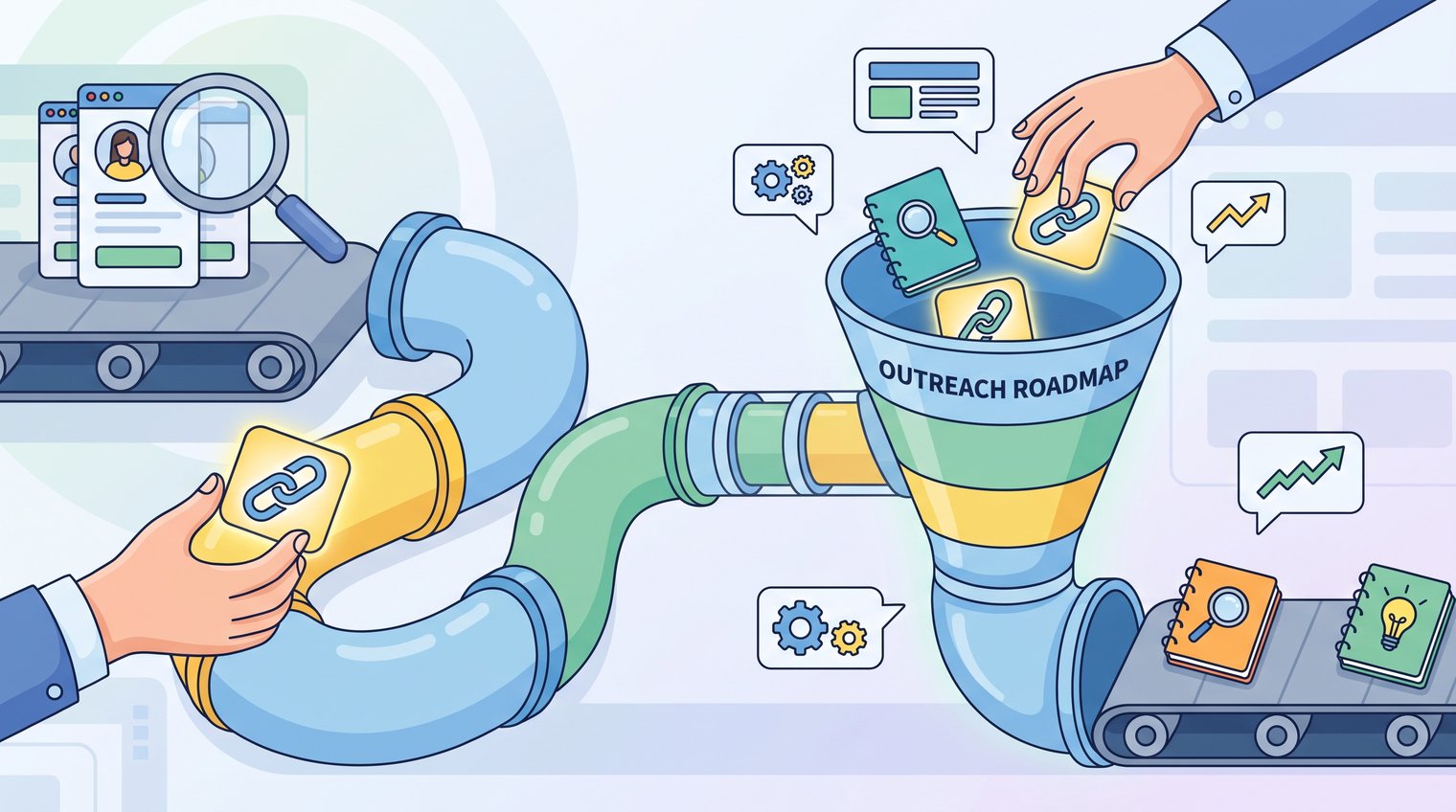
Now turn your sheet into a working pipeline. For each prospect, record the source page, editor or contact where appropriate, competitor example, target page, proposed angle, acquisition path, priority, current status, and next action. If you need a broader framework, use this SEO outreach strategy for B2B link building.
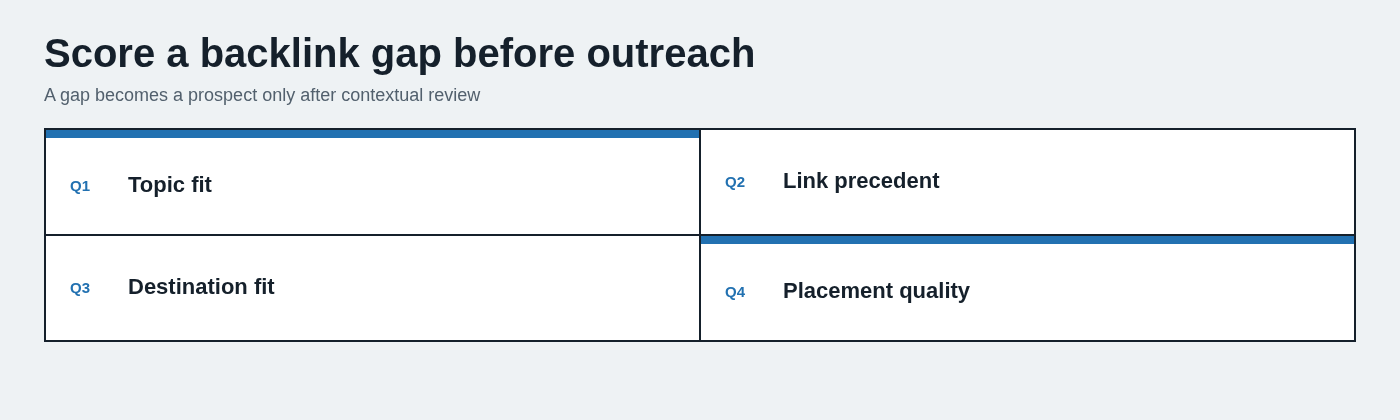
Use a simple priority model. Score each prospect on four factors: relevance to your audience, likelihood of a natural placement, strategic value of the target page, and effort required. A highly relevant page that can naturally cite your resource should usually outrank a prestigious but vague opportunity that requires a speculative pitch.
Do not let domain authority dominate the decision. It is one imperfect signal, not the goal. The best prospect is the one that can send an appropriate audience to a page that deserves the citation.
Match each prospect to one specific value proposition
Before looking for an email address, write a one-sentence outreach hypothesis: why would this page be more useful with your resource included? Keep it concrete.
Your reason might be updated data, a missing implementation detail, an original template, a more current comparison, a subject-matter contribution, or a relevant partnership. For example: "This guide explains how to choose a CRM but does not cover handoff workflows; our implementation checklist gives sales and customer success teams a usable sequence for that step."
If you cannot write a specific hypothesis, the prospect is probably not ready for outreach. Generic requests for "a valuable backlink" are not editorially credible.
Improve the target page before you ask for links
Competitor analysis often reveals that your real weakness is the destination page. The competitor may be earning citations because its page is more complete, current, easier to skim, or supported by an original asset that gives writers something worth referencing.
Before outreach, check that your target page:
- Matches the search intent behind the keyword cluster
- Offers firsthand evidence, original data, examples, or a genuinely useful template where possible
- States its unique contribution clearly near the top of the page
- Uses headings, tables, and short sections that make the content easy to cite
- Loads properly, is indexable, and is available without technical barriers
Do not ask a publication to link to a page simply because it covers a related keyword. Give its readers a resource that improves the existing article.
Run outreach that references context without copying competitors
A strong outreach note is short and anchored in the prospect's page. Start with a relevant observation, identify a reader-facing gap or update, point to the specific resource that addresses it, and end with a low-friction close.
For example, your internal structure might be: mention the section you read, explain the missing detail or outdated element, share the exact page and why it helps, then invite the editor to review it. The message should stand on its editorial usefulness, not pressure or flattery.
Avoid deceptive edits, paid undisclosed editorial links, irrelevant anchor requests, and bulk templates sent without page-level review. Those shortcuts damage relationships and create a fragile backlink profile.
Use competitor examples for research, not as leverage
Keep competitor links private. They are useful because they show a publication's citation standards and the resource types it values. They are not a reason to tell an editor, "You linked to our competitor, so you should link to us."
A weak pitch says, "We noticed you linked to another company. Please add our link too." A context-led angle says, "Your workflow section covers selection criteria but not implementation handoffs. We published a practical checklist for that step, including examples for B2B teams." The second approach respects the editor's audience and gives them a reason to consider the resource.
Track placements, backlink changes, and target-page impact
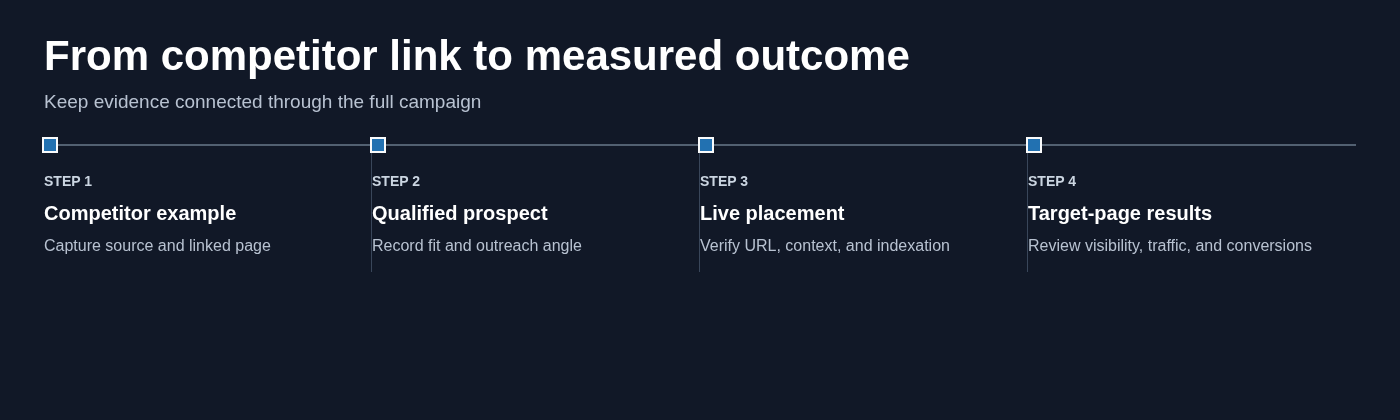
Research is not complete when a link goes live. Record the live placement URL, anchor and surrounding context, target page, date secured, follow status, and a review date. Verify that the page is accessible and indexed after publication.
Monitor for link loss, redirects, content changes, or a page dropping from the index. Then review target-page performance over time: impressions, rankings, organic visits, relevant referral traffic, assisted conversions, and conversion activity where your analytics setup supports it.
Measure impact at the target-page level
Domain-level authority movement is too indirect for useful campaign reporting. Group earned placements by the page they support and compare that page's performance against a pre-placement baseline. This helps you see whether the pages receiving relevant links are gaining visibility and attracting the right audience.
Be careful with attribution. Rankings and traffic move for many reasons, including content changes, technical fixes, seasonality, and competitors' activity. Report contribution signals and trends rather than claiming that one backlink caused a specific ranking increase.
Avoid the competitor backlink analysis mistakes that waste outreach time
The most expensive mistake is exporting every competitor link and treating the resulting list as an outreach plan. It wastes research time and encourages generic pitching. Filter by topic, linked page, placement context, and realistic acquisition path first.
Other common errors include chasing irrelevant high-metric domains, copying competitor anchors, contacting publications before improving the target asset, and treating every lost competitor link as an opening. A lost link may reflect an outdated page, a broken relationship, a removed campaign, or a source that is not worth replacing.
The best backlink strategies for B2B and SaaS companies are selective. They prioritize editorial relevance, durable audience value, and pages that genuinely deserve to be cited over raw link counts.
Use competitor intelligence to build a repeatable link pipeline
Competitor backlink analysis is not about replicating every link in someone else's profile. Its value is in identifying validated patterns: the pages that earn citations, the audiences behind them, the assets that attract attention, and the publications that have a reason to care.
Use those patterns to improve your content, qualify a smaller prospect list, and run outreach with a clear editorial rationale. Over time, the spreadsheet becomes more than a one-off gap report; it becomes a repeatable pipeline for building authority around your most valuable pages.
Teams that need help turning qualified competitor gaps into transparent, white-hat outreach can explore LinkHandy's backlink services.