
A contextual link insertion outreach email should ask an editor to improve an existing article with a resource that genuinely helps its readers. The best pitch is not "please give us a backlink." It is a short, evidence-based editorial suggestion tied to one page, one section, and one clear reader benefit.
That distinction matters. Publishers can spot generic link building outreach immediately, and most will ignore it. A useful proposal, however, gives them a quick reason to consider an update without creating unnecessary editorial work.
What a contextual link insertion outreach email should do
A contextual link insertion email should identify a relevant existing article, point to an exact place where additional information would help, and offer a credible resource to support that point. The request should be easy for an editor to verify in a minute or two.
This is a content-improvement proposal, not a generic request for a link. Instead of leading with your company's SEO goals, lead with the article's audience and explain why the proposed resource belongs in that specific context.
Contextual insertions differ from other outreach approaches:
- Guest post outreach proposes new content for a publisher's site and often forms part of broader blogger outreach services.
- Broken link outreach identifies a dead resource and suggests a replacement.
- Resource page outreach asks to be included in a curated collection of links.
- Contextual link insertion outreach suggests a useful addition within an already published article.
The last approach succeeds or fails on relevance. If you cannot identify a natural placement and explain the editorial value without stretching the argument, it is probably not a good prospect.
The contextual link insertion outreach email template
Use this template as a starting point, then customize every field with page-level research. The brackets are not decorative; each one should contain information that proves you read the target article.
Subject: Quick suggestion for {{article_title}}
Hi {{first_name}},
I was reading your article, "{{article_title}}," and noticed the section on {{specific_section}}.
You mention {{specific_point_or_sentence}}, but readers looking for {{reader_next_step}} may benefit from a more detailed resource. We published {{your_resource}}, which covers {{relevant_topic}} and may be useful as a supporting reference.
Would you consider adding it where you discuss {{specific_section}}? The editorial reason is straightforward: {{editorial_reason}}.
No problem if it is not a fit for your update priorities or editorial policy.
Thanks,
{{your_name}}
{{company}}
The most important line is the editorial rationale. "It is relevant to your readers" is not a rationale. "Your article explains how to audit referral sources but does not show how to assess referring-domain quality; this guide provides the evaluation criteria readers need for that next step" is.
Subject lines should be specific without sounding manufactured. Try one of these angles:
- Relevance: Supporting resource for your {{topic}} section
- Update suggestion: Small update idea for {{article_title}}
- Specific page reference: Suggestion for your {{topic}} guide
Short version for a highly specific placement
A shorter email can work when the page, placement, and resource fit are unusually obvious. Brevity is effective only when the research is concrete, not when the personalization is a superficial compliment.
Subject: Addition for your {{specific_section}} section
Hi {{first_name}},
In "{{article_title}}," the section on {{specific_section}} explains {{what_the_article_covers}}. A supporting resource on {{your_resource_topic}} may help readers with {{next_step_or_question}}.
Our guide, {{your_resource}}, covers {{specific_value}}. Would you consider adding it near "{{nearby_phrase_or_concept}}"?
Thanks for considering it,
{{your_name}}
This version is typically 70 to 100 words. It works because it lets the editor immediately compare the proposed resource with the surrounding article context.
Why this template works for publishers
Editors assess link insertion requests through a practical lens: Does the resource fit the topic? Is it accurate and credible? Will it help readers? How much work will reviewing and adding it require? Can they trust the sender?
Most weak backlink outreach templates focus on the sender's desired outcome: better rankings, more authority, or a reciprocal arrangement. Those are not editorial reasons to alter a live page. A publisher has little incentive to update an article unless the change improves the content or supports a legitimate commercial arrangement they are willing to consider.
A strong pitch reduces uncertainty. It names the page, points to the relevant context, describes the resource honestly, and makes one modest request. The editor can accept, decline, or ask a question without deciphering a broad sales message.
Even a relevant request may be declined. Some publishers do not add external links after publication, use nofollow attributes for contributed references, require payment for sponsored placements, or simply do not have time to revisit older articles. A decline does not automatically mean the outreach was poor.

How to personalize every field without sounding automated
Personalization should prove relevance, not imitate familiarity. A repeatable process is more reliable than trying to make every email sound unusually friendly.
- Find a page that overlaps with your resource's actual subject.
- Read the relevant section and identify a sentence, missing step, or incomplete explanation.
- Assess whether your destination page provides substantive help rather than a loosely related mention.
- Write one sentence explaining why the addition helps that article's audience.
Avoid empty praise such as "I loved your excellent article" unless you follow it with a precise observation. Also avoid vague statements like "our guide would be a great fit." Editors have seen that sentence thousands of times.
Generic: "Your post on SEO was great. Our article would be a perfect fit for your audience."
Evidence-based: "Your section on evaluating link opportunities covers domain metrics, but it does not address topical relevance or natural placement context. Our guide adds those qualitative checks for readers deciding whether an opportunity is worth pursuing."
The second version does not need excessive flattery because the relevance case does the work. It also gives the editor a clear reason to inspect the suggested page.
How to evaluate contextual link insertion opportunities before emailing
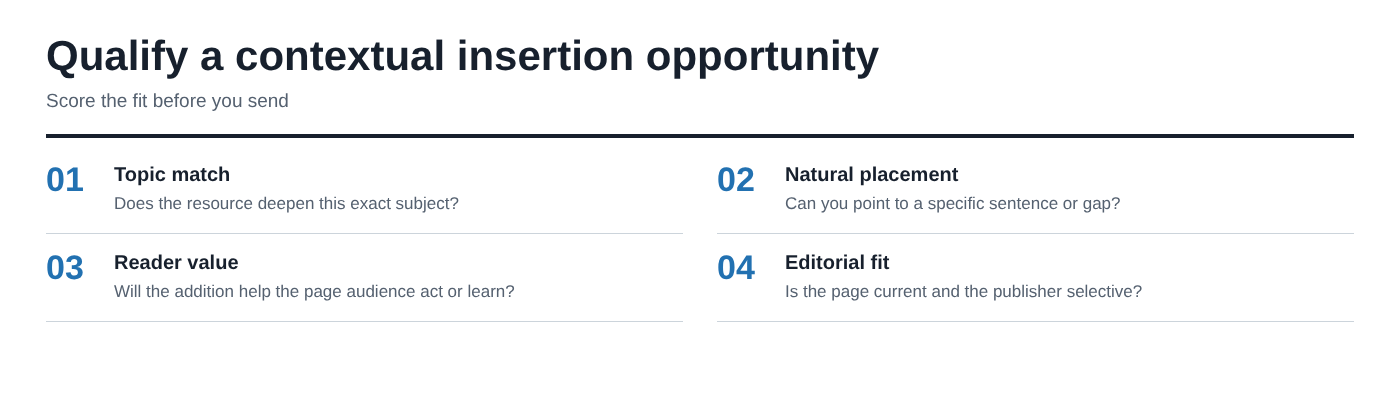
Not every article that mentions a related keyword is a contextual insertion opportunity. Qualify the prospect before writing the email, or you will spend time trying to justify placements that never made editorial sense.
Start with topic and audience alignment. A B2B SaaS guide about SEO may be relevant to a link-building resource; a broad entrepreneur roundup mentioning SEO once usually is not. The destination page should deepen the exact subject under discussion, not merely share an industry label.
Then look for a natural placement. Can you identify a sentence that would support a useful reference, or a gap that the resource fills? If you have to request an entirely new paragraph to manufacture relevance, the editorial friction is likely too high for a simple insertion.
Also consider whether the page appears maintained, whether the publisher is credible and selective, and whether the article has competing commercial intent. A vendor comparison, for example, may not be an appropriate place to pitch another vendor's promotional resource, even when the topic overlaps. These are the same quality checks teams should apply when evaluating link placement services.
Reject poor-fit opportunities. A smaller, well-qualified prospect list will generally produce better conversations than a large list built on keyword similarity alone.
Write the request around a specific editorial improvement
A persuasive request makes the proposed improvement concrete without trying to dictate the publisher's editorial decisions. Name the relevant section, describe the concept your resource supports, and explain the benefit to readers.
For example, instead of asking for an exact-match anchor text such as "best contextual link building service," suggest the broader concept: "a reference on evaluating contextual link opportunities." This gives the editor room to choose wording that fits their style and protects the natural flow of the article.
Describe your resource in useful terms. Say what it helps readers understand, compare, calculate, or complete. Do not claim it is "the definitive guide," "the best resource," or a source of results you cannot substantiate.
One simple ask is enough: would they consider adding the resource near a specified section? A publisher may decide the appropriate anchor wording, link attribute, or placement based on their own policy. Trying to control all three in the first email makes the request feel transactional.
Contextual link insertion email examples for common situations
The basic logic stays the same across situations: identify an existing context, explain the reader benefit, and make a low-friction suggestion. What changes is the reason an editor might see value in updating the page.
When the existing article has a clear information gap
This works when an article introduces a topic but leaves readers without help on the next practical step.
Subject: Supporting resource for your backlink evaluation section
Hi {{first_name}},
In your guide to off-page SEO, you explain why backlinks matter and briefly mention evaluating potential referring domains. The article does not go deeper into how readers can judge whether a placement is topically relevant and naturally contextual.
We published a guide covering those evaluation criteria. Would you consider referencing it in that section as a next-step resource for readers assessing link opportunities?
Best,
{{your_name}}
The key phrase is "as a next-step resource." It connects the proposed page to a specific reader need that the current article introduces but does not fully address.
When the publisher cites an outdated or thin source
Use this approach carefully. The goal is not to criticize the publisher's content or displace a source simply because you want a link. It is to suggest a materially more current or useful supporting reference.
Subject: Possible updated reference for {{article_title}}
Hi {{first_name}},
I noticed that your {{specific_section}} section links to a resource published in {{year}}. It still provides helpful background, but readers looking for a more detailed explanation of {{specific_topic}} may benefit from an additional current guide.
Our resource covers {{specific_scope}} and includes {{substantive_element}}. If you are updating the article, would it be useful as an added reference near the existing discussion?
Thanks,
{{your_name}}
Do not use this angle when the existing citation remains authoritative, when your content is only marginally newer, or when the update does not materially improve the reader experience. "Newer" alone is not a persuasive editorial argument.
When a relevant resource would strengthen a list or toolkit
Curated lists require a higher bar because publishers are protecting the usefulness of the collection. Your email should show that you understand the list's audience and inclusion criteria.
Subject: Resource suggestion for your {{toolkit_or_list_name}}
Hi {{first_name}},
Your {{toolkit_or_list_name}} is aimed at {{audience}}, especially readers trying to {{goal}}. I wanted to suggest {{your_resource}}, a practical guide focused on {{specific_problem}}.
It may be useful alongside the resources in your {{relevant_category}} section because it helps readers {{specific_outcome}}. Would you be open to reviewing it for inclusion?
Best,
{{your_name}}
Do not present inclusion as expected or guaranteed. A well-run resource list is selective, and a respectful pitch gives the editor every reason to maintain that standard.
Follow up once or twice without turning a useful pitch into spam
Follow up, but do it sparingly. A reasonable operating pattern is one short follow-up after roughly five to seven business days, followed by a final close-the-loop note about a week later if the opportunity is especially strong.
The first follow-up should restate the page-specific value rather than resend a long version of the original email.
Hi {{first_name}},
Just following up on my suggestion for the {{specific_section}} section of "{{article_title}}." The resource may help readers who need guidance on {{reader_need}} after your introduction to {{topic}}.
If it is not a fit, no worries at all.
A final note can be even shorter: "I will close the loop here. Thanks for considering the suggestion, and please feel free to keep it on file for a future update." There is no need to keep checking in after that.
Stop when there is no reply after your planned sequence, the publisher rejects the request, a policy conflict becomes clear, or you cannot defend the relevance case. Persistence does not turn a weak opportunity into a good one.
Mistakes that cause contextual link insertion pitches to be ignored
Most ignored pitches increase an editor's effort or reduce trust before the editor has even reviewed the resource. The following mistakes are especially costly:
- Mass-mail signals: Generic greetings, copied compliments, and references that do not match the recipient's site suggest the email was not researched.
- Irrelevant destination pages: A broad topical overlap is not enough. The proposed resource must help the readers of that exact article.
- No placement context: Asking for a link without naming a section leaves the editor to do all the reasoning and placement work.
- Overlong explanations: A publisher does not need a company history or a full SEO strategy to assess a small content update.
- Manipulative anchor-text demands: Insisting on commercial exact-match language makes the request look like a ranking play rather than an editorial suggestion.
- False urgency: Claims that a link is urgently needed, time-sensitive, or mutually beneficial without evidence undermine credibility.
Before sending, run a quick check:
- Is this the correct recipient for the page?
- Did you verify the target URL and the destination URL?
- Are all claims about the resource accurate?
- Did you identify an exact section, sentence, or information gap?
- Is the reader benefit clear in one sentence?
- Did you make one simple request?
Use the template as a research-led editorial pitch
A contextual link insertion outreach email template is useful only when the qualification behind it is real. The template gives your message structure, while the page-level research, honest relevance case, and respect for editorial standards are what earn a response. A broader SEO outreach strategy can help teams apply the same principles consistently across prospecting and follow-up.
Think like the editor receiving the email: would this addition make the article more useful, and is the request easy to evaluate? If the answer is not clearly yes, choose a better prospect rather than forcing the pitch.
Teams that need help finding qualified publishers and managing transparent contextual placements can explore LinkHandy's link-building services.