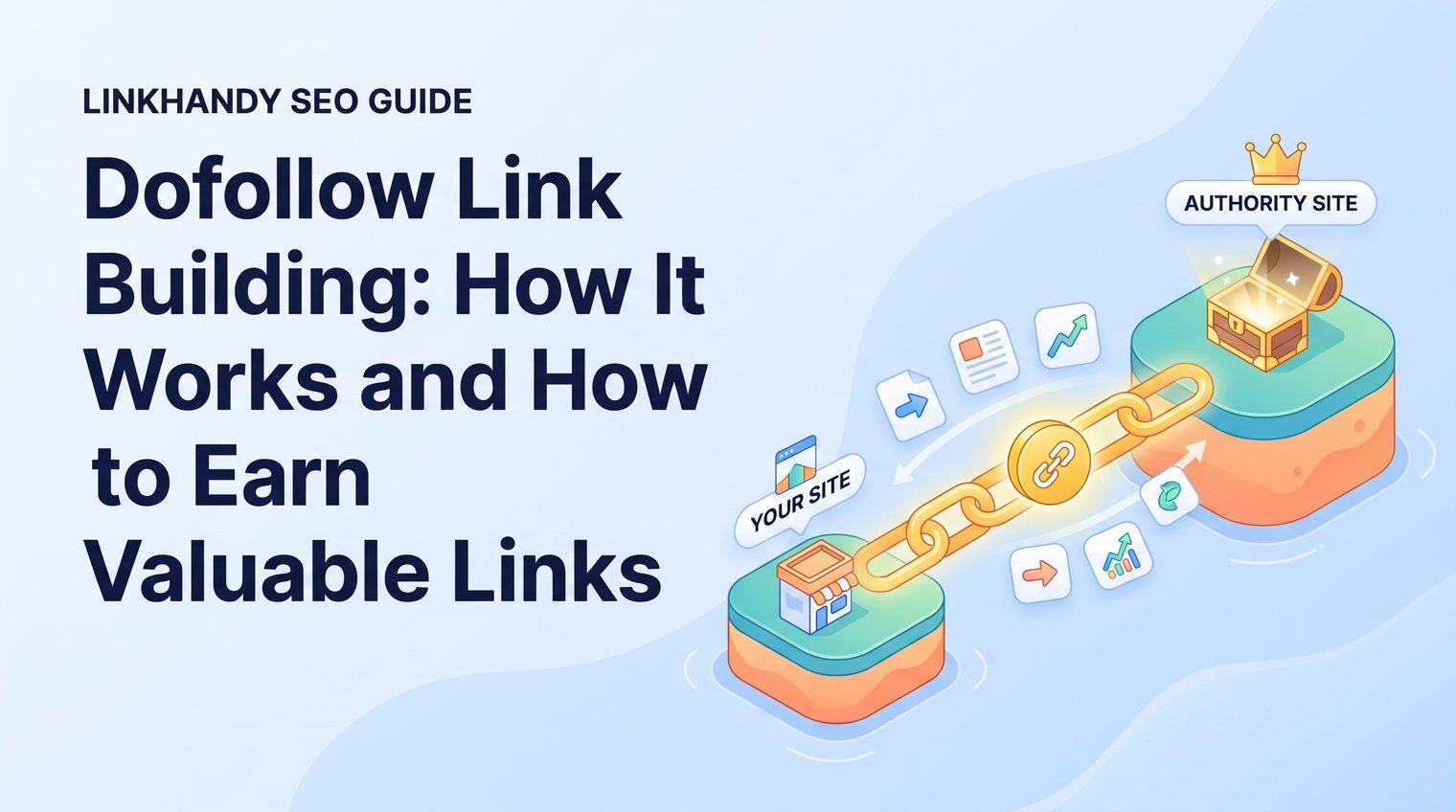

Dofollow link building means earning standard editorial hyperlinks that do not carry nofollow, sponsored, or ugc instructions. These links can contribute useful search signals, but a dofollow attribute alone does not make a backlink valuable or guarantee a ranking improvement.
Link building is part of SEO, yet the best approach is not to chase a label. Focus on earning relevant, well-placed citations from credible publications where the link genuinely helps the reader understand a topic or take the next step.
Dofollow link building: the direct answer
"Dofollow" is industry shorthand, not an HTML attribute publishers add to a link. A normal hyperlink is simply a standard link without a rel="nofollow", rel="sponsored", or rel="ugc" value.
Search engines may crawl those links, discover pages through them, and use them as one of many signals when evaluating pages and websites. But dofollow backlinks are not fixed authority transfers. Google can decide how much weight a link deserves, if any, based on the page, its context, and the broader link profile.
That distinction matters. A relevant editorial mention in a respected B2B publication is usually more worthwhile than a standard link placed on an unrelated site built primarily to sell links.
How dofollow links work in search
Search engines use links to find content and understand relationships between pages. When a reputable article links to a useful resource, that connection can help a search engine discover the destination and assess how it fits within a topic.
That does not mean every link is a literal vote or that every standard link passes the same amount of value. Search engines evaluate the surrounding content, the source page's quality, the destination, the anchor text, and whether the placement appears editorially justified.
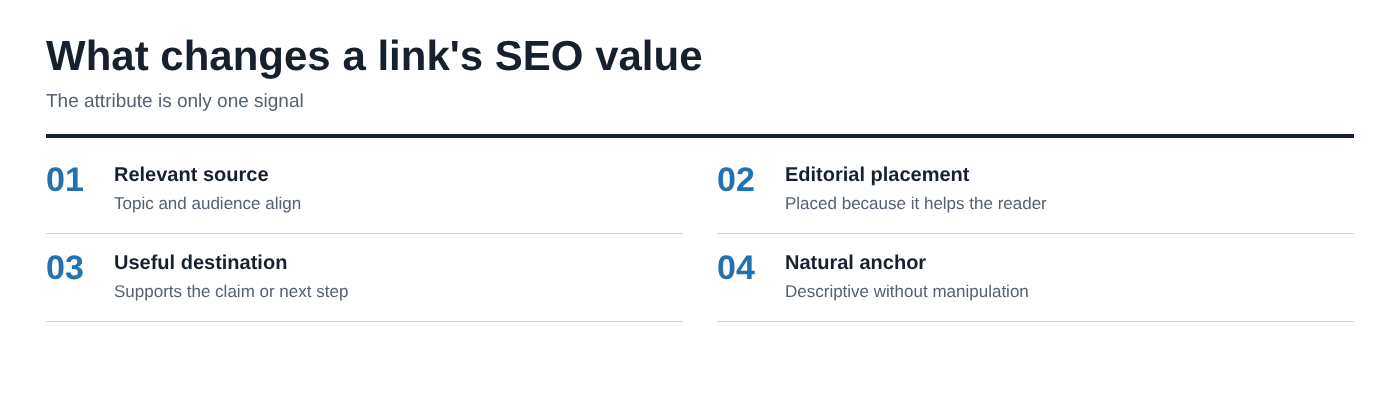
The links most likely to be useful tend to share a few characteristics:
- Topical relevance: The source page covers a subject related to the destination page.
- Editorial placement: An editor or writer included the link because it improves the content.
- Source quality: The site has a real audience, credible content, and reasonable editorial standards.
- Destination-page fit: The linked page directly supports the reader's likely question or need.
- Natural anchor text: The wording describes the resource without looking forced or repetitive.
A dofollow link example
A standard editorial link might look like this:
<a href="https://example.com/saas-benchmark-report">SaaS benchmark report</a>
There is no dofollow attribute because none is needed. In practical terms, this is what people usually mean by a dofollow link.
Now compare it with a nofollow link:
<a href="https://example.com/saas-benchmark-report" rel="nofollow">SaaS benchmark report</a>
The destination is the same, but the publisher has added an instruction describing how it wants search engines to treat the relationship. The presence or absence of that attribute is useful information, but it is not the complete measure of SEO value.
Dofollow, nofollow, sponsored, and UGC links
Link attributes provide context. They are not a simple switch that determines whether a backlink matters or does not matter.
| Link type | What it generally communicates |
|---|---|
| Standard link | No special rel instruction is present. This is commonly called a dofollow link. |
| rel="nofollow" | The publisher does not want to endorse the destination in the conventional way. |
| rel="sponsored" | The link is connected to advertising, sponsorship, compensation, or another commercial arrangement. |
| rel="ugc" | The link appears in user-generated content, such as a forum post or comment. |
When a site sets links to nofollow, it is usually signaling editorial caution. The publisher may not have reviewed every external destination closely enough to endorse it, or it may apply a blanket policy to contributor links, comments, directories, or certain resource mentions.
A healthy backlink profile can contain all of these link types. Nofollow links can still send qualified visitors, build brand awareness, support relationships, and put your company in front of writers who may cite you elsewhere. Do not pressure publishers to remove appropriate disclosures merely to obtain a followed link.
When nofollow, sponsored, and UGC are appropriate
Sponsored is appropriate for paid placements, advertising, and compensated promotions. UGC fits links published by users in comments, communities, or forums. Nofollow may be used when a publisher references an external resource without wanting to provide a conventional endorsement.
Trying to convert a paid placement into an undisclosed dofollow link is a poor strategy. It can conflict with search engine guidelines, put publishers in an awkward position, and create a link profile that looks engineered rather than earned.
What makes a dofollow backlink valuable
The most powerful backlink is not automatically the one from the site with the highest third-party authority metric. Those metrics can help with initial research, but they are not a substitute for editorial judgment.
A strong link comes from a page that is relevant to your audience, contains useful content, is accessible to search engines, and provides a logical reason to click through. In-content links are often more meaningful than isolated author-bio or sitewide links because they appear within the discussion they support.
For example, a cybersecurity SaaS company earning a contextual citation in an article about security compliance may gain more from that placement than from an unrelated mention on a broad entertainment site with stronger-looking metrics. The relevant article reaches the right readers and gives the link a clear topical purpose.
Before pursuing a placement, ask whether the linked page deserves to be there. If the answer is unclear to a human reader, the opportunity is probably weaker than it first appears.
How to earn valuable dofollow links without manipulating the attribute
The practical goal is an earned contextual citation. Build something useful, identify publications with a legitimate reason to reference it, and make a contribution that improves their content. Whether the publisher leaves the link as a standard link remains an editorial decision.
Create pages people can cite
Writers need sources that make their work better. The most linkable pages usually provide evidence, clarity, or utility that is difficult to replace with a generic blog post.
- Original surveys, benchmark reports, or first-party data
- Expert-led frameworks that solve a specific operational problem
- Templates, calculators, checklists, and implementation guides
- Clear product documentation or technical explainers
- Differentiated comparisons that explain tradeoffs fairly
As a link-building example, a B2B SaaS company might publish benchmark data on how mid-market teams adopt a new workflow. An industry publication discussing that trend can cite the findings as evidence, linking readers to the underlying research rather than to a generic product page.
Find relevant publications and resource gaps
Good link-building websites are not simply domains with impressive metrics. They publish content for an audience you want to reach, cover subjects connected to your expertise, and demonstrate real editorial care.
Review recent articles before you pitch. Look at the depth of coverage, the authors involved, the sources they cite, and whether their outbound links are selective and relevant. You are looking for a resource gap: a claim that needs data, a topic that deserves expert input, or a guide that would benefit from a more useful supporting resource.
Pitch a contribution that improves the publisher's page
The strongest outreach is specific. Offer a credible expert quote, a data point with methodology, a thoughtful guest-post angle, or a resource that directly substantiates a claim in an existing article. A focused SEO outreach strategy for B2B link building can help organize that process.
Avoid generic guest-post emails, demands for exact-match anchor text, and requests to add your link to unrelated articles. Those tactics create work for editors without giving them a defensible editorial reason to say yes.
Instead of asking, "Can you add our link?", explain the contribution: "Your guide notes that teams struggle to measure onboarding time. We published anonymized benchmark data across 200 implementations that may help support that section." The difference is substantial.
Build partnerships that produce repeatable citations
Long-term link acquisition works best as relationship building, not one-off transactions. Content partnerships, expert networks, digital PR, and editorial guest posts can create repeatable opportunities when both sides contribute useful ideas and maintain transparency.
A managed link building service should preserve that standard. LinkHandy works with SaaS and B2B teams on relevant prospects, contextual placements, editorial guest posts, and authority strategy while allowing clients to review prospects and outreach direction before placements go live.
That is fundamentally different from buying undisclosed dofollow placements at scale. The first approach is built around relevance and approval; the second treats links as inventory.
A practical workflow for evaluating link opportunities
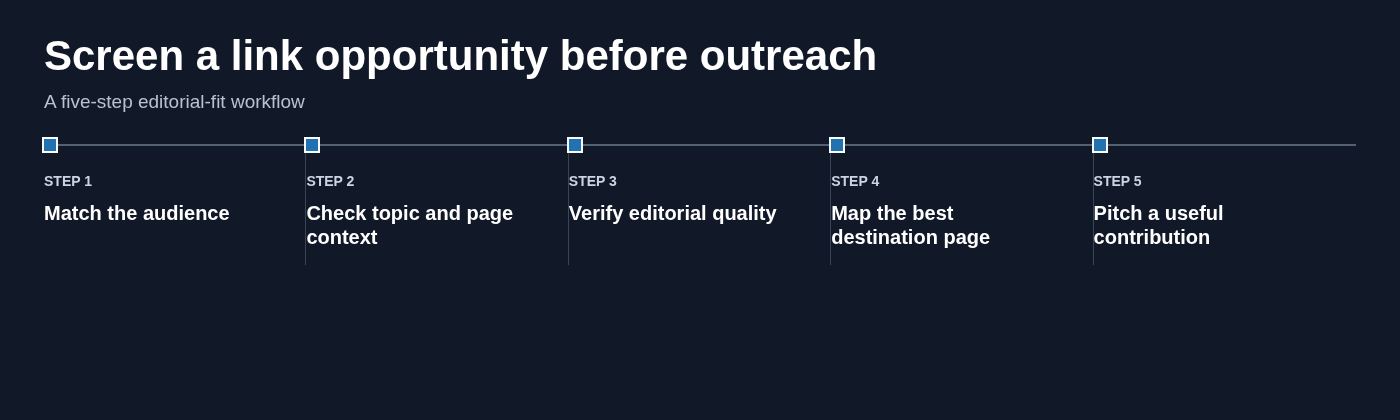
Screen opportunities before outreach. This prevents your team from spending time on irrelevant sites, weak content, or placements that cannot reasonably serve your readers or SEO goals.
- Match the audience: Would this publication reach potential customers, influencers, or credible industry peers?
- Check topic and page context: Is there a natural article, section, or proposed topic where your resource belongs?
- Verify editorial quality: Review recent publishing, author attribution, source use, and whether the site appears maintained for real readers.
- Map the best destination page: Choose the page that most directly answers the likely reader question. Do not default every time to a homepage.
- Pitch a useful contribution: Lead with evidence, expertise, or a content angle the publisher can reasonably use.
If an opportunity has an audience mismatch, irrelevant context, or requires an undisclosed paid placement, stop there. Treat domain-level metrics and referral potential as secondary signals.
How to check whether a backlink is dofollow
You can inspect a link through your browser's developer tools or by viewing the page source. Developer tools may show the live DOM, while page source shows the original HTML, so check both if the result is unclear. Find the relevant <a> element and check whether it contains a rel attribute.
If the anchor has no rel attribute, it is generally a standard link. If it includes rel="nofollow", rel="sponsored", or rel="ugc", the publisher has provided that context. Multiple values can appear together, such as rel="sponsored nofollow".
Do not overinterpret what you find. A standard link does not prove it will influence rankings. The linking page still needs to be crawlable and indexed, the destination needs to be accessible, and search engines still evaluate the quality and relevance of the relationship.
Common dofollow link-building mistakes to avoid
Most weak link-building campaigns fail because they optimize for the visible attribute rather than the quality of the placement.
- Paying for undisclosed followed links: This creates guideline risk and often leads to low-trust placements.
- Prioritizing metrics over relevance: A high-scoring but irrelevant domain may deliver little referral value or topical support.
- Forcing exact-match anchors: Repetitive commercial wording can look unnatural and makes editors less likely to accept the placement.
- Scaling low-quality guest posts: Thin, interchangeable articles rarely build authority with readers or publishers.
- Treating nofollow links as worthless: You may miss referral traffic, brand visibility, and relationships that lead to future editorial coverage.
Track outcomes beyond raw link counts. Watch referral traffic, organic performance of the linked page, assisted conversions, the quality of referring sites, and whether the relationship can support future content opportunities.
Build links worth citing, not just links labeled dofollow
Standard editorial links can support SEO, but their real value comes from relevance, credibility, and usefulness. The best dofollow link-building strategy is therefore simple: create pages worth citing and earn placements where that citation genuinely improves the publisher's content.
For B2B and SaaS teams that need transparent, editorially focused link acquisition, explore LinkHandy's approach to authority strategy and contextual placements.