
A contextual link insertion can look excellent in a spreadsheet and still be a poor SEO decision. A high authority score, a recognizable publisher, and a dofollow attribute do not matter much if the link is bolted into an irrelevant paragraph that no real reader would click.
The strongest opportunities connect an existing article, a specific reader need, and a destination page that genuinely adds something. This guide shows how to evaluate contextual link insertion opportunities before approving a placement, with a process your SEO team can repeat and defend.
Start with the destination page and the job the link must do
Do not begin by browsing publisher lists. Start with the page you want to strengthen and decide what the link needs to accomplish. A link to a product page, a comparison page, a research report, and a practical guide should each be evaluated differently.
Write down the target URL and its primary search intent. For example, a SaaS company's guide to SaaS link building may need topically relevant editorial links to build authority around the subject, while a product feature page may need placements that can send qualified referral traffic from readers actively looking for that capability.
There are usually three reasonable goals: improving topical authority, attracting referral traffic, or supporting a commercial page with a credible editorial citation. One placement can contribute to more than one goal, but forcing every opportunity to do all three is a mistake.
A seemingly strong publisher is not automatically an opportunity. If its existing article cannot naturally lead a relevant reader to your destination page, the placement is likely to feel manufactured. That creates a weak reader experience and a fragile link that may be edited out later.
Define a pass condition before prospecting
Create a short placement brief before anyone starts outreach. It should include the target URL, the page's core topic, the audience you need to reach, acceptable anchor concepts, and constraints for the insertion.
- Target URL: The exact page receiving the link.
- Topic: The subject the destination page covers in depth.
- Reader: The person who would benefit from clicking, such as an in-house SEO manager at a B2B SaaS company.
- Anchor concepts: Natural descriptive phrases, such as "contextual backlink strategy" or "link-building outreach process."
- Placement constraints: Relevant editorial content, a crawlable live page, and a paragraph where the resource adds practical value.
For instance, if the destination is a guide on evaluating backlink opportunities, a useful host article might cover off-page SEO planning, editorial link building, or backlink quality. A general marketing trends post with no connection to link evaluation is not a fit merely because the publisher has a high domain-level metric.
Common mistake: approving targets solely because of Domain Rating, Domain Authority, or a similar aggregate score. These figures can be useful comparison signals, but they cannot tell you whether a particular article has a relevant audience, a healthy page, or a logical insertion point.
Confirm that the existing article is genuinely contextually relevant
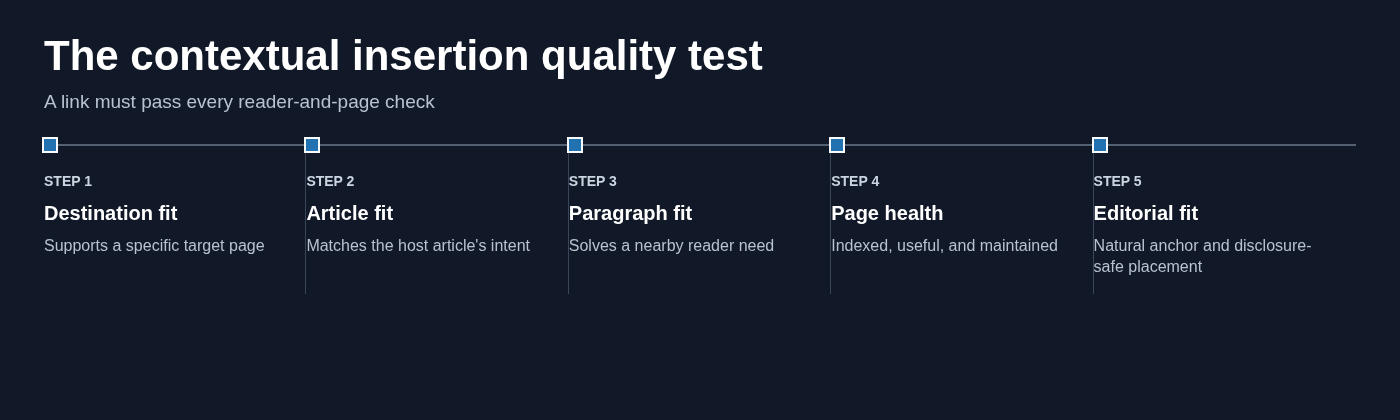
Contextual relevance has three layers: the publisher's overall focus, the host article's topic, and the exact paragraph where the link would appear. All three matter.
A B2B publication may be broadly relevant to your company, but its article about employee onboarding may not be an appropriate place to cite a guide about technical SEO. Conversely, a broader business publication can be a strong fit when an article or section clearly serves the audience you want to reach.
Look for articles that already address an adjacent question your destination page expands on. If the host article tells readers to assess backlink quality but does not explain how to review an insertion placement, a link to a detailed contextual link insertion outreach email template can provide a useful next step.
Look for a real information gap the target page can fill
The best insertion addresses a gap that already exists in the article. Read the full post, not just the suggested paragraph, then ask what the reader still needs after reaching that section.
A useful destination may add a definition, a practical method, a template, original data, an example, or a more detailed next action. For example, an article may mention that backlinks should be relevant, while your linked page explains how to evaluate publisher, article, paragraph, and anchor-level relevance before approving a placement.
Reject placements where the target page merely repeats what the host article has already explained. If the article already provides a complete checklist for assessing backlinks, inserting a link to another checklist adds little value unless your resource offers a distinct angle or deeper evidence.
Contextual backlinks are simply links placed within relevant editorial content, rather than in a sitewide footer, sidebar, author bio, or unrelated directory. Their value comes from the editorial context and reader journey, not from the location alone.

Assess the placement, surrounding copy, and anchor-text fit
Once an article passes the broad relevance test, inspect the proposed placement at sentence level. Read the sentence before the insertion, the sentence that contains it, and the one after it. The link should support a continuous idea rather than interrupt it.
Check the closest heading too. A link in a section titled "How to assess editorial backlinks" has a clearer contextual relationship than the same link placed under "Social media reporting." Heading proximity does not replace paragraph relevance, but it helps confirm the reader's intent at that point in the article.
Anchor text should describe what the reader will find after clicking. Use language that makes sense in the host sentence first, then consider SEO relevance. A phrase such as "a framework for evaluating contextual link opportunities" is generally more useful than forcing an exact-match commercial term into a sentence where it does not belong.
Avoid repetitive anchor patterns across campaigns. If every placement uses the same keyword-heavy phrase, the work starts to look coordinated rather than editorial. Vary anchors based on the specific point each host article makes.
Check whether the link would survive a human edit
Use a simple test: remove the link and ask what the reader loses. If the answer is a useful resource, evidence, explanation, or next step, the placement may be justified. If nothing changes except that your company loses a backlink, the insertion is weak.
Watch for generic anchors such as "click here" or "learn more" when a more descriptive phrase is possible. Also flag abrupt product mentions, promotional claims that the article cannot support, and paragraphs that sound as though they were inserted after publication.
Editors are more likely to keep links that make their article stronger. They are more likely to remove a placement that reads like an advertisement disguised as a citation.
Evaluate the host page before relying on sitewide authority metrics
A healthy domain can contain poor pages. Evaluate the actual URL that will host the link before you give weight to domain-wide authority scores.
First, confirm that the page is indexed and accessible. Search for the URL or a distinctive title phrase, inspect the page directly, and make sure it loads normally. A page that is not indexed, redirected unexpectedly, blocked from crawling, or canonicalized to another URL is not a dependable placement.
Then assess whether the article appears useful and maintained. It does not need to be newly published to be valuable; evergreen topics often perform for years. But a post about changing platforms, regulations, or SEO practices may need recent updates to remain credible.
Page-level organic visibility, relevant keyword rankings, and an audience with a genuine reason to care can matter more than a large aggregate authority number. A focused article that ranks for a handful of commercially relevant queries may create more long-term value than an unrelated page on a much larger site.
Review page-level signs of usefulness
Look for signs that the article serves a real search or audience need. Strong pages tend to answer a specific question clearly, cover the subject with enough depth, use credible citations where needed, and connect to related content through internal links.
- Does the page appear for queries related to its stated topic?
- Does the content provide original explanation, examples, or expert perspective?
- Has the page been updated when the subject changes quickly?
- Are external links used as normal citations and supporting resources?
- Does the page have a reasonable number of outbound links for its length and format?
External links are not inherently a problem. Editorial articles often cite research, tools, and useful resources. The concern is commercial link stuffing: repeated keyword-rich links to unrelated businesses, especially when they appear across many otherwise thin posts.
Inspect technical and link attributes
Check the page's HTTP status, canonical URL, indexability, and crawlability. The ideal host page returns a 200 status, uses a self-referencing or appropriate canonical tag, and is available to search crawlers. If the publisher uses a different canonical destination, the authority and relevance signals may consolidate elsewhere.
Also confirm how the prospective link will be implemented. Depending on campaign goals, determine whether it is likely to be a standard crawlable link or marked with nofollow, sponsored, or ugc attributes.
Attributes are only one input. A relevant, credible, properly disclosed placement can still be worthwhile for referral traffic and brand visibility even when an attribute limits direct ranking signals. Conversely, a dofollow link does not rescue a poor-quality or irrelevant insertion.
Vet the publisher's quality, audience, and editorial standards
After reviewing the host page, zoom out to the publisher. You want evidence that the site exists to inform or serve a real audience, not simply to publish pages that sell links.
Review its topical focus, author pages, editorial consistency, publication quality, and original material. A credible publisher usually has recognizable subject areas, articles that sound like they were written for readers, and some consistency in how it presents bylines, sources, and updates.
Do not confuse niche relevance with an exact topical match. A publication covering business operations, B2B software, growth, or digital strategy may be appropriate for a SaaS link-building resource when the specific article and section clearly align. What matters is whether the intended audience has a plausible reason to engage.
Identify link-selling and quality-risk patterns
No single footprint proves that a publisher sells links or lacks quality. Review the pattern across several articles and document why the opportunity raises concerns.
- Large numbers of unrelated commercial outbound links in otherwise ordinary articles.
- Formulaic contributor posts that follow the same structure and promote different businesses.
- Thin, spun, or poorly edited content published at high volume.
- Implausibly broad topic coverage, such as finance, gambling, health, legal advice, and enterprise software on one loosely organized site.
- Paid placements presented as independent editorial recommendations without appropriate disclosure.
- A sudden publishing surge that does not match the site's prior editorial cadence.
A few guest contributors or sponsored articles are not automatically disqualifying. The issue is whether editorial judgment appears absent. If the site publishes nearly any topic for nearly any advertiser, a contextual insertion there carries more quality, reputation, and durability risk.
Use SEO tools to validate the opportunity, not to score it automatically
SEO tools help you corroborate a manual review. They can reveal visibility trends, referring-domain patterns, and anomalies that are hard to spot by reading a single page. They should not replace judgment about relevance, usefulness, or editorial integrity.
Use tool data to investigate questions, not to generate a blind score. A traffic decline, for example, may be a warning worth reviewing, but it can also reflect seasonal demand, a content refresh, or changes to a single cluster of keywords.
Validate relevance and visibility in Ahrefs
Use Ahrefs to examine the host page and publisher's organic keywords, estimated traffic trend, backlink profile, and competing pages. Start with the exact URL when possible, then compare it with the broader domain.
Check whether the page ranks for topic-relevant terms rather than receiving traffic from unrelated queries. Review the trend over time and look at the pages attracting the site's strongest links. If a publisher's profile is dominated by low-quality referring domains or the host page has no evidence of discovery, investigate further rather than approving automatically.
Always pair the data with the live article and search-result context. A tool can show that a page ranks; it cannot tell you whether the proposed sentence is helpful or whether the insertion sounds editorial.
Cross-check page and backlink signals in Semrush
Semrush can provide another view of organic visibility, backlinks, and referring domains. Use it to cross-check unusual patterns, such as a site with a large number of links but little visible topic relevance, or a page whose estimated visibility has changed sharply.
Review referring-domain patterns, the relevance of linking sites where available, and the type of pages generating visibility. If the data suggests an anomaly, manually inspect the pages and publisher rather than treating the estimate as a verdict.
Authority metrics and traffic estimates are comparative signals, not guarantees of editorial value. A smaller publisher with a concentrated B2B audience and a well-performing article can be more valuable than a larger site whose audience never needs your resource.
Estimate value beyond rankings: referral potential, brand fit, and durability
A contextual link should be evaluated as a real audience touchpoint, not only as an SEO input. Ask whether a reader on this page would have a credible reason to click and whether a click would introduce your brand in a useful, trustworthy setting.
Format matters. A well-ranked evergreen guide, a frequently referenced resource page, or a detailed how-to article can continue generating discovery long after publication. A short news item may offer temporary visibility but little durable value.
There is a practical trade-off here. A high-metric placement on a weakly related article might offer a number that looks impressive in a monthly report. A smaller, tightly aligned article may deliver more qualified referral traffic, reinforce topical relevance, and create a stronger brand association.
For B2B companies, consider the likely reader's role and stage of awareness. A link in an article read by SEO managers comparing outreach approaches may be more useful than one in a broad entrepreneurship post with a larger but less qualified audience.
Review the commercial terms and editorial safeguards before approval
Even an excellent prospect can become a poor deal if the terms are vague. Before approval, confirm exactly what will change on the page, who reviews the copy, and what evidence you will receive after publication. Guidance on assessing link placement services can help teams structure this review.
- What exact URL, anchor concept, and surrounding copy will be used?
- Will you review the final wording before the placement goes live?
- What are the expectations for placement permanence and replacement if the link is removed?
- Which link attributes will be applied?
- How will paid, sponsored, or commercial relationships be disclosed where required?
- Will the publisher provide the live URL and confirmation of the final placement?
Follow publisher policies and search-engine spam policies. Reject arrangements that require deceptive edits, fake editorial endorsements, hidden sponsorships, or manufactured relevance. The short-term appeal of an easy placement is not worth the risk of placing your brand on content you would not want a prospective customer to scrutinize.
A transparent process is especially important for in-house teams that need approval control. At LinkHandy, prospects and outreach pitches can be shared for client review before links or placements go live, helping teams assess fit before a commitment is made.
Score opportunities with a weighted decision sheet
A weighted scorecard keeps one attractive metric from overriding more important concerns. Give relevance and editorial quality the greatest influence, then use authority and technical signals as supporting evidence.
Score each category from 1 to 5, divide each rating by 5, multiply it by its weight, and record the evidence behind the score; because the weights total 100%, this produces a score out of 100. A simple approval threshold might be 75 out of 100, but set a non-negotiable rule too: reject any opportunity with a serious quality, relevance, or compliance concern even if its total score is high.
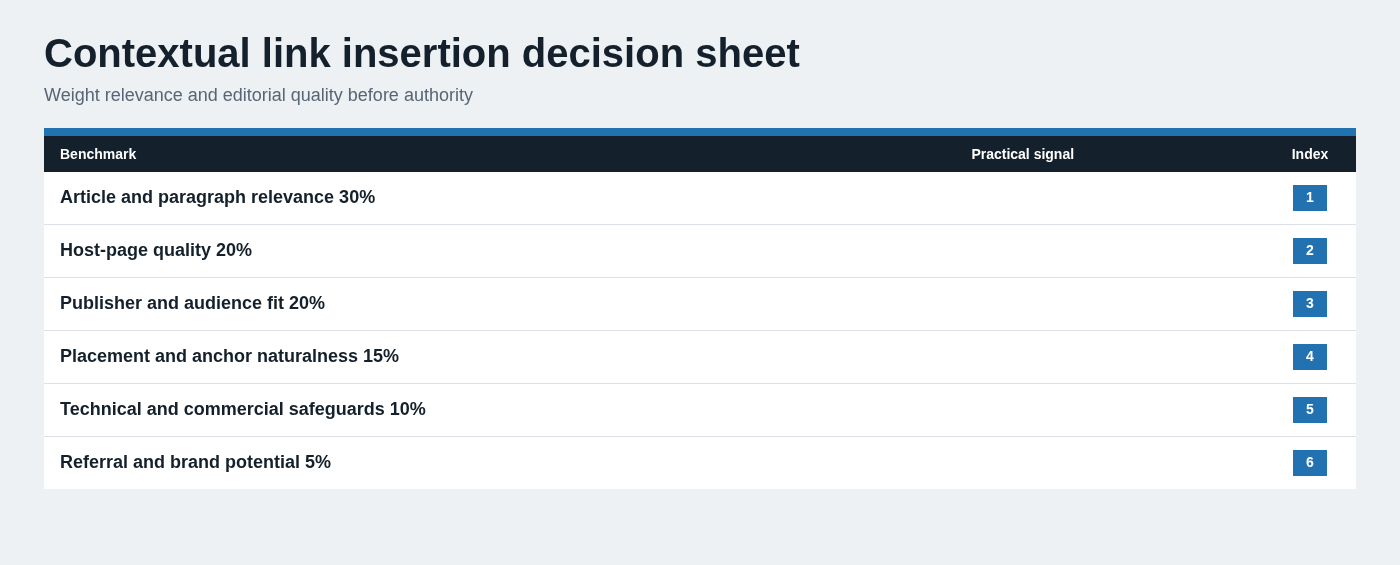
For each review, save the host URL, proposed insertion language, page-level observations, tool data, commercial terms, final score, and one clear decision: approve, reject, or investigate. Over time, this creates a useful feedback loop. Your team can compare outcomes and refine the criteria that actually identify durable placements.
Run a final pre-approval check on a real opportunity
Before giving final approval, work through the same sequence every time:
- Confirm that the destination page serves the reader need raised in the host article.
- Read the entire host article, not only the proposed paragraph.
- Inspect the heading, surrounding sentences, proposed anchor, and editorial flow.
- Check that the page is indexed, stable, useful, and technically sound.
- Review publisher quality patterns and validate key signals with SEO tools.
- Confirm the final copy, link attributes, disclosure approach, reporting, and replacement terms.
Consider two opportunities for a guide about evaluating contextual link placements. The first is an editorial article on B2B SEO that explains why relevant links matter but lacks a step-by-step evaluation process. A paragraph discussing publisher review can naturally cite the guide as a deeper resource. The article ranks for related queries, has a credible author, and the proposed anchor describes the resource accurately. That is a strong candidate for approval.
The second is a high-metric business site with an article about remote hiring. The publisher offers to insert an exact-match anchor into a paragraph that currently discusses recruiting software, even though the destination page covers link-building evaluation. The metric may be attractive, but the reader journey is broken and the insertion is forced. Reject it.
Make contextual link insertion decisions you can defend
The best contextual link insertion opportunities create a useful connection for a specific reader on a healthy, relevant page. They are not simply backlinks from domains with strong-looking metrics.
Start with the destination page, test relevance down to the paragraph, assess page and publisher quality, validate findings with data, and confirm commercial safeguards before anything goes live. That process is slower than buying a number from a list, but it produces placements that are more credible, more durable, and more likely to support meaningful organic growth.
Teams that need vetted contextual placements, transparent outreach, and approval before publication can explore LinkHandy's link-building services.