
A link placement can look impressive in a spreadsheet and still do almost nothing for your business. A high authority metric, a "dofollow" label, and a low unit price do not prove that the publisher is relevant, the article has readers, or the link belongs in its context.
That is why buying link placements is less about finding the largest inventory and more about building a repeatable way to judge opportunities. The right service should help you earn credible editorial backlinks, retain visibility into what is being proposed, and verify exactly what went live.
What link placement services are and what they should deliver
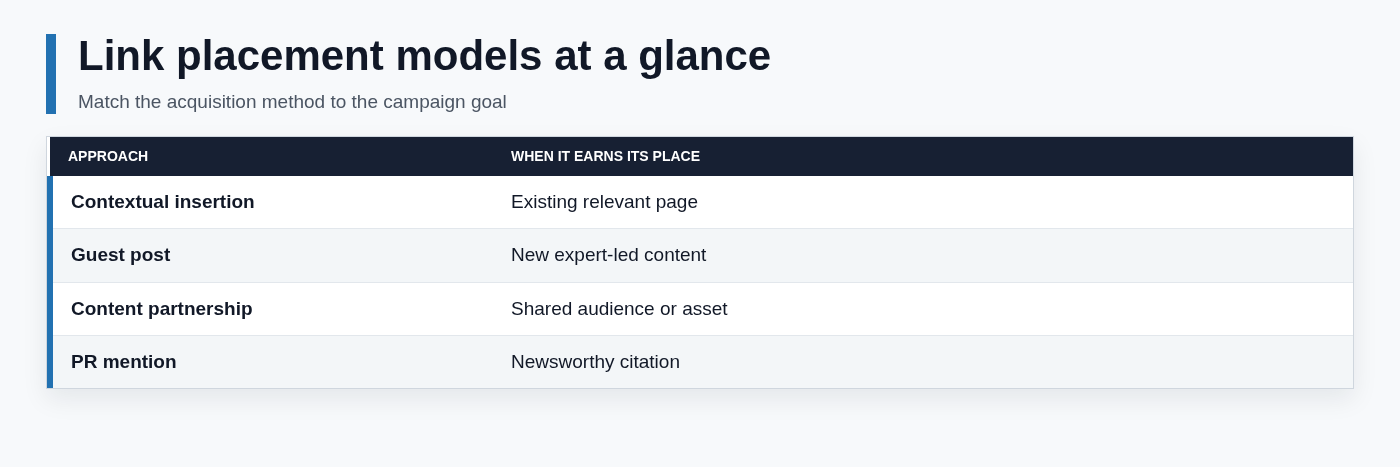
Link placement services secure backlinks on third-party websites. The placement may be a contextual addition to an existing article, an editorial guest post, a content partnership, or a PR-driven brand mention. In every case, the useful outcome is the same: a live link to a relevant page on your site, placed where the publication's readers can understand why it is there.
This is different from buying a URL metric or submitting a company website to a directory. A domain authority score can be useful for screening prospects, but it is not the product. The product is a credible, appropriately placed editorial citation that supports a real audience and a clear SEO objective.
Good link placement services make the details visible. You should be able to assess the publisher, the specific page, the intended destination, the surrounding context, the anchor language, and the final live URL. If a provider only reports a monthly link count, it is not giving you enough information to judge quality.
Quality depends on relevance, editorial context, placement, transparency, and verification. Domain-level metrics are supporting evidence, not a substitute for those factors.
Quick-start: the quality checklist before you outsource
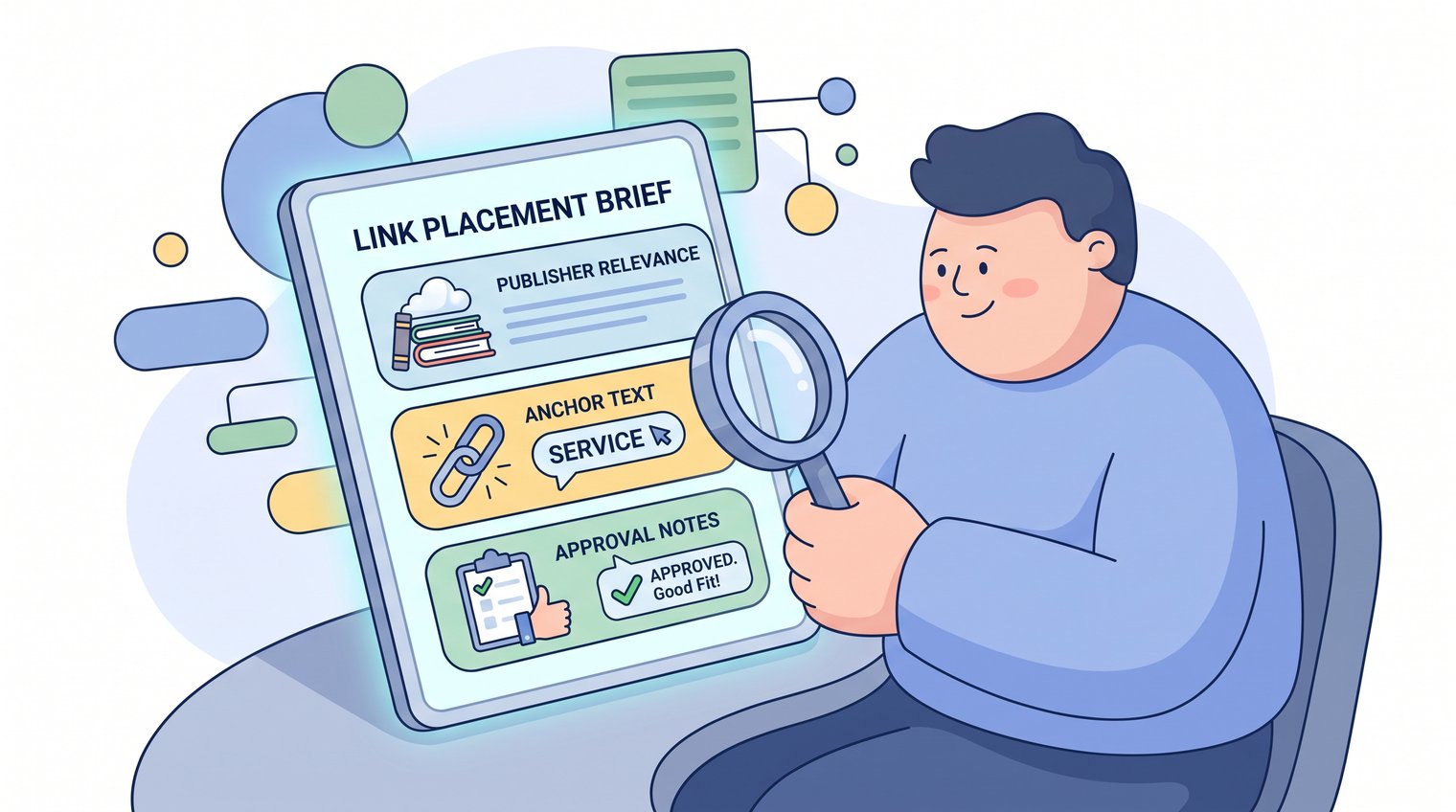
Before comparing professional managed link building services, create a minimum brief. It prevents an agency from guessing what "quality" means to your team and gives you a consistent way to compare proposals.
- Priority pages and goals: Identify the pages you want to support and whether the goal is rankings, topical authority, referral traffic, or visibility for a commercial initiative.
- Topical relevance: Define the industries, subjects, customer roles, and publication types that make sense for your brand.
- Traffic and audience fit: Decide whether the publisher's likely readers resemble your buyers, partners, or influencers.
- Editorial standards: Set expectations for useful content, author quality, page accessibility, and sensible outbound-link practices.
- Approval rights: Establish what must be reviewed before publication and what can remain under publisher editorial discretion.
- Reporting fields: Require live URLs, destination URLs, anchor text, placement dates, context, and replacement records.
- Replacement terms: Clarify what happens if a link is removed, materially changed, or delivered outside the agreed brief.
This is not unnecessary bureaucracy. It is the baseline needed to purchase link placements as a strategic SEO input rather than an opaque commodity.
Where link placements fit in an SEO strategy
Authority link building works best when it supports pages that already deserve to compete. That means the page answers a meaningful search intent, is accessible to search engines, fits a clear topic cluster, and gives visitors a reason to continue toward a product, demo, signup, or deeper resource.
For a B2B SaaS company, placements may support a product comparison page, an integration page, a solution page, or a detailed guide that has already shown signs of search demand. For a services business, they may reinforce a commercial service page and the educational content that helps buyers evaluate that service.
Link placements can contribute to several goals:
- Improving the competitive strength of priority pages in search results
- Building topical authority around a product category or customer problem
- Creating relevant referral paths from publications your buyers trust
- Supporting content-led demand generation with credible third-party citations
They cannot fix poor fundamentals. If the target page is thin, the site has indexation problems, the messaging is unclear, or the business publishes without a topical focus, more backlinks are unlikely to create durable results. Resolve those issues first, then use placements to strengthen content with a credible opportunity to perform.
The link placement service models buyers will encounter
Not all placements are acquired the same way, and they should not be evaluated as interchangeable products. A contextual insertion may be the right choice for a mature guide that already attracts readers. A guest post can make more sense when your expertise needs fuller explanation. Partnerships and PR can deliver the strongest audience fit, but often with less predictable timing.
Contextual link insertions
A contextual link insertion is an editorial addition to an existing article. The publisher updates a relevant page and includes a citation to your resource, product page, research, or guide where it genuinely improves the content.
The advantage is speed and placement on a page that may already be indexed, established, and attracting readers. The risk is superficial relevance. A link added to a loosely related article simply because it contains a matching keyword is not the same as a citation that helps the reader solve the problem discussed in that paragraph.
Review the surrounding paragraph closely. If removing your link would make no difference to the article's usefulness, the placement may be too thin to justify the investment.
Editorial guest posts
Editorial guest posts involve creating original contributor content for a third-party publication. They give you more control over the page's topic, argument, and link context, which can be valuable for specialized B2B subjects that require more than one sentence of explanation.
The standard should be a useful, standalone article that an editor would be comfortable publishing for its own audience. Avoid templated sponsored content that exists only to carry a backlink. Strong guest-post opportunities include genuine editorial review, sensible contributor guidelines, and a subject that aligns naturally with your expertise.
Content partnerships and PR mentions
Content partnerships and PR-led mentions usually start with something worth citing: original research, expert commentary, an integration announcement, a joint webinar, a useful data set, or a timely perspective on an industry issue. The resulting citation may be more natural because the publication has an independent reason to cover the item.
These approaches can produce excellent brand and audience fit, especially for SaaS companies with credible product insights or subject-matter experts. They also tend to be less predictable than a conventional placement campaign. Editorial calendars, news cycles, and the strength of the underlying story all affect timing.
What makes a link placement high quality
The strongest placements are credible to both search engines and real readers. That requires a broader standard than any third-party authority score can offer.
Topical and audience relevance
Judge relevance at three levels: the publisher, the article, and the paragraph containing the link. A cybersecurity publication may be relevant for security software, but a specific article about employee training may not be the right environment for a link to a cloud infrastructure cost calculator.
Consider a B2B SaaS company selling customer support software. A well-maintained publication for support leaders, with an article on reducing ticket backlog, can be a strong fit for a guide on support workflow automation. A general lifestyle site with a higher authority metric is not automatically more useful simply because its score is larger.
Audience fit matters for the same reason. A modest industry publication read by the people who evaluate, recommend, or buy your category can create both a meaningful citation and potential referral value.
Editorial context, placement, and link attributes
In-content links generally provide clearer context than author bios, footers, or generic resource lists. The anchor text should read naturally, and the destination should fulfill the promise made by the surrounding sentence.
For example, an article explaining how SaaS teams assess integrations could link to an integration page using language such as "the platform's CRM integration details." Linking the same sentence to an unrelated homepage would weaken the reader experience and create an obvious mismatch.
Do not treat every valuable link as one that must use a follow attribute. Follow, nofollow, sponsored, and UGC attributes communicate different relationships between the publisher and the linked page. A healthy backlink profile is not built from a single attribute, a single page type, or repetitive keyword-heavy anchors.
Publisher quality and real-site signals
Authority metrics can help you prioritize review, but manual assessment should decide whether a placement is worth pursuing. Look for signs that the website operates as a real publication or business resource:
- Recent, consistent publishing activity
- Useful articles written for a coherent audience
- Clear authorship or editorial accountability where appropriate
- Pages that are accessible and indexable
- Organic visibility that appears aligned with the publication's subject matter
- Outbound links that are selective and contextually reasonable
- A visible editorial approach rather than a stream of unrelated commercial articles
A high quality link building service should be able to explain why the site and candidate page fit your campaign. "The metrics are good" is not a sufficient answer.
Durability and risk
No agency can permanently control a third-party website. Publishers change ownership, update pages, alter linking policies, and sometimes remove or redirect content. Durable placements come from selecting stable sites with real editorial incentives to maintain useful content, not from promising permanence that nobody can guarantee.
Ask providers how they handle link losses and material changes. Reasonable terms may include a replacement process, remediation period, or a documented review of what happened. Be cautious when a site appears to exist mainly to sell placements, publishes unrelated topics at high volume, or adds commercial links to nearly every paragraph.

How approvals should work before a link goes live
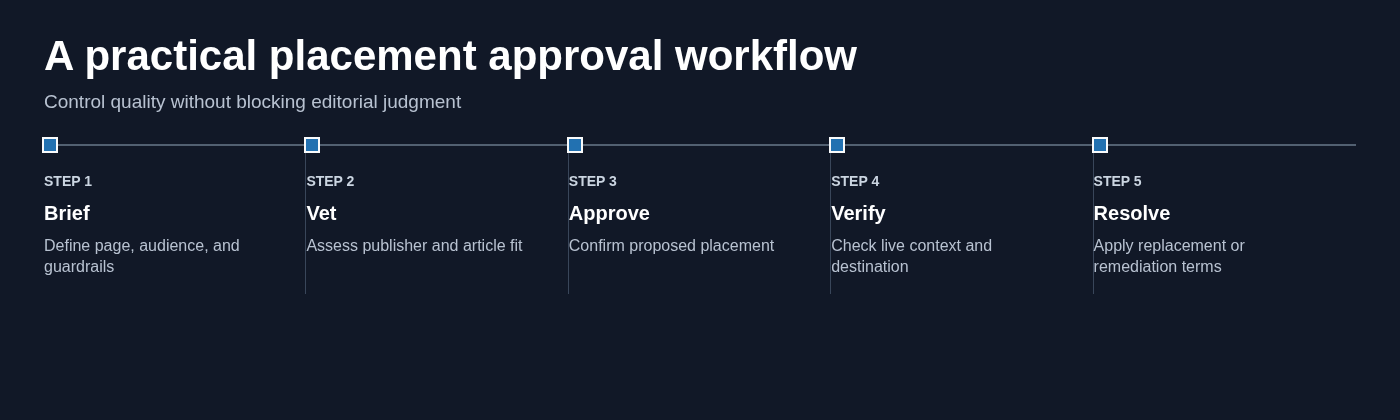
Approval governance is one of the clearest differences between a managed, transparent service and a volume-driven link package. Buyers should know what they are approving, when they can raise objections, and which aspects of the placement may change because of legitimate editorial judgment.
Full control over every word on a third-party publication is rarely realistic and can undermine editorial credibility. The practical goal is clear guardrails: approve the publisher, topic, destination, and overall placement logic while allowing the editor to make reasonable final adjustments.
The minimum pre-approval packet
Before approving a placement, ask for enough information to make an informed decision. Depending on the service model, that packet should include:
- Publisher name, or anonymized qualification data when confidentiality is genuinely necessary before commitment
- Target article or planned content topic
- Your proposed destination URL
- A concise topical rationale
- Content format, such as contextual update, guest post, partnership, or mention
- Expected timing and any dependencies
- Commercial terms tied to the proposed opportunity
There are situations where a provider cannot reveal a publisher immediately because the relationship or opportunity is sensitive. Even then, you should receive meaningful evidence: the site's topic, audience, traffic and quality indicators, link practices, and enough detail to assess whether it meets your criteria.
Anchor text and destination-page approval
Approve anchor themes rather than demanding the same exact-match phrase repeatedly. Overly prescriptive anchors can sound unnatural, restrict editorial options, and create patterns that do not resemble organic citations.
Coordinate destination pages across SEO, content, legal, product, and brand teams when claims are sensitive. A security page, healthcare page, or regulated-industry landing page may need additional review to ensure the linked language does not overstate product capabilities or make unsupported claims.
What must be approved after publication
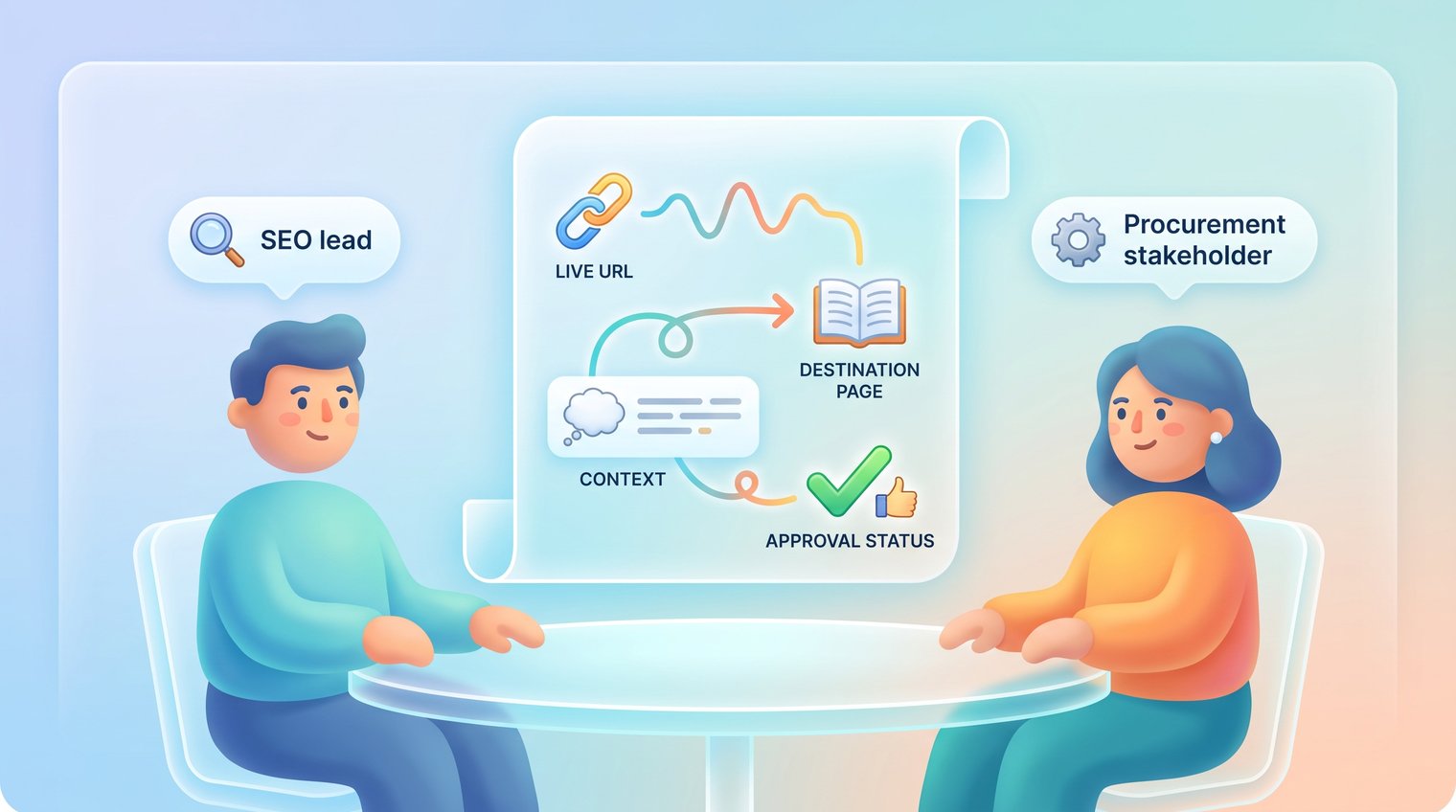
Once a placement is live, the report should confirm what was actually delivered. At minimum, request the live URL, final anchor text, destination URL, surrounding context, publication date, and observable link attribute. Confirm that the page is accessible and can be indexed where relevant.
If the live placement materially differs from the approved brief, there should be a documented process for raising the issue. A changed destination page, irrelevant surrounding copy, wrong anchor concept, or placement in a low-value section of the page is not a minor reporting detail. It can change the value of the deliverable.
How reputable providers source and vet publishing opportunities
A credible sourcing process usually combines prospect research, relationship-based outreach, editorial pitching, publisher review, and clear documentation. The provider identifies potential fits, tests whether the publisher is open to the proposed content or update, and presents suitable opportunities against the client's brief. Teams building this process internally can use an SEO outreach strategy to structure prospecting, qualification, and communication.
This differs from treating a large inventory list as proof of quality. Mass outreach and opaque inventory reselling can produce placements, but neither automatically demonstrates that the publisher, article, and destination page are right for your campaign.
Publisher vetting criteria that should be documented
Ask a provider how it evaluates opportunities before they reach your approval queue. Useful checks include topical alignment, intended audience, article quality, organic visibility trends, publishing cadence, outbound-link patterns, disclosure practices, and technical accessibility.
No single metric replaces manual review. A strong prospect can have lower traffic because it serves a narrow professional niche. Conversely, a site can have attractive aggregate metrics while publishing incoherent, low-value content and accepting excessive commercial links.
Why availability and pricing change
Publisher availability changes because editorial calendars, category demand, content requirements, and relationship terms change. Specialized industries also require more precise prospecting and more careful review. A placement in a tightly relevant publication for finance, security, enterprise software, or healthcare is not comparable to a generic placement on a broad site.
That is why fixed bargain pricing across every niche deserves scrutiny. Low cost alone does not prove poor quality, but buyers should ask what the price excludes: prospect research, content development, approvals, editorial review, reporting, or replacement support.
A worked example: evaluating one proposed SaaS link placement
A checklist becomes more useful when it changes a real decision. Consider a hypothetical B2B SaaS company that sells a workflow automation platform for customer support teams and wants to strengthen an integration page for its help desk connection.
The campaign brief
The target page explains how the company's platform connects with a popular help desk tool. The intended audience is support operations leaders at mid-market SaaS companies. The broader topic cluster covers ticket routing, support automation, service-level agreement management, and reducing repetitive support work.
The SEO team asks for publications read by support, customer experience, or SaaS operations professionals. It excludes low-quality software-list sites, competitor-adjacent pages, and articles with excessive outbound commercial links. The preferred anchor concept is informational rather than aggressively commercial: language related to automating help desk workflows or connecting support systems.
This level of specificity makes outsourced link building services easier to evaluate. The provider knows what to pursue, and the client has a defensible basis for saying yes, no, or revise.
The proposed placement
The provider proposes a contextual update on a niche customer experience publication. The existing article covers practical ways to reduce ticket backlog. The planned sentence is: "Teams can also reduce manual handoffs by connecting their help desk with workflow automation tools that route requests based on issue type, priority, and customer status."
The phrase "connecting their help desk with workflow automation tools" would link to the SaaS company's integration page. The publisher is active, the article is directly relevant, and the timeline is estimated at three weeks after approval.
Those are positive signals, but the buyer should still verify several points: Does the publication serve support practitioners rather than a general marketing audience? Is the article genuinely useful and receiving ongoing attention? Are the surrounding paragraphs practical rather than superficial? Does the page link out heavily to unrelated software companies? Will the final destination page explain the integration clearly enough to satisfy a reader who clicks?
The approval decision and rationale
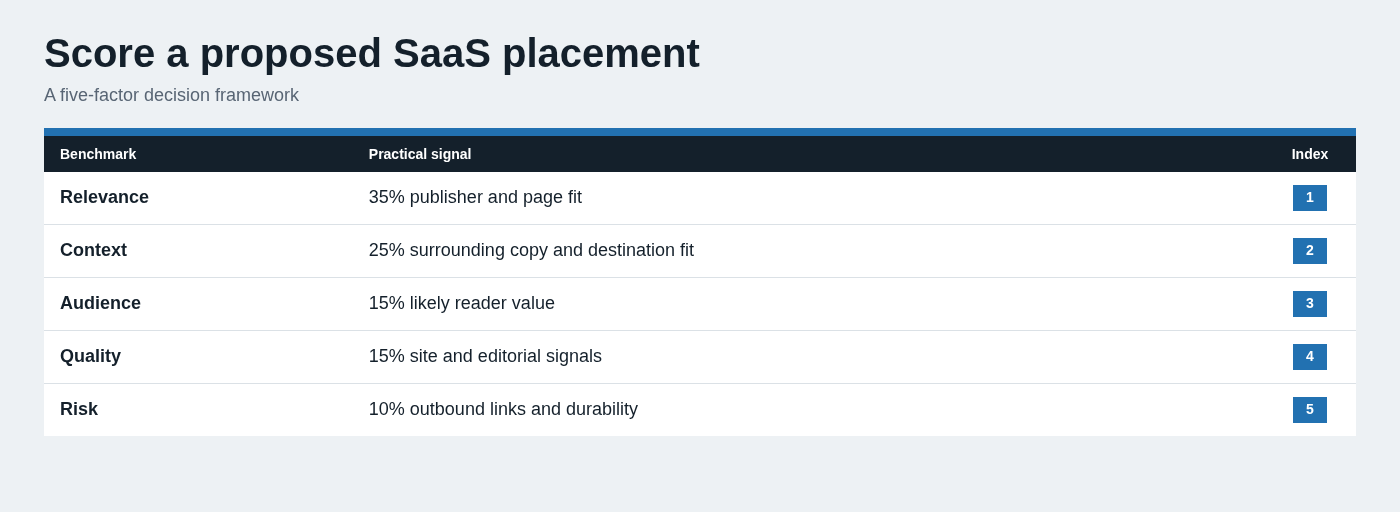
Use a weighted scorecard to keep the decision focused on campaign contribution rather than chasing the highest authority number. In this example, the opportunity might score well on relevance and context, reasonably on audience, and require a final check on outbound-link patterns and pricing before approval.
| Factor | Weight | Assessment |
|---|---|---|
| Publisher and article relevance | 35% | Strong: support operations topic and a directly related article |
| Context and destination fit | 25% | Strong if the integration page supports the sentence's practical claim |
| Likely reader value | 15% | Good: support leaders could reasonably use the linked resource |
| Site and editorial quality | 15% | Verify publishing consistency, authorship, and outbound-link behavior |
| Risk and durability | 10% | Review placement terms and whether the page appears stable |
The right decision may be "approve with conditions": confirm the exact article URL, request a final check on the surrounding paragraph, and make sure the target page is suitable for referral visitors. If the publication turns out to accept unrelated commercial links throughout the article, the decision should shift to reject or request an alternative.
Pricing, scope, and delivery expectations
There is no universal price for a high-quality placement. Cost varies with niche specificity, publisher standards, geography, content creation needs, editorial complexity, target page type, exclusivity, volume, and the amount of strategic and operational work involved.
Your statement of work should define the deliverable type, estimated delivery range, approval process, reporting fields, revision limits, replacement policy, payment milestones, and exclusions. Ambiguity at this stage is a common reason buyers and providers disagree later about whether a placement met the brief.
Why cheap links often cost more later
Cheap links are not automatically bad, but a very low price often reflects a trade-off. That trade-off may be weak relevance, templated content, thin editorial review, undisclosed networks, poor communication, or reporting that makes validation impossible.
The later cost can be wasted budget, cleanup work, lost time, and links that do not contribute to the pages that matter. Instead of asking only, "How much is each link?" ask, "What research, review, content, approval, and verification work is included in this price?"
How to measure delivery beyond link count
Link count is a production metric, not a complete performance measure. Review whether the provider delivered the agreed placement type, matched target clusters, maintained live links, and supplied complete documentation. Where data is available, assess referral engagement and whether the publications expose your brand to a useful audience.
Organic ranking movement should be evaluated over time and in context. Content quality, technical SEO, search intent, competition, site history, and market changes all influence results. A provider should be accountable for placement quality and delivery accuracy, not make simplistic claims that every individual link caused a specific ranking gain.
Red flags when choosing an SEO link service
Risk screening should focus on observable behavior. You do not need to assume bad intent to ask better questions; you need evidence that a provider's process can meet your standards.
Guarantees that should prompt questions
Be careful with guaranteed rankings, unrealistic volume promises, universal dofollow claims, instant delivery in highly selective niches, and statements that links are completely risk-free. Search performance and publisher decisions are not fully controllable by any agency.
A better promise is process-based: transparent prospecting, defined qualification criteria, approvals, documented delivery, and clear handling of material deviations or link losses.
Reporting that hides the details that matter
A report should not omit the live URL, destination page, final anchor, surrounding context, placement date, and replacement status. If those details are unavailable, it is difficult to verify what was purchased or whether it remains live.
Request a sample report before signing. It is one of the simplest ways to separate a polished sales claim from an operationally transparent service.
Link patterns that do not match your brand
Watch for irrelevant publishers, repetitive anchors, sudden unnatural velocity, pages overloaded with commercial links, and content with no apparent audience value. These patterns may not be visible from a single placement, which is why ongoing review matters.
If they emerge, pause the campaign. Revisit the brief, tighten qualification criteria, reassess the provider's sourcing process, and only resume when the standards are clear.
Building a link placement brief that providers can execute
A useful brief makes it easier for an agency or internal partner to find placements that serve commercial and SEO goals. This matters for link building services for small business teams with limited budgets and for larger B2B organizations managing multiple product lines: prioritization is more valuable than unfocused scale.
Inputs to provide
Give the provider the information needed to make good decisions without forcing them to reverse-engineer your strategy. Include priority URLs, topic clusters, ideal publication types, target geographies and languages, customer segments, competitor exclusions, approved claims, and brand voice guidance.
For international link building services, define local-language editorial expectations and regional relevance before outreach begins. A translated article on an unrelated site is not a substitute for a placement in a publication that genuinely reaches the country, industry, and reader you are targeting. Country-specific landing pages should also be clearly mapped to the right markets.
Rules to set without over-constraining the campaign
Set guardrails for relevance, acceptable publisher patterns, content quality, approval thresholds, anchor diversity, and any link-attribute requirements. Then leave room for editors and experienced outreach teams to choose natural wording and suitable opportunities.
Overly rigid rules can lower quality. Requiring only sites above one metric threshold, demanding exact-match anchors, or insisting on one specific placement type may eliminate the publications that actually offer the best topical and audience fit.
How to evaluate a link placement provider before committing
Provider selection should be a due-diligence exercise, not a contest over who claims the biggest network. Review strategy, sample qualification logic, transparency, reporting, communication cadence, and fit with your niche and risk tolerance.
Questions to ask on the first call
- How do you source publisher opportunities: direct relationships, outreach, partnerships, or a mix?
- What vetting criteria do you apply before presenting a placement?
- What can we approve before publication, and what remains subject to editorial discretion?
- Who owns contributed content, and how is content quality reviewed?
- How do you handle disclosures, link attributes, and publisher policies?
- What fields appear in your delivery report?
- What happens if a placement is removed or materially changed?
- How do you evaluate success beyond the number of links delivered?
Ask for process evidence, not just broad statements about network size or authority metrics. The answers should help you understand how decisions are made when an opportunity is imperfect, delayed, or inconsistent with the initial brief.
How to run a pilot campaign
A pilot campaign should be limited enough to inspect closely and substantial enough to reveal how the provider operates. Select a small set of priority pages, define quality criteria in advance, agree on approval steps, and set a review point after the first placements are delivered.
Evaluate both the links and the process. Did the provider understand your audience? Were prospects sensibly qualified? Did the approval workflow work? Was reporting complete? Did the team communicate constraints early rather than hiding them until delivery? Those answers are often more predictive of a successful long-term program than the first month's raw link count.
Turn link placements into a durable authority program
Effective link placement services do not reduce authority building to a monthly quota. They identify relevant editorial opportunities, match them to pages with a clear purpose, obtain sensible approvals, verify final delivery, and assess results over time.
As covered in the quality and approval sections, the useful standard is straightforward: a real publication, a relevant page, helpful context, an appropriate destination, transparent reporting, and a process for handling deviations. Use that standard consistently, and link acquisition becomes easier to manage, defend internally, and improve.
Teams that need a transparent, white-hat B2B placement process can evaluate whether LinkHandy's approach fits their approval and reporting requirements.