
One inaccurate AI answer can do more damage than a stale search snippet. A prospect may see the wrong pricing model, an outdated leadership team, a false product capability, or even a confused company identity before they ever reach your website.
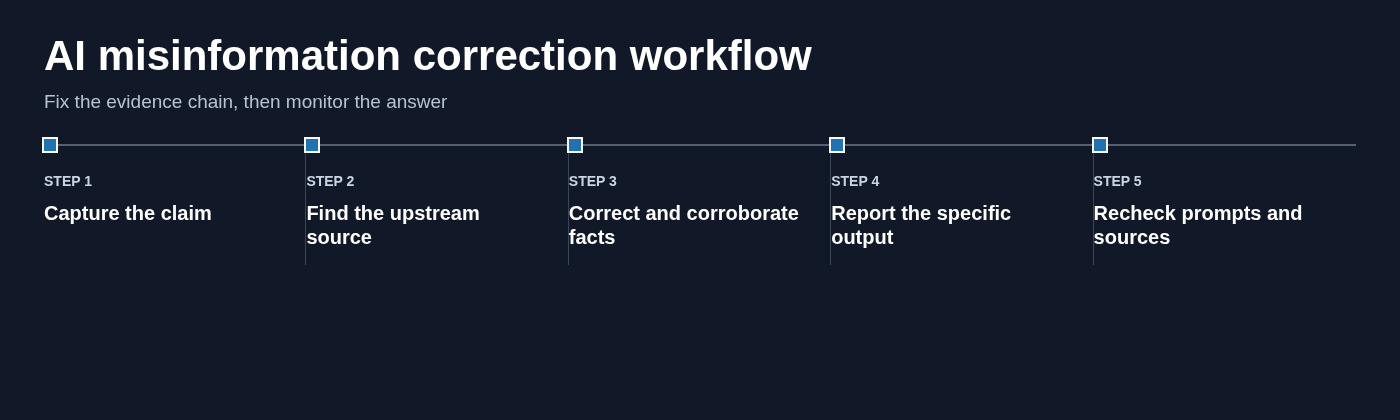
The fix is not usually to argue with the AI result alone. You need to identify what is wrong, correct the evidence behind it, report the specific output, and monitor whether the error continues to appear. Here is a practical process for doing that without wasting time on vague reputation-management work.
Confirm the claim before trying to correct it
First, separate a genuinely false AI-generated statement from an answer that is technically based on an old source or a confusing interpretation of a real company fact. Those situations require different responses.
For example, "Company X was acquired by Company Y" may be false outright. But "Company X offers a free plan" could be an outdated claim pulled from an old pricing page. A statement such as "Company X is based in London" may result from the AI mixing your business with another company that has a similar name.
Before escalating anything, capture the exact circumstances of the result:
- The precise prompt or query used
- The full AI-generated answer, including the sentence that is incorrect
- The date and time you saw it
- Your location and language settings, where relevant
- The product surface, such as an AI Overview, chatbot, search assistant, or other AI search feature
- Any citations, links, or named sources attached to the answer
- A screenshot showing the prompt and output together
Then repeat the query in a clean browser session or another account, if appropriate. Generative answers can vary by phrasing, history, location, and product changes. One bad output is important evidence to investigate, but it is not automatically proof of a persistent visibility problem.
Classify the error and set the right correction goal
Not every inaccurate answer should be treated as a removal request. The type of error determines the best remedy, who should own it internally, and how long a correction may take to appear in search or AI outputs.
Common high-impact errors include:
- Wrong company identity, ownership, parent company, or headquarters
- False statements about products, integrations, pricing, or availability
- Outdated leadership, funding, acquisition, or operating-status information
- Fabricated allegations involving fraud, security, legal issues, or customer harm
- Incorrect local details, including business hours, address, phone number, or service area
Prioritize issues based on customer harm, reputational or legal risk, and how likely the claim is to be repeated across search results, partner sites, directories, and AI platforms. A wrong office phone number matters, but a false claim that your SaaS product is discontinued may need immediate attention from marketing, customer success, leadership, and legal teams.
When the AI answer is unsupported or potentially harmful
If the answer makes an unsupported claim, preserve the evidence immediately and use the reporting controls in the product where it appeared. At the same time, investigate the web sources that may be contributing to the error. Reporting is worthwhile, but it should not be your only action.
Bring in legal, compliance, security, or communications stakeholders when the claim involves defamation, impersonation, fraud, safety, false regulatory information, or material financial assertions. Keep the original screenshots, URLs, dates, and any customer reports in a central record.
Do not assume a report guarantees removal or a personal response. The practical goal is to create a documented record, correct the underlying facts, and escalate through the right channels when the risk warrants it.
When the answer is outdated or based on a real but obsolete source
An outdated answer usually calls for a source correction, not a generic demand that an AI system change its response. If your old pricing page, an archived announcement, or a stale partner profile says something that used to be true, make the current fact clearer and easier to verify.
AI search systems often encounter old information because it remains indexed, syndicated, quoted, or copied across many third-party pages. The durable fix is to update the strongest source, preserve context where necessary, and make sure other authoritative records agree with the current position.
Build an evidence packet that makes the correction easy to verify
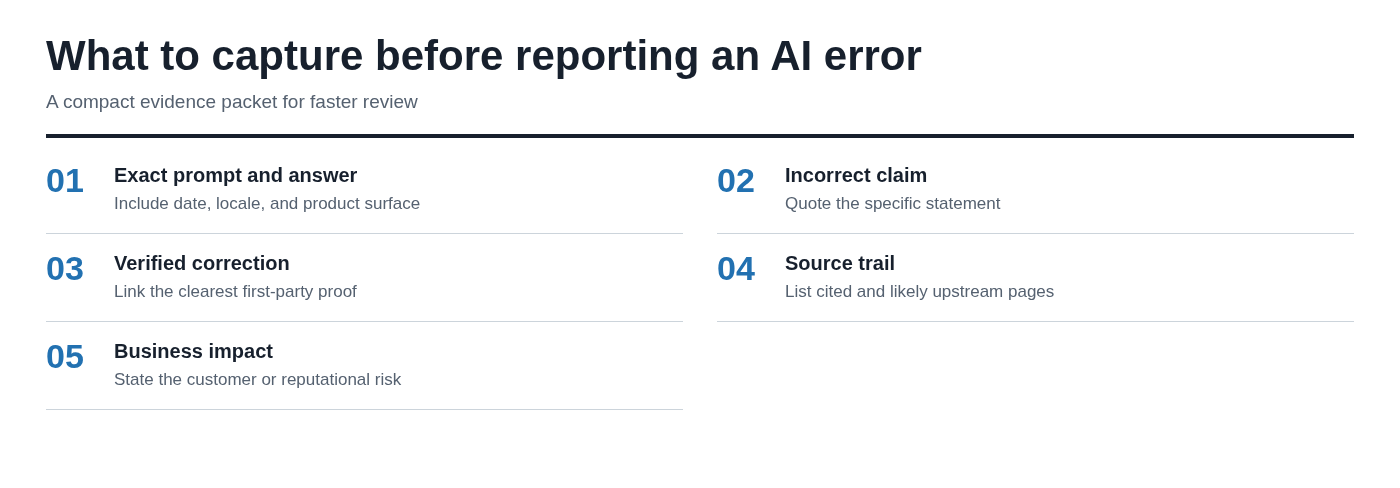
Vague complaints are difficult for publishers, platforms, and internal teams to act on. Build a compact evidence packet that lets someone verify the correction in a few minutes.
- Erroneous statement: Quote the exact sentence that is wrong.
- Correct statement: Write the replacement fact in one clear sentence.
- First-party proof: Link to the best current page on your site.
- Independent corroboration: Include reliable third-party proof when available.
- Source trail: List citations shown in the answer and likely upstream pages.
- Evidence: Add screenshots, dates, locale, and the platform where the result appeared.
- Business impact: Briefly explain the customer, reputational, or operational risk.
Precision matters. Do not submit a general paragraph describing your brand when the problem is one sentence about a supposed acquisition, discontinued product, or incorrect headquarters. Quote the disputed claim and link directly to the page that resolves it.
A simple evidence log can keep multiple issues organized:
| Field | What to record |
|---|---|
| Issue ID | A short label, such as "Wrong pricing model - September" |
| Prompt and surface | The exact query and where the AI answer appeared |
| Incorrect claim | The exact sentence or phrase to correct |
| Verified correction | The approved factual replacement and proof URL |
| Sources and status | Cited pages, outreach owner, report date, and next review date |
Trace the claim to the source AI systems are likely using
The most effective correction work happens upstream. AI answers may not disclose every source or input, so do not waste time trying to prove one hidden cause. Instead, find the most authoritative and most replicable sources supporting the wrong claim.
Start with citations attached to the AI answer. Open each one and note whether it directly contains the incorrect statement, contains an ambiguous version of it, or simply discusses a related topic. Then search for the distinctive incorrect phrase in quotation marks, along with your company name.
Review branded searches as well. Search combinations such as your company name plus "acquired," "pricing," "headquarters," "closed," or the disputed product name. This often reveals old press releases, directories, scraped company profiles, reseller pages, and copied descriptions that do not show up in a single AI citation.
Where accessible, compare indexed or cached versions with the live page. The goal is to determine whether the claim originated on your own site, a trusted third party, an entity database, or a network of copied listings.
Check first-party pages and structured business facts first
Start with your own website because first-party contradictions are common and entirely fixable. Audit the homepage, About page, contact page, product pages, pricing, careers page, press room, support documentation, and any status or changelog pages.
Look for wording that is stale, vague, or internally inconsistent. A homepage saying "global team" while a contact page lists an old headquarters can create entity confusion. A retired plan still mentioned in help documentation can make an outdated pricing claim look credible.
Review structured business facts as well. Use appropriate Organization schema, and LocalBusiness schema where it applies, with consistent company name, address, phone number, official website, and social profiles. Major announcements should be clearly dated so readers and systems can distinguish a current fact from historical context.
Check third-party profiles, directories, and copied descriptions
Next, prioritize third-party sources according to the claim at issue. For a product or pricing error, check review platforms, software directories, partner pages, app marketplaces, customer documentation, and old press coverage. For identity confusion, look at social profiles, company databases, industry listings, and pages for similarly named businesses.
Do not try to correct every low-quality scraper first. Fix the pages that are prominent, trusted, frequently copied, or visibly cited in search results. A single inaccurate industry profile can be more influential than dozens of obscure sites.
For wrong hours, location, phone number, category, or similar local-business facts, review your Google Business Profile. Profile edits solve local listing problems; they do not correct unrelated web pages or broad corporate misinformation.
Correct the authoritative source rather than publishing a vague denial
Once you identify a source, correct it with direct language. A page that says "We have updated our company information" is weak. A page that says "LinkHandy is an independent boutique link-building agency serving SaaS and B2B companies" is specific and verifiable.
Update the original publisher when possible. If the error appears on your own site, revise the canonical page and ensure related pages do not contradict it. If the information is historical, preserve useful context with dates rather than quietly removing it and leaving old syndicated copies unexplained.
For example, an old product page can state that a plan was retired on a specific date, explain the current offering, and redirect users to the active pricing or product page. This gives customers and search systems a clearer record than an empty deleted URL.
When contacting a third-party publisher, send a concise correction request containing:
- The exact text that is incorrect
- The approved replacement wording
- A link to first-party proof and any relevant independent source
- The specific URL and location of the error
- A polite request for an update, correction note, or removal where appropriate
Follow up once after a reasonable interval, then document nonresponses. Repeated aggressive outreach rarely helps and can make routine editorial corrections harder.
Create a single canonical fact page for recurring confusion
If customers, prospects, or AI tools regularly misunderstand the same fact, create a reliable place to resolve it. This can be a well-maintained About page, company facts page, press page, or a dedicated page addressing a recurring source of confusion.
Useful topics include ownership, headquarters, business status, product availability, integrations, pricing model, or whether a company operates in a particular market. Write plainly, provide the relevant context, include a last-updated date, and link to supporting product, press, or legal pages where appropriate.
Do not publish a thin rebuttal page that repeats the false allegation without useful evidence. The page should stand on its own as an accurate company resource, not as a defensive statement built for one search query.
Strengthen the corroborating signals around the corrected fact
A corrected company page may not immediately outweigh a claim that has been copied across directories, reviews, news coverage, and partner sites. The answer is not to manufacture mentions or buy low-quality links. It is to make accurate information consistently available in relevant, credible places. For broader guidance on establishing trustworthy visibility in AI-driven search, see AI Optimization: The Definitive Guide to Organic Growth.
Update owned social profiles, partner listings, marketplace pages, customer documentation, and directory records that matter to your buyers. If a material claim needs public clarification, seek accurate editorial coverage or expert commentary that adds real context rather than repeating corporate boilerplate.
For SaaS and B2B companies, content partnerships and editorial placements can help establish trustworthy third-party context around important company facts. That work must be transparent and accurate. A placement that merely exists to push a narrative is not a durable reputation asset. When assessing these signals, distinguish overall domain reputation from the authority of any single page.
When you need help coordinating credible third-party coverage, LinkHandy supports transparent editorial outreach, contextual placements, and content partnerships for B2B brands.
Report the inaccurate answer in the AI product where it appears
After you have evidence, report the specific output in the AI product where it appeared. Most AI search and assistant products provide feedback controls near the response, often through an icon, menu, or reporting option. Reporting interfaces can change, so use the current official help or feedback page for the relevant product if the controls are not clear.
Use a simple reporting sequence:
- Open the exact answer containing the error.
- Choose the feedback or report option attached to that output.
- Select the closest available category, such as inaccurate information or harmful content.
- Quote the false passage exactly.
- State the correction in one or two sentences.
- Provide the strongest supporting URLs.
- Save a screenshot or record of the submission.
If you need to report incorrect Google AI results, use the feedback controls attached to the specific AI-generated result or AI Overview. Focus on the exact inaccurate or harmful passage, not a general objection to the answer. Include reliable evidence that a reviewer can check quickly.
Feedback can help the product team identify quality issues, but it is not a substitute for correcting source pages. You may not receive a direct response, and the same wording may not disappear immediately even after a report is submitted.
Use Google Business Profile when the inaccuracy is local-business information
Use Google Business Profile for business facts that belong in a local listing: address, hours, phone number, website, category, service area, accessibility details, and business status. Update the profile directly through the account that manages it.
For sensitive changes, be prepared to complete verification or provide documentation if requested. A location move, new ownership details, or a changed business name may require more support than a simple hours update.
Also check for duplicate profiles, former locations, and similarly named businesses. Entity confusion can happen when an old listing remains live or a nearby business has a nearly identical name. Correcting the official profile while leaving duplicate records untouched can prolong the problem.
A Google Business Profile is not the right remedy for incorrect product descriptions, company ownership claims, or misinformation on unrelated websites. Use it for local-business data, then address broader web sources separately.
Recheck the same prompts and track whether the correction is taking hold
Do not judge success from one follow-up query. Re-run the documented prompts on a schedule that fits the severity of the issue, such as weekly for a high-risk claim and monthly for lower-risk monitoring. Use the same wording, locale, and product surface where possible.
Test relevant variations as well, especially in markets where you sell. A company summary may be correct for one phrasing and wrong when users ask about competitors, pricing, locations, founders, or integrations.
Track source-level and answer-level progress separately:
- Was the first-party page updated?
- Did the directory or publisher correct its record?
- Is the revised page visible in search?
- Have citations in AI answers changed?
- Does the incorrect claim still recur across prompts?
Set alerts for your brand name alongside the disputed claim. Assign an owner, due date, and escalation status to each issue so correction work does not disappear into a shared inbox after the initial report.
Know when to escalate beyond a standard correction request
Some cases should not follow a normal editorial correction timeline. Escalate quickly when an AI result involves impersonation, scams, doxxing, false criminal or regulatory claims, dangerous instructions, trademark misuse, or material harm to customers, investors, or business operations.
Preserve evidence before the output changes. Then route the issue to the appropriate platform reporting channel and internal stakeholders. As an operational rule, send immediate customer or safety risk to security and leadership; potentially defamatory or regulated claims to legal and communications; local listing issues to the listing owner; and source-page errors to the publisher or site owner. The right path depends on the type of claim and your jurisdiction.
Specialist support can also be useful when the issue spans many publishers, when entity confusion has a technical SEO component, or when a business needs credible third-party coverage to replace a widely circulated false narrative. The work still begins with evidence and accurate source correction, not blanket suppression requests.
Prevent the next inaccurate AI company summary
The best long-term defense is making your core facts easy to verify. Assign clear ownership for company details, review material pages after launches and leadership changes, synchronize important profiles, and date announcements that may later be misread as current.
- Maintain a single approved record for company name, ownership, locations, leadership, and product facts.
- Review high-traffic website pages after major changes.
- Keep partner profiles, directories, and local listings aligned with your site.
- Use clear dates on launch, retirement, acquisition, and pricing announcements.
- Monitor high-risk prompts and branded searches on an ongoing basis.
The central principle is simple: make the correct fact clear across authoritative sources, then report the specific AI output with evidence when it gets the answer wrong.