
Guest post revisions can feel like a threat when a carefully planned contextual link is suddenly questioned, moved, changed, or removed. The wrong response is to defend the backlink at all costs. That approach makes contributors look transactional and gives editors a reason to distrust future submissions.
The better approach is to treat revisions as editorial collaboration. Protect accuracy, usefulness, and publisher standards first, then make sure any citation that remains is genuinely relevant to the reader. That is how you preserve link value without damaging a relationship that could lead to far more valuable opportunities later.
Assess the revision request before changing the draft
Do not accept or reject an editor's request on instinct. First, compare it with the original pitch, approved topic, content brief, and any agreement about the proposed destination page or contextual citation. A request to tighten a claim is very different from a request that changes the article's audience, angle, or purpose.
Your first responsibility is to the published article. If the revision makes the content more accurate, clearer, or better suited to the publisher's audience, it is usually a positive sign. A link earns its value by appearing as a useful editorial resource in a credible article, not merely by remaining live.
Before responding, read the full draft with the suggested changes in place. Looking only at an individual comment often leads to a poor decision because a small wording change may alter the surrounding context, reader intent, or factual support for the citation.
Classify revisions by their effect on the article and link
A simple classification system keeps routine edits from becoming a prolonged email thread while ensuring material changes receive appropriate attention.
- Low-risk revisions: House-style changes, grammar fixes, formatting, clearer wording, additional source requests, and headline suggestions. Make these promptly unless they introduce an inaccuracy.
- Review-needed revisions: A substantial reframing of the argument, a revised target audience, new factual claims, or removal of an important example. These may affect whether your proposed resource still fits naturally.
- High-risk revisions: Link deletion, a change to the anchor text, a move from the body to the author bio, a changed destination URL, a rel attribute request, or replacement with a competing resource.
Maintain a short revision log as you work. A spreadsheet or document with the editor comment, requested action, your response, and final status is enough. This prevents a common mistake: fixing visible copy edits while overlooking a material link or policy change buried in the comments.

Check the link's value in the revised context
Do not evaluate a link solely by whether it is still present. A contextual citation has value when it appears in a passage where a reader could reasonably want more detail, and when the destination page delivers what the surrounding sentence promises. For a more detailed framework, see How to Evaluate Contextual Link Insertion Opportunities.
Read the sentence before the link, the linked sentence, and the paragraph after it. Then ask whether the revised passage still creates a legitimate need for that resource. If the editor has removed the explanation that supported the citation, keeping the link may make the article weaker and more promotional.
Check five practical details:
- Placement: Is the link still in the main body near the topic it supports, rather than isolated in a generic resource list?
- Topical relevance: Does the paragraph address a problem the destination page helps solve?
- Anchor wording: Does the anchor accurately describe the resource without sounding forced or excessively keyword-focused?
- Destination match: Does the page meet the reader's likely expectation, or does it send them to a broad page with little connection to the claim?
- Reader usefulness: Would the sentence still make sense if the reader did not know your company or campaign existed?
A contextual link is not automatically valuable because it appears in an article. If it is shoehorned into an irrelevant paragraph, it may create editorial risk for the publisher and little durable value for your brand.
Watch for changes that require a direct conversation
Some edits are too consequential to silently accept or casually revise around. Start a focused conversation if the editor proposes to remove the link, move it to an author bio, replace it with a homepage or less relevant URL, alter the anchor so it no longer describes the destination, or rewrite the section until the citation is no longer supported.
A request to apply rel="nofollow" or rel="sponsored" also warrants clarification, but not an argument. Ask what publisher policy, disclosure practice, or commercial arrangement prompted the request. The appropriate response depends on the publisher's rules and the nature of the collaboration.
Do not treat all attributes and placements as interchangeable. An author-bio link can still create brand exposure and referral traffic, but it is a different editorial outcome from a relevant in-content citation. Record it accurately rather than presenting it internally as equivalent.
Reply quickly with a collaborative, specific response
Editors are managing publishing schedules, style requirements, legal concerns, and audience expectations. A prompt response signals that you respect their process. Aim to acknowledge comments within one business day, even if you need more time to complete a substantial rewrite.
Keep your reply organized. Confirm the routine edits you will make, then isolate the one or two items that need clarification. Avoid a long defensive explanation of why the original draft should remain unchanged.
A compact email structure works well:
- Thank the editor and acknowledge the goal behind the feedback.
- Confirm the routine changes you will make.
- Ask one focused question about any material issue, or offer a specific alternative.
- State when you will return the revised draft.
For example: "Thanks for the detailed edits. I will update the wording, add the requested primary source, and align the subheads with your style. On the resource link in the section on SaaS authority, would a link to our educational guide be a better fit than the current destination? It directly supports the revised sentence and removes the product-oriented language. I can send the tracked revision by tomorrow at 2 p.m. ET."
Ask publisher feedback questions that move the revision forward
Good questions help the editor resolve a problem. They do not force the editor to defend normal quality control. For additional prompts, see these Publisher Feedback Questions After a Guest Post Goes Live.
- Which concern does this change address: accuracy, relevance, tone, audience fit, or linking policy?
- Is there a house-style guideline or source standard I should follow for this section?
- Would narrowing the claim and adding a stronger supporting source solve the issue?
- If the current destination is not suitable, is a more educational and topically specific page acceptable?
Avoid questions such as, "Why can't you keep the link as agreed?" unless there is a clear factual misunderstanding that must be resolved. Even then, frame the discussion around the reader and the publisher's standards, not the campaign's link target.
Revise the content first, not just the link
Many link objections are actually content objections. An editor may be reacting to an overstated claim, a vague example, weak evidence, or language that makes a useful resource look like an advertisement. Changing the anchor text alone will not fix that problem.
Strengthen the surrounding passage before you negotiate the citation. Define the concept more clearly, reduce a broad claim to one you can support, add a relevant example, and use sources that the publisher can verify. Then make the link the natural next step for a reader who needs additional detail.
For instance, this sentence is likely to trigger concern: "Every SaaS company needs high-authority backlinks to dominate search results, so use our link-building service." It is broad, unsupported, and overtly promotional.
A stronger version would be: "For competitive B2B search topics, earning relevant editorial mentions can help establish topical credibility alongside strong technical SEO and useful content. Teams evaluating outreach methods may benefit from a resource that explains how contextual placements are reviewed for relevance and fit." The citation now supports a specific reader need rather than interrupting the article with a sales message.
Verify product claims, case examples, and statistics before resubmitting. Do not use a revision round to add stronger-sounding claims that you cannot substantiate. Editors often notice, and one unsupported sentence can undermine the credibility of the entire contribution.
Use the original brief as a guardrail, not a weapon
A solid Guest Post Content Brief Template for B2B SEO should document the target audience, search intent, approved angle, core claims, preferred evidence, source expectations, internal linking expectations, external citation approach, and proposed destination page. This gives both sides a shared reference point before drafting starts.
Use that brief to identify when an edit has genuinely moved the article away from the approved direction. Do not use it as a demand that the publisher print content they no longer consider suitable. Editors retain responsibility for what appears on their site, and a good brief supports alignment rather than limiting editorial judgment.
Offer alternatives when the original link no longer fits
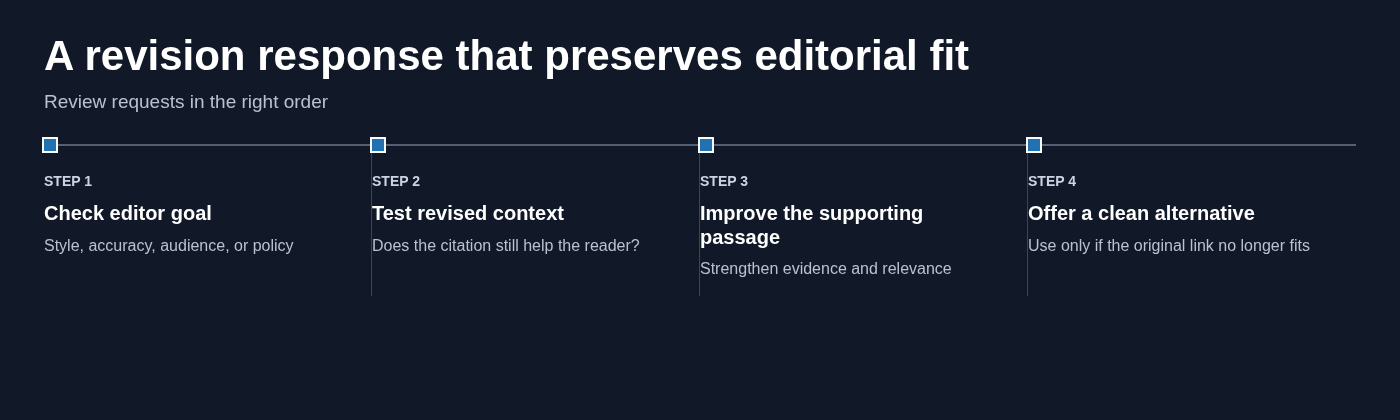
Sometimes the editor is right: the original destination no longer fits the revised article. This can happen when the page is too commercial for the publisher's standards, the article's angle has changed, or the publication has a documented policy that limits certain kinds of external links.
Offer an alternative only when it solves the editor's actual concern. The best options are usually a more educational deep link, a closer topical resource, a rewritten example that removes promotional language, or an independent source that supports the factual claim. If none of those options creates an honest fit, remove the link.
Trying to force a backlink into an editorially unsuitable article is short-sighted. It can lead to removal after publication, harm your contributor reputation, and close the door to future placements with a publisher that may otherwise be an excellent long-term fit.
Match the alternative to the editor's actual concern
Do not respond to every objection by changing a few words around the anchor. Diagnose the mismatch first.
| Editor concern | Best response |
|---|---|
| The destination is not relevant enough | Offer a closer, more specific destination page that answers the reader's question. |
| The passage sounds promotional | Rewrite in neutral language and link only where a reader would reasonably seek more detail. |
| The claim lacks evidence | Add a credible primary or authoritative supporting source; do not use your own page as proof of a broad claim. |
| The publisher has a linking policy | Follow the policy, clarify acceptable options, and do not pressure the editor to make an exception. |
If the destination itself is the mismatch, changing anchor text will not solve it. A tightly optimized anchor pointing to an unsuitable page often looks more suspicious, not less.
Handle link-attribute and placement requests professionally
Publishers may request a specific link attribute or decide that a link belongs in an author bio rather than the body copy. These decisions can affect how the placement is measured internally, but they should be handled as editorial and compliance matters, not as a dispute over guaranteed SEO outcomes.
If an editor requests rel="sponsored", rel="nofollow", or link removal, ask for the applicable policy if it is unclear and comply with the publisher's final standard. Do not make promises about the SEO effect of a particular attribute, and do not encourage anyone to conceal a commercial relationship or bypass disclosure requirements.
When a contextual citation is moved to an author bio, decide whether the remaining brand value and relationship justify publication. It may still be worthwhile for visibility with a highly relevant audience, but it should be recorded as an author-bio placement, not counted as an equivalent contextual editorial mention.
Send revisions in a format that makes approval easy
Editors should not have to hunt for your changes. Return the revision in the format they requested, usually a document with tracked changes or clearly resolved comments. If they did not specify a format, use tracked changes for substantive revisions and include a brief summary in your email.
Answer every comment directly. Where you disagree or need a decision, leave a short, respectful note explaining the proposed solution. Include working source URLs and verify that each page is accessible without a login, broken redirect, or regional restriction.
Do not introduce unrelated rewrites, additional links, fresh promotional language, or new claims during a revision round. That creates extra work and can make the editor feel that each approval leads to another negotiation.
Name the final file clearly, such as "B2B-Authority-Guest-Post_Revision-2_Final-For-Review." In your handoff, state what has been addressed, what remains open, and whether you need a decision on any specific point.
Use a concise revision handoff checklist
- Every editor comment is addressed or has a clear response.
- All factual claims are verified and appropriately qualified.
- Supporting sources are credible, accessible, and correctly linked.
- The destination page has been checked for relevance and functionality.
- The anchor text and surrounding copy read naturally.
- Formatting, headings, spelling, and citation style match the publisher's requirements.
- No unapproved links, claims, or promotional additions were introduced.
Know when to accept the edit, negotiate once, or walk away
Use relevance, editorial legitimacy, collaboration value, and reputational risk as your decision criteria. Domain metrics alone are not a reason to accept a misleading placement or repeatedly push an editor to keep a link that no longer belongs.
Accept routine changes that improve quality, even if they make the article less aligned with your original wording. Strong editorial standards are often a positive signal.
Negotiate once when there is a reasonable alternative that preserves reader usefulness. Present one clear option, explain why it fits, and make it easy for the editor to approve or decline.
Walk away or publish without the link when the remaining placement would be misleading, the editorial direction has fundamentally changed, or continued pushback would damage a relationship. One backlink is rarely worth a strained publisher relationship, especially in a niche where editors and contributors often know one another.

Document the outcome and improve the next guest post pitch
Once the article is published, record the final URL, destination page, link attribute, placement context, anchor wording, requested changes, turnaround time, and any publisher preferences you learned. This documentation helps teams report accurately and makes future outreach more efficient.
Look for patterns. If multiple editors ask you to replace commercial pages with educational resources, improve the destination pages you propose. If publishers repeatedly request stronger sources, build source requirements into the brief before drafting. If a certain angle creates heavy revisions, refine the pitch so expectations are clearer from the start.
A transparent link-building partner can help manage prospecting, briefs, revision workflows, and placement records. Publishers still retain final editorial control, which is exactly how credible editorial collaboration should work.
Protect long-term publisher relationships over a single guest post link
The best way to handle guest post editor revisions is simple: respond quickly, understand the editorial concern, improve the article, and offer a relevant alternative only when one genuinely helps the reader. A strong contextual link is the result of a useful contribution, not the reason to compromise a publisher's standards.
For SaaS and B2B teams that need help managing editorial placements and revision workflows, LinkHandy can support transparent, white-hat link-building campaigns.