
The best publisher feedback questions after a guest post goes live are short, specific, and focused on improving the next collaboration. Ask whether the topic was a good editorial fit, what worked in the draft, what would make future submissions easier to edit, and whether there is a natural opportunity to contribute again.
Do not turn a thank-you email into a survey or ask for details already visible on the published page. A good follow-up respects the editor's time, confirms any reporting details you need, and leaves the relationship stronger than it was before publication.
What to Ask a Publisher After a Guest Post Goes Live
Start with appreciation, then ask only the questions that will change how you work. In most cases, that means one or two feedback questions, a factual confirmation if needed, and a low-pressure question about future collaboration.
A useful post-publication follow-up can cover:
- Whether the topic and angle fit the publication's audience
- What the editor thought worked particularly well in the draft
- What would reduce editing effort on future submissions
- Final publication details for your placement records
- Whether future expert contributions or partnerships may be relevant
Skip questions that the live article answers on its own, such as the visible URL, title, or publication date. Also avoid asking an editor for ranking predictions, traffic guarantees, or additional promotional treatment. Those requests make a professional contribution feel transactional.
Why Post-Collaboration Feedback Is Worth Requesting
Publisher feedback tells you whether your guest post succeeded beyond simply being published. A placement can go live while still creating unnecessary editorial work, missing the publication's preferred voice, or solving the wrong content need.
Even a brief reply can reveal whether your topic selection, source quality, structure, tone, and communication process met the editor's standards. That is valuable information for an in-house SEO team or content team managing repeated guest-post campaigns.
The goal is relationship-building feedback, not a negotiation after the fact. Editors control their publication, including what they publish, how they edit it, and how they handle links. A thoughtful follow-up demonstrates that you care about being an easier, more useful contributor next time.

Ask Whether the Topic and Angle Were a Good Editorial Fit
First, find out whether your idea met a genuine editorial need. A strong draft cannot compensate for an angle that was only loosely relevant to the publication's readers.
You can ask: "Was the topic and angle a strong fit for your editorial calendar and readers?"
This question is especially useful when the post was pitched months before publication, when several stakeholders reviewed it, or when the final angle changed during editing. The answer can help you distinguish a topic that happened to be accepted from one the publisher would actively welcome again.
Record the response in your outreach or placement log. If a publisher consistently prefers tactical SaaS examples, original research, executive commentary, or beginner-friendly explainers, use that insight to improve future pitches. Over time, this makes prospecting more selective and pitches more relevant.
Ask What Worked Well in the Draft
Positive feedback is not just nice to receive; it identifies what your team should repeat. Ask what was especially helpful or effective in the contribution, whether that was subject-matter depth, practical examples, data, organization, tone, or the ease of editing.
A simple version is: "Was there anything in the draft or collaboration process that worked especially well for your team?"
Suppose an editor says the piece was easy to approve because it used credible sources, clear subheadings, and examples that did not read like product promotion. That is a usable standard for future contributor briefs. It is more useful than a vague instruction to "write better guest posts."
Build these strengths into a repeatable process. Your internal checklist might require a clear audience problem, verifiable claims, a logical structure, and a final review for unnecessary promotional language before anything is submitted. A Guest Post Content Brief Template for B2B SEO can help standardize those requirements.
Ask What Would Make a Future Submission Easier to Edit
The most valuable feedback often concerns friction. Editors may have spent extra time fixing formatting, replacing weak sources, shortening a draft, adjusting voice, reviewing links, or waiting on approvals.
Ask directly without reopening the published piece: "For future contributions, is there anything we could do to reduce editing time on your side?"
This is a process-improvement question, not an invitation to revisit every edit in the live article. Keep that distinction clear. Once a post is published, questioning editorial decisions can damage goodwill unless there is a genuine factual or technical error.
Common areas worth noting include:
- Preferred word-count range and heading structure
- Source standards and citation expectations
- House style, tone, and formatting requirements
- Rules around author bios, links, and commercial references
- Review timelines and approval contacts
If multiple publishers raise the same issue, address it upstream. For example, recurring concerns about sources may mean your content brief needs stricter research requirements before a writer starts drafting. Likewise, documenting expectations for bios can make contributor submissions more consistent; see How to Write a Guest Post Author Bio for SEO.
Ask About Link, Attribution, and Publication Details
After publication, confirm the factual details that affect your reporting. You may need the final URL, publication date, author attribution, linked destination, anchor text, and any link attributes applied to the placement.
Some of this can be checked directly on the live page. If you need confirmation, keep the request concise: "For our records, could you confirm that the published version at this URL is the final version?"
Publishers retain editorial control over their link policies. Do not pressure an editor to remove a rel attribute, add a commercial link, revise anchor text, or change the article simply because it differs from your original preference. If the agreed placement differs materially from the approved terms, raise that fact professionally and once. For a broader framework, see Link Placement Services: How to Evaluate Quality and Delivery.
Save final details in a placement log, including the live URL, date, target page, anchor text, attribution, link status, publication category, and any notes about the collaboration. Accurate records make later reporting far more reliable.
Ask Whether There Is a Natural Next Collaboration
If the collaboration went smoothly, it is reasonable to ask whether there is a relevant way to work together again. The key is to offer useful expertise rather than immediately pitching another generic guest post.
Depending on the publisher's format, future opportunities may include expert commentary, original data, interviews, co-created content, contributed articles, or a content partnership. A low-pressure question might be: "If you are planning related coverage in the future, would it be useful for us to share ideas or expert input?"
Not every publisher wants repeat contributors, and that is fine. Do not ask if the editor gave clear signs that the process was difficult, did not respond beyond essential logistics, or publishes rules that prohibit repeat submissions. Respecting a boundary is often more valuable than forcing one more pitch.
Send a Short Follow-Up That Is Easy to Answer
Send your follow-up shortly after publication, or after the editor confirms the post is live. Keep it brief enough that a busy editor can reply in a few lines.
Tailor the note to the actual collaboration. If the editor heavily revised the piece, ask about editing friction. If the post followed an unusual format, ask whether that format worked for readers. Do not paste every possible question into every email.
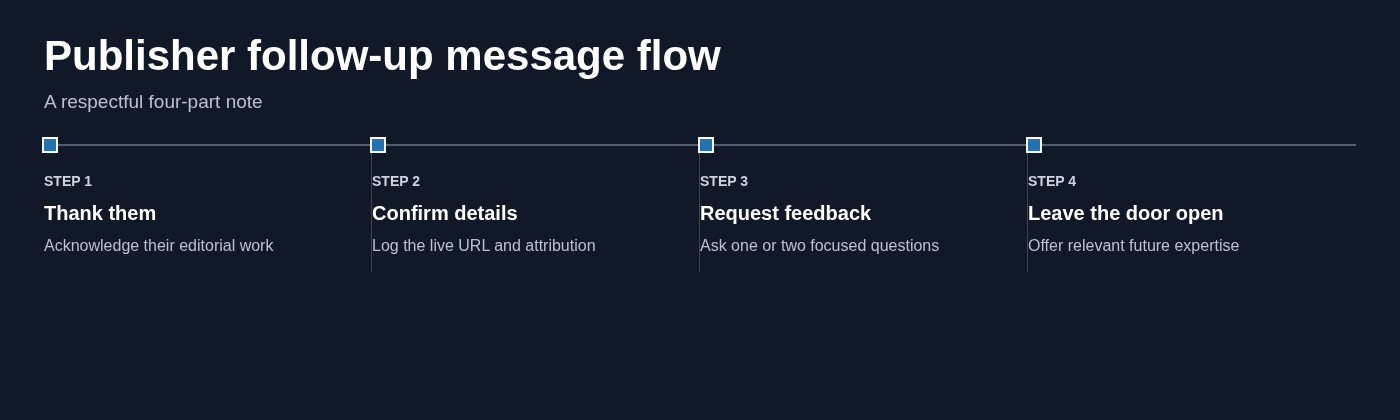
Here is a compact template:
Subject: Thank you for publishing [Article Title]
Hi [Name],
Thank you for the time and care your team put into publishing the article. We appreciate the opportunity to contribute to [Publication].
For future contributions, I would value your quick perspective on two points: Was the topic and angle a strong fit for your readers? And is there anything we could do to make a future submission easier for your team to edit?
We have logged the live article and attribution on our side. If you have upcoming coverage where [specific expertise or content type] would be useful, we would be glad to share relevant ideas.
Thanks again,
[Name]
Monitor the Placement Without Burdening the Publisher
Once a guest post is live, monitor the placement periodically rather than repeatedly contacting the publisher. Check that the page remains accessible, the destination URL resolves correctly, and the important link details have not changed.
A reasonable monitoring cadence depends on the importance of the placement and the size of your campaign. High-value editorial placements may deserve more frequent checks, while a quarterly review can be sufficient for a broader portfolio.
Contact the publisher only when there is a clear factual issue, such as a broken destination URL caused by a site migration or an obvious accidental link error. Do not email an editor about normal indexing delays, changing traffic, temporary ranking movement, or routine editorial updates. Those are not publisher support requests.
Turn Feedback Into a Better Guest-Post Process
Feedback is only useful when it changes future decisions. Log it by publication, topic, content format, revision themes, editor preferences, and potential for future collaboration.
Then look for patterns. If publications respond best to narrow, evidence-led topics, qualify prospects and shape pitches accordingly. If editors repeatedly request stronger sources or fewer self-promotional references, update your contributor brief and internal review process before the next outreach cycle.
Publisher feedback should sit alongside editorial guidelines, prospect-quality checks, and post-publication verification. Together, those inputs help teams spend less time chasing placements that are unlikely to fit and more time producing contributions editors genuinely want to publish.
Use Publisher Feedback to Build Better Editorial Relationships
A concise, respectful follow-up does more than collect notes. It shows publishers that you value their editorial standards and want to become a better contributor, not merely secure a link.
Ask focused questions, record the answers, and let the feedback improve your next pitch and draft. That approach builds trust over time and leads to more sustainable editorial opportunities than one-off, transactional outreach.
Teams that need support with transparent, editorially appropriate guest-post campaigns and authority strategy can consult LinkHandy.