
A backlink report that only shows "new referring domains" is not enough. It may look positive while the pages you actually need to rank remain flat, receive no referral visitors, and generate no pipeline.
To understand whether link building is working, track each placement against the destination page it supports. That means connecting a live link to page-level rankings, organic clicks, referral sessions, and conversions over a defined period - not declaring victory because a domain-wide authority metric changed. This page-level view also helps explain how backlink link juice may pass between pages without treating it as a guaranteed ranking outcome.
Start with a target-page measurement model
The unit of analysis is one destination URL. Instead of asking whether the website gained backlinks this month, ask a more useful question: Did this new or improved link help this specific page earn more qualified visibility, traffic, or business value?
For every placement, track four potential outcomes on the target page:
- Rankings and visibility for the page's relevant query cluster
- Organic clicks and impressions
- Direct referral visits from the linking page
- Conversions, such as demo requests, trials, purchases, or qualified leads
Backlinks are one ranking signal among many. A page may also move because of a content update, internal linking change, technical fix, seasonality, competitor activity, or a shift in the search results page. The goal is not to pretend you can prove perfect causation. It is to create enough evidence to make better link-building decisions.
Build a target-page tracking sheet
Create a spreadsheet, database, or reporting dashboard with one row per backlink placement. This becomes both a practical backlink anchor text mapping template and the foundation for monthly reporting.
| Field | What to record |
|---|---|
| Target URL | The canonical page intended to benefit from the link |
| Page type | Product page, comparison page, blog post, integration page, category page, or resource |
| Primary query cluster | The closely related non-branded searches the page should rank for |
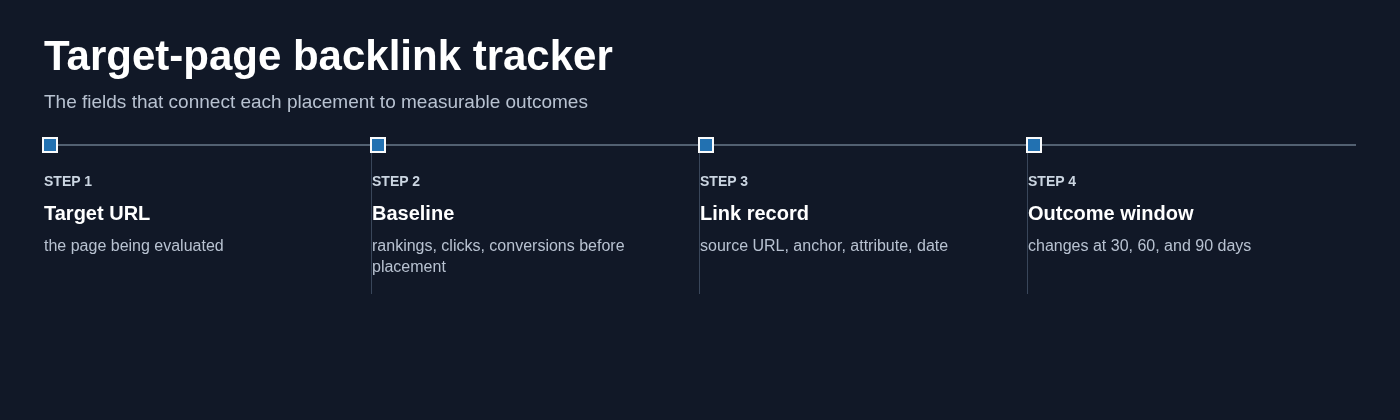
| Baseline date and metrics | Rankings, impressions, clicks, organic entrances, and conversions before placement |
| Placement date | The date the link was published or confirmed live |
| Referring page URL | The exact source article or page, not only the referring domain |
| Anchor text and attribute | Anchor wording plus follow, nofollow, sponsored, or UGC attributes |
| Link status | Live, removed, redirected, changed, or unverified |
| Referral and conversion data | Referral sessions, leads, revenue, and assisted conversions where available |
Keep the target URL exact. If the backlink points to a URL that redirects, record both the linked URL and the final canonical destination. Otherwise, reporting can quietly mix performance from multiple pages.
Establish a clean baseline before the backlink goes live
A post-placement result is only meaningful when you know where the target page started. Capture a baseline before publication whenever possible, then use historical data to understand the page's normal range of movement.
For most B2B pages, review at least the previous 28 to 90 days. A one-day ranking change is rarely evidence of backlink impact. Search results fluctuate, especially for pages with low impressions or broad keyword coverage.
Record search performance by page and query
In Google Search Console, open the Performance report and apply a Page filter for the exact target URL. Export clicks, impressions, average position, and CTR for a defined date range. Then open the Queries tab to see which searches are actually associated with that page.
Document the date range in your tracker. Also confirm that the URL is canonical, indexed, and eligible to rank. If Google has selected another canonical URL, comparing backlink performance against the wrong address will produce misleading results.
Do not base the baseline on a single head term. A SaaS integration page, for example, may receive impressions across dozens of variations: "CRM integration," "[product] CRM integration," "connect [product] to CRM," and category-specific searches. Track the cluster that reflects the page's intended search demand.
Record business outcomes already attributed to the page
Next, pull the page's existing organic entrances and conversion performance from your analytics platform. For a demand-generation page, that may include demo submissions or qualified lead events. For a self-serve product page, it may be trial starts, purchases, or account creations.
Also review assisted conversions for longer B2B buying journeys. A visitor may land on a comparison page from organic search, return later through another channel, and convert after several touches.
Keep page-level performance separate from total site lead volume. If the company launches a webinar, starts paid campaigns, or receives broad press coverage, sitewide leads may rise for reasons that have nothing to do with one backlink.
Verify the backlink placement and its indexability
Do not measure impact until the placement passes quality assurance. A link that was removed, points to the wrong destination, sits on an unindexed page, or has changed attributes cannot be treated as an active ranking input.
A vendor delivery report is useful, but it is not a substitute for checking the live source page yourself. Record what is actually published.
Check the source page, link attributes, and destination
Open the referring page and confirm that the link resolves to the intended canonical target URL. Check the anchor text, surrounding paragraph, and topical relevance. A contextual mention inside a relevant editorial discussion is materially different from a link buried in a generic author bio or sitewide footer.
Record any redirect chain, rel attribute, duplicated placement, or unusual page treatment. Links in low-visibility template areas may still be crawlable, but they should not be evaluated in the same way as an editorial citation within the body content. For a broader review of anchors and link attributes, use an SEO link audit alongside the placement-level checks.
A common mistake is marking every nofollow link as worthless. Nofollow links may still send qualified referral traffic and support brand discovery. They simply should not be presented as equivalent to a followed, contextual editorial link when assessing likely SEO contribution.
Check whether the backlink page is indexed
Start by searching the exact source URL in Google. A site: query can serve as a supplemental check, such as site:publication.com/full-source-page-url, though it is not a definitive indexing test.
Then inspect the page in your backlink monitoring tool. Tools can help identify whether they have discovered the link, but their indexes lag and do not represent Google's link graph. A visible link is not proof that Google has indexed, crawled, or assigned value to its source page.
If the source page is not indexed after a reasonable period, flag the placement for review rather than counting it as a fully active SEO asset.
Create a post-placement observation schedule
Backlink discovery, source-page indexing, and ranking response do not happen on the same day. Use fixed checkpoints at 7, 30, 60, and 90 days so the team can monitor progress without reacting to every small fluctuation.
The 7-day check is mostly for placement health. The 30-, 60-, and 90-day checks are more useful for observing search performance, although competitive pages can require a longer view.
Track link persistence and source-page changes
At each checkpoint, confirm that the link is still live, crawlable, and pointing to the correct target. Note whether the source page remains indexed and whether the anchor or link attribute has changed.
Log meaningful changes to the referring page, including deindexing, redirects, content removal, a switch to nofollow, or a major topical rewrite. A page that becomes a thin list of unrelated links is not the same asset it was when it was first approved.
Compare results against the baseline and a control
Compare the target page's results against its own pre-placement trend first. If possible, also compare it with similar pages that did not receive new links during the same window.
For example, if a linked integration page gains non-branded impressions while three comparable integration pages stay flat, that is more persuasive than a raw ranking increase alone. It is still not laboratory-grade proof, but it is useful operational evidence.
Flag confounders in the tracker: content refreshes, internal-linking changes, technical fixes, seasonality, SERP feature changes, ranking volatility, and multiple backlinks landing in the same period. These notes protect the report from overconfident conclusions later.
Measure ranking and organic-traffic impact at the page level
Prioritize the query cluster relevant to the target page. A single vanity keyword can jump because of localization, personalization, or a temporary result change; a sustained improvement across several related queries is much more meaningful.
Review impressions, clicks, CTR, and average position together. Each metric answers a different question, and none should be interpreted in isolation.
Look for a pattern, not a single ranking jump
Strong evidence usually looks like this: relevant queries gain visibility over several reporting periods, impressions rise first, clicks follow as positions improve, and the trend persists beyond one short spike.
Average position can be noisy because Search Console averages performance across many queries, countries, devices, and result types. A page may improve for high-value terms while its average position barely changes because it also begins appearing for a larger number of low-position queries.
For that reason, compare query-level movement alongside page totals. If the page begins earning impressions for more relevant commercial searches and clicks increase, that often tells a better story than average position alone.
Segment branded and non-branded demand
Separate branded queries from non-branded queries. Branded growth may reflect increased awareness, product launches, or other marketing activity. Non-branded gains are generally more useful when evaluating whether the target page is expanding its discovery in the broader market.
Also verify where the gains occurred. Property-level organic traffic may rise while the target page remains unchanged. Your backlink report should show whether traffic and query visibility are improving on the page the link was built to support.
Track referral traffic and conversions from each backlink
Direct referral value and SEO value are separate outcomes. A relevant editorial placement can send highly qualified visitors before it has any visible effect on rankings, and that alone can justify the investment.
Use source and medium data to identify referral sessions, then connect those sessions to engagement and conversion events. Where feasible, use a placement-level naming convention in your tracker so several links from the same publication do not blend together.
Find referral sessions by linking domain and source page
In GA4, start with the Traffic acquisition report and filter for referral traffic from the linking domain. Then review landing-page performance to confirm that sessions began on the target URL.
When one publication sends several links, the referring domain alone may not separate them. Review the full referrer path where available, use campaign parameters only when appropriate and agreed, and match dates against your placement records.
Referral data can be incomplete due to privacy settings, redirects, or browser behavior. Treat it as directional evidence, not a reason to ignore the quality of the placement itself.
Attribute leads and revenue without overstating certainty
Track the conversion events that matter to the business: form submissions, booked demos, free trials, purchases, qualified leads, or pipeline value. For longer sales cycles, review assisted conversions and CRM attribution where those systems are connected.
Be precise in reporting. You can say that a placement generated referral sessions and contributed to a conversion path. You cannot reasonably claim that the same backlink caused a later organic ranking gain simply because both events happened after publication.
Use two separate columns in the report: direct referral outcomes and observed organic outcomes. That distinction makes decisions clearer and prevents inflated ROI claims.
Use backlink tools to monitor link health, not to claim causation
Backlink tools are useful operational systems for finding new and lost links, checking anchors, and investigating discrepancies. They are not a substitute for Search Console, analytics, or careful comparison against a baseline.
Choose one primary source of truth for routine link monitoring. Use a second platform when it resolves a specific data gap, not because more dashboards automatically produce better analysis.
Ahrefs
Ahrefs can help you review referring pages, new and lost backlinks, anchor text, and target URLs. Use those fields to verify that a placement remains live and that it is attributed to the intended page in your working tracker.
Its backlink index is valuable for discovery and operational validation, but it is not Google's link graph. If Ahrefs has not found a recent link, investigate the live page and indexing status before assuming the placement has failed.
Semrush
Semrush Backlink Analytics provides another way to cross-check referring domains, referring pages, link attributes, anchors, and profile changes around a target URL.
If one tool reports a link and another does not, do not rush to label it lost. Check the source page directly, review redirects and canonicalization, and give recently published pages time to be crawled. The live placement is the primary fact; tool coverage is supporting evidence.
Decide whether a backlink likely helped the target page
Use a practical evidence standard instead of forcing a simple yes-or-no causal conclusion. Classify each placement according to what the data actually supports:
- Confirmed direct referral value: the placement generated identifiable referral sessions, leads, or revenue.
- Plausible SEO contribution: the link is relevant, indexed, persistent, and followed by sustained target-page gains that are not easily explained elsewhere.
- Inconclusive: the page moved, but multiple changes or insufficient time make attribution uncertain.
- No observable impact: no meaningful referral or organic movement appeared within the documented observation window.
Signals that strengthen the case
The strongest cases share a few traits: the referring page is indexed, relevant, persistent, and contextually connected to the target page; the destination is correct; enough time has passed; and the target page shows sustained improvement across its relevant query cluster.
For example, suppose a B2B software comparison page receives a contextual editorial link from a respected industry article. Over the next 60 to 90 days, the page gains non-branded impressions and clicks for comparison-related queries while similar unlinked pages remain flat. That is a plausible SEO contribution worth repeating, especially if the placement also drives engaged referral visitors.
Signals that make the result inconclusive
Be cautious when a backlink lands alongside a major content refresh, site migration, internal-linking overhaul, broad algorithm turbulence, or several other new placements. Weak source-page indexing and short observation windows also limit what you can conclude.
Record these caveats in the monthly report. "Inconclusive" is a useful outcome because it tells the team to keep observing, improve the target page, or seek cleaner future tests rather than inventing a positive ROI story.
Turn the data into a monthly target-page backlink report
Your monthly report should include one row per placement and a page-level summary. The placement rows preserve operational detail; the summary helps stakeholders decide what to do next.
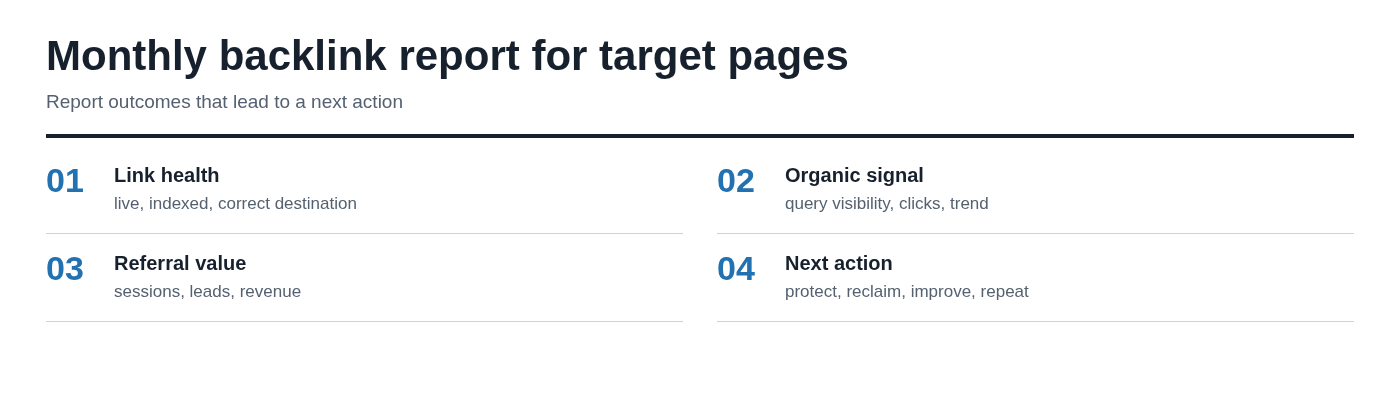
For each target page, report link delivery, current link health, organic search signals, referral value, conversion outcomes, and the recommended action. Keep the narrative short and decision-focused.
Use the report to prioritize work:
- Protect valuable placements that remain live, relevant, and commercially useful.
- Reclaim links that were removed, redirected incorrectly, or changed materially.
- Improve target pages with strong links but weak conversion or relevance signals.
- Repeat placement types that consistently produce qualified referral traffic or plausible organic gains.
- Refine future prospecting criteria when links repeatedly fail quality or persistence checks.
Make backlink measurement a repeatable page-growth practice
Reliable backlink measurement is not about finding one perfect metric. It comes from disciplined baselines, placement QA, scheduled health checks, page-level search analysis, and honest interpretation of the evidence.
Track the pages that matter, not just the number of links acquired. Over time, this shows which target pages respond to authority building, which placements deliver direct commercial value, and where content or technical improvements are needed alongside link acquisition.
Teams that need transparent, target-page-focused placements and reporting can evaluate whether LinkHandy's link-building services fit their SEO strategy.