
A backlink profile can look healthy in a dashboard and still contain expensive blind spots: valuable links pointing to broken pages, too much authority flowing to the homepage, or a pattern of anchors that deserves a closer look. An SEO link audit turns that messy inventory into decisions.
The goal is not to panic over every low-metric domain or build a giant disavow file. It is to understand which links help your most important pages, where equity is being lost, and what your next link-building efforts should support.
What an SEO link audit should tell you
An SEO link audit is a structured review of the external links pointing to your site and the actions they justify. It is not simply a toxic-link hunt. A useful audit should help you identify risks, protect valuable placements, recover lost equity, and uncover realistic opportunities to earn better links.
Start by separating three terms that are often mixed together:
- Referring domains are unique websites that link to you. Ten links from one publication still represent one referring domain.
- Backlinks are individual links from a source page to a page on your site. A single article can contain multiple backlinks.
- Internal links connect pages within your own website. They matter for site architecture, but they are not part of a backlink audit.
Your outcome should be a clear action list: retain high-value editorial links, repair links that no longer reach useful pages, investigate suspicious patterns, and build authority for commercial or strategic pages that are currently under-supported.
Set the audit scope and collect a complete backlink export
Begin with the question you are trying to answer. An annual domain-wide audit is useful for a broad health check, but it is not always the right scope. If a product section has lost visibility, a migration is planned, or a high-value resource page is underperforming, narrow the review to that subdomain, folder, target URL, or topic cluster.
For a full audit, export backlink data from Google Search Console and then add data from a third-party crawler. No source sees the entire web, so treating one export as the complete truth is a common mistake.
Create a working spreadsheet before you start judging anything. Include these columns:
- Source URL and source domain
- Target URL on your site
- Anchor text and surrounding context
- Follow status or rel attribute
- First seen and last seen dates
- Estimated source-page traffic and third-party authority signals
- Link status: live, lost, redirected, broken, or unknown
- Disposition: keep, reclaim, investigate, remove, or disavow candidate
Use Google Search Console as the verification source
In Google Search Console, open the Links report to review external links, top linked pages, and top linking sites. This is especially useful because it reflects links Google has associated with your verified property and shows which destination pages receive reported external links.
Use it to validate ownership, confirm important target URLs, and spot unexpected concentration around a page or section. However, Search Console exports are samples, not a complete universe of backlinks. Do not assume a link is absent simply because it does not appear in the report.
Add a crawl-based backlink tool for broader discovery
Pair Search Console with a crawl-based backlink index such as Ahrefs or Semrush. These tools can surface additional referring pages, lost links, link attributes, historical changes, and competitor context that are harder to see in Search Console alone.
Use their metrics as comparison signals, not ranking factors. A domain rating, authority score, or traffic estimate can help you sort a large dataset, but Google does not use a third-party score as a pass/fail measure of link quality.
Verify important findings manually
A crawl-based backlink tool is particularly useful when you need a fast inventory of referring domains, backlinks, linked pages, and changes over time. Its reports can make it easier to identify links that have disappeared, pages attracting unusual volumes of links, and competitor content that consistently earns citations.
The limitation is the same for every external backlink index: coverage is incomplete and reporting can lag behind real-world changes. Use these tools for broad discovery and comparative analysis, then verify important findings by visiting the source page and checking the destination behavior yourself.
Normalize the data before judging link quality
Raw exports are noisy. The same source can appear with URL variations, tracking parameters, HTTP and HTTPS versions, or multiple subdomains. Normalize these records before calculating totals or making decisions.
Deduplicate at two levels: exact source URL and referring domain. Then standardize domains so that variants such as www.example.com and example.com are grouped appropriately. Keep subdomains separate when they represent materially different properties, such as a publication's editorial site and its user-generated forum.
Also separate sitewide links from editorial mentions. A footer link repeated across 5,000 pages can inflate backlink totals while adding little insight into your actual editorial footprint. One well-placed citation in a relevant industry guide may be more meaningful than hundreds of template placements.
Flag records that need manual checking rather than forcing an automated verdict. This includes source pages that redirect, pages that appear broken, target URLs returning 404 errors, and links with missing or unclear follow-status data.
Map links to the pages and topics they support
A strong backlink profile is not just a high total of referring domains. It should support the pages that matter to the business: product pages, solution pages, comparison content, category pages, and genuinely useful resources that feed authority into the wider site.
Group your target URLs by page type and topic. Then ask whether external links are concentrated on the homepage, blog posts, or a few viral resources while high-intent pages receive little relevant support. Homepages naturally attract many links, but excessive concentration can leave important commercial sections isolated.
Topical alignment matters more than a single domain-level metric. A relevant B2B software publication linking to a SaaS comparison page with descriptive anchor text is usually a stronger fit than an unrelated website with a high authority score linking to the homepage from a generic resource list.

Look at the relationship between the source topic, anchor language, and destination page. If all three align, the link is more likely to make sense for readers and search engines. If they do not, investigate whether the link is simply low value, the target page has changed, or the placement was acquired without a clear topical strategy.
Evaluate link quality using context, not a single score
"Link juice" is a convenient shorthand, but it oversimplifies how links work. Links can help pages discover, contextualize, and earn authority, yet their likely value depends on relevance, editorial placement, crawlability, link attributes, and whether the destination can actually be accessed and indexed. For a deeper explanation of how authority can pass between pages, see backlink link juice.
Review each meaningful link through several lenses: Is the source relevant? Is the placement editorial? Does the page appear useful and maintained? Does the anchor fit naturally? Could the link plausibly send a qualified visitor? A single metric cannot answer all of those questions.
Check editorial relevance and placement
Prioritize links placed within the body of a relevant article, case study, guide, or resource page. These editorial citations usually provide more context than footer links, sidebar widgets, author bios, comment sections, or boilerplate partner pages.
That does not mean every non-editorial link is harmful. A legitimate association listing, partner directory, or event sponsor page can be useful. The question is whether the placement has a clear purpose for readers, not whether it matches an arbitrary layout rule.
Review follow attributes and technical accessibility
Check the rel attributes on important links. A standard follow link has no restrictive rel value, while nofollow asks search engines not to treat the link as an endorsement. Sponsored identifies paid or compensated placements, and ugc identifies user-generated content. See this guide to link rel attributes for the distinctions and associated SEO considerations.
Nofollow links are not automatically worthless. They can generate brand awareness, referral traffic, and editorial discovery. The technical check is broader: confirm the source page is indexable, the target URL returns a valid page, and the link does not pass through an unnecessary redirect chain.
Common mistake: treating a link to a redirected URL as fully resolved. A redirect may preserve value, but the better fix is often to update the publisher's link directly, especially when the old URL sits in an important article or resource page.
Assess anchor text patterns at profile level
Review anchor text across the profile, not link by link in isolation. Natural profiles commonly include branded anchors, naked URLs, generic phrases such as "learn more," topical wording, and occasional partial-match commercial language.
Repeated exact-match anchors deserve investigation when they appear across similar domains, on low-quality pages, or within a concentrated acquisition window. But repetition alone is not proof of manipulation. Legitimate PR coverage, syndicated announcements, navigation, and product naming can create similar patterns for valid reasons.
Identify links that deserve manual risk review
Most weak-looking links do not require action. Still, certain patterns warrant a closer review, especially if they align with a sudden ranking decline, a manual action, or a history of aggressive link acquisition.
- Irrelevant foreign-language pages with no plausible business connection
- Scraped, spun, or automatically generated pages
- Links placed on hacked or compromised pages
- Obvious paid-link networks with repetitive templates and outbound-link patterns
- Sites that appear deindexed or exist only to publish outbound links
- Repeated exact-match anchors from closely related or similarly constructed domains
Do not call a link toxic simply because the domain is small, the authority metric is low, or the link is nofollow. Review patterns by domain, source-page purpose, anchor text, timing, and acquisition history. A spreadsheet full of questionable rows is less important than evidence of a coordinated, manipulative pattern.
Protect and reclaim the links you have already earned
Link reclamation is often the highest-return part of a link audit because you are repairing authority and relevance you already earned. Start with lost links from credible, relevant sites, followed by links pointing to 404 pages, outdated resources, or unnecessary redirect chains.
For each opportunity, choose the smallest effective fix. Restore the old page if it still serves a real search or user need. Otherwise, redirect it to the closest relevant live page, not automatically to the homepage. If the publisher controls the link and the placement is valuable, ask them to update it to the preferred URL.
When an older asset is cited but no longer useful, refresh it. Update the statistics, improve the examples, retain the original URL where possible, and make the page worth keeping linked. Reclamation works best when the publisher and their readers benefit from the correction.
Find backlink opportunities from profile gaps
Your audit should inform acquisition, not just cleanup. Compare your profile with the competitors that rank for your priority topics. Focus on the types of websites and assets that earn links, rather than trying to copy every referring domain.
You may find that competitors attract citations from niche publications, integration partners, expert roundups, original research, or practical templates. Those patterns can reveal where your own expertise, product data, or content can become genuinely useful.
Build a target list around relevant publications, partner ecosystems, expert sources, data-led resources, and pages that link to outdated alternatives. Then match each prospect to a specific asset or angle. Generic outreach asking for "a backlink" is rarely persuasive; a useful replacement, expert contribution, or relevant editorial resource is more credible. For a structured process, see this guide to how to build an SEO outreach strategy for B2B link building.
Reciprocal links can happen naturally between legitimate partners or complementary resources. The problem is not that two sites link to each other; it is arrangements created primarily to manipulate rankings. Prioritize editorial fit, audience value, and a clear reason for the placement to exist.
Decide whether removal or disavowal is actually warranted
Do not request link removals or submit a disavow file simply because a backlink has weak metrics, comes from an unfamiliar website, or is difficult to remove. For most sites, aggressive disavowal creates more work than value and can accidentally discount links that were not causing a problem.
Removal requests and Google's disavow process are best reserved for a documented pattern of manipulative links, particularly where there is a manual action or clear unnatural-link risk. Keep an evidence log with source domains, example URLs, anchor patterns, dates, outreach attempts, and the reason for escalation.
If disavowal is appropriate, prepare the file carefully and use domain-level entries when the issue applies to an entire domain. Follow Google's disavow links guidance closely. A disavow file is not a routine maintenance task; it is a targeted response to a defensible problem.
Turn audit findings into a prioritized action plan
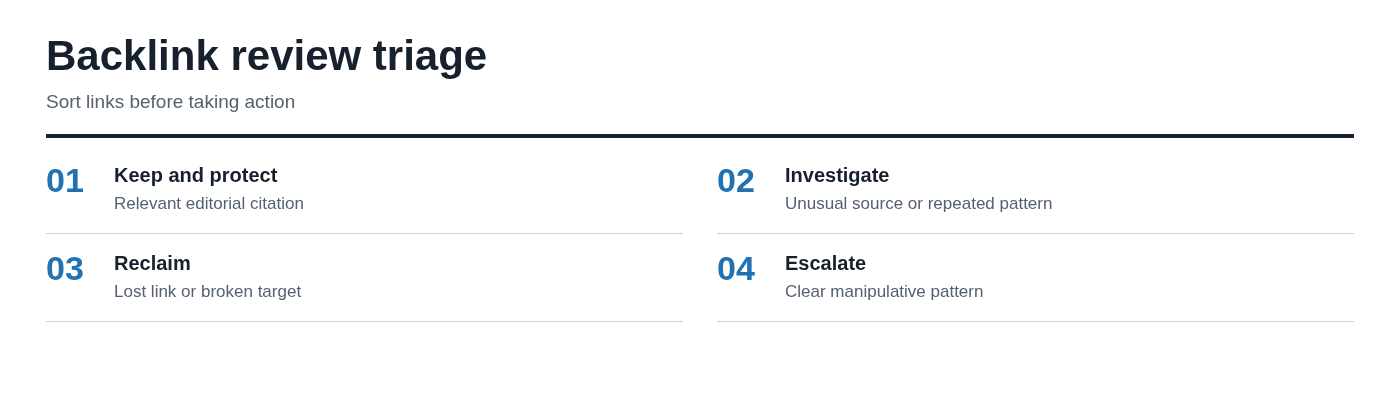
Convert your findings into four workstreams so the audit does not become an abandoned spreadsheet:
- Preserve valuable links: monitor high-value editorial placements and protect the pages they support.
- Reclaim broken or lost equity: fix 404 targets, update redirects, refresh cited assets, and contact publishers where appropriate.
- Investigate suspicious patterns: document evidence, review acquisition history, and escalate only when the risk is credible.
- Build links to priority pages: create campaigns for under-supported commercial pages and linkable assets in strategic topic clusters.
Prioritize each task using business impact, relevance, likely link quality, feasibility, and urgency. A lost editorial link to a high-converting solution page should usually outrank a vague opportunity to improve a low-traffic blog post.
Use a practical cadence: lighter monitoring each month, a fuller quarterly audit, and event-driven checks after a migration, major redirect rollout, manual action, or unusual ranking change. The audit becomes much easier when you maintain a clean baseline instead of starting from zero every time.
Use your link audit to improve the next quarter's backlink strategy
A strong SEO link audit produces evidence-backed priorities, not a panic-driven disavow list. It shows which pages deserve protection, where technical fixes can recover equity, what link patterns need attention, and which topics give your next acquisition campaign the best chance of succeeding.
Document the placements that delivered meaningful editorial links and the assets that earned them. Over time, those insights should shape your content partnerships, digital PR angles, and outreach targets more than a generic authority-score filter ever could.
SaaS and B2B teams that need help turning audit findings into a transparent, white-hat acquisition plan can explore LinkHandy's backlink services.