

A weak guest post author bio can undo the credibility your article worked hard to earn. Readers spot inflated titles, awkward keyword phrases, and irrelevant links quickly - and editors do too.
A strong bio does something more useful. It tells readers why you are qualified to speak on the topic, gives them a reason to learn more, and, when the publisher allows it, creates a legitimate path to a relevant page on your site. Here is how to write one without turning it into a miniature sales pitch.
Start with the role your bio needs to play
Your guest post author bio has two jobs that should support each other: establish credibility with readers and create a relevant, policy-compliant link opportunity. The first job comes first. If the bio does not make sense to a human reader, its SEO value is limited at best.
Do not use the space to repeat your article introduction, list every job you have held, or squeeze in every service keyword your company targets. A bio is attribution, not a landing page. Its purpose is to connect a real person, a real area of expertise, and a useful next step.
Before you write a word, check the publisher's contributor guidelines. Confirm the allowed length, whether a link is permitted, how many links are allowed, whether first or third person is preferred, and whether the site creates a separate author page. These details determine what a useful bio can realistically include. If guest posts are part of a broader SEO outreach strategy, record these requirements so they are applied consistently across publications.
Match your expertise to the host site and the article topic
Choose the one or two facts that make you credible for this article and this publication's audience. Relevance beats seniority here. A SaaS marketer writing about product-led growth should lead with experience in SaaS growth, onboarding, or acquisition - not a broad claim such as "digital marketing expert."
For example, someone contributing an article about technical content strategy to a B2B software publication might say they lead organic growth for SaaS companies. Someone writing about backlink quality could reference experience in editorial outreach and authority strategy. The reader should immediately understand why that person is contributing this particular article.
In practical terms, credible author signals are straightforward: use a real name, a named role, a company or established publication where appropriate, and experience that can be verified. Keep your public identity consistent across your company site, professional profiles, author pages, and guest contributions. A different job title or company name in every bio creates unnecessary doubt.
Choose one clear audience benefit
Ask one question before drafting: why should this publication's audience trust or follow this author? Your answer should become the central value statement in the bio.
Good value statements are tied to actual work. "She helps B2B teams improve organic acquisition through content and authority building" is specific enough to be meaningful. "He helps founders turn customer research into clearer product marketing" explains a useful outcome without making a grand promise.
Avoid empty labels such as "thought leader," "guru," and "passionate professional." They do not prove expertise, and they consume space that could establish it. If you have a strong proof point, state it plainly: the markets you work in, the discipline you practice, or the type of problem you solve.
Include the essential elements of an SEO-friendly author bio
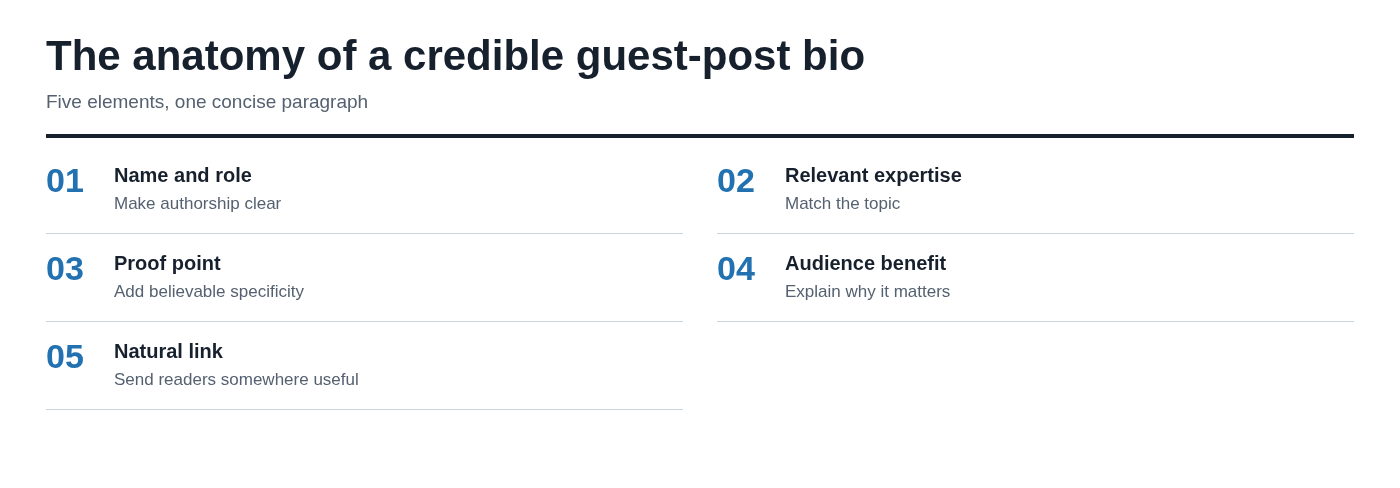
A reliable guest post bio usually follows a simple structure: name, relevant role or company, specific expertise or proof, reader-relevant focus, and one natural destination link when the publisher permits it.
For example: "Maya Chen is an organic growth strategist at Acme SaaS, where she helps B2B teams improve content performance and search visibility. Read more from Maya on the company blog." The final destination would need to match the author and subject matter in a real submission, but the structure is sound.
The SEO value does not come from repeating a target keyword in a 60-word paragraph. It comes from legitimate attribution, topical relevance, useful linking, and consistent brand and entity signals. A credible author bio supports the quality of a guest contribution; it is not a shortcut around editorial standards.
Choose a link destination that fulfills the promise in the bio. That might be an author page, a closely related guide, or a company page that explains the author's work. A random homepage or aggressive sales page is rarely the best reader experience.
Write for the publisher's format and word limit
Length changes what a bio can accomplish. Trying to fit a full professional history into a short byline produces clutter, while using a 25-word sentence on a detailed author profile wastes a useful credibility asset.
- 25 to 40 words: Include the author's name, role, specialty, and one concise link or company reference. This is the best format for a simple article byline.
- 50 to 80 words: Add a focused proof point and a reader benefit. This is the most common range for a standard guest-post bio.
- 100 or more words: Use this for an author-profile introduction, where you can add career context, selected areas of expertise, and links to related work.
Follow the publication's house style. First person can work well on founder-led blogs and personal publications: "I help..." Third person is often a better fit for editorial B2B sites: "Alex helps..." If the site uses third person for every contributor, do not make an exception for your bio.
Keep your name, company spelling, job title, and brand link consistent. A blog author profile should reinforce the same identity readers see elsewhere, not introduce a slightly different version of it.
Use keywords and links naturally without over-optimizing
You can use a topical phrase in an author bio when it accurately describes the author's work and reads naturally. For instance, "a B2B content strategist focused on organic acquisition" is a useful description. Repeating "best SaaS SEO agency" or another commercial phrase is not.
Exact-match anchor text, several promotional links, and unrelated destinations can make a bio look engineered for search engines rather than written for readers. They may also conflict with the host site's editorial rules. Publishers are not obligated to preserve your preferred wording, link, placement, or follow attribute.
If an in-bio link is allowed, a branded or topic-led anchor is usually the safest default. "Learn more about LinkHandy" or "read the team's guide to editorial link building" is more natural than a long commercial keyword phrase. Keep a bio link distinct from an in-article citation: a citation should support a claim in the article itself, while the bio link identifies the contributor or offers a logical next resource.
Choose a destination that reinforces topical relevance
Start with the reader's likely next question. If they want to assess the author's expertise, an author profile is a strong choice. If the article introduces a process and readers need a deeper explanation, a related guide can work. If the contributor represents a specialist service, a relevant service page may be appropriate.
A homepage is acceptable when it is the clearest route to more information, but it is often less useful than a focused page. Whichever destination you choose should be live, substantive, trustworthy, and aligned with the article. Do not send a reader from a practical SEO article to a thin conversion page that offers no educational value.
Use these short guest post author bio examples as models
The following blog author bio examples are original templates, not profiles of real contributors. Adapt the facts and language to your actual role, experience, and publisher requirements. Do not copy a template and add claims you cannot support.
Example: SaaS content strategist bio
Jordan Lee is a content strategist at Northstar Cloud, where he develops organic growth programs for B2B SaaS teams. His work focuses on connecting customer research, product positioning, and search-focused content into practical acquisition channels. Find more of Jordan's writing and resources at Northstar Cloud.
This works because it identifies a relevant role, names a focused discipline, and gives readers a realistic reason to click. The proof point is restrained: it explains the type of work Jordan does rather than claiming impossible results or universal expertise.
Example: Founder or subject-matter expert bio
Priya Shah is the founder of ClearPath Analytics, a reporting platform built for growing B2B teams. She writes about the operational decisions behind reliable marketing measurement, drawing on firsthand experience building analytics processes with lean growth teams. Explore Priya's background and resources on her author page.
This bio establishes firsthand operational experience without calling Priya an authority simply because she is a founder. It also makes the author-page link feel useful: readers who want more context have a clear place to go.
Example: Agency contributor bio
Daniel Ortiz is an outreach specialist at LinkHandy, a boutique link-building agency for SaaS and B2B companies. He works on editorial outreach, contextual placements, and authority strategy, with an emphasis on relevant publications and transparent approval processes. Learn more about LinkHandy's approach to editorial link building.
This version keeps the agency mention connected to the topic. It describes the contributor's area of work, avoids promises about rankings or link volume, and uses a brand link as an attribution detail rather than a disruptive pitch.
Create a reusable author bio system, not one generic paragraph
One generic bio is convenient, but it becomes stale and often fails to match the host site's audience. Build a simple author-bio system instead. Start with a master fact sheet that includes approved job titles, accurate credentials, selected proof points, preferred company descriptions, and validated destination URLs.
Then create short, medium, and long versions for each main expertise area. A SaaS founder may need one version for product strategy, another for customer research, and another for operational leadership. The identity details should remain truthful and consistent, while the emphasis changes to fit the article.
Maintain author pages as supporting assets. A strong page includes a clear bio, relevant work or articles, a credible way to verify the person's professional identity where appropriate, and internal links to the subjects they genuinely cover. That makes a guest post bio more credible because readers can find coherent evidence behind it. Teams coordinating this work at scale may also compare their process with established blogger outreach services.
Check credibility, compliance, and link quality before submitting
Use a quick final review before sending the draft to an editor. The goal is not to make the bio sound more promotional; it is to make it accurate, useful, and easy for the publisher to approve.
- Can every claim be verified through a company site, author page, publication, or professional profile?
- Is the author's connection to the article topic obvious in the first sentence?
- Does the copy follow the publication's length, tone, person, and linking rules?
- Is the link explicitly permitted, useful to readers, and relevant to the contribution?
- Does the wording avoid unsubstantiated awards, client claims, guarantees, or prohibited promotional language?
Do not assume the editor will use your preferred anchor text, link attribute, or placement. Those decisions belong to the publisher. Once the piece is live, save the published URL, final bio copy, destination URL, publication date, and any editorial changes in a shared record. This helps you spot outdated titles and broken links later.
Avoid author bio mistakes that undermine trust
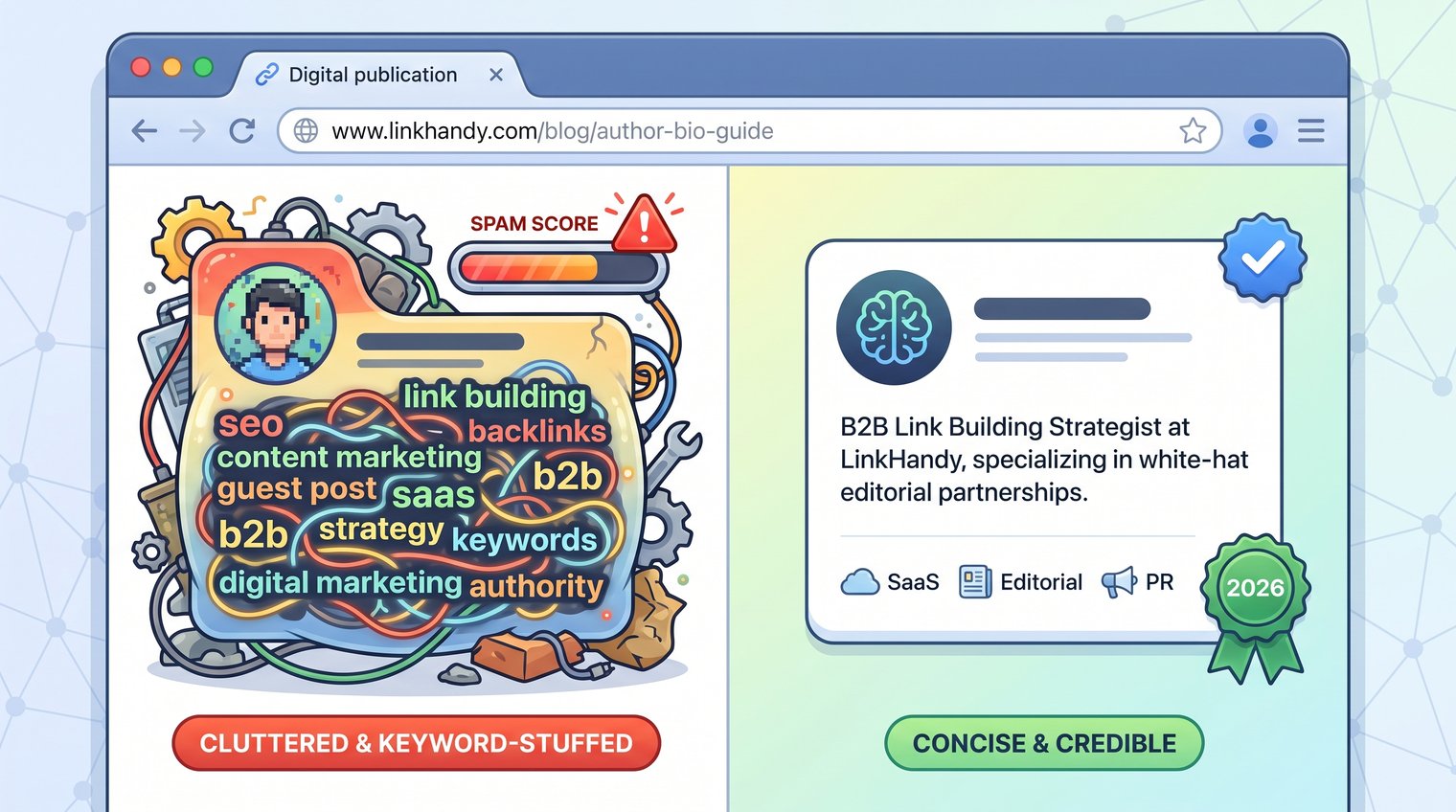
The most common error is credential dumping: a dense list of roles, certificates, awards, and industries that tells readers nothing about why the author wrote this article. Replace it with one relevant role and one specific area of experience.
Keyword stuffing is another easy way to lose trust. Instead of writing, "Taylor is a top B2B SEO consultant providing SaaS SEO services and backlink services," write, "Taylor works with B2B software teams on technical SEO and editorial authority." The second version is clearer, more believable, and more useful.
Other mistakes include linking to an irrelevant page, claiming awards or client outcomes that cannot be verified, copying the same bio word-for-word across every publication, and using a voice that clashes with the host site. Correct each one with concise, evidence-led writing and a destination that serves the article's reader.
Most importantly, do not treat guest post bios as a scalable backlink tactic detached from editorial value. The right placement is one where the author's experience, the article, the publication, and the link all belong together.
A guest post bio should make the next click feel earned
A good guest post author bio is short because it has a focused job. Establish relevant expertise, explain the value you bring to the audience, follow the publisher's rules, and use one helpful link naturally when it is allowed.
That approach supports both reader trust and sustainable SEO. Teams building editorially relevant B2B backlink campaigns can also seek support from LinkHandy.