
Link building automation can make a strong SEO program more efficient. It can also turn a carefully built brand into another sender filling editors' inboxes with irrelevant, generic pitches.
The difference is not the software. It is where you draw the line between operational work a system can handle and editorial decisions that require a person. Automate the repetitive work around link building, and your team gets more time for strategy, research, and relationships. Automate judgment, and quality usually collapses.
What link building automation is - and what it is not
Link building automation is the use of systems, data, and workflows to reduce repetitive work across prospecting, qualification, outreach operations, relationship management, and reporting. It can enrich a prospect list, remove duplicates, schedule follow-ups, log replies, monitor lost links, and pull campaign data into a dashboard.
It is not a license to automate the decision to pursue a publisher, accept a placement, or send a message that claims a relationship you do not have. Those are high-context decisions with consequences for your brand, your sender reputation, and the usefulness of the eventual link.
AI link building fits this distinction. AI can help cluster prospects, summarize recent articles, surface editorial cues, and draft research notes. It cannot reliably decide whether a publication is a credible fit for your audience or whether a proposed link genuinely improves a reader's experience.
The quick-start rule: automate volume, keep humans on value judgments
Use one operating principle from the start: automate repeatable data tasks and handoffs; keep people responsible for relevance, claims, relationships, and final approval.
That means data enrichment, reminders, CRM updates, and reporting can be automated safely. Prospect scoring, contact suggestions, draft messages, and anomaly detection need review. Publisher selection, negotiation, editorial angles, link placement, and quality acceptance should remain human-led.

Why quality breaks when automation is aimed at the wrong task
Most poor automated link building does not fail because teams use automation. It fails because they use it to increase outreach before they have a reliable definition of a qualified prospect.
The familiar pattern is easy to spot: a broad list assembled from weak filters, generic sequences sent to everyone, exact-match anchor text pushed into unsuitable articles, and placements reported without meaningful checks. The result may look like activity in a spreadsheet, but it rarely creates durable authority.
Irrelevant outreach wastes budget and harms sender reputation. Templated messages can damage relationships with publishers who might otherwise have been useful partners. Weak placements create brand risk, particularly for B2B companies that need to appear credible to sophisticated buyers. And links from pages with no real topical or audience connection often have little strategic value.
Scale itself is not the problem. Indiscriminate scale is. A program can review hundreds of candidates efficiently and still send a small, highly relevant set of messages. In fact, that is usually the better outcome.
Set the strategy before you automate the workflow
Software should support a link strategy, not become the strategy. Before building queries or sequences, identify the pages that matter, the people those pages serve, the topical authority gaps holding them back, and the acquisition methods that are realistic for your assets. A documented SEO outreach strategy can help turn those decisions into a repeatable workflow.
Start with a concise link brief for every priority page. It should include the business goal, page type, target topic cluster, ideal referring-site profile, message angle, and success measure. A benchmark report may earn citations from industry publications; a product page may need supporting educational content and internal links before it is an appropriate outreach destination.
Prioritize pages by linkability, not just keyword difficulty
A commercial page can be important without being a credible direct link target. Editors are rarely looking for a reason to cite a pricing page, feature page, or category page. They are more likely to reference original research, a useful calculator, a detailed guide, a template, or an expert-led resource.
When the target is a money page, build a supporting asset that deserves editorial attention and use internal links to pass readers and relevance toward the commercial page. This avoids the common mistake of forcing a promotional destination into an article where it does not help the reader.
Define a quality standard that a team can actually apply
Quality must be more specific than "high authority." Domain-level metrics can help prioritize research, but they are not a standalone acceptance rule. A strong domain can still host irrelevant, thin, or poorly maintained pages.
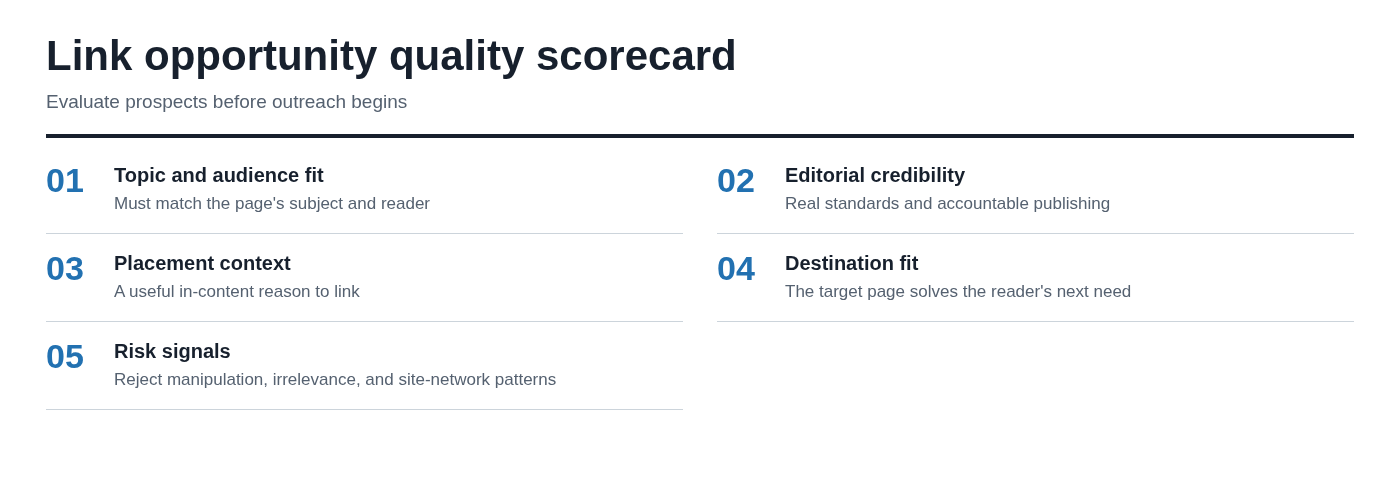
Evaluate each opportunity against practical criteria:
- Topical relevance: The publication and page relate to the target page's subject.
- Real audience: The site appears to serve actual readers, customers, or a defined professional community.
- Editorial credibility: There are visible standards, accountable publishing, and consistently useful content.
- Placement context: There is a natural, in-content reason for a reader to follow the link.
- Destination fit: The target page answers the next question a reader would reasonably have.
- Risk signals: The opportunity does not show patterns of manipulation, irrelevant paid placements, or site-network behavior.
The automation boundary: a task-by-task decision framework
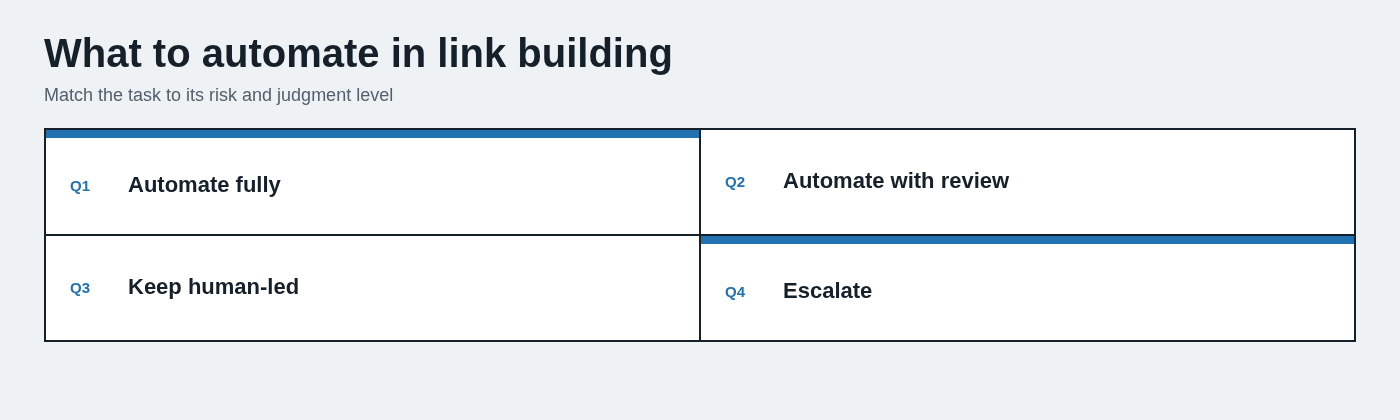
A useful automation boundary considers four things: whether a mistake is easy to reverse, the reputational risk involved, how much context the decision requires, and the cost of being wrong. The more public, irreversible, or nuanced a decision is, the more human ownership it needs.
Low-risk tasks to automate fully
Automate work that improves consistency without making an editorial claim on your brand's behalf. This includes data enrichment, duplicate removal, CRM updates, campaign status changes, reminder creation, reporting pulls, broken-link monitoring, and list hygiene.
For example, a workflow can flag a newly broken external link on a relevant resource page and create a research task. It should not decide that your page is the right replacement and send a pitch without review.
Tasks to automate with human review
Prospect scoring, topical classification, contact suggestions, first-draft outreach, follow-up timing, and anomalies in link reports all benefit from automation, but they need controls. Use confidence thresholds and approval queues rather than treating machine output as final.
A practical approach is to auto-approve only low-impact data changes, route medium-confidence prospects to a reviewer, and escalate high-value or uncertain opportunities to an experienced strategist. Sample the output regularly. If a classifier repeatedly calls adjacent-but-irrelevant sites a match, revise its inputs and exclusions rather than accepting the error rate.
Tasks that should remain human-led
Relationship selection, publisher vetting, partnership negotiation, content angles, final copy approval, anchor and placement acceptance, and vendor quality control should stay with accountable people. These decisions depend on tone, audience expectations, existing relationships, and editorial context that no score can fully capture.
Automation can tell you that a publication has written about a topic. It cannot tell you whether its editor will see your contribution as useful, self-serving, or off-brand.
Automate prospect discovery without automating prospect quality
Discovery should be broad. Qualification should be selective. That is the most productive way to use automation in prospecting.
Build candidate pools from topic clusters, competitor referring domains, unlinked brand mentions, resource pages, podcasts, expert roundups, digital PR angles, and broken-link opportunities. These sources expand coverage, but a source is not an endorsement. Every candidate still has to pass the quality standard established earlier.
Build reusable prospecting queries and source lists
Create a query library organized by asset type and vertical. For example, a report may be suited to "industry statistics," "state of," "benchmark," and "research roundup" queries. An expert guide may fit resource pages, contributor opportunities, and articles addressing a specific operational problem.
Include exclusions for irrelevant industries, low-value page types, and known low-quality patterns. Record why each source entered the workflow, such as "covers B2B finance operations" or "maintains a vetted SaaS resources page." That rationale lets the next reviewer validate the opportunity instead of guessing why it was selected.
Score candidates with multiple signals, then inspect the short list
A transparent score can order work effectively when it combines topical similarity, audience overlap, signs of active editorial publishing, contextual placement opportunity, and risk indicators. It should never replace review.
Use the score to create a short list and clear rejection reasons. A candidate might be rejected because the audience is consumer-focused, the recent content is mostly sponsored posts, the relevant page is stale, or the target resource does not solve a reader need in that context. Those reasons are valuable data: they improve future filters and prevent the same poor-fit prospects from returning.
Use AI for research and drafting, not fabricated personalization
AI can remove the slowest parts of research without removing responsibility. It can cluster a large prospect list, summarize recent coverage, extract stated contributor guidelines, identify shared topical ground, draft research notes, and propose message variants for a reviewer to improve.
It should not invent familiarity with an article nobody read, praise a publication in generic terms, impersonate a person, or send unedited pitches at scale. False personalization is worse than no personalization because it signals that the sender does not respect the recipient's work.
Create an AI research brief for each high-priority prospect
For high-priority publishers, create a short brief before outreach. Include the publication's audience, relevant recent coverage, contributor or editor cues, a possible value exchange, destination-page fit, and a human-written outreach angle.
Suppose a SaaS company has published original data on onboarding friction. An AI-assisted brief might identify that a publication recently covered customer retention, accepts expert commentary, and serves customer success leaders. A strategist can then decide whether the data adds something new and write a truthful message around that specific editorial opportunity.
The brief becomes a useful handoff artifact. Research, outreach, and relationship management can all refer to the same documented rationale instead of relying on fragmented notes.
Design outreach automation around relevance and consent
Outreach systems should make good follow-through easier, not make cold-email volume the primary KPI. Use sequencing for reminders and timing, maintain contact suppression lists, honor opt-outs immediately, and monitor deliverability so you catch problems before they affect the whole program.
Segment-level templates can preserve speed while leaving room for a real reason to contact each person. The template provides the structure; the researcher or outreach lead supplies the specific, verified relevance.
Build sequences by relationship type, not one universal template
An editorial contributor, a content partner, a journalist, an existing customer, and a contact responsible for an unlinked brand mention each need a different approach. Their incentives are different, so their messages should be too.
- Editorial contributors: Lead with a useful evidence-backed angle or expert insight.
- Potential partners: Explain the shared audience and a practical collaboration opportunity.
- Journalists: Offer timely data, a qualified source, or a concise perspective on a current topic.
- Existing customers: Focus on a credible case study, co-marketing asset, or mutually useful story.
- Unlinked mention contacts: Make a clear, low-friction request to add an accurate supporting reference.
Each sequence should have its own value proposition, proof point, call to action, and follow-up ceiling. There is no defensible reason to send the same four-message series to every contact type.
Add stop rules that protect relationships and sender reputation
Every campaign needs hard stop rules. Stop automation when a prospect replies, bounces, unsubscribes, gives a negative response, enters an existing conversation, completes a placement, or fails a later quality check.
Log disqualifying feedback. If several editors say a pitch is too commercial, too broad, or not relevant to their readership, treat that as a process signal. Update the asset positioning, segmentation, or source filters rather than simply sending more messages.
Automate relationship operations after the first conversation
The highest-value link building is often relational rather than transactional. Once a publisher, expert, or partner has engaged, automation can support the relationship without impersonating it.
Use workflows for meeting reminders, contributor records, editorial calendar prompts, co-marketing opportunities, placement follow-up, content-update alerts, and renewal conversations. A partner pipeline helps a team remember context, commitments, and past collaborations.
This is fundamentally different from treating every contact as a one-time link target. Content partnerships and PR relationships can compound over time because they are based on useful work and credible editorial fit, not a single automated sequence.
Keep link placement, anchors, and editorial value under human control
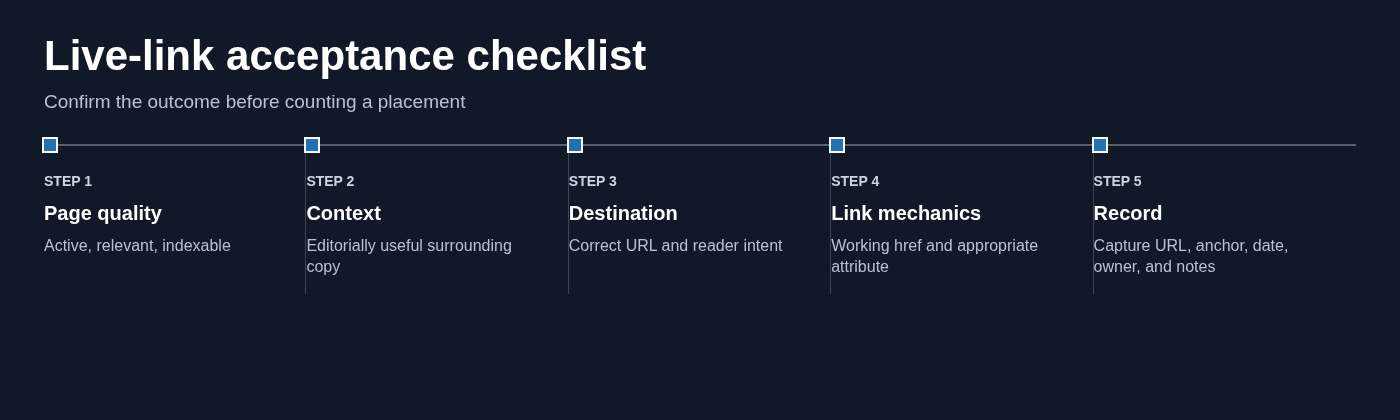
A placement is not complete when someone says the link is live. It is complete when a reviewer confirms that the live page, the surrounding copy, the destination, and the technical details match the agreed standard.
Check whether the page is relevant and indexable, whether the link resolves correctly, whether the surrounding copy makes the reference useful, and whether the attributes accurately reflect the relationship. A link buried in unrelated boilerplate or inserted into an awkward sentence is not the same as a true editorial recommendation.
Anchor text needs the same restraint. Treat it as a distribution issue to manage conservatively, not a field to optimize mechanically in every placement. Natural wording that fits the sentence and reader intent is usually more defensible than forcing a commercial exact-match phrase into copy.
Review the live page rather than trusting a placement confirmation
Use a post-publication checklist before counting a placement:
- The page is live, accessible, relevant, and indexable.
- The link points to the correct URL and resolves properly.
- The placement is contextual and useful within the surrounding copy.
- The link attribute is accurate for the arrangement.
- The page quality has not changed since initial review.
- The record captures the URL, anchor, date, owner, and relevant notes.
Request a correction when the agreed destination is wrong, the link is broken, the attribute is incorrect, or the placement materially misrepresents the asset. If the page turns out to be poor quality or the context is too weak to be useful, exclude it from reporting rather than trying to make an unsuitable link look valuable.
Build a quality-control system that scales with your program
Quality assurance should not begin after a campaign produces bad links. It should operate throughout research, outreach, negotiation, placement, and reporting.
Document acceptance criteria, define escalation paths, and assign separate accountability for prospect research, message approval, and live-link verification. Separation matters because the person rewarded for sending more pitches should not be the only person deciding whether those pitches were appropriate.
Use sampling to audit large outreach and placement volumes
You do not need to re-review every low-risk administrative action. You do need to inspect a meaningful sample of approved prospects, sent messages, and completed placements every week or campaign cycle.
Track defects by category: irrelevant prospecting, unsupported personalization, poor contextual fit, incorrect destination URL, weak anchor treatment, or incomplete live-link verification. Trends reveal where the workflow is failing. One-off errors happen; repeated errors indicate a broken rule, source, template, or training gap.
Measure process quality alongside link quantity
Link count alone is an incomplete measure. Track leading indicators such as qualified-prospect rate, reply quality, positive-response rate, placement acceptance rate, correction rate, publisher repeat rate, and the reasons candidates are disqualified.
Keep these measures separate from downstream SEO performance. Rankings and organic traffic matter, but they are also affected by content quality, competition, technical health, internal linking, and time. Process metrics tell you whether the link-building operation itself is getting more precise.
A worked example: automating a SaaS resource-page campaign with quality gates
Consider a fictional B2B SaaS company that publishes an original benchmark report on how operations teams handle manual reporting. The report contains a clear data point: teams using fragmented reporting workflows spend significantly more time reconciling data than teams using standardized processes. Its audience is operations leaders, finance teams, and SaaS managers evaluating workflow improvements.
The aim is not to place the report everywhere. The aim is to earn relevant references from pages where the data helps readers understand an operational problem.
Stage 1: turn the asset into a credible outreach proposition
First, the team validates the asset. Does it offer original data, a useful methodology, and a finding that a publisher could cite without turning their article into an advertisement? If not, outreach should not begin.
The team identifies likely page types: guides to operational reporting, articles on finance automation, benchmark roundups, resource libraries for operations leaders, and expert pieces about reducing manual work. The go/no-go requirement is simple: if the report lacks a clear reason to cite it, automation cannot create one.
Stage 2: process 300 candidates into a human-approved outreach list
Automation gathers 300 candidates from relevant queries, competitor referral patterns, and resource-page research. It removes duplicates, identifies likely contacts, groups sites by audience, and assigns a preliminary score based on topic, recent publishing activity, likely contextual opportunity, and risk signals.
A human reviewer then examines the strongest candidates. A respected operations publication with a recent article on reporting bottlenecks is accepted because the report offers a specific, relevant data point. A SaaS resource library is accepted because it actively maintains a reporting-tools section and the report is a genuine educational resource.
A general business blog is rejected because its audience is too broad and its recent posts are mostly affiliate comparisons. An apparently strong domain is rejected because the relevant page has not been updated in years. A finance publisher is rejected because it focuses on personal budgeting, not business operations. The output may be 40 carefully approved prospects rather than 300 contacts, which is a better list.
For the highest-priority prospects, AI drafts research briefs that summarize relevant coverage and editorial cues. A human then writes the final opening and verifies every claim. The outreach sequence varies by relationship type: editors receive a concise data angle; resource-page owners receive a clear explanation of how the report fills a documented gap.
Stage 3: verify outcomes and feed learnings back into the system
Replies immediately stop the automated sequence. Positive responses are assigned to a relationship owner. If a publisher asks for a different format, such as a short expert comment or a chart with methodology, that request is handled manually.
Every completed placement is checked against the live-link checklist. A link from an article on reporting automation with clear surrounding context is accepted. A link placed on an unrelated software roundup is excluded, even if it technically points to the right page.
Finally, the campaign data feeds back into the process. If resource pages produce strong placements and generic business blogs do not, source priorities change. If editors respond positively to a specific statistic, that finding becomes a stronger message angle. If a site type repeatedly produces weak contexts, it goes on the exclusion list.
Choose a lean automation stack based on workflow gaps
A lean stack is usually better than a crowded one. Choose tools based on the gap you need to solve: backlink intelligence, prospect research, contact organization, sequencing, collaboration, monitoring, or reporting. No platform removes the need for the quality gates described above.
Backlink intelligence: Ahrefs and Semrush
Backlink intelligence platforms help teams analyze competitor referring domains, identify link patterns, monitor gained and lost links, and generate initial opportunity ideas. They are useful at the discovery stage because they reveal where relevant pages and competitors have attracted attention.
Ahrefs is a practical option for initial backlink and referring-domain research. Its limitation is the same as every aggregate backlink dataset: it can help identify a lead, but it cannot determine whether an individual publisher or placement is right for your campaign.
Semrush
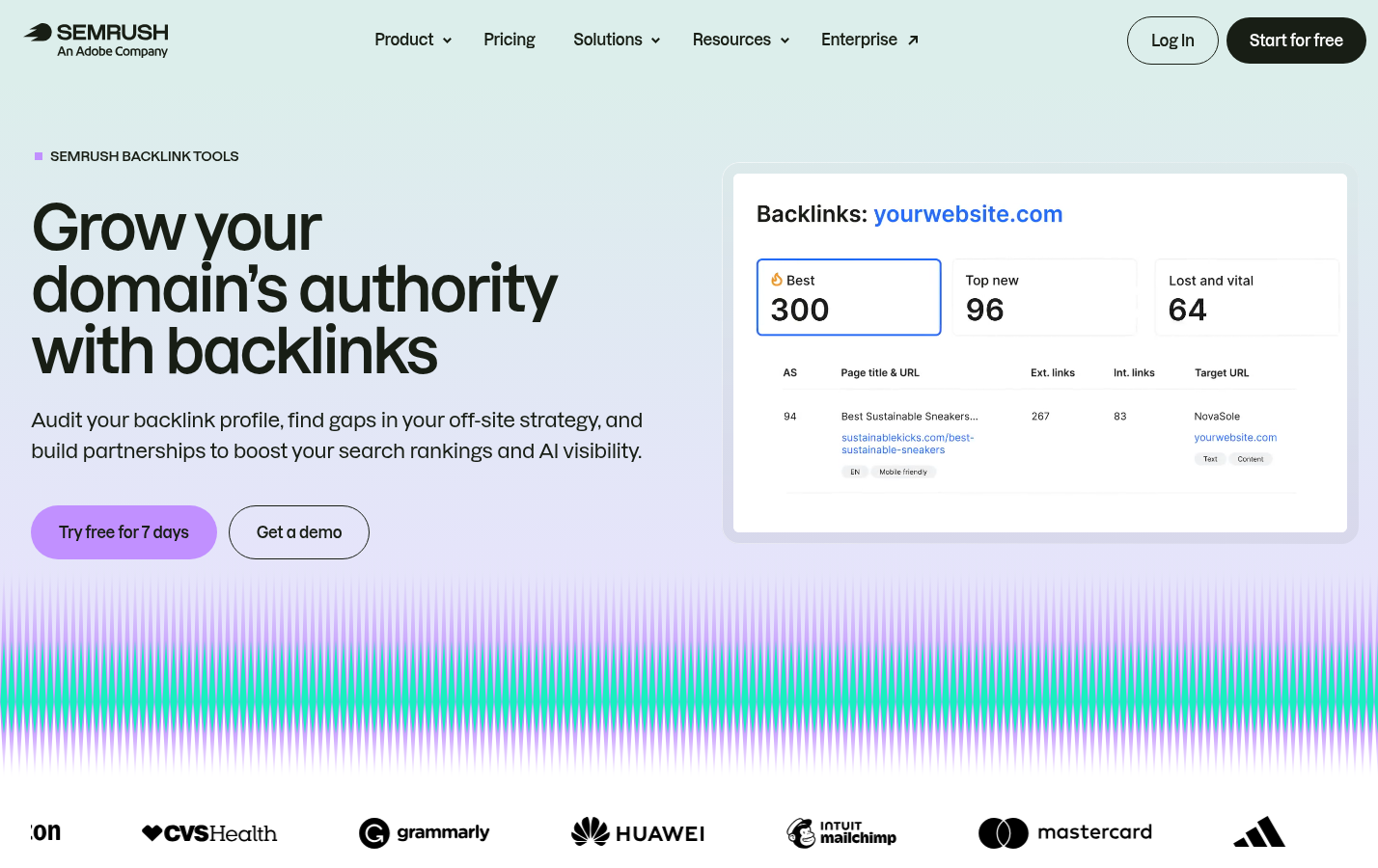
Semrush also supports backlink research and monitoring, making it useful for teams that want discovery and ongoing link visibility within a broader SEO workflow. It is a sensible fit when backlink analysis needs to sit alongside keyword and competitive research.
The limitation is not unique to Semrush: a platform can surface a domain and its signals, but it cannot validate editorial standards, reader fit, or the quality of a specific insertion. Use the Semrush link building tool and similar features to organize research, then verify each prospect individually.
Outreach and relationship workflow: BuzzStream and Pitchbox
Outreach platforms are most useful for organizing contacts, sequences, templates, follow-up tasks, team visibility, and campaign reporting. They make an approved process easier to execute consistently. They do not make a poor prospect relevant or an unreviewed pitch safe to send. Teams comparing execution models can also review this guide to blogger outreach services.
BuzzStream is suited to teams that need a structured way to manage outreach relationships and keep prospect notes, contact records, and campaign activity in one place. Its value is operational discipline, especially when several people contribute to research and outreach.
Pitchbox
Pitchbox is designed for more structured prospecting and outreach workflows, making it a potential fit for teams handling larger, documented campaigns. Its meaningful limitation is that more automation capacity can amplify bad process just as efficiently as good process.
Choose it when you already have clear quality standards, reviewer ownership, stop rules, and placement verification. If those controls are not in place, define them first. The best tool for link building is the one that supports accountable decisions rather than encouraging indiscriminate volume.
What not to automate in a quality-first link-building program
Some tactics do not become acceptable because a workflow makes them faster. Avoid bulk link purchases, automated comment or forum links, spun guest posts, deceptive personalization, mass reciprocal-link requests, forced exact-match anchors, and acceptance decisions based solely on authority scores.
These approaches fail the basic quality test: would you be comfortable explaining the tactic to the publisher's audience, your customers, or your leadership team? If it depends on hiding how it works, misleading a contact, or treating editorial space as a commodity, it does not belong in a sustainable program.
Build an automation system that earns links worth keeping
The practical answer is straightforward. Automate research operations, data movement, monitoring, reminders, and repeatable follow-up. Keep editorial judgment, relationship decisions, content angles, and final placement approval with people who are accountable for quality.
That division gives B2B teams the efficiency they want without sacrificing relevance, trust, or long-term search value. It also creates a program that can improve over time because every approval, rejection, reply, and placement becomes useful feedback.
Teams that need transparent, quality-controlled support for contextual placements, editorial guest posts, content partnerships, PR mentions, and authority strategy can explore LinkHandy's approach.