
You ask two agencies for a link-building quote. One offers ten links for less than the other charges for five. Before you choose, you need to know whether they are selling the same work: research, writing, outreach, publisher coordination and placements that fit your business.
Link building pricing is the cost of earning or arranging links from other websites. It can be quoted per placement, per month or per campaign. For a SaaS or B2B team, the useful question is how much a relevant, accepted placement costs once the whole project is included.
Current public examples below range from $198 to about $428 per advertised link, but they cover different packages and commitments. That is a comparison of three published offers, not a market average or a quality rating. Use it to understand the units in a quote, then build a budget around your own requirements.
Prices checked: Sep 29, 2026. All figures are in US dollars; confirm taxes, payment terms and the final scope with the provider.
What published link-building prices actually include
These providers publish enough information to calculate a package price per link. The figures describe their advertised offers; we have not purchased or tested these services.
|
Public offer |
Advertised price and quantity |
Price divided by links |
Detail to confirm before buying |
|---|---|---|---|
|
$990 for five placements; one-off pilot |
$198 |
The page says payment follows approval and live verification. Confirm which service and target requirements apply. |
|
|
$1,750 package for five editorial links |
$350 |
Pre-approval is listed. Confirm delivery timing, payment cadence and the exact scope of the package. |
|
|
$2,999 per month for seven links |
$428.43 |
The page includes prior domain approval, an account manager, consultation and competitor analysis. Confirm any minimum commitment. |
The small differences matter. A one-off pilot is not equivalent to a recurring monthly programme. Domain approval is not necessarily approval of the exact article, surrounding text or destination URL. A package's claim about authority or traffic does not establish how relevant its placements will be to your buyers.
Treat published rates as a starting point for a written quote. Avoid combining unrelated rates into a supposedly precise industry average: that would mix different deliverables, niches and payment schedules.
Choose a pricing model that matches the work
Per-placement pricing
You pay for a defined delivered link, usually after agreeing criteria such as topic, placement format and target page. This can suit a small test or a team that already owns its strategy and content.
Ask what triggers payment. A prospect accepting a pitch, a draft being approved and a verified live link are different milestones. Also confirm whether writing, revisions and publisher charges are included.
A monthly retainer
A retainer funds ongoing work such as prospect research, outreach, content coordination and reporting. Some include a placement target or minimum; others pay for time and campaign activity.
The distinction affects your budget. Ten researched opportunities are not ten published links. Ask how undelivered work, unused budget and cancellation are handled. For a broader explanation of the operating model, see our managed link-building guide.
A campaign or project fee
A research report, expert-commentary campaign or digital PR project may involve substantial work before any publication agrees to cover it. Here, a fixed fee can buy research, an asset and outreach rather than a guaranteed number of links.
Request a breakdown of the work and ownership of the resulting content. Ask how the provider reports coverage, unlinked mentions and syndicated copies so you can judge the campaign without inflating its link count.
In-house or freelance support
An hourly rate is only one part of the cost. Include the time spent managing the work, writing content, reviewing prospects, using tools and checking completed placements.
Use your actual staffing costs. A generic estimate for a three-person agency team says little about a company with an existing content writer who needs a few hours of outreach support each week.
What changes the price of a relevant placement?
The available audience. A broad business blog and a specialist publication for enterprise security buyers serve different purposes. Narrow topics or target countries can mean fewer suitable publishers and more research per opportunity.
The content requirement. Updating a useful reference in an existing article is different work from producing a researched guest contribution. Original data, expert input and editorial revisions add effort. Agree who provides that material before comparing quotes.
The approval process. Reviewing domains, pitches and drafts adds work, but it also gives you control over brand fit. Set the approval criteria and response times early so the provider can price the actual process.
The service around the placement. Strategy, reporting, content production and post-publication checks may be bundled or billed separately. A more expensive package may include work your team would otherwise have to do; an inexpensive one may be appropriate when you already cover it.
The commercial terms. Minimum commitments, setup fees, prepaid discounts and replacement coverage affect the total amount at risk. A lower monthly equivalent can require a larger upfront payment.
Domain Rating, Domain Authority and estimated traffic can help with screening, but a price tier based on a score cannot answer whether the page reaches your audience. Inspect the page, its topic, the proposed context and its recent content. Record tool traffic estimates as estimates rather than verified visitors.
Compare quotes with a complete cost worksheet
Before asking which agency is cheaper, put both proposals into the same set of fields:
|
Cost or commitment |
What to put in your comparison |
|---|---|
|
Service fee |
The fee for the same evaluation period, including setup charges |
|
Content |
Research, writing, expert review, design and revision costs not already included |
|
Publisher costs |
Whether there are separate placement or sponsorship charges, and any markup |
|
Internal work |
Your team's estimated review and management hours multiplied by its internal hourly cost |
|
Delivery definition |
Live links, unique referring domains, accepted opportunities or campaign activity |
|
Acceptance criteria |
Audience, topic, exact placement context, target URL and agreed link attributes |
|
Commitment and remedies |
Upfront payment, minimum term, cancellation, replacement period and exclusions |
Do not add a bundled cost twice. If writing is included in the service fee, enter zero additional writing cost and note that inclusion.
For internal comparison, calculate:
Total evaluation cost = service fees + additional content and publisher costs + internal review cost.
Then divide that total by the number of delivered placements that satisfy your agreed requirements. Where you are evaluating new referring domains, count each domain once. Keep repeat links and syndicated copies visible in a separate count.
Worked example: the cheaper quote can have the higher effective cost
Imagine two fictional campaign results over the same evaluation period. Both totals include all fees and review time; the numbers below are illustrative, not LinkHandy prices or customer results.
|
Measure |
Campaign A |
Campaign B |
|---|---|---|
|
Total evaluation cost |
$2,400 |
$3,000 |
|
Reported placements |
10 |
8 |
|
Placements meeting the agreed criteria |
4 |
8 |
|
Cost per reported placement |
$240 |
$375 |
|
Cost per accepted placement |
$600 |
$375 |
Campaign A's headline unit cost is lower, but its effective cost is higher in this example. It costs $2,400 ÷ 4 = $600 per accepted placement, compared with $3,000 ÷ 8 = $375 for Campaign B. The acceptance count changes the comparison.
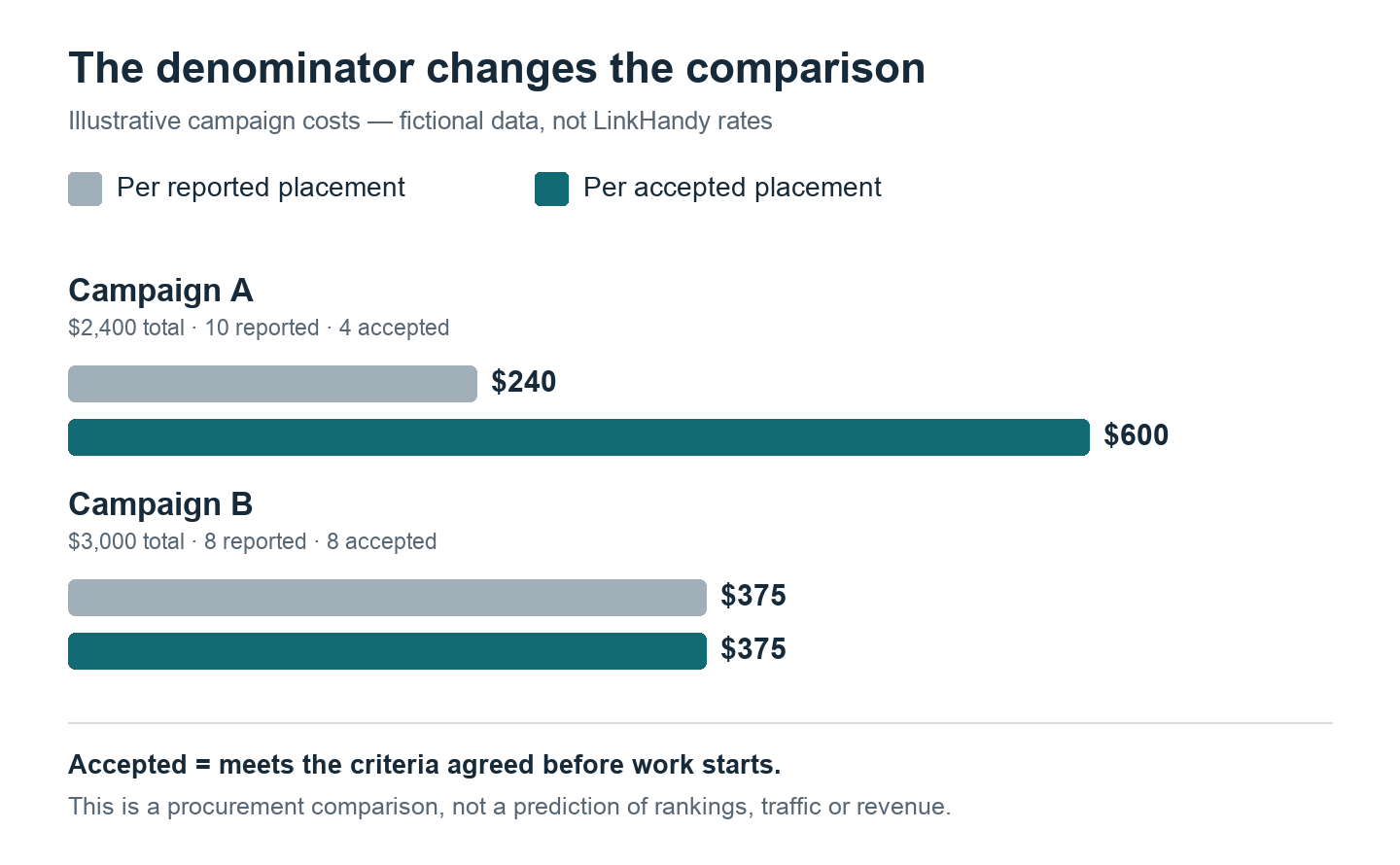
Original illustration using fictional campaign totals. Acceptance means meeting a predefined brief; it does not predict ranking, traffic or revenue.
Agree the criteria before work begins, ideally with approval before commitments are made. If a placement fails them, use the contract's correction or replacement process. The calculation helps you evaluate spending; it should not become an excuse to accept unsuitable delivery.
Keep paid placements and earned coverage clear
Paying a specialist to research publishers, create useful material and pitch editors is different from paying a publisher for a link intended to pass ranking credit. Ask the provider to explain which activities a quote covers.
Google's spam policies identify buying or selling links for ranking purposes as link spam. For advertising or paid placements, Google recommends the sponsored link attribute; nofollow remains acceptable. A vendor's promise of a dofollow link does not settle whether the arrangement complies with those policies.
Sponsored coverage can still have a business purpose, such as reaching the right audience. Evaluate it against that purpose and the agreed disclosure. Our guide to link rel attributes explains the distinctions.
Set a budget your team can evaluate
Start with two or three priority pages and a clear reason a relevant publisher would reference each one. If the page needs original research, stronger examples or a better explanation, budget for that work alongside outreach.
Next, ask providers to quote the same scope and evaluation period. Request a small, clearly defined first phase if you need to test communication and delivery. Check the evidence at the end: approved live URLs, target pages, context, attributes, total cost and any outstanding work.
Track business results separately. Useful measures can include referral visits, relevant enquiries and changes in target-page search performance. Neither a link count nor an authority-score increase proves that a campaign caused additional revenue. Keep the spending decision tied to evidence you can actually observe.
What to request from LinkHandy
LinkHandy's public services cover link insertions, guest posts, content partnerships, brand mentions and authority strategy for SaaS and B2B companies. Its published process describes strategy, prospecting, outreach, placement verification and reporting.
The public service pages do not list fixed rates, so this guide does not assign LinkHandy a per-link price. To get a useful scope, send LinkHandy your domain, priority pages and competitors, along with your intended audience, budget and approval requirements. Ask for the deliverables, exclusions and payment terms in writing so you can compare the proposal on the same basis as your other options.