
Most backlink strategies fail for a simple reason: they optimize for link counts instead of business relevance. A hundred low-value placements will not do what a handful of credible, contextual citations can do for a B2B or SaaS company.
The best backlink strategies combine useful content, real relationships, editorial standards, and disciplined measurement. They are not shortcuts, and they are not limited to cold email outreach. Done well, link building strengthens rankings, referral traffic, brand trust, and increasingly, visibility in AI-driven search experiences.
What makes a backlink strategy effective for B2B and SaaS
An effective backlink strategy is built around five things: topical relevance, editorial context, audience fit, useful link placement, and a repeatable way to earn placements. The goal is not merely to get another domain pointing at your site. It is to earn citations from pages where your product, expertise, research, or resource genuinely improves the reader's understanding.
Backlinks still matter in 2026, and they still work for SEO. They remain an important trust, discovery, and authority signal, but raw volume matters far less than it did in earlier eras of SEO. A relevant editorial link from a respected industry publication can be more valuable than dozens of links from unrelated blogs with inflated authority metrics.
Links are only one part of the broader SEO picture. The top SEO priorities are usually technical site health, genuinely useful content, search-intent alignment, authority building, and measurement. These are complementary disciplines: a strong page with poor technical accessibility may not rank, while technically sound content with no evidence of external credibility may struggle in competitive B2B categories. For more context, see this overview of domain reputation and SEO strategies.
1. Build linkable assets around high-value buyer problems
The most durable way to earn backlinks is to publish something a credible publisher would want to cite even if link building did not exist. For B2B and SaaS companies, that usually means practical assets tied to expensive, recurring buyer problems rather than another broad opinion post.
Useful examples include proprietary benchmark reports, ROI calculators, implementation templates, integration guides, process checklists, industry surveys, and definitive workflow explainers. A payroll platform might publish a calculator showing the cost of manual compliance work. A cybersecurity company could release annual data on common configuration failures. A project management SaaS might provide a detailed template for enterprise rollout planning.
Choose asset topics at the intersection of three questions:
- What problem does your ideal customer actively need help solving?
- What search opportunity supports a revenue-relevant page or topic cluster?
- What evidence, utility, or explanation would another publisher have a reason to reference?
Do not create an "ultimate guide" solely because it seems linkable. It needs a distinct reason to exist: original data, a genuinely useful tool, an unusually clear methodology, or expertise readers cannot get from ten competing articles.

2. Turn competitor backlink analysis into a targeted opportunity list
Competitor backlink analysis is not about copying every domain that links to a rival. It is a way to identify publications, page types, and content formats that have already demonstrated a willingness to cite sources in your niche.
Start with true organic competitors: companies or publishers competing for the same commercial and informational search results, not simply firms that sell similar software. Compare referring domains at the page level, especially for pages ranking for terms you want to own. Then classify why each link exists. Was it a data citation, guest contribution, integration listing, partner page, resource roundup, digital PR mention, or directory profile?
Only pursue opportunities you can credibly replicate. A link earned through a founder's private relationship, a long-expired campaign, or a local sponsorship may be interesting context, but it is not necessarily an outreach target.
Separate replicable links from links you should ignore
Editorial resource links, expert contributions, partner pages, digital PR citations, association listings, and integration marketplace profiles are often repeatable when your company has a relevant angle. These links have an identifiable purpose and usually offer a clear pitch path.
Ignore links that depend on circumstances you cannot recreate: old acquisitions, personal relationships, sitewide footer links, irrelevant coupon pages, spammy directories, or placements on sites that appear built mainly to sell outbound links. Prioritize prospects with audience relevance, a realistic contribution angle, and an identifiable editor, owner, or partnership contact.
Ahrefs
Ahrefs' Backlink Checker is useful for quickly seeing a competitor's referring domains and backlink patterns. It helps teams move from vague assumptions about competitor authority to a concrete list of pages and publications worth reviewing.
Its strength is the ability to support structured research across competitors and target pages. Its limitation is that backlink data alone does not explain whether a placement is achievable, valuable, or still active; a human review is still required. It is best for in-house SEO teams that need a dependable starting point for prospecting and gap analysis.
3. Reclaim unlinked brand mentions and broken backlinks
Link reclamation is often faster than cold outreach because the publisher already knows your brand, product, executive, customer story, or research. You are not asking them to cover an unknown company from scratch. You are asking them to correct or improve an existing reference.
Look for unlinked brand mentions, incorrect URLs, missing image credits, backlinks pointing to deleted pages, and references to outdated product pages. A review may mention your platform without linking. An article might link to an old pricing page after a site migration. A journalist may have used your research without citing the original methodology page.
Keep the outreach simple: verify the mention, choose the most useful destination URL, make a specific request, and record the result. "Could you add a link?" is weak. "Your article references our 2026 benchmark data; would you link the statistic to the methodology and full dataset here?" gives the editor a clear, low-friction action.
4. Earn editorial guest posts that add expertise, not filler
Guest posting still has value when treated as a selective editorial partnership rather than a scaled placement tactic. The best guest-post backlinks sit naturally within an article that teaches the publication's audience something specific and useful.
Build a short list of publishers your buyers actually read. Study their recent articles, the sources they cite, and topics they have not covered well. Then pitch a non-promotional angle supported by firsthand expertise, customer observations, original data, or a concrete operating framework. A structured SEO outreach strategy for B2B link building can help organize this research and follow-up.
The strongest links in this category are editorially reviewed, tightly aligned with the host publication's topic, and placed where the destination resource genuinely helps the reader. A contextual link in a well-researched article is worth more than an author-bio link on a loosely relevant site.
Pitch topics that solve a gap in the publisher's existing coverage
Generic offers to "write a guest post" rarely earn attention. Instead, audit the publisher's recent coverage and identify a useful missing perspective: a new data point, an implementation example, a framework from an experienced operator, or a tactical follow-up to a topic they have already introduced.
A practical B2B SaaS pitch formula is: audience problem + missing perspective + credible proof + appropriate destination resource. For example, a SaaS security company might propose "Why security questionnaire response time is becoming a revenue bottleneck, based on implementation data from mid-market teams," then link to a detailed response-time benchmark only where it supports the article.
5. Use digital PR to create newsworthy citation opportunities
Digital PR earns links when there is an actual story worth citing. Original data, expert commentary, category trends, buyer behavior shifts, and well-supported contrarian findings can create opportunities with trade publications, journalists, newsletters, and influential industry blogs.
Mass press-release distribution is not digital PR. It usually produces low-value syndication rather than meaningful editorial coverage. A credible campaign starts with a focused angle, a transparent methodology, and an expert who can respond quickly when a reporter needs context.
A lightweight workflow works well for lean SaaS teams: identify a timely theme, package the evidence into a clear story, build a focused media list, pitch selectively, and repurpose successful coverage into sales enablement, social content, and supporting articles. The coverage may earn a link, but the larger value is external validation that compounds across channels.
6. Build integration, partner, and ecosystem links
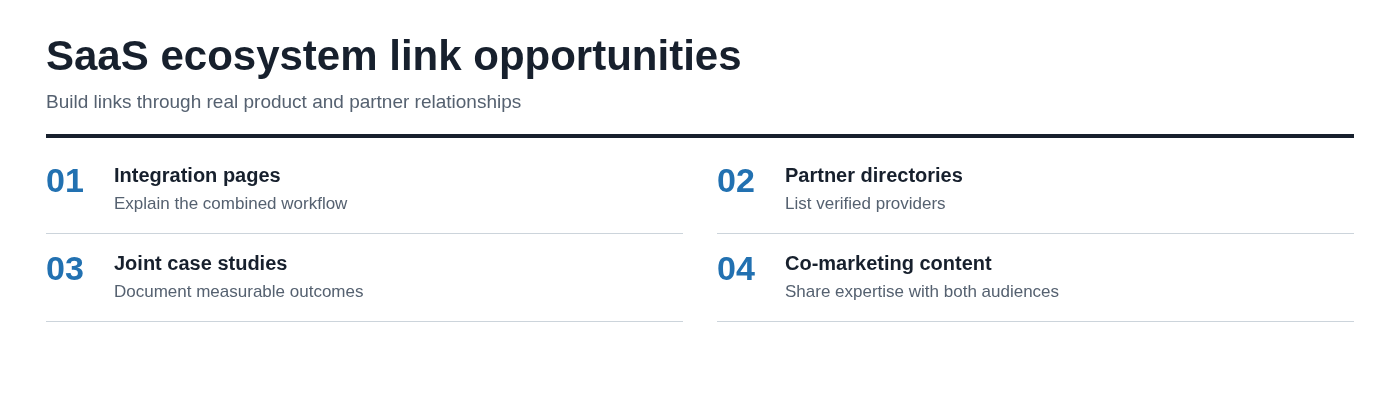
SaaS businesses have an advantage many companies underuse: their product relationships naturally create legitimate link opportunities. Integrations, agencies, technology partners, marketplaces, communities, resellers, and implementation partners all need clear information about how customers can work with both companies.
Create assets those partners can confidently reference: integration landing pages, joint use cases, migration guides, verified partner directories, co-hosted webinars, customer stories, and co-authored research. These placements are especially valuable because they tend to be topically relevant and can generate qualified referral traffic.
Reciprocal links are not automatically bad. The problem is artificial, sitewide exchange schemes with no benefit to users. A selective link between two products or partners that share customers can be entirely appropriate when it helps a buyer evaluate a workflow.
7. Refresh, consolidate, and redirect content to recover lost authority
Content decay is a link-building problem. A page may have earned strong backlinks years ago, then gradually lose value because the content is outdated, the page no longer matches search intent, or a redesign created a poor redirect path.
Refresh an existing URL when the topic remains relevant and the page has worthwhile link equity. Consolidate overlapping articles when several weak pages compete for the same intent. Use a relevant 301 redirect when a page has a clear successor, not simply the homepage. If a high-value linking domain points to a retired URL, it can be worth contacting the publisher with the correct replacement.
A "corrupted" link usually means a link that no longer works as intended. Common symptoms include a 404 page, redirect chain, wrong canonical target, blocked or inaccessible destination, and a link that lands on an unrelated page. Verify the URL in a browser, inspect redirect behavior, confirm the canonical page, and make sure the final destination serves the promise made by the referring article.
8. Create resource pages and free tools people can reference
Free templates, calculators, checklists, glossaries, and well-maintained resource hubs can attract backlinks over time because they solve a narrow job better than a standard blog post. But publishing a tool is not enough. It needs distribution, updates, and a clear audience.
Share the asset through partner channels and relevant communities. Reach out to carefully selected resource pages, consultants, educators, and comparison writers who serve the same audience. Keep the page current so it remains a reliable citation rather than a one-time campaign artifact.
A useful backlink strategy example is a SaaS ROI calculator supported by a transparent methodology page, customer benchmark data, and a guide explaining the assumptions. That package gives consultants something to reference, gives buyers a reason to use the tool, and gives publishers a credible source for cost and outcome discussions.
9. Use selective resource-page and directory outreach for foundational relevance
Vetted directories, association listings, integration marketplaces, and genuinely useful resource pages can provide foundational relevance. They should support your backlink plan, not become the entire plan.
Use clear inclusion criteria: human editorial review, a relevant audience, a real business purpose, transparent listing standards, and no obvious footprint of selling links to anyone willing to pay. A respected industry association or software marketplace can be useful. A directory with thousands of unrelated categories and thin descriptions is usually not.
Ecommerce companies may lean more heavily on supplier, stockist, and product-resource links. B2B SaaS companies generally benefit more from category listings, integration ecosystems, expert communities, implementation partners, and publications where buyers research complex decisions.
10. Make expert-led content easier to cite
Journalists and publishers need credible sources, concise expert views, and claims they can verify. Your founders, subject-matter experts, customers, and internal data can become a repeatable source of link-worthy material if you package their knowledge properly.
Publish attributable insights with transparent methodology. Make original statistics easy to understand and quote. Turn recurring customer questions into concise, defensible perspectives. Outreach becomes much more effective when you can offer a specific claim or evidence point rather than simply asking someone to link to a general service page.
This approach supports organic backlink acquisition and brand credibility at the same time. A cited executive or benchmark report can influence how prospects perceive your expertise long before they become ready to buy.
11. Evaluate link quality before you pursue or buy a placement
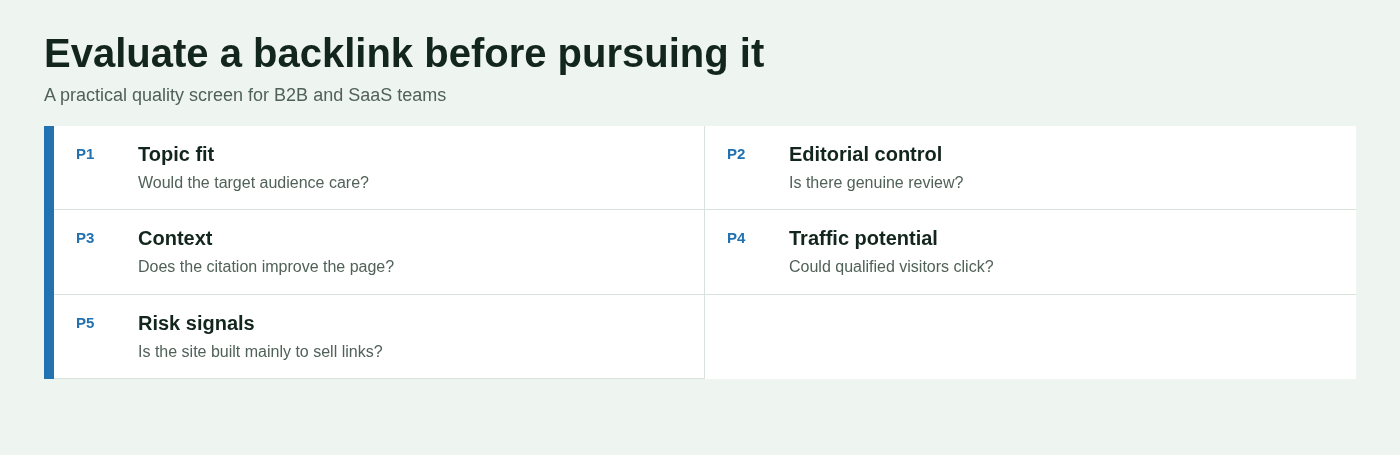
The most powerful backlink is not automatically from the site with the highest authority metric. It is a relevant, editorially earned citation from a trusted page that serves an audience likely to care about your business. Ideally, it can send qualified visitors as well as support search visibility.
A good backlink strategy consistently pursues links that make sense for users. Evaluate the topic fit, whether an editor has real control, the context around the citation, referral traffic potential, and signs that the site exists primarily to sell links.
Toxic backlinks are manipulative, irrelevant, automated, hacked, or network-based links designed to manufacture authority. They often come from low-quality sites with excessive outbound links, spun content, hidden placements, or no meaningful audience. Not every low-authority link is toxic; a new but legitimate niche publication can still be valuable.
Is it worth paying for backlinks? Paying for legitimate content production, PR support, relationship development, and outreach labor can be reasonable. Paying for undisclosed, manipulative placements on sites built for link sales is a different proposition and creates long-term risk. A quality backlink service should be transparent about its methods, proposed sites, editorial standards, approvals, and reporting. Be wary of opaque reseller packages that promise a fixed number of links without explaining where or how they will be earned. Teams comparing providers can use this guide to blogger outreach services as part of their evaluation.
12. Use dofollow and nofollow links as part of a natural authority profile
Dofollow and nofollow describe how a link is marked in its HTML. In simple terms, a standard link may be treated as a ranking signal, while a link with a rel="nofollow" attribute asks search engines not to treat it in the same way. Sponsored and user-generated-content attributes can also appear on links.
You can inspect a link by opening browser developer tools or viewing the page source and looking for the anchor tag's rel attribute. If there is no nofollow, sponsored, or UGC instruction, it is commonly described as a dofollow link. That label is useful for analysis, but it should not become the sole decision criterion.
Nofollow links can still be good for SEO indirectly. They can send referral traffic, create brand awareness, help search engines discover content, and lead to later editorial citations. Chasing only dofollow backlinks, or seeking lists of sites that provide them, misses the bigger question: would this placement be credible and useful to the right audience? Do not manufacture an artificial ratio. Earn a natural mix through legitimate marketing and publishing activity.
How many backlinks do you need to rank? Set targets by gap, page, and intent
There is no universal number of backlinks required to rank a website. The answer depends on the search intent, quality of competing pages, technical readiness of your site, existing referring domains, and the authority gap between your target page and the pages already ranking.
For a small group of revenue-critical pages, estimate the competitive gap rather than setting a random monthly link quota. Review the referring domains earned by ranking competitors, identify the quality and relevance of those links, and choose a realistic mix of reclamation, partner links, editorial contributions, digital PR, and linkable assets.
Set quarterly targets for relevant referring domains and outreach activity, then measure qualified referral visits, ranking movement for target clusters, and assisted conversions. Avoid backlink pyramids and volume-based packages that optimize counts instead of relevance, destination quality, and business outcomes.
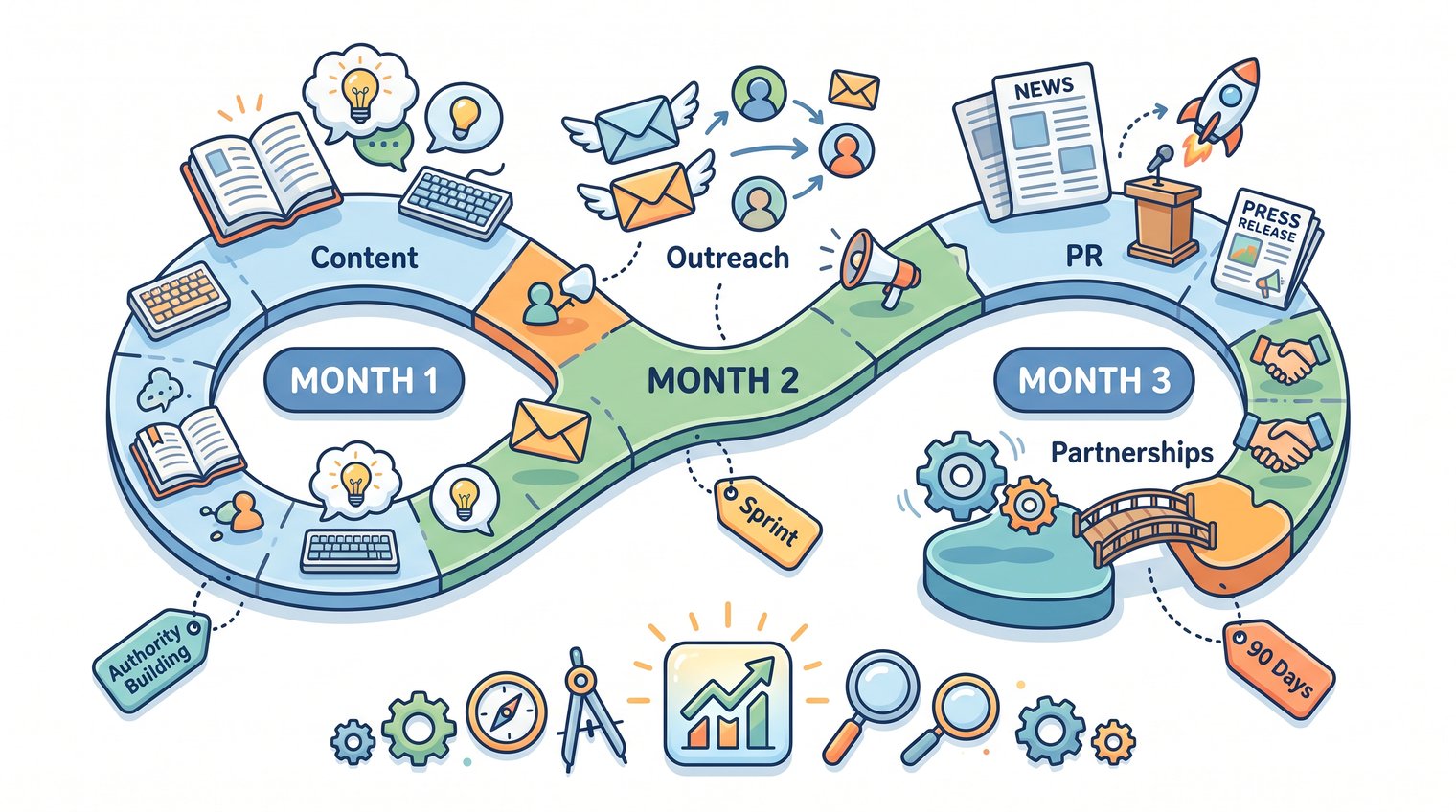
A 90-day backlink strategy for a B2B SaaS team
A workable backlink strategy needs an operating rhythm. The following 90-day plan gives a lean B2B SaaS team a practical way to connect research, content, outreach, partnerships, and measurement.
- Days 1-30: Audit priority pages, identify technical or redirect issues, analyze competitor link patterns, and build lists for unlinked mentions, broken links, partners, and high-fit publishers.
- Days 31-60: Publish or refresh one genuinely linkable asset, begin reclamation outreach, and run targeted guest-post or digital PR outreach around a specific expertise-led angle.
- Days 61-90: Expand the channels producing qualified opportunities, secure partner and integration placements, follow up on active pitches, and review every acquired link for quality and destination-page fit.
Track a small KPI set: relevant referring domains, links to priority pages, referral visits, assisted conversions, rankings for target topic clusters, and outreach conversion rate. These measures keep the program focused on progress that matters instead of vanity metrics.
Choose fewer, better link-building plays - and execute them consistently
The best backlink strategies are rarely the loudest or fastest. They rely on citation-worthy assets, relevant relationships, editorial judgment, and a willingness to improve the pages being linked to. A smaller number of strong placements will usually outperform a large batch of generic links.
For teams that need transparent, white-hat help with contextual placements, editorial content partnerships, and authority strategy, LinkHandy provides managed support built for B2B and SaaS growth.