

Most link building fails for a simple reason: the asset gives nobody a good reason to reference it. A generic blog post, a recycled infographic, or a mass guest-post campaign may create activity, but it rarely creates the kind of editorial links that improve authority over time.
Creative link building is not about clever tricks. It is about producing useful evidence, tools, expertise, and partnerships that make a relevant editor, writer, or industry peer genuinely want to cite your brand. For SaaS and B2B companies, that usually means getting much closer to the problems your buyers deal with every day.
What makes a creative link building idea worth pursuing?
A worthwhile creative link building idea earns relevant editorial mentions because it helps an audience understand, decide, calculate, or act. It is not a disguise for a link scheme. The best assets have value even if they never rank on their own, because they give other people something credible to quote, share, or include in a resource.
Before committing to an idea, assess it against five questions:
- Is it topically relevant? A link from a publication that serves your buyers, partners, or industry matters more than a random mention from a broad site.
- Does it offer audience value? The asset should answer a real question, reduce effort, or provide evidence that readers cannot easily find elsewhere.
- Does it fit editorially? Ask whether a writer could reference it naturally in an article without making the recommendation feel forced.
- Can your team execute it well? Original research sounds attractive, but it is only useful if you can collect credible data and explain the methodology.
- Can it scale without losing quality? A repeatable campaign can have several angles, but every placement should remain relevant and editorially justified.
Relevant backlinks can support discoverability, referral traffic, and perceived authority when they point to content worth citing. The goal is not to collect isolated votes at any cost, but to earn credible references that help readers find and assess useful sources.
1. Build original data assets buyers and publishers can cite
Original research is one of the highest-leverage creative link building ideas because it gives publishers something they cannot get from another vendor's opinion piece. A well-designed benchmark, survey, anonymized product-data study, or trend report can support dozens of stories, outreach angles, and sales conversations.
Start with a question that recurs in your category. A workflow automation platform might study how long operations teams spend reconciling data across systems. A security SaaS company could analyze common compliance-readiness gaps. A finance tool might calculate the cost of manual reporting across company sizes.
The methodology matters as much as the headline. Define the sample, time period, data source, exclusions, and limitations before publishing. Then package the research for different audiences: a full report for analysts, short charts for journalists, a practical takeaway for operators, and a sales-ready summary for prospects.
When pitching, lead with the specific finding. "B2B operations teams lose an average of X hours to manual handoffs" is more useful than "We published our annual report." Publishers need a story, not an attachment.

2. Turn product expertise into a free utility or calculator
A lightweight utility can attract links because it turns specialist knowledge into an immediate answer. The strongest tools solve a narrow, high-intent problem rather than attempting to become an all-purpose platform.
Useful examples include an ROI calculator, implementation planning template, security-readiness checklist, cost-of-inefficiency estimator, onboarding timeline generator, or maturity grader. A procurement writer may link to a total-cost calculator; a consultant may share a readiness checklist with clients; an industry publication may cite a benchmark template in a how-to guide.
The asset-to-link connection is important. Build for people who already create content, advise buyers, or document workflows. Give them a clear reason to reference the resource, such as an editable worksheet, transparent assumptions, or a result they can use in their own analysis.
Avoid broad tools with no distinct insight or maintenance plan. A generic "AI business name generator" is unlikely to earn relevant B2B links. A calculator built from real implementation variables in your category has a much stronger case.
Choose a problem with an observable input and useful output
A practical test is simple: can someone enter information, choose a few conditions, or follow a defined checklist and receive an output they can act on? Inputs might include team size, software spend, number of monthly transactions, compliance requirements, or existing systems. The output should clarify a decision, estimate an impact, or reveal the next step.
Validate the idea before investing in design and development. Review sales-call notes, support tickets, onboarding conversations, search queries, community threads, and competitor content gaps. If prospects repeatedly ask your team to estimate something manually, there may be a useful public tool hiding in that request.
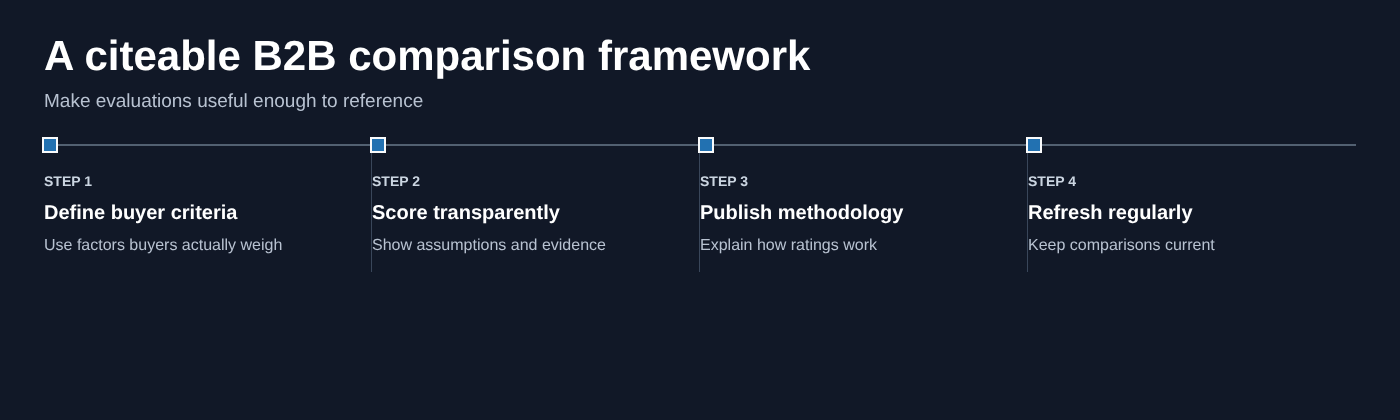
3. Create a definitive comparison framework for a confusing buying decision
Buyers in crowded B2B categories often struggle to compare options fairly. A transparent comparison framework can earn links from consultants, evaluators, and writers if it helps people make sense of a complicated decision without pretending your product is the only viable choice.
The framework should use criteria buyers actually weigh: implementation complexity, total cost of ownership, integration depth, data portability, compliance readiness, governance, support model, or time to value. Explain what each criterion means, how it is assessed, and where the evidence comes from.
Credibility disappears when every assumption conveniently favors your brand. Disclose limitations, include an update date, and make the methodology visible. If a category has no objectively correct winner, say so. The value is in helping the reader identify the right fit for their situation.
4. Mine customer workflows for overlooked integration and use-case content
Generic feature pages rarely earn meaningful links. Content built around real workflows can. Look for the practical combinations of tools, roles, handoffs, and operational constraints that customers use to get results.
For example, instead of another page about your reporting feature, create a guide to how RevOps teams connect CRM, billing, product analytics, and finance data for monthly forecasting. Instead of describing your compliance software in general terms, document a practical workflow for preparing vendor evidence during a security review.
Source ideas from customer interviews, onboarding calls, solution-engineer notes, support patterns, and community discussions. Protect confidentiality by anonymizing examples and securing approval before sharing identifiable customer details. When a customer is comfortable participating, co-promote the finished workflow guide with them, their integration partner, and relevant niche publications.
5. Publish expert commentary around emerging industry changes
Fast, informed commentary can earn attention when a real shift affects your audience. Regulatory changes, platform updates, new standards, market behavior, and operational disruptions all create openings for a useful point of view.
The mistake is commenting on every headline. Your team should respond only when it has credible expertise and a clear audience consequence to explain. A privacy platform can comment on a new compliance requirement. A workflow vendor can explain what a major API change means for operations teams. A security company can translate a technical development into procurement implications.
Create a simple response process: monitor relevant developments, identify named subject-matter experts, prepare evidence-backed talking points, offer a concise quote, and publish deeper analysis on your own site when the topic warrants it. Relevance and speed matter more than volume.
6. Reclaim unlinked brand, product, and research mentions
Link reclamation is an efficient creative link building tactic because the writer already knows your company, product, research, executive, or resource. You are not asking them to discover a new idea from scratch; you are helping them improve an existing reference.
Look beyond unlinked company-name mentions. Potential targets include proprietary data, visual assets, templates, webinars, events, partner references, expert quotes, and executive commentary. A writer may have cited your benchmark statistics without linking to the full study, or referenced a tool integration without directing readers to the implementation guide.
Keep outreach low-friction. Confirm that the page is relevant, identify the natural place for a citation, and explain why the link would help the reader verify or use the information. Do not demand a link, and do not ask for a keyword-stuffed anchor. A precise citation is usually the best outcome.
7. Co-create content with complementary B2B brands
A strong partner can give a content asset more expertise, distribution, and citation potential than either company could create alone. The best partnerships serve overlapping audiences without putting two direct competitors in an awkward promotional arrangement.
Consider joint benchmark reports, expert roundtables, co-hosted webinars supported by an enduring resource hub, integration playbooks, or collaborative templates. A CRM consultancy and a sales-enablement platform, for instance, could create a guide to improving handoffs between sales and customer success. Each contributor brings a different point of view and audience.
Choose partners carefully. Look for non-competing audience overlap, credible expertise, a clear shared promotion commitment, and agreement about ownership, review rights, lead handling, and ongoing maintenance. A partner's logo alone does not make the content useful; the collaboration has to add substance.

8. Build a resource around a niche community's recurring problem
Broad industry content is easy to publish and easy to ignore. A focused resource for a specific role, vertical, or operational problem can become much more useful because it addresses the details broad content skips.
A resource could be a curated vendor directory with clear inclusion standards, an implementation guide for a regulated vertical, a glossary hub for a complex category, a salary or benchmark resource, or a maintained event calendar. The key is depth and accuracy. A directory for security leaders evaluating a narrow compliance requirement is more likely to be referenced than another generic "top software" list.
Assign a maintenance owner before launch. Stale directories, broken calculators, outdated glossary definitions, and abandoned event pages rarely earn durable links. If you cannot update the asset at a sensible cadence, choose a format with a lower maintenance burden.
9. Use digital PR to package a useful story, not just announce the company
Routine product announcements rarely earn editorial coverage unless the company is already a major news source. Digital PR works better when it packages a useful story around evidence, expertise, and a timely consequence for a specific audience.
A strong story typically includes a timely hook, credible data or firsthand knowledge, a focused implication, and supporting materials that make a journalist's job easier. The same research can produce different angles for SaaS, finance, operations, security, or HR publications if each angle addresses the pressures of that audience.
For example, a study on software-spend waste might become an operations story about duplicate workflows, a finance story about budgeting leakage, and an IT story about tool sprawl. The underlying research remains consistent; the editorial framing changes.
Create a pitchable evidence package
Prepare a concise angle, the key statistics or quotes, methodology notes, source links, usable visual assets, and an available expert contact. This material should let an editor assess the claim quickly and confirm that the story has substance.
Match the pitch to a journalist's existing beat. A personalized message referencing the kind of stories they already cover is far more effective than sending the same release to a large, unrelated list.
10. Earn links by contributing truly editorial guest content
Editorial guest content can still be valuable, but only when it is treated as an expertise channel rather than a scaled placement tactic. The goal is to contribute an original argument or operating lesson to a publication your ideal customers actually trust.
Identify publications with a relevant readership, real editorial standards, and a clear fit for your team's expertise. Then pitch an idea that would stand on its own without mentioning your company. Useful contributions often draw from implementation lessons, category misconceptions, anonymized patterns observed across customers, or a contrarian but defensible point of view.
Use one contextual link only when it genuinely supports the article's point. If the contribution needs multiple commercial links to justify the effort, it was probably not editorially strong enough in the first place.
11. Refresh aging industry resources before building something new
Sometimes the best opportunity is not a brand-new campaign. It is a resource that is still widely linked but no longer accurate, complete, or useful. Find aging pages with ongoing backlink value, then build a materially better replacement.
The improvement needs to be real: newer data, clearer methodology, more useful examples, a better structure, updated regulations, or an added utility such as a checklist or calculator. Simply making a longer version of an existing list is not enough.
Outreach should be ethical and straightforward. Let publishers know that a resource they reference may be outdated, explain what has changed, and offer your alternative as an optional update. Never imply an affiliation you do not have, and never pressure an editor to replace a link.
12. Repurpose high-performing content into citation-ready formats
You may already have linkable material buried in webinars, product documentation, customer research, reports, or internal newsletters. Repurposing works when it creates a new utility or format, not when it simply duplicates the original page.
Pull a well-supported chart from a long report and publish it with source notes. Turn a webinar's best operational lesson into a concise explainer. Convert product documentation into a genuinely useful implementation checklist. Extract expert insights from a roundtable into a quote collection with context and attribution.
These smaller assets are often easier for writers to reference than a 50-page report. They can also support a broader link building campaign by giving outreach different angles for different audiences while reinforcing the same topic cluster.
How to prioritize creative link building ideas for your campaign
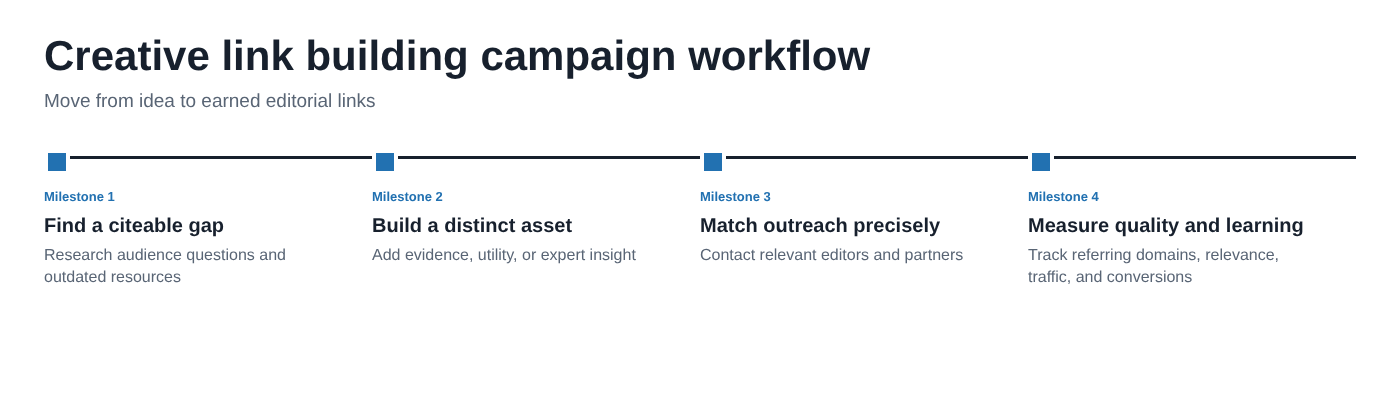
Do not launch twelve disconnected tactics at once. Start with one flagship asset that is close to your unique data, expertise, customers, or partner ecosystem, then develop several focused outreach angles around it. A clear SEO outreach strategy can help turn that asset into a focused campaign rather than a series of disconnected pitches.
Use a simple scoring method for each idea. Rate it on audience relevance, uniqueness, proof available, production cost, promotion reach, and maintenance burden. An idea with modest production effort but strong proof and partner distribution may outperform an ambitious report that nobody has the data or time to promote.
- Audience relevance: Will the asset matter to the people your business needs to reach?
- Uniqueness: Does it offer a perspective, data source, workflow, or tool competitors cannot easily copy?
- Proof available: Can you support claims with research, expertise, customer evidence, or transparent methodology?
- Production cost: Can the team produce a high-quality version without delaying it into irrelevance?
- Promotion reach: Do you have partners, customers, experts, or communities that can help the right people discover it?
- Maintenance burden: Can you keep the resource accurate enough to remain worth citing?
Some campaign tasks can be systematized, but quality checks should remain deliberate. Sensible link building automation can assist with prospect research or monitoring without replacing relevance checks and editorial judgment.
Measure quality rather than celebrating raw link counts. Watch the topical relevance of referring domains, whether placements are editorial, qualified referral traffic, rankings across the supported topic cluster, and assisted pipeline where attribution is possible. Those metrics reveal whether the ideas above are strengthening actual market visibility.
Build links by becoming easier to cite
The strongest creative link building ideas work because they give another publisher a genuine reason to reference your brand. They solve a problem, document an overlooked reality, make a confusing decision easier, or contribute evidence to an active industry conversation.
Choose the idea closest to an advantage your business already has: proprietary data, hard-won expertise, customer workflow knowledge, a useful integration, or a credible partner ecosystem. Then execute it with the same editorial standards you would expect from a publication you want to earn a link from.
Teams that need help developing and placing white-hat editorial link assets can explore LinkHandy's managed link building service.