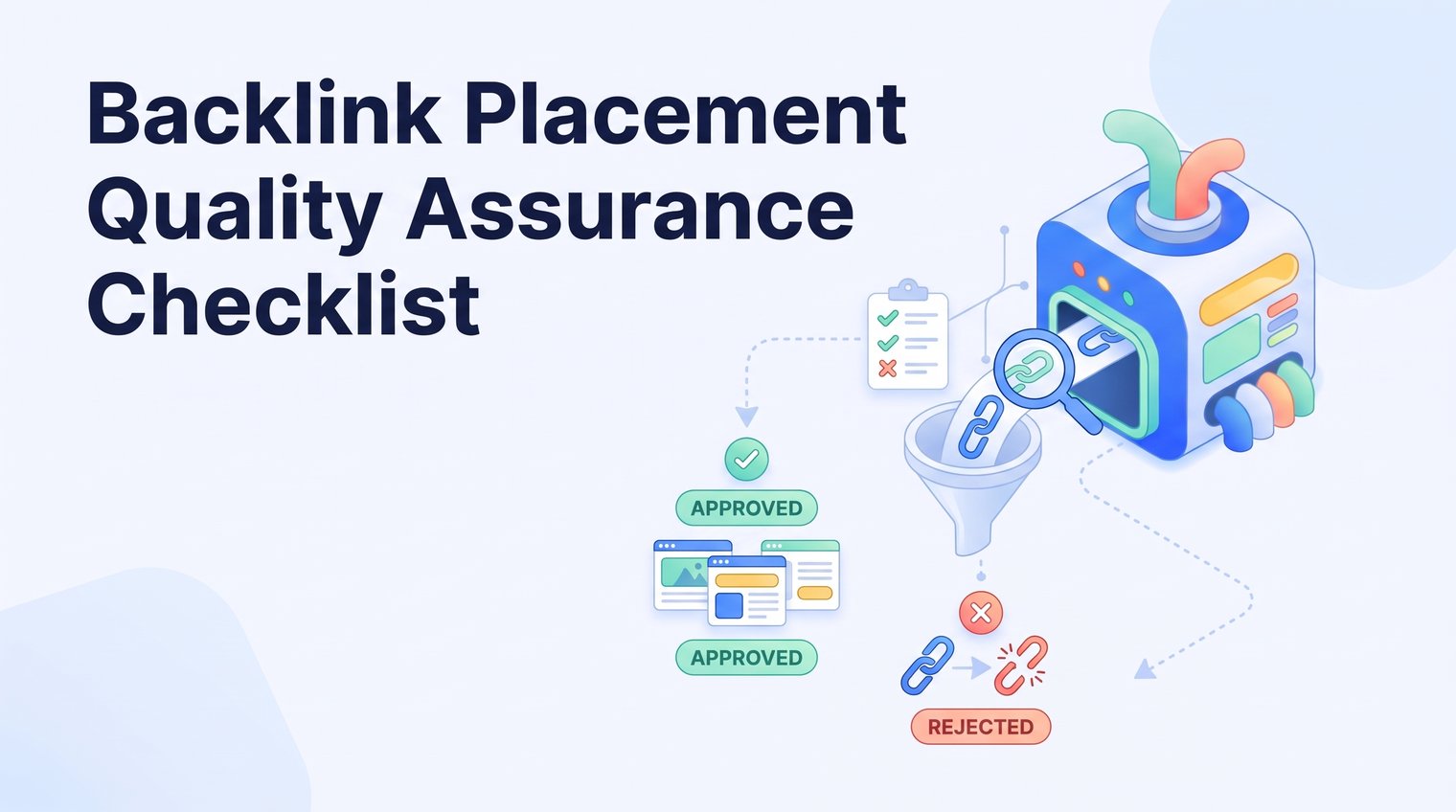

A backlink is not "done" because it appears in a report. The live placement can point to the wrong page, carry an unexpected attribute, sit inside weak copy, or disappear after publication. Without a repeatable review process, those problems are easy to miss and hard to prove later.
Use this backlink placement quality assurance checklist before approving any editorial link, contextual insertion, guest post, content partnership, or PR mention. It is designed for B2B and SaaS teams that need a defensible record of what was promised, what went live, and what needs attention.
Set the acceptance criteria before a backlink goes live
Quality assurance starts before outreach or publication, not after. Define the conditions that make a placement acceptable so the person reviewing it is not making subjective decisions link by link. For more detail on assessing suppliers and delivery standards, see Link Placement Services: How to Evaluate Quality and Delivery.
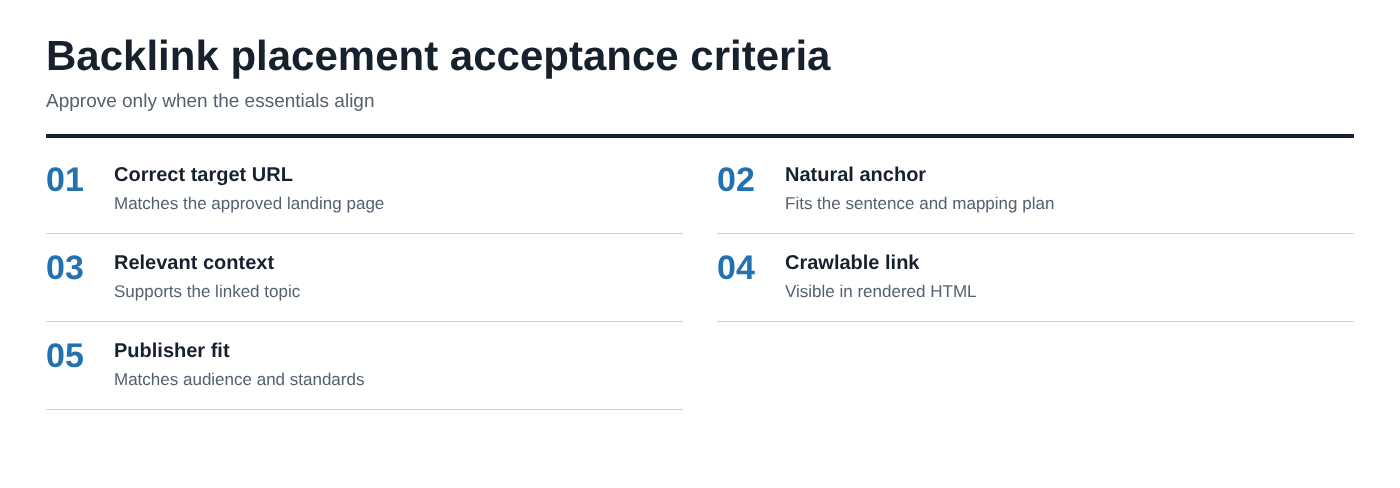
Every approved opportunity should specify the publisher, expected live page or content type, destination URL, proposed anchor text, expected link attribute, contextual relevance, and the evidence required at delivery. If any of these details are vague, a placement can technically be live while failing the actual campaign objective.
Separate essential requirements from nice-to-have preferences. Essentials are non-negotiable: the correct target page, an approved publisher, an accessible link, relevant context, and reporting evidence. Preferences might include a particular section of the article, a preferred anchor variation, or a follow attribute where that is commercially appropriate and agreed in advance.
Maintain an anchor text mapping template for every campaign. Tie each proposed anchor to a target page, search intent, topic cluster, and reason for the placement. This prevents the common mistake of repeatedly sending keyword-heavy anchors to the same commercial page just because they appear to be easy to measure.
1. Confirm the publisher and page match the approved opportunity
Verify the live domain and exact URL against the approved prospect. Check for changed subdomains, redirected domains, or a placement on a different property than the one reviewed. A recognizable root domain does not automatically make every subdomain, section, or syndicated page acceptable.
Confirm the page serves a real audience and topic. Read enough of the article and its surrounding site section to judge whether the subject aligns with your product, target page, and intended reader. A B2B SaaS resource linked from a useful operations, marketing, or technology article is materially different from the same link placed in an unrelated lifestyle post.
Review editorial standards beyond DA or DR. Authority metrics are directional signals, not a quality guarantee. Flag thin archives, weakly edited content, pages overloaded with sponsored copy, irrelevant outbound links, or a site whose audience clearly does not match the campaign.
Check whether the page exists primarily to host links. Useful content can cite outside sources. But when the article's main pattern is inserting commercial anchors for unrelated companies, its value and durability are questionable.
Evaluate PR mention quality separately from a standard content placement
PR coverage should be reviewed on its own terms. Confirm that the company, spokesperson, product, or expert contribution is named accurately and that the publication's story is credible, relevant, and useful to its readers.
A nofollow PR mention can still be a strong brand outcome, particularly when it reaches the right audience or validates expertise in a respected publication. Record it accurately rather than counting it as equivalent to a followed contextual SEO placement. The objective determines whether it passes.
2. Verify the destination URL resolves correctly
Click the live link in a clean browser session. Confirm that it reaches the exact approved canonical destination, not simply a page that looks close enough. Logged-in sessions, cached redirects, and browser extensions can conceal routing errors, so test the experience a normal visitor receives.
Check for broken paths and unwanted redirects. Look for typos, malformed UTM parameters, 404 pages, redirect chains, country or device-specific routing, consent walls, and pages that require a login. A link that eventually reaches the intended page after several hops should be documented, not ignored.
Record the final resolved URL in the placement log. The href displayed in source code or a delivery spreadsheet may not be the endpoint a user or crawler reaches. Your record should reflect the real final destination at the time of QA.
3. Check the anchor text against the anchor map
Compare the published anchor with the approved anchor and target-page plan. The anchor should describe the destination honestly, fit the sentence, and support the purpose of that page. An exact-match phrase that reads awkwardly is not a quality win.
Review anchor distribution across the campaign. Repeating the same commercial phrase across many placements creates an unnatural pattern and often produces poor editorial copy. Use a practical mix of brand anchors, partial-match phrases, topical descriptions, and natural URL or generic references where appropriate.
Classify deviations before escalating them. A harmless editorial variation may still preserve the page's intent, such as "project management platform" instead of "project management software." A changed phrase that shifts the topic, overpromises what the destination offers, or points readers toward the wrong intent requires review or correction.

4. Inspect link attributes, crawlability, and renderability
Inspect the rendered page and HTML for the actual link attribute. Record whether the link is follow, nofollow, sponsored, or UGC exactly as published. Do not assume an attribute based on what was proposed or how the placement was sold.
Confirm it is a standard, clickable HTML link. It should be visible in the rendered article, accessible to users, and placed in normal content. Flag links hidden in scripts, obscured by styling, attached only to an image without clear contextual text, or dependent on an interaction that prevents straightforward rendering.
Judge attributes against the campaign agreement. A nofollow or sponsored attribute is not inherently a failed placement. It becomes an issue when the campaign specifically required a different outcome, or when the reported result does not match what was delivered.
Check whether the linking page can be indexed
Look for evidence that the linking page is discoverable. A site: query can be a useful initial check, and teams that control the property can use URL inspection data. The guide How to Check if a Backlink Page Is Indexed provides a structured way to review this status. Reputable index-status checks may add context, but none should be treated as perfect proof on its own.
Review obvious indexing barriers. Check for a meta noindex directive, restrictive robots instructions, problematic canonical tags, and pages blocked behind login or other access barriers. Distinguish a newly published page that has not yet been indexed from one that is structurally prevented from appearing in search.
Document the date of the check. Indexation status changes. Recording when you reviewed it prevents outdated assumptions from entering future reports.
5. Assess contextual placement and editorial integration
Confirm the link sits in the main body near relevant copy. A contextual citation should support the point being made in the paragraph or adjacent section. Footer links, author bios, tag pages, sidebars, and generic resource blocks should not be accepted as equivalent unless they were explicitly approved.
Read the complete paragraph, not just the anchor. The surrounding copy should accurately frame the destination and give readers a logical reason to click. A link can be technically present but still be editorially weak when the sentence is forced, vague, or misleading.
Check visual prominence and competing links. A relevant citation buried among several unrelated commercial links has less editorial value than a clean, well-integrated reference. Flag crowded paragraphs, generic "learn more" anchors, and placements that look inserted rather than written into the article.
6. Review outbound-link patterns and page-level risk signals
Review the individual page, not just the domain profile. Even a generally reputable site can publish a weak page. Look for excessive outbound commercial links, repeated keyword-rich anchors, irrelevant industries sharing the same paragraph, or patterns that suggest paid insertion without editorial review.
Check for harmful or clearly off-brand adjacency. Casino, adult, pharmaceutical, and other sensitive commercial content can be a concern when it appears on the page or immediately around the placement. Scraped copy, incoherent writing, and copied sections are also meaningful risk signals.
Use proportional judgment. One relevant external source is normal and often beneficial. A page that appears designed mainly to distribute commercial links is a different situation and should be escalated.
Log observations, not vague scores. Write down what you found: "seven unrelated keyword-rich commercial links in a 900-word article" is actionable. "Low-quality page" is not enough for a supplier, editor, or internal stakeholder to understand the decision.
7. Capture proof and log the placement consistently
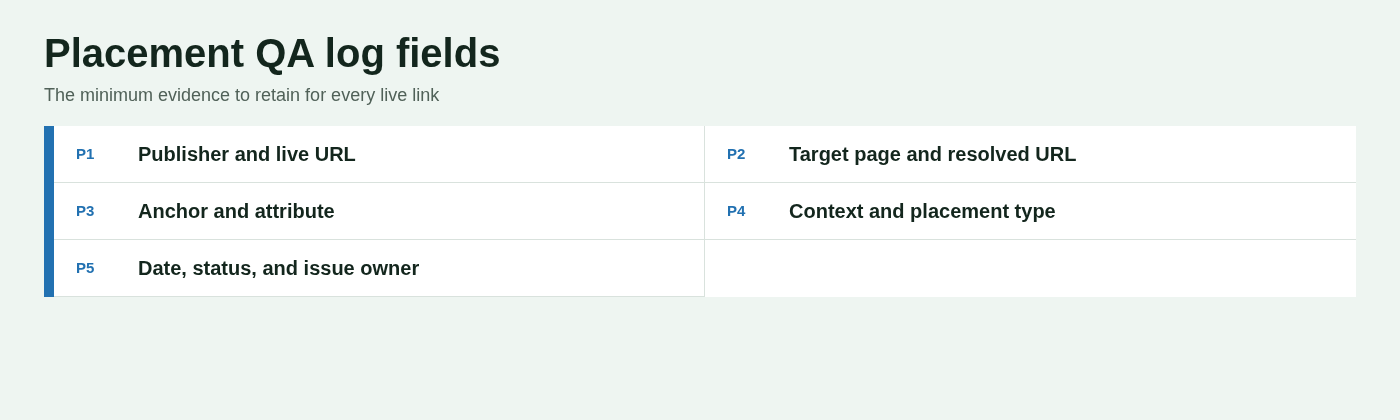
Create one placement record for every live link. At minimum, log the publisher, live URL, approved target URL, final resolved URL, anchor text, link attribute, placement type, publication date, reviewer, status, and any remediation required.
Save dated evidence of the live paragraph. A screenshot or archived capture makes later disputes much easier to resolve, especially when publishers update pages, change attributes, or remove content. Capture enough surrounding copy to show why the link was contextually appropriate.
Use clear reporting statuses. A monthly backlink report template should separate placed links from pending indexation, correction requests, removed links, and placements that require monitoring. Combining those categories into one total hides work that is still incomplete.
8. Monitor changes after placement
Recheck priority placements on a defined cadence. Monitor for link removal, anchor changes, changed attributes, redirect updates, noindex status, and meaningful content degradation. A placement can meet every acceptance criterion on publication day and still change later.
Prioritize by business value. Money pages, high-authority editorial placements, strategic topic clusters, and time-sensitive PR coverage should be reviewed earlier and more often than lower-impact links. Monitoring every link with identical urgency wastes time.
Keep before-and-after evidence when something changes. Then make a deliberate decision: ask for a correction, seek a replacement placement, mark the result as lost, or update reporting. A vague note that a link "seems different" is not sufficient for accountability.
Track impact by target page, not only by referring domain
Group placements by the page they support. For a more focused measurement process, see How to Track Backlink Impact by Target Page. Over time, compare organic visibility for relevant query clusters, referral traffic, assisted conversions where available, and coverage gaps across important product or solution pages.
Do not claim that one backlink caused a ranking movement. Search performance is influenced by many variables. The useful outcome of tracking is identifying patterns: which target pages receive sustained authority support, where links are concentrated too heavily, and where further investment may be justified.
9. Apply a clear pass, fix, or reject decision
Pass the placement when every essential criterion meets the approved brief and the evidence is logged. A pass should mean the team can confidently report the result without revisiting basic questions about the publisher, destination, anchor, or attribute.
Request a fix when the issue is remediable. Common examples include an incorrect target URL, accidental nofollow attribute, missing context, a broken link, or an anchor variation that changes the intended meaning. Give the publisher a precise correction request and record the deadline and owner.
Reject or replace placements that materially violate the agreed standard. A mismatched publisher, poor page quality, hidden link, misleading integration, or obvious link-selling pattern is not something to normalize because the placement is already live. Document the reason so suppliers and internal teams can improve future approvals.
Use this compact backlink placement QA checklist every time
Before approval, verify publisher and page fit. Confirm the exact live domain and URL, relevant audience, credible editorial standards, and a page purpose that is not simply distributing commercial links.
Before approval, test the destination and anchor. Click through to the final resolved target URL, compare the anchor with the mapping plan, and make sure the sentence accurately represents what the visitor will find.
Before approval, inspect the technical link conditions. Record the published attribute, ensure the link is rendered and clickable in normal HTML, review indexability signals, and confirm the contextual placement meets the agreed brief.
After approval, retain proof and update the log. Save a dated capture, assign a clear status, note any open remediation, and maintain the core fields needed for an auditable backlink placement quality assurance checklist template.
After approval, monitor what matters most. Recheck high-value placements for removals, content edits, attribute changes, redirects, and indexing issues. Report results by target page so link acquisition stays connected to the pages and business outcomes it is meant to support.
For teams outsourcing editorial placements, LinkHandy supports transparent, white-hat link-building workflows for SaaS and B2B companies, with placement details that make quality assurance and reporting more straightforward.