

Anchor text audits go wrong when teams chase a magic percentage. A page does not become safe because it has a certain share of branded anchors, and it does not become risky because one legitimate publisher used a keyword-rich phrase.
The useful question is whether your backlink profile tells a believable editorial story. This guide shows how to audit anchor text distribution for backlinks at the page level, identify patterns worth investigating, and make measured decisions without damaging good links.
Define a safe anchor-text profile before you audit
Anchor text is the visible, clickable wording in a hyperlink. In SEO, it gives search engines context about the destination page, but it is only one signal among many. The wording, source-page topic, placement, timing, and quality of the linking site all affect how a link should be interpreted.
Do not begin with a preset ratio such as "keep exact-match anchors below 5%." There is no universal safe percentage. A new SaaS brand with few mentions will naturally have a different profile from an established company cited in hundreds of industry articles.
Your audit should look for three things: unnatural concentration around commercial phrases, links whose anchor text does not match the destination, and missing topical relevance. You are trying to understand the pattern, not force every page into the same numerical mold.
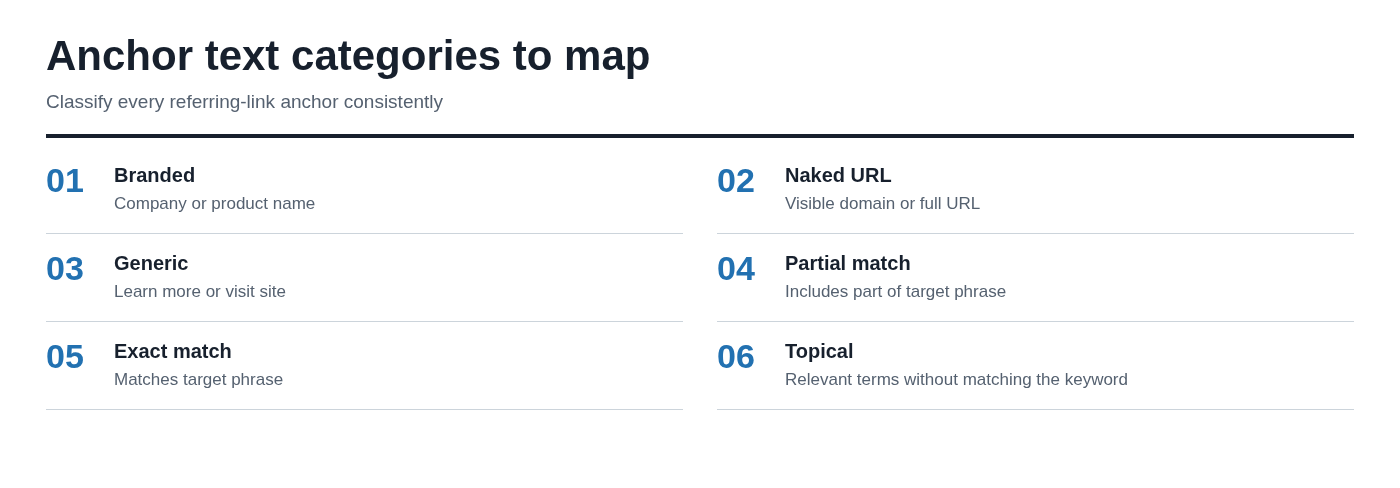
Use consistent categories so that your analysis remains useful:
- Branded: The company, product, or recognizable brand name, such as "LinkHandy" or "HubSpot."
- Naked URL: A visible domain or complete URL, such as "example.com/pricing."
- Generic: Non-descriptive phrases such as "learn more," "this website," or "visit the site."
- Partial-match: An anchor that includes part of the target phrase, such as "B2B backlink services" for a page targeting "SaaS backlink services."
- Exact-match: An anchor that matches the primary target phrase exactly.
- Topical or related: Descriptive wording related to the destination without repeating the target keyword, such as "ways to evaluate a backlink profile."
- Image alt text: The alt text associated with an image link, when available in your backlink data.
Set the audit scope at page level, then review the domain
A domain-wide anchor profile can look balanced while one commercial page has a conspicuous cluster of exact-match links. That is why the primary unit of review should be the individual target URL, especially for product, service, pricing, comparison, and other revenue-driving pages.
Start with money pages, pages that recently lost rankings, URLs that received an unusual burst of new links, and pages promoted through keyword-led outreach. Then use a domain-level review to spot broader patterns across the site. A broader SEO link audit can provide useful context after the page-level review.
For a risk-focused audit, include all live referring domains you can identify. Segment the data by date as well, such as the last 30, 90, and 180 days, to see whether an issue is historical or emerging now.
Choose the right unit: referring domains, backlinks, or both
Use unique referring domains as your primary lens. One source website may link several times with the same anchor, and counting every link equally can make a sitewide footer or navigation link appear more influential than it really is.
Then review raw backlink counts separately. This catches repeated anchor text from one domain, syndicated articles, template placements, or a collection of pages generated from the same source. Both views matter: referring domains show breadth, while backlinks expose repetition.
Export a complete backlink and anchor-text dataset
Export data before you start classifying. A workable file should include the linking page URL, linking domain, target URL, anchor text, follow or nofollow status, sponsored status where available, first-seen date, link type or placement, and current link status.
Backlink tools do not have identical indexes, so one export is not always enough. Keep the original exports in separate raw-data tabs, then create a cleaned working tab for analysis. That preserves your audit trail and lets you check whether a normalization rule changed the result.
Third-party tools are directional rather than complete records of the web. If a suspicious link, missing link, or apparent cluster would change your decision, open the referring page and verify it manually.
Pull an anchor-text report in Ahrefs
Ahrefs can provide a useful starting point through its anchor and backlink reporting. Filter the data to the target URL whenever possible, then export anchor text alongside referring domains and linking pages.
Use the report to find patterns, not to issue a verdict. For example, a phrase may look like an exact-match anchor in an aggregate table but turn out to be part of a natural sentence, an old navigation label, or a syndicated placement when you inspect the page.
Supplement with Google Search Console and a second index
Google Search Console's Links report is valuable first-party reference data. Compare it with a second backlink index when a pattern appears suspicious or when a link's presence or absence materially affects your next step.
Differences between tools are normal. Crawlers discover links at different times, interpret canonical pages differently, and may not report every link they have found. Treat disagreements as a prompt to investigate, not evidence that one tool is automatically wrong.
Build a backlink anchor text mapping template
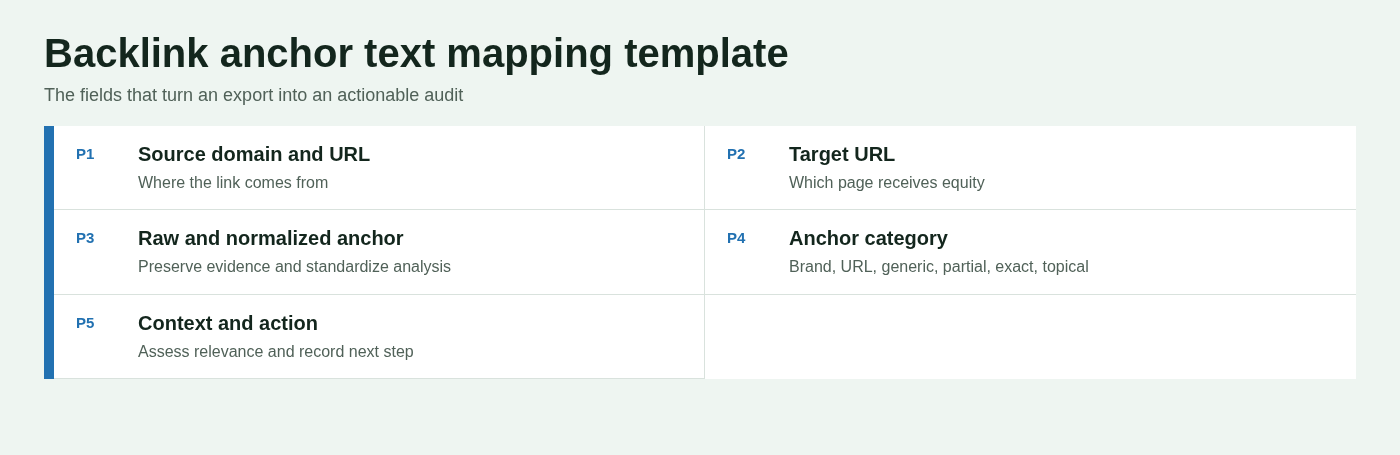
Move your cleaned data into a mapping sheet that makes each classification and recommendation traceable. At minimum, use these columns:
- Source domain
- Source URL
- Target URL
- Raw anchor text
- Normalized anchor text
- Anchor category
- Target topic
- Follow, nofollow, or sponsored status
- First-seen date
- Placement and surrounding context
- Quality and relevance notes
- Recommended action
Create a separate summary table or pivot table that groups links by target URL and anchor category. The detailed sheet explains why a link was classified a certain way; the summary sheet reveals where a concentration exists.
Normalize anchors without losing the original evidence
Never overwrite the original anchor text. Keep it in a raw-anchor column, then create a normalized version for counting and grouping.
For most audits, normalization means lowercasing text, trimming extra whitespace, standardizing brand variants, and grouping URL variants that clearly refer to the same domain. For example, "LinkHandy," "linkhandy," and "LinkHandy.com" may belong in a single brand family, while the raw values should remain available for review.
Write your edge-case rules before you classify the entire export. Decide how you will handle punctuation, product names, co-branded mentions, sentence fragments, and anchors containing both a brand name and a keyword.
Also flag empty anchors, image links, navigation links, and repeated sitewide links. A common mistake is treating dozens of footer links as dozens of independent editorial endorsements. They are not.
Classify ambiguous anchors by context, not wording alone
The same phrase can fall into different categories depending on context. A product name may be branded in a review, topical in a resource list, or keyword-oriented when it has been deliberately inserted into repeated commercial wording across unrelated sites.
Check the target page, the source-page topic, and the sentence around the link. Categories are analytical shortcuts; contextual relevance determines whether the link actually looks natural.
Calculate distribution for each target page
Build a pivot table with target URL as the first grouping and normalized anchor category as the second. Count unique referring domains by category, then calculate the category share:
Category share = referring domains in that category / total referring domains to the target URL x 100
Repeat the exercise using backlink counts. The referring-domain share is usually the more meaningful headline figure, while backlink share helps diagnose repetition from individual sources.
When the total view hides a concern, segment the table by follow status, acquisition period, and source quality. Ten exact-match links accumulated over four years from relevant editorial pages are different from ten similar links acquired in two weeks from thin, unrelated blogs.
Use percentages as a clue, not a pass-fail threshold
Do not declare a profile clean or toxic based on a percentage alone. Brand maturity, industry language, campaign activity, and link velocity all influence the expected mix.
Look for concentration instead. A narrow set of keyword-led anchors arriving quickly from similar sites is more meaningful than an isolated exact-match link. Likewise, a page with mostly branded links may still deserve scrutiny if those links sit on irrelevant or low-quality pages.
Interpret the distribution in context before calling it risky
Assess four signals together: the anchor wording, relevance between source and destination, editorial placement, and acquisition timing. A natural editorial citation can use a keyword-rich anchor. Conversely, a branded anchor can still be concerning if it comes from a low-value, unrelated page created only to place links.
Prioritize recent clusters and page-level anomalies. Do not treat every exact-match anchor as a problem, and do not assume generic anchors are automatically harmless.
Signals that deserve a closer manual review
- Repeated commercial anchors across unrelated referring domains.
- Exact-match clusters acquired in a short period, particularly when they point to one conversion-focused page.
- Anchor text that does not accurately describe the destination.
- Links from irrelevant, thin, or obviously low-quality source pages.
- Repeated anchors in sidebars, footers, author boxes, or other template locations.
- Multiple sites with similar layouts, writing patterns, ownership signals, or outbound-link behavior.
These are investigation triggers, not proof of a manual action, algorithmic suppression, or deliberate manipulation. The direct page review is where the useful judgment happens.
Patterns that are often normal
Branded citations in press coverage, naked URLs in resource lists, and varied descriptive anchors from credible editorial articles are generally unsurprising. Well-known companies may also attract many generic or navigational links because readers already recognize the brand.
The page's purpose should support the profile. A product homepage may naturally collect more brand and URL anchors, while a detailed research guide may earn descriptive topical phrases from writers citing a specific finding.
Manually inspect the links driving the anomaly
Sort your mapping sheet by the suspicious anchor group, then open the highest-impact links first. Check whether the link appears inside useful editorial content, whether the surrounding paragraph makes sense, and whether the source page is genuinely relevant to the target page. If you are evaluating third-party placements, this guide to link placement services covers related quality and delivery considerations.
Look for sponsorship disclosures, paid-placement language, pages that are not indexed, and pages built around excessive outbound links. Note whether the source appears maintained and useful to real readers rather than existing only as a link vehicle.
Group duplicate domains, syndicated copies, and network-like sites before deciding what to do. A dozen links may represent one underlying placement strategy, not 12 independent problems. Record the evidence and priority in your mapping sheet so another team member can understand the decision later.
Decide whether to keep, request a change, remove, or disavow
Use a conservative action hierarchy. Keep legitimate editorial links even if their anchors do not improve your preferred distribution. Good links should not be changed just to make a spreadsheet ratio look cleaner.
- Keep: The source is relevant, the placement is editorial, and the anchor reasonably describes the destination.
- Request a change: A legitimate publisher used the wrong destination URL, made a clear naming mistake, or linked with misleading wording that they can reasonably correct.
- Request removal: The placement is clearly manipulative, deceptive, or part of an unwanted paid or network-like arrangement.
- Consider disavow: You have documented a broader pattern of low-quality or manipulative links and have a defensible reason to ask Google not to associate them with your site.
Anchor text alone is not a sufficient reason to disavow a link. Document the source quality, relevance, placement, timing, and outreach history behind the decision. In most cases, improving future acquisition is more valuable than attempting to cosmetically repair a historical ratio.
Prevent future anchor-text concentration in link building
The best prevention is to stop prescribing the same commercial phrase across every placement. Give publishers accurate destination information and let them choose wording that fits their article and readers. A documented SEO outreach strategy can help teams coordinate that process without imposing identical anchor text.
Target relevant pages, promote assets that deserve citations, and vary the types of pages you earn links to. A SaaS company that only builds links to its pricing page is more likely to create an unnatural pattern than one earning coverage for product pages, original research, integrations, expert resources, and helpful guides.
Review new links monthly by target page and referring domain. This catches concentration before it becomes a large cleanup project.
For SaaS and B2B teams that need a transparent, context-led approach, LinkHandy can support authority strategy and editorial placements built around relevant sites and natural linking context.
Make anchor-text auditing a repeatable monitoring habit
Review priority pages monthly, especially after a link-building campaign or a noticeable ranking change. Complete a deeper domain-wide review quarterly, and rerun the analysis whenever your acquisition strategy changes significantly.
The reliable standard is simple: work from clean data, classify links at the page level, inspect meaningful anomalies in context, and use restrained remediation. That approach produces a far better anchor-text audit than chasing a fixed ratio ever will.