
A PR mention can look impressive on a report and still do almost nothing for your SEO or pipeline. A logo on a high-metric publication, a followed link buried in a contributor bio, or dozens of syndicated pickups may sound like wins, but none automatically puts your brand in front of the right audience or strengthens the right page.
The better question is not, "Did we get coverage?" It is, "Was this a credible editorial reference that helps the right reader, supports a relevant asset, and can remain valuable over time?" Use the process below to answer that question before you pursue, approve, or report a PR placement.
Define what a successful PR mention should accomplish before you score it
In SEO, PR includes earned editorial coverage, expert quotes, citations, backlinks, product references, and unlinked brand mentions. These can support discoverability, perceived authority, referral traffic, branded demand, and sometimes organic visibility. They do not all work in the same way.
Start by defining what you are evaluating. Is it a full PR campaign, one article placement, a potential contextual link insertion, or an unlinked mention that may be worth reclaiming? Treating every mention as a backlink KPI creates bad decisions, especially when a valuable editorial citation has no hyperlink or a weak website happens to offer a followed link.
Set a baseline before outreach begins. A documented SEO outreach strategy can help align that baseline with your campaign goals. Record the following for the campaign or asset:
- Priority pages you want relevant audiences to discover
- Topics and buyer problems those pages address
- Target audience, such as B2B SaaS marketers, security leaders, or procurement teams
- Current referring domains and the relevance of those domains
- Organic visibility for the target pages and related topic cluster
- Conversion paths, including demo requests, trials, newsletter signups, or resource downloads
For example, if you publish original benchmark data for SaaS growth teams, a citation in a B2B marketing publication may be useful even if the link is nofollow. The same citation in a broad entertainment roundup is far less likely to help your audience, reputation, or organic strategy.
Separate mention quality from link quality
A reputable publication can mention your company without linking to it and still create real value. A reader may remember the brand, search for it later, share the article internally, or treat the mention as proof that your company is credible in its category.
The reverse is also true: a followed backlink can be low quality. If it appears in a poorly edited article, on a site built primarily to sell placements, or in an irrelevant paragraph that reads as though someone added it after publication, the link may carry little practical value and can create unnecessary risk.
Review every opportunity in two layers:
- Editorial mention value: Is the brand included for a legitimate editorial reason? Does the publication reach a relevant audience? Does the reference reinforce expertise, evidence, or a useful solution?
- Technical and link value: Is there a live, crawlable link? Is the destination appropriate? What link attributes are used? Does the link sit naturally in the main content?
This distinction prevents a common mistake: reducing PR quality to a domain metric and a dofollow checkbox. Those details matter, but they are only part of the decision.
Start with relevance: audience, topic, and the page being cited
Relevance should be your first filter because it affects nearly every other outcome. A mention is stronger when the publication reaches potential buyers and the article topic naturally connects to your company, data, product, or expertise.
Review the publication's audience first. A niche site with a smaller but highly relevant readership can be more valuable than a large general-interest outlet. For a B2B software company, an article read by operations leaders, IT buyers, or growth teams can have more commercial and SEO value than a broad consumer publication with vastly higher traffic.
Then inspect the destination-page match. The page you want cited should answer the reader's next logical question. Good matches include:
- Original research supporting a statistic or trend in the article
- An expert resource expanding on advice from your spokesperson
- A product page when the article is genuinely comparing or recommending solutions
- A relevant case study when the article discusses a specific problem and result
Be skeptical of mismatches. A SaaS product page inserted into a lifestyle article, or a sales page linked where a neutral informational source is expected, is not a quality placement just because the outlet has authority. The destination should earn its place in the paragraph.
Check whether the mention adds a credible reason to visit or cite your brand
Read the sentence containing the mention and the paragraph around it. A strong PR reference explains why your brand belongs there: it may cite original data, quote a subject-matter expert, describe a relevant use case, or direct readers to a genuinely useful tool or guide.
A weak mention simply drops a company name into a list with no explanation. If the writer cannot articulate why a reader should care about the reference, the placement is unlikely to build much trust or attract qualified visits.
Assess the publication's real authority and editorial standards
Authority is not a single number. A publication deserves confidence when it has a clear subject-matter focus, identifiable editors or authors, consistent publishing standards, a maintained site, and evidence that real people can find its work.
Check who owns the site and who writes for it. Look for named authors, contributor guidelines, editorial contact information, article dates, bylines, and a coherent archive. A specialist publication may have modest third-party metrics but still be a strong place for a B2B mention if its reporting is credible and its audience is appropriate.
Use authority metrics as comparative signals, not pass/fail scores. Metrics from tools such as Ahrefs or Semrush can help you compare prospective sites, but they do not prove editorial quality, reader trust, or likely business impact.
Watch for warning signs:
- Thin, templated articles published at an unnatural volume
- Contributor posts across unrelated industries with little editorial oversight
- Large numbers of commercial outbound links with no clear relevance
- Frequent sponsored placements that look indistinguishable from editorial content
- No clear author, editor, ownership details, or contact information
- Pages that appear unindexed, abandoned, or rarely updated
Use authority metrics without overvaluing them
Record authority metrics alongside the factors they cannot measure: topical relevance, estimated organic visibility, quality of the site's own referring domains, and editorial standards. This creates a more useful audit than sorting a prospect list from highest to lowest domain authority.
A simple worksheet might include columns for publication topic, audience fit, editorial owner, author quality, estimated organic visibility, outbound-link patterns, authority metric, and a short approval rationale. That rationale matters when a team needs to explain why one niche placement was approved over a higher-metric but off-topic site.
Review the exact placement and surrounding context
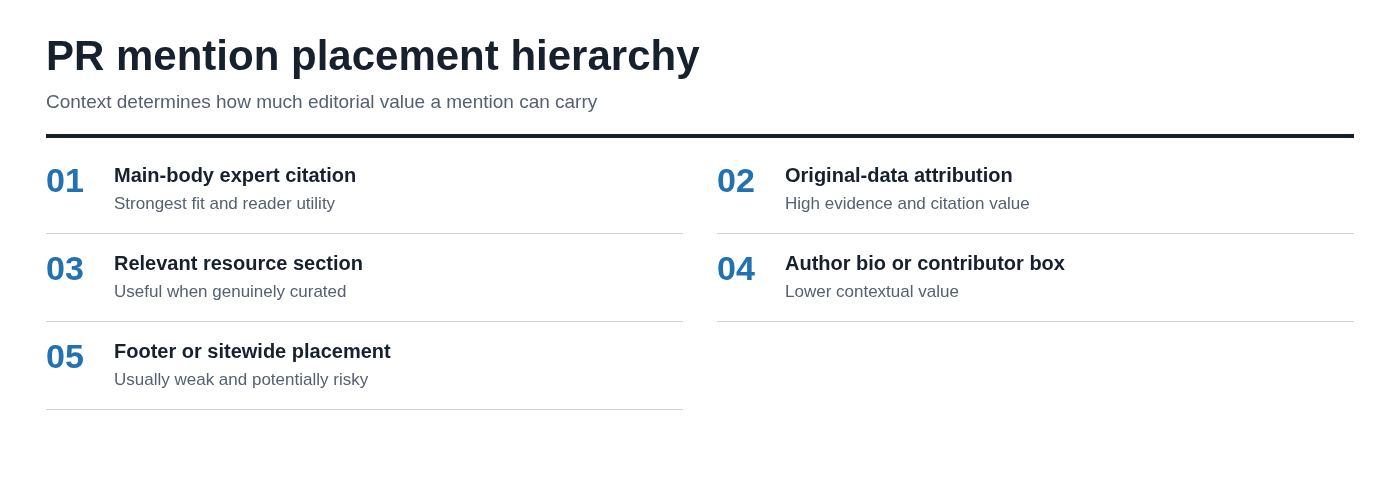
Where a mention appears changes its value. Main-body editorial citations are generally strongest because they are part of the article's argument and visible to readers. A reference in the title, opening section, expert quote, research attribution, or carefully curated resource section can be meaningful when it fits the content.
Lower-value locations include author bios, contributor boxes, generic partner pages, footers, and sitewide links. These placements may still have branding value, but they should not be valued the same way as a contextual citation in the main article body.
Read the surrounding copy as if you were a skeptical reader. Does the mention use natural language? Does the source support a claim? Is there a clear reason to click? A relevant sentence such as, "LinkHandy's research on B2B outreach response rates found..." provides a coherent editorial role. A sudden, keyword-heavy phrase such as, "best SaaS link building services" in the middle of unrelated advice does not.
This is especially important for contextual link insertion opportunities. Reject insertions that feel retrofitted, are added to stale content with no current audience, or fail to improve the original article. A placement should make the page better, not merely more commercial.
Inspect the link attributes and destination experience
For linked coverage, verify the technical details after publication and before you count it as a completed placement. Confirm that the link is live, clickable, crawlable, and points to the intended canonical URL rather than an irrelevant redirect or error page.
Check the attribute applied to the link. A standard followed link may contribute to search engine discovery and authority signals. Nofollow, sponsored, and UGC attributes communicate different relationships to search engines; see this guide to link rel attributes for the distinctions. A nofollow mention is not automatically a failed placement; it can still reach qualified readers, drive branded search, and strengthen credibility.
Review the anchor text as well. The best default is natural descriptive language tied to the sentence's claim. Avoid forcing exact-match commercial anchors, particularly when they make the article less readable or create a pattern that looks manipulated.
Finally, audit the destination itself. The page should be indexable, relevant to the surrounding claim, reasonably fast, and ready to convert interest into a next step. Sending earned editorial attention to a generic homepage when a relevant research report or guide exists wastes the opportunity.
Treat a follow link as a signal, not the final verdict
A followed link can be useful, but it is not proof of a worthwhile PR result. The strongest placements pair a legitimate editorial reason, relevant publication, suitable destination, and durable page with a technically sound link.
Do not accept a poor publication or an irrelevant placement simply because it offers a dofollow attribute. The context and legitimacy of the reference should decide whether the link is worth pursuing.
Verify that the coverage is original, visible, and durable
Not all media pickups are equal. Check whether the article is original reporting, a meaningful editorial rewrite, or a syndicated copy of coverage published elsewhere. If it is syndicated, identify the original source and its canonical version before counting the pickup as a distinct PR win.
Then verify that the page is indexed, publicly accessible, and likely to remain live. A strong placement should not disappear behind a temporary campaign page, a broken archive, or an account login. Publication freshness matters too: an active site with maintained archives is a safer long-term bet than a domain that appears neglected.
One durable original article on a respected niche outlet can outperform dozens of duplicated pickups. Syndication can extend awareness, but it should not inflate your link-building or PR quality report.
Estimate business value alongside SEO value
PR should support the business, not just a monthly backlink total. Score each placement for audience intent, likely referral traffic, brand credibility, usefulness in sales conversations, and buyer-journey relevance.
A trusted industry publication may create value even with limited direct traffic because sales teams can use the coverage in prospect conversations, partners may see it, and future buyers may encounter it during research. Conversely, a high-traffic article with an irrelevant audience can produce visits that never engage or convert.
Use analytics annotations when a placement goes live. Where appropriate, use UTM parameters on links that you control, particularly for paid or negotiated distribution. For earned editorial links, publishers may not accept tracked URLs, so rely on referral reports, landing-page behavior, branded-search changes, and assisted-conversion data instead.
Track referral sessions beyond the click. Look at engaged visits, scroll depth where available, return visits, newsletter signups, trial starts, demos, and assisted conversions. Do not claim that one mention directly caused a ranking improvement. Assess a group of comparable placements over a realistic time period and look for consistent evidence.
Use a weighted PR mention scorecard for consistent decisions
A weighted scorecard keeps teams from approving a placement solely because a publication has a high authority metric. It also makes prospecting, client reviews, and post-campaign reporting more consistent.
Score the opportunity before you commit to it. Give relevance and editorial context more weight than raw authority or a single link attribute.
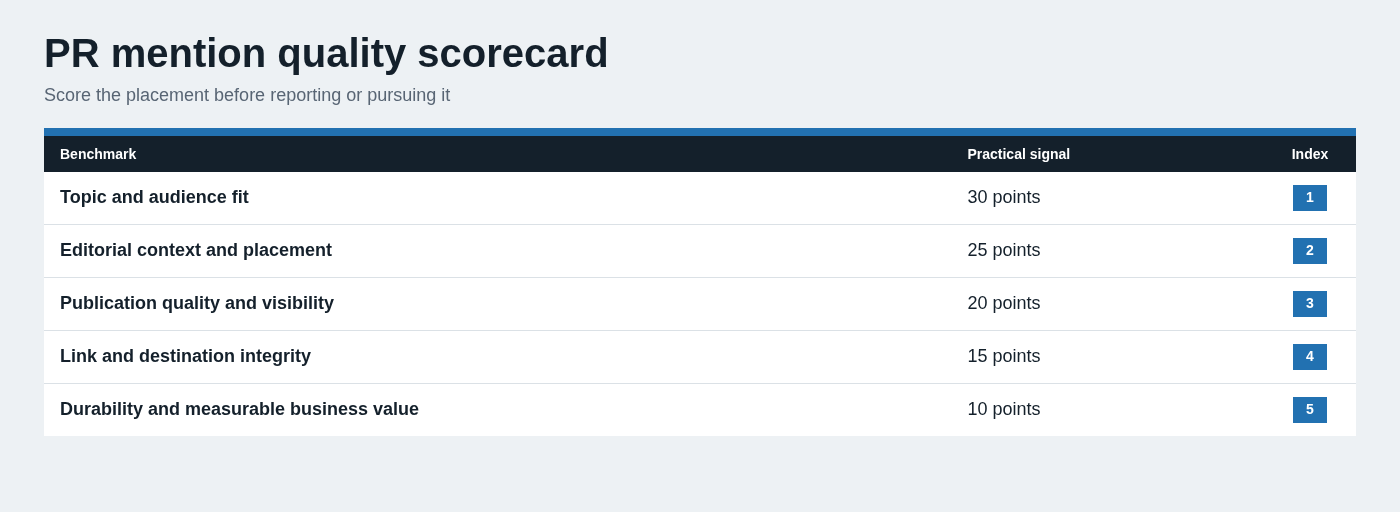
Use a 100-point total and document the evidence behind each section. For example, under topic and audience fit, record the publication's core subject, relevant article category, and why its readers match your target buyers. Under editorial context, paste the proposed sentence, placement location, and the destination URL.
| Score range | Recommended action |
|---|---|
| 80-100 | Pursue or approve. The mention has strong relevance, credible context, and a sound destination. |
| 60-79 | Negotiate improvements. Request a better destination, clearer attribution, stronger context, or confirmation of the final placement. |
| 40-59 | Monitor carefully. Consider the opportunity only if it offers a specific strategic benefit outside traditional link value. |
| Below 40 | Decline. The likely value does not justify the effort, cost, or risk. |
The most common mistake at this stage is giving authority too many points. A publication's metric should not outweigh poor audience fit, weak editorial standards, or a link that does not belong in the article.
Run quality assurance before the mention goes live
Turn the scorecard into a pre-publication quality assurance checklist. Do not assume the final article will match the prospecting notes or approved draft.
Confirm these details before the placement is marked complete:
- Publication URL and final article URL
- Author name, article status, and expected live date
- Final brand spelling, product naming, and attribution
- Target URL, redirects, and canonical destination
- Anchor wording and surrounding paragraph
- Link attribute, if the placement includes a link
- Canonical status of the publishing page, especially for syndicated coverage
- Screenshot or archived proof of the final live placement
Request corrections before publication when the context, attribution, destination, or disclosure materially changes the value of the mention. It is much easier to correct a draft than to ask a writer or editor to revise a live article.
This process also supports transparent outreach and clean reporting. Stakeholders should be able to see what was proposed, what was approved, what went live, and why the final placement met the campaign standard.
Handle unlinked brand mentions as selective outreach opportunities
An unlinked mention is not automatically a link-reclamation task. Contact the writer or editor only when a hyperlink would genuinely help readers verify a claim, access cited research, explore a useful tool, or find the source of an expert quote.
Prioritize mentions where your company is already being used as a source. If an article cites your original research but does not link to the report, a link request can be reasonable. If it simply names your company in passing, asking for a backlink may add no reader value and can strain the relationship.
Keep the outreach concise. Thank the writer, identify the exact sentence, explain how the source page supports that claim, and offer the most relevant URL. Make it easy to decline. The goal is to improve the article, not turn every brand reference into a transactional request.
For example, point to a specific statistic and provide the direct research page rather than asking for a generic homepage link. This approach is more useful to the editor and more likely to preserve a long-term relationship.
Report PR SEO impact as a portfolio, not a single-placement promise
PR SEO reporting should show the quality and pattern of placements, not promise that any one article will move rankings. Separate leading indicators from lagging outcomes so stakeholders understand what has been achieved and what still needs time.
Leading indicators can include the number of relevant referring domains, distribution of scorecard grades, indexed live placements, quality of editorial contexts, and referral engagement. A regular SEO link audit can help verify which placements remain live, relevant, and accessible. Lagging outcomes can include branded-search growth, organic visibility for linked assets, assisted conversions, and sustained pipeline influence.
Compare results with the baseline you set at the start. If your goal was to strengthen an original research asset, report the relevant publications that cited it, referral behavior from those pages, new referring domains, and changes in visibility for the research topic over time.
Avoid common reporting errors:
- Counting syndicated versions of one story as separate primary wins
- Double-counting links that redirect to the same final URL
- Reporting authority metrics without relevance or editorial context
- Calling correlation proof that a single PR mention caused a ranking increase
- Counting links that are no longer live, indexed, or accessible
Make every PR mention earn its place in your SEO strategy
The best PR mentions are relevant, editorially justified, durable, and useful to the reader. They put your brand in a credible conversation and point interested people to a page that deserves their attention.
Use the scorecard during prospecting, again during pre-publication QA, and once more when you report outcomes. Over time, this creates a clearer picture of which publications, topics, formats, and destination pages produce meaningful SEO and business value.
Teams that need help vetting and securing contextually relevant B2B placements can explore LinkHandy's white-hat link-building services.