
A B2B content partnership can produce far more than a polite backlink exchange. Done well, it gives two companies a credible reason to collaborate, creates an asset their audiences actually need, and earns links because the work is worth citing.
Done poorly, it becomes a thin co-branded ebook, a forced reciprocal link, and a long approval process that delivers little business value. The difference comes down to planning: choose the right partner, solve a shared buyer problem, and build distribution into the project before anyone writes a draft.
Define the partnership outcome before choosing a partner
A content partnership earns links when both companies bring something real to the table: a relevant audience, useful expertise, proprietary insight, or distribution reach. If the only reason to collaborate is "we both want a link," the finished asset will usually feel transactional to readers and editors alike.
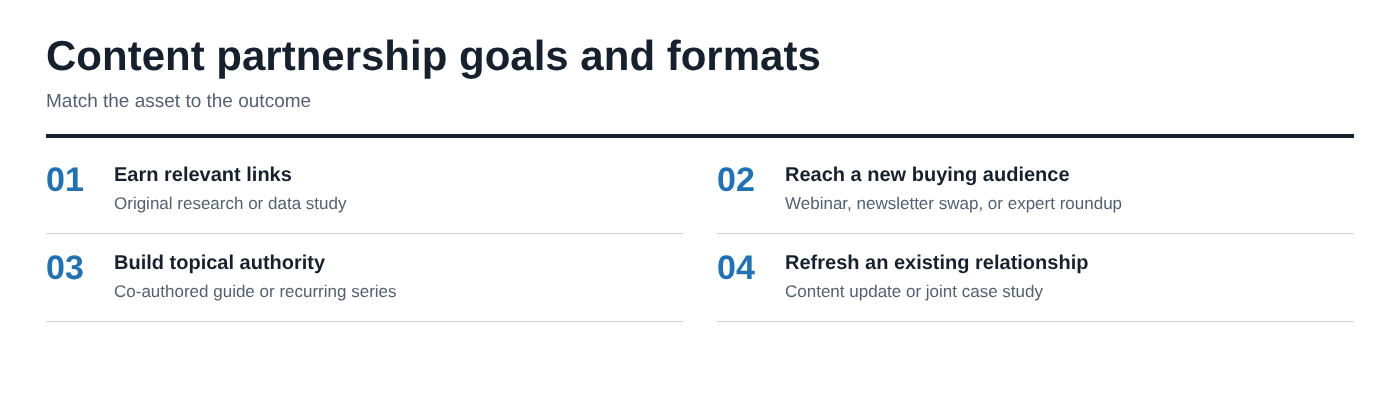
Start by defining the result you need. Common goals include earning relevant referring domains, driving qualified referral traffic, supporting a topic cluster with stronger authority, growing an email list, or influencing pipeline through a useful resource that sales can share.
Then select the partnership format that fits that goal. A one-off co-marketing asset works well when you need a launchable campaign, such as a data report or webinar. A recurring editorial partnership is better when two brands serve the same audience over time and can sustain a series. A guest-post exchange can be appropriate for editorial contributions, but it should never be treated as an automatic swap or a substitute for a useful idea.
Choose one primary success metric and supporting guardrails
Pick one primary metric so the project has a clear decision-maker. For example, a SaaS company building authority around revenue operations might make relevant new referring domains its primary metric. A partner promoting a new integration may prioritize qualified referral sessions or demo-assist activity instead.
Use guardrails to prevent a vanity-first plan. Set minimum expectations for topical relevance, editorial quality, publication timing, and distribution. A placement on an impressive-looking site is not a win if its audience is unrelated, its content is clearly published without standards, or the asset will sit unpublished for six months.
A practical target might be: publish within eight weeks, reach at least two relevant owned audiences, and secure links only where they improve the reader's path to a supporting resource.
Set partner criteria that protect relevance and editorial quality
Do not choose a partner solely because of a high DR or DA score. Those third-party metrics can be useful signals, but they do not tell you whether the company reaches your buyers, publishes credible work, or will produce a placement that makes sense in context.
Qualify potential partners against a short, practical checklist:
- Audience overlap with your target buyers or influencers
- Topical adjacency without direct, unnecessary competition
- Visible editorial standards and credible authorship
- Organic visibility for relevant topics
- A distribution channel that can reach the intended audience
- Brand fit and a professional reputation
- A willingness to include contextual links when they help readers
Review the partner's blog, resource center, newsletter, contributor pages, social activity, and prior collaborations. You are looking for proof that they publish substantive content and can bring an audience to it, not just proof that they accept submissions.
Assess audience overlap and topic adjacency
The best B2B partners are often adjacent to your product rather than identical to it. A project management platform might collaborate with a workflow consultancy, an agency serving operations teams, a respected industry community, or a non-competing software tool used by the same buyer. Teams evaluating possible formats can also review these creative link-building ideas for examples of collaboration angles.
For example, a cybersecurity SaaS company and an IT compliance consultant may both serve mid-market IT leaders. Their joint asset could address audit preparation, with the SaaS company contributing product usage patterns and the consultant contributing implementation guidance. The audience overlap is clear, but each side adds a different form of expertise.
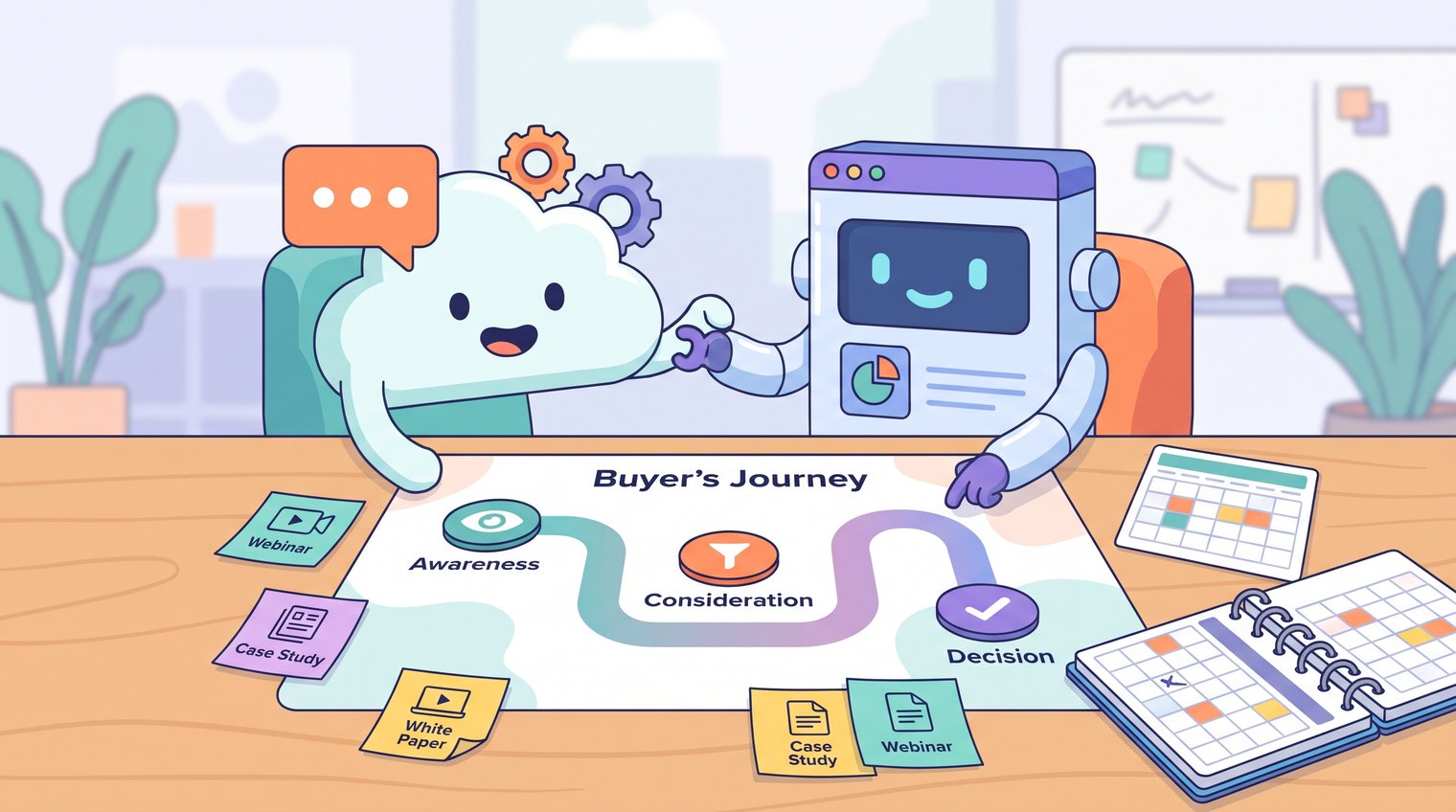
Look for shared buyer problems, shared stages of the customer journey, and integration ecosystems. These are more reliable starting points than a broad category label such as "B2B software."
Review editorial evidence before outreach
Before you contact a prospect, inspect recent articles closely. Check whether posts have named authors, meaningful bylines, current publication dates, external citations, and enough depth to serve a professional reader. Review how outbound links appear: are they placed naturally in supporting context, or are they scattered through shallow articles?
Also look for signs of a real audience. Relevant search visibility, an active newsletter, event programming, thoughtful social discussion, and credible contributors all matter. Avoid sites that publish indiscriminately across unrelated industries or appear to exist mainly to sell placements.
Build a short partner list around shared buyer problems
Mass outreach is rarely the right answer for a B2B content partnership. Build a focused list of high-fit prospects that have a genuine reason to participate. Ten well-researched names are more valuable than 200 generic contacts.
Start with customer segments and the problems they are trying to solve. Then look for organizations that already speak to those problems: adjacent software providers, implementation consultants, integration partners, event speakers, industry newsletters, specialist publications, expert sources quoted in your content, and companies cited in the articles your buyers read.
Score prospects from 1 to 5 on five factors: relevance, audience access, editorial fit, relationship warmth, and execution effort. A partner with a slightly smaller audience but a warm relationship and strong editorial fit may be a better choice than a large publication that cannot commit to a collaborative process.
Develop a partnership idea that is useful to both audiences
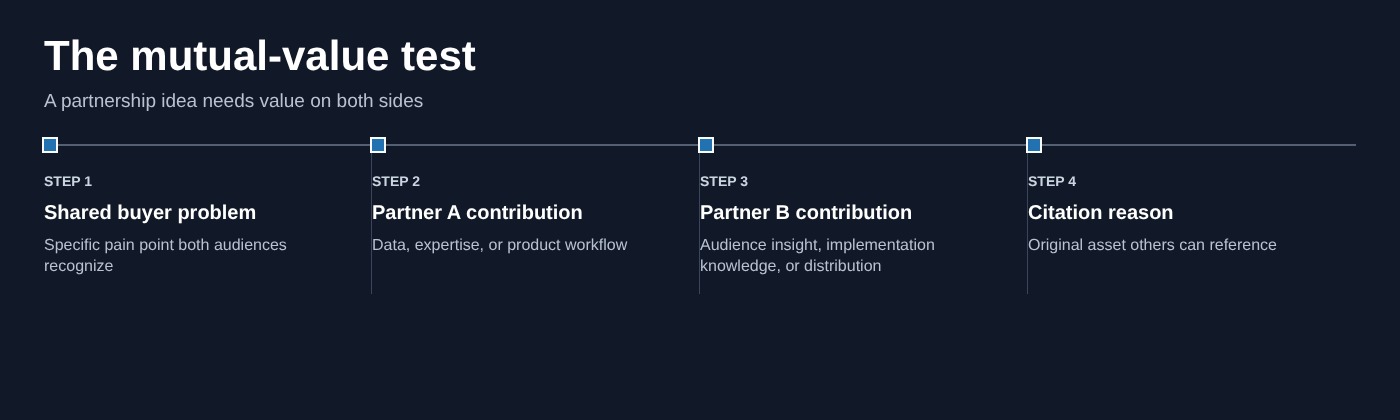
Your idea needs to pass a simple mutual-value test. It should answer a meaningful question both audiences recognize, and each partner should make a distinct contribution. If one brand could create the exact same asset alone, the partnership probably adds little value.
Strong formats include original benchmark research, an implementation guide, a joint webinar with an evergreen recap, an expert roundtable, an integration playbook, a co-authored template, or a detailed case study. The common thread is not the format. It is the presence of useful, specific inputs that make the work hard to duplicate.
Choose a narrow editorial angle. "The future of B2B marketing" is too broad to produce a citeable asset. "How 50 mid-market SaaS teams structure product-led sales handoffs" gives readers, contributors, and potential publishers a concrete reason to pay attention.
Use original inputs to make the asset linkable
Links are earned when another writer has a reason to reference your work. Build those reasons into the asset from the beginning. Proprietary data, anonymized customer patterns, practitioner interviews, expert commentary, decision frameworks, and downloadable templates all create something that third parties can cite.
For example, a joint guide on CRM cleanup is stronger when it includes findings from a customer survey, a consultant's implementation checklist, and a template for assigning data ownership. It is weaker when it simply restates familiar advice about maintaining clean records.
Avoid partnership ideas that create weak links
Be skeptical of reciprocal-link-first proposals, generic "top trends" listicles, and thin co-branded ebooks assembled from existing blog posts. They may create a link on launch day, but they rarely attract secondary citations or meaningful attention.
Another common mistake is agreeing to an idea before confirming how it will reach an audience. A good asset without a distribution plan is a production project, not a content partnership.
Write an outreach pitch that makes the collaboration easy to say yes to
Lead with a relevant observation, not a request for a link. Show that you understand the prospect's audience, point to a recent article, event, product focus, or customer problem, and propose a collaboration that fits their editorial direction. A focused SEO outreach strategy can help keep this research and personalization consistent across prospects.
Your pitch should make the work feel manageable. State the concept, explain the benefit to both audiences, define what each party would contribute, mention the intended distribution, and suggest a realistic timeline. End with a simple next step, such as asking whether they would be open to a 20-minute discussion or a short reply on fit.
Do not ask for a backlink before establishing editorial value. It turns a potentially useful partnership into a transactional request and gives the recipient little reason to engage.
A concise outreach structure
Keep the first email short enough to read quickly:
- Relevant opening: Reference a specific piece of their work or audience need.
- One-sentence concept: Describe the shared buyer problem and proposed asset.
- Mutual benefit: Explain why the topic helps both audiences.
- Contribution plan: State what you can provide, such as data, an SME, a template, or design support.
- Promotion plan: Mention the channels you expect to use.
- Clear CTA: Ask for a brief call or a simple yes/no response.
Tailor every pitch. A generic message about "mutual SEO benefits" will underperform because it gives no evidence that the collaboration belongs on that company's content calendar.
Agree on scope, ownership, and linking expectations before production
Once a prospect is interested, put the working agreement in writing. It does not need to be a complex legal document for every project, but it should prevent the predictable problems: missed deadlines, unclear attribution, delayed approvals, and disagreement about where the asset will live.
Define deliverables, named owners, approval rounds, deadlines, source access, brand review requirements, publication location, campaign tracking, and repurposing rights. Decide who has final editorial responsibility. One accountable editor should resolve conflicting feedback and keep the asset coherent.
Discuss links transparently. Agree on the destination pages that may be useful to readers, use descriptive anchors where they fit naturally, and recognize that the publisher retains editorial judgment. Do not force exact-match anchor text or demand links that do not serve the page's purpose.
What to include in a B2B content partnership brief
A useful brief should cover the audience, search intent, working angle, evidence sources, key messages, contributor roles, draft deadlines, on-page CTA, internal-link opportunities, promotion commitments, and success measures.
When the collaboration includes an editorial guest contribution, a guest post content brief template for B2B SEO can keep the scope clear. The important point is not the template itself; it is making sure both teams agree on the reader, the argument, the evidence, and the publication standards before drafting begins.
Create the asset with an editorial workflow, not a handoff
Partnership content needs an editorial process, not a loose exchange of notes. Use a sequence that keeps both contributors aligned: collect research, approve the outline, draft, obtain SME review, fact-check claims, complete design, gather partner feedback, make final edits, and prepare for publication.
Build citation-worthy sections into the outline early. If the asset will include survey findings, expert quotes, a calculator, or a template, decide where those elements belong before the draft is written. Trying to add "linkable" material after the fact usually creates awkward, disconnected sections.
Set review limits. Two structured approval rounds are usually enough for a standard guide or report. Unlimited feedback cycles are a common way good partnership ideas die.
Plan contextual links where they genuinely help the reader
Map one or two links per contributor to the most relevant supporting resources, product education pages, original research, or implementation guides. A link should help a reader take the next step, verify an assertion, or explore a topic in more depth.
Do not overload a joint asset with self-serving links. A crowded page looks promotional and weakens the editorial case for every link on it. The correct approach is selective placement, natural wording, and a destination page that fulfills the promise of the anchor text.
Publish on the strongest relevant home and coordinate distribution
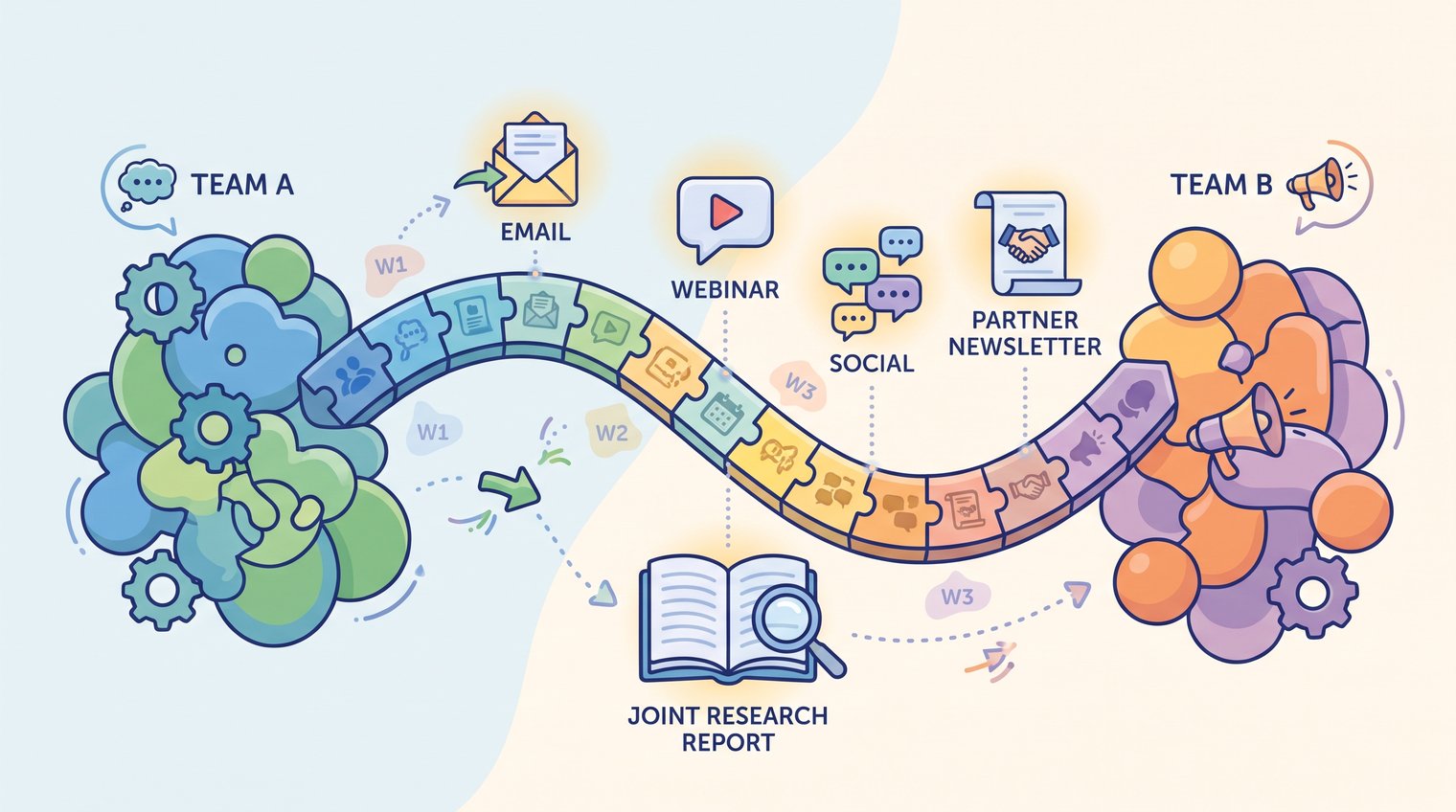
Choose one canonical home for the full asset whenever possible. This is usually the partner with the stronger topical audience, better editorial infrastructure, or clearest ability to support the campaign. The other partner can amplify it through email, social, a companion post, a webinar recap, or a resource page that adds distinct value.
Do not publish the complete text on multiple domains. Duplicate full-text publication can confuse readers and make it harder to understand which version is the primary resource. Each supporting piece should have its own job: summarize findings, provide implementation steps, share a recorded discussion, or point readers to the canonical asset.
Coordinate distribution before launch. A practical checklist includes:
- Email newsletters from both partners
- Social posts tailored to each company's audience
- Sales enablement for account executives and customer teams
- Relevant communities and professional groups
- Webinar follow-up, if the asset supports an event
- Contributor outreach to quoted experts and cited sources
- Targeted outreach to publications, authors, and newsletters covering the topic
Turn the published asset into earned-link outreach
The link from your partner is only one outcome. The stronger opportunity is the additional earned links the asset can attract after publication. Identify authors, journalists, newsletter editors, resource curators, and websites that cover the same problem and would benefit from the data, quote, template, or framework you created.
Personalize the outreach around their audience. If an article covers onboarding workflows, point to the exact finding or checklist in your guide that strengthens that conversation. If a newsletter frequently shares practical templates, lead with the template rather than a vague request to "check out our new report."
Do not send a generic request to add your link to an old post. Explain why a specific resource is useful, and accept that an editor may decide it is not a fit. That is how legitimate editorial outreach works.
Track links, referral quality, and business impact
Monitor new referring domains, the relevance of each linking site, anchor context, referral sessions, on-site engagement, rankings across the related topic cluster, assisted conversions, and partner-sourced opportunities. Tag campaign links so you can separate partnership traffic from other acquisition sources. A documented link campaign strategy can make those responsibilities and reporting windows easier to manage.
Report in two windows. Launch reporting captures immediate distribution performance, while a longer-term citation view tracks links and mentions that accrue over the following months. Many valuable B2B links arrive well after the initial promotion period.
Review the partnership and decide whether to repeat, expand, or stop
Run a short retrospective with both teams after the campaign has had time to perform. Discuss what readers found useful, where approvals slowed down, which channels drove qualified attention, what links appeared, and what should change next time.
Repeat or expand the relationship when it has consistent audience fit, reliable execution, strong editorial quality, and measurable mutual value. A successful first project can become a quarterly research series, recurring webinar, expert column, or a set of integration-focused implementation guides.
Stop when the work is consistently difficult to approve, the audience fit is weak, or the collaboration produces little value beyond a token link. Not every partner deserves a second project.
Plan partnerships around value first, then earn links naturally
The strongest B2B content partnerships begin with a shared audience problem, not a link request. They create a genuinely citeable asset, establish transparent expectations, and use coordinated distribution to put that asset in front of people who may reference it.
Teams that need help identifying credible partners and securing contextual editorial placements can explore LinkHandy's link-building services.