
A link campaign can waste months of effort when it starts with a spreadsheet of websites instead of a business objective. Sending more emails is not a strategy, and a higher domain metric does not make an irrelevant placement valuable.
The campaigns that produce durable SEO gains are focused: they identify a page worth promoting, give publishers a credible reason to reference it, and measure more than the number of links acquired. This guide explains how to plan, run, and evaluate a link campaign for a B2B or SaaS business without sacrificing editorial quality.
What a Link Campaign Is - and What It Is Not
A link campaign is a time-bound, goal-led program for earning relevant editorial backlinks. It has a defined target, an outreach or promotion plan, quality standards, a reporting window, and a decision about what to do next based on results.
That is different from ongoing link building. Ongoing work may steadily build relationships, earn mentions, and support multiple pages over time. A campaign narrows that work into a specific initiative, such as improving visibility for a category page, launching original research, reclaiming lost links, or earning citations around a new product category.
It is also different from passive link attraction. A strong article may earn links organically, but publishing useful content alone does not guarantee that the right people will discover it. A campaign combines a worthwhile asset or page with deliberate prospecting and outreach.
Finally, a link campaign is not bulk link acquisition. Hundreds of irrelevant placements, manipulated anchor text, or low-quality sites created mainly to sell links can create reporting activity without building meaningful authority. Editorial relevance, audience fit, and placement context matter far more than raw volume.
The quick-start plan
If you need the short version, follow this sequence:
- Audit your target page, backlink profile, competitors, and technical foundations.
- Set one measurable campaign goal and define quality guardrails.
- Choose pages that are ready to benefit from links.
- Create or identify a credible reason for another publisher to link.
- Build and segment a prospect list based on topical relevance.
- Send personalized outreach tied to a specific editorial opportunity.
- Verify every live placement, then measure quality, visibility, and business impact.
- Use campaign evidence to improve the next sprint rather than repeating the same outreach at greater volume.
Set the Campaign Goal Before You Choose Tactics
Link building tactics should follow the outcome, not the other way around. A business trying to strengthen a commercial category page needs a different campaign from a company launching a research report or recovering links lost during a site migration.
Your goal determines the target page, the kind of asset you need, the publishers worth pursuing, the outreach message, and the metrics that count. Without that clarity, teams often collect links that look good in a monthly report but do little for the page or topic they actually need to improve.
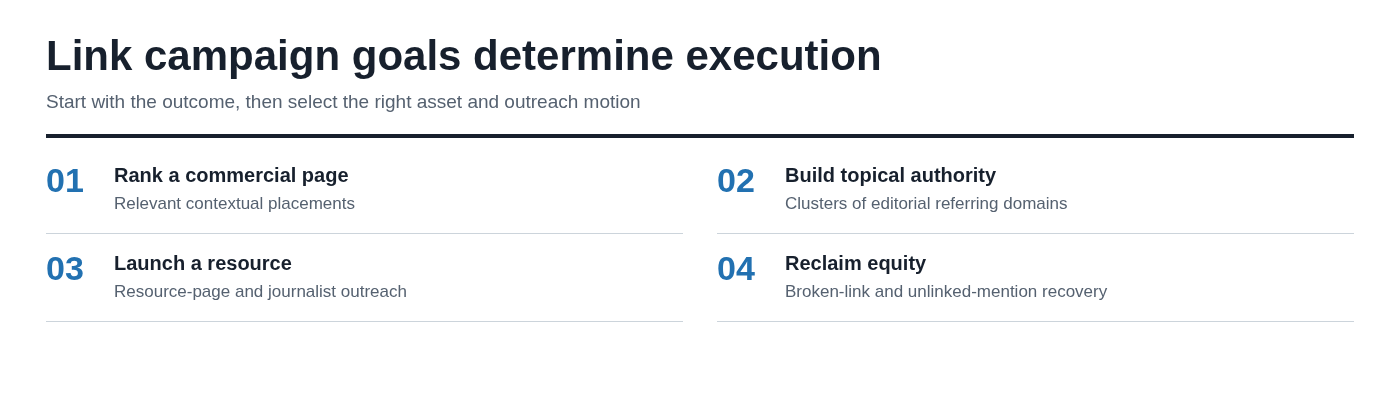
Common campaign objectives include:
- Improve rankings for a commercial page: Earn relevant contextual placements, often supplemented by links to supporting informational content.
- Support a new content asset: Build initial awareness and citations for a data study, guide, calculator, or resource.
- Build topical authority: Earn editorial references across a connected cluster of pages in one subject area.
- Reclaim lost equity: Recover broken backlinks, redirects, removed links, or unlinked brand mentions.
- Earn brand and PR mentions: Position company experts or original data in publications read by your audience.
A campaign with a vague goal such as "get more backlinks" creates poor decisions later. A more useful goal might be: earn editorial citations from relevant B2B software, operations, and growth publications that support a workflow-automation category page and its related benchmark resource over a defined quarter.
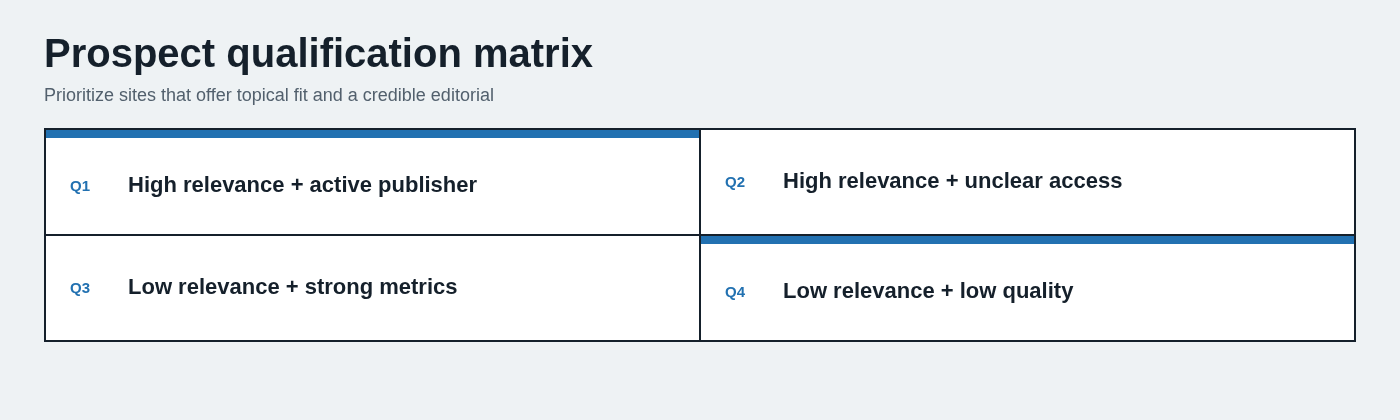
That goal gives the team a practical filter. If a prospect has no audience overlap, no sensible placement opportunity, and no relationship to the topic, it is not a priority no matter how impressive its headline metric appears.
Establish a Baseline With a Link Audit
Before setting a link target, establish what is actually holding the target page back. An SEO link audit should not assume that every ranking problem requires more backlinks. Weak search intent alignment, thin content, poor internal links, slow pages, incorrect canonical tags, or indexation issues can all limit performance.
Review the current profile at both the domain and page level. Look at referring domains, linking-page relevance, anchor-text distribution, recently lost links, new links, competitor patterns, and the organic visibility of the target page. Check whether the target is indexed, eligible to rank, internally linked from relevant pages, and useful enough to satisfy the query it targets.
The goal is to find the constraint. If comparable pages rank with similar authority but offer more complete answers, improve the page first. If your page is strong but lacks relevant third-party citations compared with competitors, a focused link campaign may be justified.
Choose pages that are ready to benefit from links
Not every URL deserves campaign resources. Prioritize pages with a clear search intent, credible and differentiated content, a conversion path appropriate to their intent, and realistic ranking potential.
A page ranking on the second page for a commercially important query may be a strong candidate if it is already indexed, well structured, and supported internally. In contrast, sending links to a thin product page, a duplicate location page, or an article that does not answer the searcher's question usually compounds the problem.
Ask a simple question before promotion: if a qualified visitor arrives from a trusted publisher, will this page deliver on the promise implied by the link? If the answer is no, improve the destination first.
Find the link gap worth closing
A useful link gap is not simply a count of how many more backlinks competitors have. Compare the target page against ranking competitors by the number of relevant referring domains, the quality and topical fit of linking pages, the type of content earning links, anchor patterns, and placement context.
For example, a competitor may have 40 more backlinks because it has been cited in old directories, scraper sites, and unrelated listicles. That is not necessarily a gap worth copying. A more meaningful gap might be five respected operations publications linking to a competitor's implementation guide while your site has no equivalent resource or editorial citations.
That distinction informs the campaign. You may need a better supporting asset, a more credible expert angle, or a set of publisher relationships - not a larger quantity of generic links.
Define Success Metrics and Guardrails
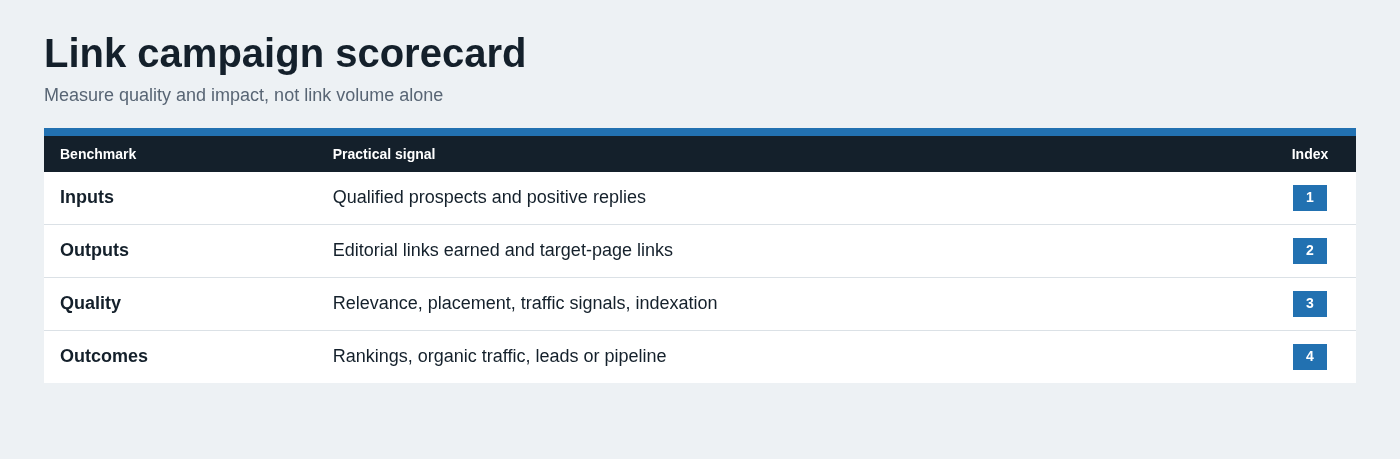
Good reporting follows the path from activity to impact. Outreach volume is useful operational data, but it is not the outcome. A campaign scorecard should show whether you reached qualified prospects, earned worthwhile placements, and improved the visibility or commercial performance that motivated the work.
Track leading indicators such as qualified prospects researched, messages delivered, replies, and positive conversations. Then measure outputs: editorial links earned, links to the target page or supporting assets, live placement status, and whether the linking page is indexed.
Quality measures deserve their own review. Record topical relevance, placement position, surrounding copy, destination-page fit, traffic or visibility signals, anchor naturalness, and editorial discretion. Finally, track outcomes such as target-keyword movement, organic landing-page traffic, referral visits, assisted conversions, leads, or pipeline where attribution is possible.
Set guardrails before outreach begins. These should cover topical relevance, publisher standards, anchor-text diversity, acceptable landing pages, disclosure practices, budget, and prohibited methods. Guardrails prevent a campaign from drifting toward easy but low-value placements when response rates are slower than expected.
In practice, a natural mix of branded anchors, URLs, descriptive phrases, and occasional relevant topical anchors is healthier than an exact-match anchor campaign. The best placement language should make sense in the publisher's sentence, not in your spreadsheet.
Choose the Right Link Campaign Type
There is no universal "best" link campaign. Each type solves a different problem and requires a different level of asset development, editorial effort, and relationship building.
Content-led campaigns
Content-led campaigns promote an asset that is naturally useful to cite: original research, data studies, calculators, statistics pages, expert roundups, templates, or practical resources. They work best when the asset offers something a publisher cannot easily replace with a generic article.
A publish-first approach still requires distribution. A well-written report with no distinctive finding, no defined audience, and no promotion plan is unlikely to earn many references. The hook might be a surprising benchmark, a useful comparison framework, a calculation tool, or a timely expert finding that helps readers make a decision.
Editorial guest-post and content-partnership campaigns
Contributed content and content partnerships can earn relevant contextual placements when the publisher, audience, topic, and destination page genuinely fit. The standard should be editorial usefulness, not merely securing a byline.
Strong campaigns propose original topics that the publisher has reason to cover, bring credible expertise, and include links only where they improve the reader's understanding. A B2B SaaS company might contribute a detailed implementation lesson to an operations publication, linking to a supporting workflow resource rather than forcing a product page into an unrelated article.
Topic originality matters. Repackaging the same generic guest post for dozens of sites produces weak content and makes editors less likely to engage.
Resource-page, broken-link, and link-reclamation campaigns
These campaigns are efficient when a clear existing opportunity exists. A resource-page campaign asks a curator to consider a genuinely useful addition. Broken-link outreach identifies a dead external resource and suggests a relevant, live replacement. Reclamation work recovers lost links, fixes incorrect URLs, and asks publishers to link a legitimate unlinked brand mention.
The common requirement is relevance. A broken link is not an invitation to pitch any page on your site. Your replacement should cover the same need at least as well as the missing resource.
Digital PR and expert-commentary campaigns
Digital PR earns attention through a newsworthy angle, expert contribution, original data, or timely reaction. It can generate high-authority mentions and valuable brand exposure, especially when your company has credible subject-matter experts or proprietary insight.
However, PR links are less controllable than direct outreach. Journalists may quote your expert without linking, use a nofollow attribute, change the angle, or choose another source. That does not make the work unhelpful; brand recognition, referral traffic, and editorial credibility can still be valuable. It does mean PR should be measured on its own terms rather than promised as a fixed number of links.
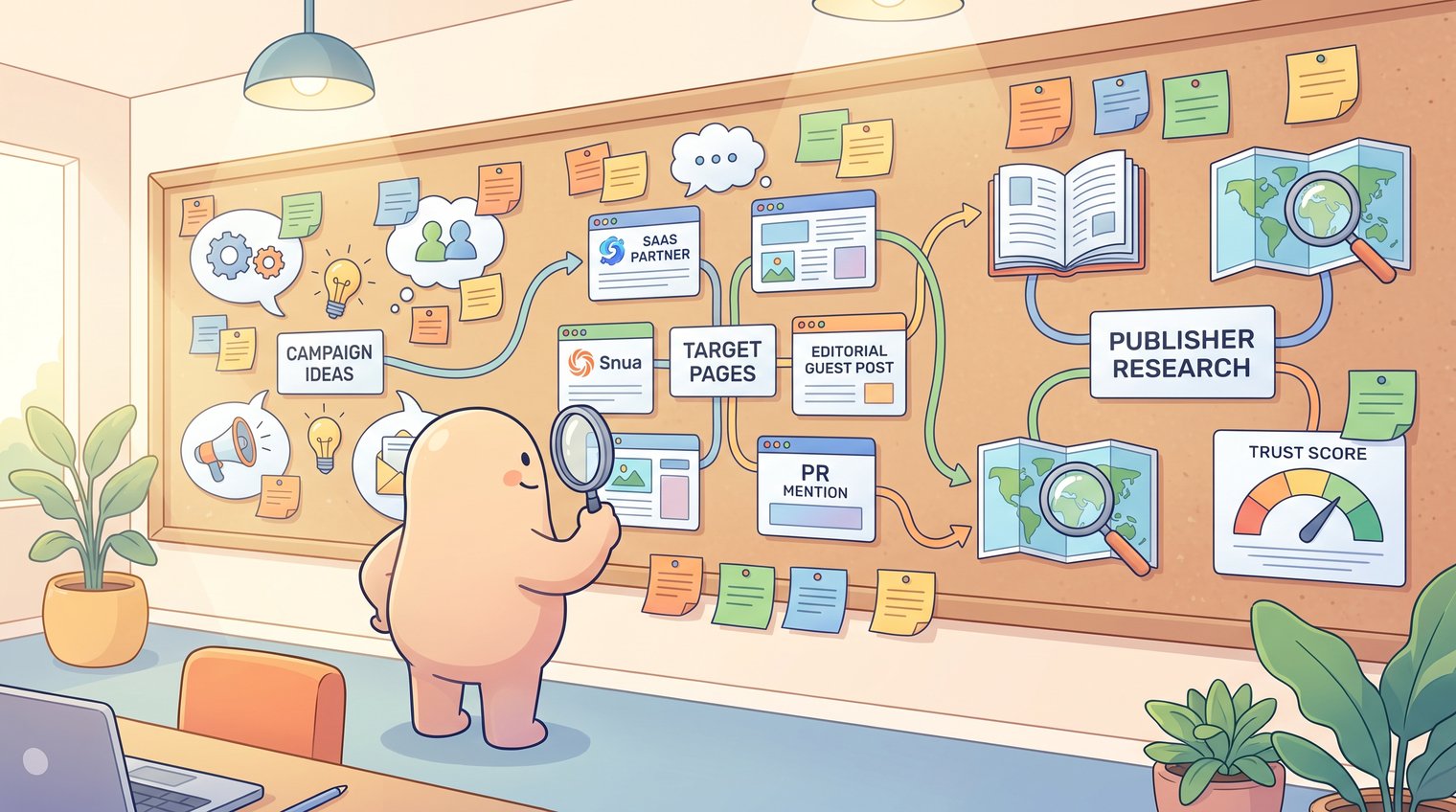
Create a Linkable Angle for the Page You Need to Promote
The central tension in link campaigns is straightforward: commercial pages often need authority, but informational assets are usually easier for publishers to cite. Trying to force every earned link directly to a product or service page is one of the fastest ways to make outreach feel self-serving.
The solution is not to abandon commercial pages. It is to build a sensible path between a linkable asset and the page that matters commercially. That may involve a benchmark report, implementation guide, calculator, integration resource, or category explainer that supports the broader topic and links internally to the commercial page.
As covered in the audit section, the destination must already be useful and aligned with intent. A supporting asset cannot rescue a weak conversion page, but it can create an editorial reason to start the conversation.
Match the hook to the prospect's audience
Use a practical test for every pitch: why would this publisher's readers care, and why would an editor reference this source now? If you cannot answer both parts clearly, the outreach is probably premature.
For SaaS and B2B audiences, credible link campaign ideas often come from material that makes a complex decision easier. Examples include benchmark data showing how teams handle a common workflow, a template for evaluating a software category, original survey findings about adoption barriers, an integration guide, or a category explainer written by practitioners.
Suppose a workflow automation platform wants to improve a category page. Rather than asking publications to link to that commercial page without context, it could publish a benchmark report on approval bottlenecks across operations teams. A publication writing about process efficiency has a clear reason to cite the report. The report can then link internally to an appropriate category or solution page for readers who want to evaluate tools.
Build internal-link paths that transfer value
Internal links connect earned authority with your commercial pages. A supporting asset should link naturally to related product, service, comparison, and educational pages where those links genuinely help a reader continue their research.
Build topic clusters rather than isolated URLs. A benchmark report might link to an implementation guide, which links to a comparison page, which links to a product solution page. This creates a coherent path for readers and search engines without treating internal links as a mechanical afterthought.
Not every external link should target the money page. A diverse campaign can earn citations to research, guides, and tools while strengthening the topical ecosystem around the commercial page that matters.
Build a Prospect List Based on Relevance, Not Domain Metrics Alone
A prospect list is not a list of sites with high authority scores. It is a list of publishers, writers, organizations, and resources that have a credible reason to reference your content, expertise, or brand.
Assess topical fit, audience overlap, editorial activity, signs of real traffic and indexation, outbound linking behavior, contact accessibility, and the context in which a link could appear. A smaller industry publication read by your buyers may be more valuable than a broad site with stronger metrics but no meaningful connection to your topic.
Useful sources of prospects include competitor referring domains, relevant resource pages, authors covering your subject, niche communities, integration partners, associations, existing relationships, podcasts or newsletters, and pages that mention your brand without linking.
Segment prospects by outreach reason
Segmentation makes outreach more useful and reporting more diagnostic. Do not send the same message to every prospect merely because they share a topic. A focused SEO outreach strategy can help align each segment with an appropriate editorial reason.
- Competitor-link replacements: Pages already linking to a comparable resource where your asset offers a legitimate alternative or improvement.
- Resource curators: Editors maintaining useful collections, directories, toolkits, or learning hubs.
- Expert-contribution publishers: Publications that accept informed guest contributions or expert commentary.
- Journalists and newsletter writers: People who need timely data, quotes, and credible sources.
- Partners and communities: Integration partners, agencies, consultants, associations, and customers with real audience overlap.
- Existing brand relationships: Organizations that already know your work, use your product, or have referenced you before.
When results are segmented, you can learn what is working. Perhaps partner outreach produces strong referral traffic while resource-page requests receive replies but few placements. That insight is far more actionable than a single campaign-wide response rate.
Prepare Outreach That Gives Editors a Clear Reason to Act
Effective outreach is concise, specific, and truthful. It shows that you understand the recipient's content, explains why the resource or contribution benefits their audience, and makes the next step easy.
The format changes by campaign type. A content pitch introduces the asset and its most useful finding. A broken-link email identifies the exact dead resource and explains why your replacement fits. An unlinked-mention request politely points out a factual reference and offers the correct URL. A guest contribution pitch proposes a distinctive topic, while PR commentary offers timely expert input rather than a promotional message.
What they share is editorial relevance. Editors do not need a long explanation of your company; they need a credible reason to take action.
Use a campaign-ready outreach template as a starting point
A link campaign template should provide structure, not a mass-email script. Use the following framework, then customize each element around the prospect's page and audience:
- Subject line: Name the relevant article, topic, or timely editorial opportunity.
- Contextual observation: Mention a specific, accurate detail that establishes why you contacted this person.
- Value proposition: State the insight, resource, correction, or contribution that could help their readers.
- Proof: Briefly support the claim with a concrete finding, expert credential, or relevant example.
- Suggested use: Recommend a sensible placement, source citation, or contribution angle without demanding it.
- Simple CTA: Ask whether they would like the full resource, a quote, or a draft outline.
For example, a message to an operations newsletter editor might note that a recent issue discussed approval delays, offer a benchmark finding on the same problem, and ask whether the editor would like the underlying methodology or an expert comment. It should not pretend that the editor's existing article is incomplete without your link.
Follow up without damaging relationships
Follow up sparingly. One thoughtful follow-up after several business days is usually reasonable; a second may be appropriate for a particularly strong and timely opportunity. Stop when there is no response, an explicit decline, or a clear signal that the contact is not relevant.
Record outcomes and objections. If editors repeatedly say an asset lacks original data, the solution is not more follow-ups. Improve the asset. If a segment does not accept external references, remove it from future outreach. Respectful follow-up protects relationships and keeps the campaign learning-focused.
Run the Campaign With an Operational Workflow
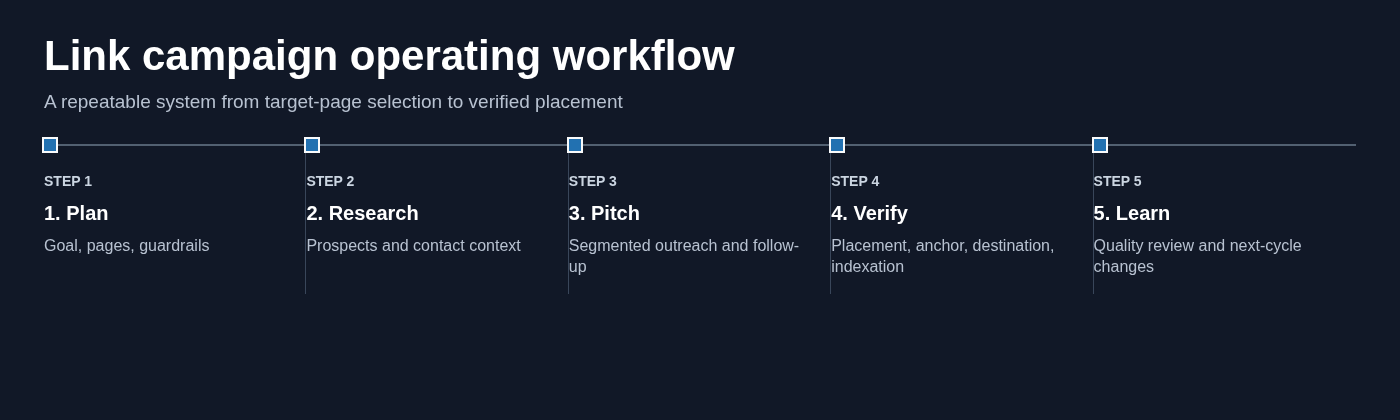
A campaign needs an operating system, not just a prospect sheet. Assign ownership for strategy, content, research, outreach, approvals, placement verification, and reporting. Set a campaign calendar that accounts for asset production, review cycles, outreach waves, and the lag between placement and SEO impact.
Track every prospect through clear statuses: researched, qualified, approved, contacted, followed up, replied, pitched, placed, declined, or not a fit. For live placements, record the publisher URL, linking-page URL, destination URL, anchor text, publication date, link attribute where visible, placement context, and verification date.
Approval steps matter, especially in B2B. Review target pages, publisher lists, content topics, and pitches before work goes live. This reduces brand risk and helps prevent links to unsuitable pages. A transparent process should make it easy for stakeholders to understand what is being pursued and why.
Responsible automation can help with research enrichment, duplicate detection, reminders, task assignment, and reporting. Guidance on link building automation is useful here: automation should not replace human judgment about whether a publisher is relevant, whether a pitch is truthful, or whether a placement meets your editorial standards.
Work a Complete B2B SaaS Link Campaign Example
Consider a hypothetical B2B SaaS company that sells workflow approval software. Its category page for approval workflow software is commercially important, but it is sitting just outside the top results for several valuable queries. The team wants to improve visibility without pushing unnatural links to the category page.
Step 1: Diagnose the ranking opportunity
The team audits the category page and finds that it is indexed, answers the core commercial query, includes useful comparison criteria, and receives internal links from relevant product and educational pages. It ranks between positions 11 and 16 for a group of category terms.
Competitive review shows that top-ranking pages have more relevant editorial referring domains. More importantly, several competitors are cited in operations and productivity publications through research and implementation content. The target page does not need 100 random links; it needs stronger topical evidence and supporting content.
The campaign objective becomes: earn a defined set of relevant editorial placements over a 90-day period, primarily to a new benchmark resource and selectively to the category page where the context is genuinely commercial.
Step 2: Build the asset, prospect segments, and pitch angles
The company develops a benchmark asset, "The State of Approval Bottlenecks in Operations Teams," based on a clearly explained survey and anonymized product data. It includes practical findings, a workflow self-assessment, and expert analysis. The report links internally to the approval workflow software category page and a detailed implementation guide.
Next, the team builds four prospect segments:
- Operations and productivity publications: Pitch benchmark findings relevant to their editorial coverage.
- Integration partners: Offer a joint perspective on how approval bottlenecks affect shared customers.
- Operations consultants and agencies: Share the resource as a client education tool or source for their own content.
- Resource curators: Suggest the self-assessment or implementation guide for relevant toolkits.
Most outreach links to the benchmark asset because it is the most citeable destination. Partnership content or comparison-focused articles may link to the category page when the surrounding discussion is about selecting approval workflow software. The internal-link paths connect both types of external citations to the commercial page.
Step 3: Track outcomes and make the next decision
At the end of the hypothetical sprint, the report should not stop at a link count. The team reviews qualified prospects, delivery and reply rates, positive responses, placements, and the quality of each referring page. It verifies that placements are live, links point to the intended URLs, pages remain indexed, and the context matches what was agreed.
Then it compares pre-campaign and post-campaign data: target-page impressions, average positions for the query cluster, organic visits, referral sessions from placements, engagement with the benchmark report, and any assisted demo requests or leads.
Suppose the operations-publication segment generates fewer links but the strongest referrals and most relevant placements. The company may scale that angle. If resource-page outreach performs poorly despite high relevance, it might improve the self-assessment or change targeting. If quality links are earned but rankings do not move, the next decision may be to improve on-page comparison content, internal linking, or technical performance rather than simply buying more outreach volume.
Evaluate Link Quality Before You Count It
Every placement should pass a practical quality review. A link is not automatically valuable because it is dofollow, nor automatically useless because it is nofollow.
- Is the publisher and linking page topically relevant to your company or target topic?
- Was the link added with editorial discretion rather than placed in obvious paid or low-quality content?
- Is the placement visible in the main content, with useful surrounding context?
- Does the destination page genuinely support the claim made in the linking article?
- Is the anchor natural for the sentence and audience?
- Is the linking page indexable and maintained?
- Is the link likely to remain stable rather than disappear after a short period?
Dofollow link building can be part of a legitimate SEO strategy, but it should not become the only criterion. A natural nofollow editorial reference can send qualified referral traffic, build brand credibility, diversify your profile, and lead to future citations. The underlying editorial value is often more important than a single attribute.
Avoid Campaign Mistakes That Create Risk or Waste
Most failed campaigns do not fail because outreach is inherently ineffective. They fail because the team optimizes the wrong thing.
- Chasing metrics over relevance: A strong-looking domain score cannot compensate for a site with no audience or topical connection to your business.
- Manipulating exact-match anchors: Repeated keyword-heavy anchors can look unnatural and make editorial copy worse.
- Paying for undisclosed low-quality placements: Cheap placements often come with weak editorial standards, poor relevance, and limited long-term value.
- Sending generic pitches: Editors can spot template outreach immediately. Personalization should be based on a real editorial reason, not superficial flattery.
- Targeting unready pages: Links will not fix thin, mismatched, non-indexed, or conversion-unready destinations.
- Ignoring internal linking: Valuable citations are less useful when related pages are disconnected across your site.
- Reporting only link counts: A campaign report should reveal relevance, placement quality, visibility, referrals, and business impact.
White-hat link building is not just about avoiding penalties. It is about protecting editorial integrity and building authority that survives algorithm changes, publisher reviews, and stakeholder scrutiny.
Know When to Use a Managed Link Building Service
In-house execution works well when you have SEO expertise, strong content resources, enough time for publisher research and relationship management, and a clear internal review process. It can be especially effective when subject-matter experts are readily available to contribute insight.
A specialist partner may make sense when the team needs deeper prospecting capacity, editorial outreach experience, publisher relationships, a steady campaign cadence, or added quality control. A hybrid model is often practical: the internal team owns product expertise and approvals, while a specialist supports strategy, prospecting, outreach, and placement management.
When evaluating link placement services or SEO link services, ask direct questions:
- How are sites and placements vetted for topical relevance and editorial quality?
- Are placements genuinely editorial, and what disclosure practices apply?
- How do you decide which pages to promote and which assets to create?
- Can clients review prospects and outreach angles before placements go live?
- What does reporting include beyond a list of URLs?
- How are live links verified, corrected, or replaced if needed?
- What practices are explicitly excluded, such as private blog networks, automated spam, or irrelevant bulk placements?
For B2B SaaS teams, transparency is non-negotiable. You should know where work is focused, why a prospect is appropriate, and how each placement supports the broader authority strategy.
Turn Each Campaign Into a Repeatable Authority System
The best link campaign is a focused, measurable effort to earn relevant editorial citations for pages and assets that deserve them. It begins with a real ranking or authority opportunity, gives publishers a useful reason to link, and treats every result as evidence for the next decision.
Over time, that discipline turns individual campaigns into an authority system: stronger content assets, better publisher relationships, clearer quality standards, and a more defensible organic growth engine. Teams that need transparent support with B2B SaaS link strategy, content partnerships, and editorial placements can explore LinkHandy.