
International expansion can stall even when a B2B company has a strong product, polished localized pages, and budget for SEO. The missing piece is often authority: search engines and prospective buyers need credible signals that the company belongs in that market.
That is where international link building services matter. Done well, they earn relevant editorial links from publications, partners, and industry resources that reach the countries and language markets you want to grow in. Done badly, they produce a spreadsheet full of foreign domains that create little visibility, referral value, or commercial progress.
What international link building services do - and when B2B teams need them
An international link building service helps a business earn or secure editorial backlinks from websites relevant to a priority country, region, or language market. That can include locally read trade publications, regional SaaS blogs, partner sites, expert-led resources, and media outlets with audiences in the market.
The distinction matters. Buying links on foreign domains is not the same as building local authority. A .de domain does not automatically help a company compete in Germany, and a .fr domain is not inherently useful for France. The publisher's audience, topical focus, editorial context, and connection to the page being promoted matter far more than the country-code top-level domain alone.
For B2B teams, international campaigns are most useful when expansion plans include localized product pages, in-market sales capacity, and a realistic opportunity to win organic demand. They are also valuable when competitors already have stronger local brand recognition and editorial relationships.
Backlinks remain one part of modern search visibility, but they are not a standalone ranking lever. Search performance depends on useful content, sound technical SEO, topical authority, brand signals, and a page that satisfies the actual search intent. Relevant editorial links remain important because they help search engines understand which sources are trusted within a topic and market. They can also send qualified referral traffic and create recognition with the people who influence a purchase.
Quick-start: the essentials before you outsource
Before engaging managed link building services, get agreement on the basics. This short checklist prevents many expensive, avoidable mistakes:
- Choose a priority market and language version. "Europe" is not a usable market definition. Specify the country, language, buyer segment, and commercial objective.
- Validate local demand and SERP intent. Confirm that people search for the problem, terminology, and solution angle your localized page addresses.
- Set quality criteria. Define topical relevance, readership geography, editorial standards, acceptable link attributes, and prohibited placement types.
- Approve destination pages first. Know which localized pages should earn links and why those pages match the publication's audience.
- Require transparent reporting. You should be able to see where a link appeared, what it points to, the anchor used, the market, and the placement status.
- Measure business outcomes, not just link counts. Track visibility, qualified traffic, leads, pipeline influence, and market-level progress alongside delivery.

Why international backlinks are harder than domestic campaigns
Domestic link acquisition already requires judgment. International work adds language, cultural expectations, local competition, different publisher economics, and market-specific search results. A campaign that works in the US can fail quietly in another country because its topic, tone, proof points, or outreach style feels imported rather than useful.
Language is not simply a copywriting issue. A French buyer may use different category terms than an English-speaking buyer, while German editors may expect greater precision, stronger evidence, or a more formal contribution structure. The terms used on the localized page, in the pitch, and in the surrounding article all affect whether the placement feels credible.
Search results also vary by country and language. One market may reward category pages and comparison content, while another surfaces guides, local review sites, media coverage, or public resources. A strong international campaign starts with the local SERP, not an assumption that the English content strategy can be copied across borders.
Country-code domains can be useful signals, but they are not a shortcut. A respected English-language publication with a substantial audience in Singapore may be more valuable for a Singapore campaign than a low-quality .sg site with no real readership. Likewise, a German industry publication can be a poor fit if its content is unrelated to your product category.
Publisher availability and cost also change by market. Some countries have dense ecosystems of niche trade media; others have fewer independent outlets, more restrictive editorial policies, or higher content expectations. A viable plan accounts for those constraints rather than promising the same volume in every geography.
Set the market, language, and page strategy before outreach begins
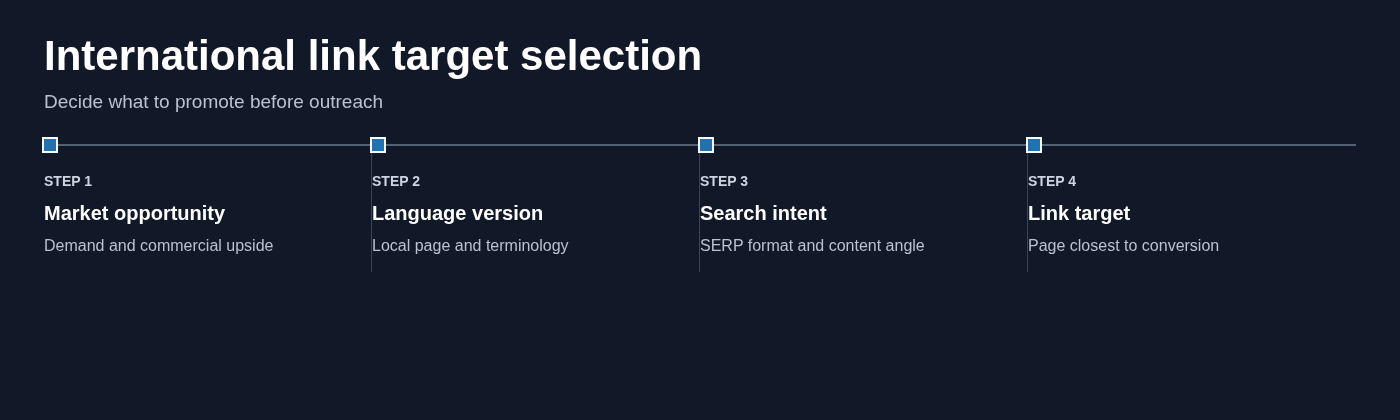
Outreach should begin after, not before, a B2B team decides what it is trying to grow. Prioritize markets using a mix of revenue potential, organic opportunity, product readiness, sales coverage, competitive pressure, and localization maturity.
For example, a SaaS company may see meaningful search demand in Spain but still defer link building there if it has no Spanish product experience, no sales support for the market, and no localized onboarding. Conversely, a smaller market may deserve priority if the product is ready, the sales team is active, and competitors have not yet built strong local authority.
Next, connect each market to a language version and a specific destination URL. A localized page should use the market's terminology, support the search intent being targeted, and give visitors a credible next step. That may be a local solution page, an industry use-case page, a comparison page, or a research asset rather than the homepage.
Technical international SEO matters here. Canonical tags communicate the preferred version of substantially similar content, while hreflang annotations help search engines select the appropriate language or regional URL for users. These signals need to align with the URLs receiving links. If a German publication links to a German page that is incorrectly canonicalized to the English version, the intended local benefit can be diluted.
A common mistake is sending every international placement to an English homepage because it feels safest. It is usually a weak choice when the article and reader are local. If the publication discusses workflow software for German operations teams, a German solution page that addresses that use case is a better destination than a broad English homepage.
Define what a high-quality international backlink looks like
A high-quality international backlink is not defined by one metric. It is a contextual editorial reference on a legitimate site that is relevant to your topic, useful for the publisher's audience, and connected naturally to a page that deserves the citation.
Use a practical standard when reviewing prospects and live placements:
- Topical relevance: The publication and article relate to your product category, buyer problem, industry, or supporting subject matter.
- Market fit: The site reaches the priority country or language audience in a meaningful way.
- Editorial integrity: Content is authored, reviewed, maintained, and not obviously built to sell links.
- Contextual placement: The link appears within useful body copy, where a reader could reasonably want the referenced resource.
- Indexability: The page can be crawled and indexed, rather than hidden behind technical barriers or placed on a thin archive.
- Sensible outbound linking: The article does not contain a clutter of unrelated commercial links.
- Natural anchor text: The wording accurately describes the destination without looking forced or repetitive.
Authority metrics can help screen large prospect lists, but they are not proof of placement value. A metric may be inflated by irrelevant traffic, expired-domain history, manipulated links, or content that ranks for unrelated queries. Review the actual publisher, its recent articles, authorship, audience, organic visibility, and the proposed article context.
Link attributes require the same judgment. A standard followed editorial link may pass ranking signals, while sponsored and UGC attributes communicate the nature of paid or user-generated links. These attributes are not automatically worthless, but they should be understood and reported accurately. For background, see this guide to link rel attributes. The real concern is deception: undisclosed paid placements, sitewide links, private blog networks, spun content, and publishers whose traffic appears manufactured.
Relevance has three layers: topic, market, and commercial context
The best placements align across three layers. First, they fit the subject matter. Second, they reach the intended market or language audience. Third, they support the commercial context of the linked page.
Consider a workflow SaaS company targeting German manufacturing teams. A link from a German operations publication in an article about reducing production handoff delays can be highly valuable even if the site has modest authority metrics. It connects the right industry, local audience, and product use case.
By contrast, a generic high-metric lifestyle publisher that inserts the same software link into an unrelated productivity roundup may look impressive on a report but offer little relevance, little referral quality, and a less convincing authority signal.
Choose the right service model for each market
Professional link building services use different acquisition models because no single tactic fits every country, publisher type, or growth objective. A credible program usually combines approaches over time rather than relying on one repeatable placement format.
Editorial guest posts
Editorial guest posts are original articles contributed to relevant publications. They work well when a company has genuine subject-matter expertise, a useful point of view, or practical lessons that a local B2B audience can apply.
For international markets, quality depends heavily on localization. The contribution should not read like an English article translated after the fact. It needs local terminology, examples, evidence, and an angle that fits the outlet's readers. Guest posts can support thought leadership and contextual links, but only when the publication has real editorial standards and the article offers more than a disguised sales pitch.
Contextual link insertions
Contextual link insertions place a relevant citation into an existing, indexed article. They can be efficient when the page already covers the topic and the new resource makes the article more useful. These link placement services are often appropriate for localized guides, research assets, or solution pages that closely match existing content.
The placement should be current, durable, and genuinely additive. Avoid retrofitted edits where the new sentence feels disconnected from the article, as well as old posts that receive no readership or maintenance. Clarify permanence expectations and how removals will be handled before work begins.
Digital PR and expert mentions
Digital PR earns mentions through newsworthy information: proprietary data, original research, expert commentary, timely market analysis, or a strong response to an industry development. For international campaigns, local relevance is especially important. A global benchmark becomes more compelling when it includes country-level findings or commentary from a credible regional expert.
Results are less predictable than a managed placement workflow because editorial decisions remain with journalists and publishers. Timelines can also vary. In return, successful PR can produce high-value brand mentions, citations, referral traffic, and links that are difficult to replicate through transactional outreach.
Content partnerships and resource-led campaigns
Content partnerships involve working with complementary companies, associations, local experts, or publishers to create something both audiences will value. A co-produced guide, webinar recap, benchmark, or implementation resource can create credible reasons for citations in a new market.
Directories and resource hubs can also contribute when they are curated, actively used, and relevant to the buyer. They should not be treated as a volume tactic. If a listing has no editorial value, no audience, and dozens of unrelated commercial entries, it is unlikely to strengthen a serious authority strategy.
Build a market-specific outreach strategy
A link building outreach agency should operate from a market-specific plan, not a generic database and an English email template. The operating sequence is straightforward: identify locally relevant publications, qualify them, develop an appropriate pitch, match an asset or expert to the outlet, agree the placement transparently, and verify the published result. Teams building this process internally may also benefit from a dedicated SEO outreach strategy.
Each stage needs local judgment. A direct translation can preserve grammar while losing the point of the pitch. Editors may respond differently to data, customer examples, executive commentary, practical how-to content, or contributed articles. Expectations around formality, follow-up cadence, disclosure, and paid collaborations also differ across markets.
Use native-level writers or reviewers for all recipient-facing communication and published copy. This is not a cosmetic preference. Small errors in phrasing, tone, or industry vocabulary can signal that the company does not understand the market it wants to serve.
Prospecting and qualification criteria
Before pitching a publisher, document why it belongs in the campaign. A useful qualification checklist includes:
- Does the publication reach readers in the target country or language market?
- Does its editorial coverage overlap with the industry, buyer role, or problem being targeted?
- Is it actively publishing substantive content?
- Does it show signs of organic visibility and a real audience?
- Are authors, editors, and publishing standards visible?
- Would a link to the proposed URL make sense in a specific article or contribution?
- Does the site's outbound-link behavior look editorial rather than commercialized?
Rejection reasons are valuable campaign data. Record whether a prospect was too broad, off-topic, inactive, overly commercial, geographically mismatched, or unsuitable for the target URL. Over time, this improves the prospecting model and prevents teams from repeatedly reviewing the same low-quality opportunities.
Localized pitch angles that editors can use
Editors need an idea that serves their readers. Product claims alone rarely qualify. Better pitches turn company knowledge into a local, usable editorial angle: a benchmark on implementation bottlenecks, commentary on a regulatory shift, a practical framework for a buyer role, or anonymized customer patterns supported by clear methodology.
For example, instead of pitching "our platform helps teams collaborate better," a SaaS company could offer a German business publication a data-led article on where cross-functional approval processes create delays in mid-market operations teams. The company can contribute expertise, but the piece must stand on its own for readers who never become customers.
Use anchors and destination URLs without creating a footprint
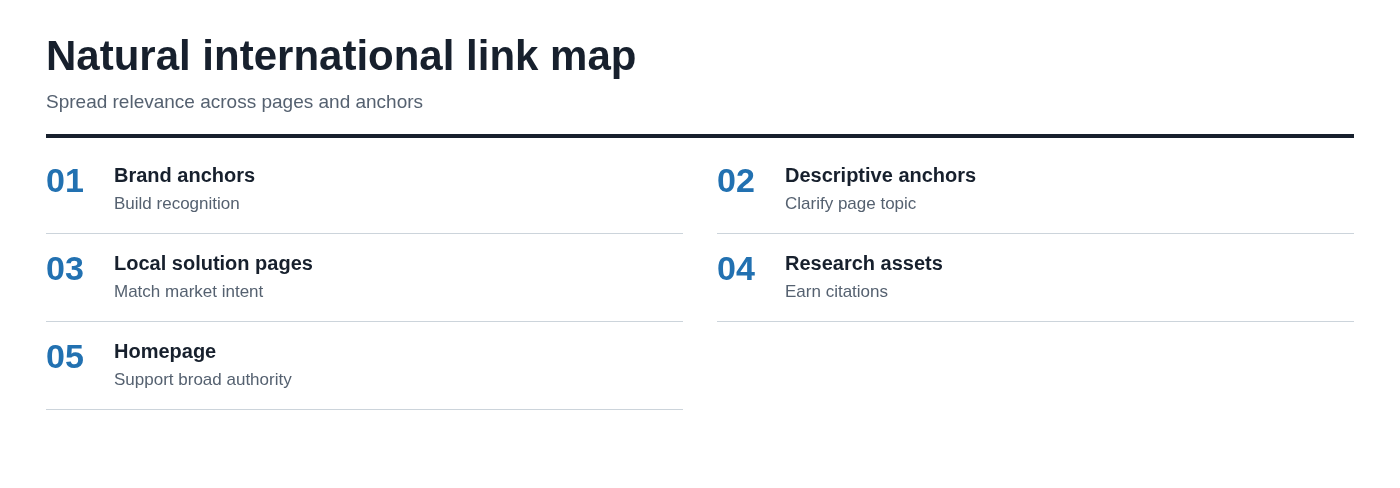
Anchor text is the visible, clickable wording of a link. In an international campaign, it should describe the destination naturally in the local language and fit the sentence where it appears. A healthy profile usually includes a mix of brand names, naked URLs, descriptive phrases, topical partial-match terms, and occasional generic anchors when they are editorially normal.
What should not happen is a repeated exact-match commercial phrase appearing across unrelated publications. That pattern is not helpful for readers and can make the campaign look engineered. The same applies to forcing a keyword into an article where a branded mention or resource reference would be more natural.
Map destination URLs before outreach. Distribute links across pages that support different objectives:
- Homepages for broad brand authority and company discovery
- Localized solution pages for market-specific commercial intent
- Industry or use-case pages for audience-specific relevance
- Comparison pages where the publication context genuinely supports evaluation
- Original research, templates, and guides that can earn citations naturally
- Thought-leadership content that establishes expertise before a prospect is ready to buy
As covered in the section on page strategy, localized landing pages should receive links when they best match the reader's intent. Do not over-concentrate every placement on one money page. A broader internal link and content strategy helps authority flow through the site while giving editors more defensible resources to reference.
How to evaluate and hire an international link building agency
When hiring an international link building agency, evaluate process quality before promises. A managed service should be able to explain its market coverage, language capability, acquisition methods, publisher-vetting standards, reporting structure, communication cadence, and escalation process.
Transparent white-hat practice means the agency can discuss how placements are sourced, why a publisher is relevant, what content will be created or edited, and what constraints exist in the market. It does not mean an agency can guarantee rankings, exact publisher inventories, or an identical pace across every country.
LinkHandy offers contextual insertions, editorial guest posts, content partnerships, PR mentions, and authority strategy for SaaS and B2B teams. Teams considering any provider should ask whether they can review prospects and outreach pitches before placements go live, particularly when protecting brand standards across new markets.
Questions to ask before signing
- How do you source and vet publishers in each target market?
- Who writes, translates, and approves localized copy and recipient-facing outreach?
- Can you explain the topical, market, and commercial relevance of a proposed placement?
- What types of placements do you exclude, even if they are available?
- How are paid relationships and link attributes handled and disclosed?
- What happens if a placement is removed or materially changed?
- Can we review prospects, pitches, and destination URLs before publication?
- What does a sample report include beyond domain-level metrics?
- How do you adjust the campaign when a market proves more difficult than expected?
Look for clarity, not theatrical certainty. A good link building consultant can explain trade-offs and show a repeatable review process. An agency that promises a fixed authority score, a guaranteed ranking position, or effortless access to every publisher is selling certainty it cannot control.
Warning signs that should stop the conversation
- Guaranteed rankings or claims that links alone will produce a specific outcome
- Undisclosed networks, vague "exclusive inventory," or resistance to explaining placement sources
- Metric-only selling with no discussion of audience, article context, or target-page relevance
- Identical exact-match anchor promises across multiple placements
- Pressure to buy bulk volume before defining markets, pages, and quality standards
- Refusal to share sample reporting or explain how removed links are handled
- Vague claims of "native outreach" without identifying who handles language and editorial review
Understand international link building costs and pricing models
International link building costs vary because the work is not a commodity. Price is shaped by the target market, language requirements, publisher availability, editorial quality, content production, campaign type, technical complexity, and the amount of strategy and coordination required.
Common commercial models include per-placement pricing, monthly retainers, project or campaign fees, and strategy-plus-execution engagements. None is automatically best.
| Pricing model | Best fit | Trade-off |
|---|---|---|
| Per placement | Teams testing a narrow market or defined set of pages | Can encourage quantity if quality standards are not explicit |
| Monthly retainer | Ongoing authority building across several pages or markets | Requires clear monthly priorities and reporting discipline |
| Campaign or project fee | Research launches, market-entry initiatives, or partnership-led work | Scope must account for changing editorial timelines |
| Strategy plus execution | Companies that need market planning, URL mapping, and acquisition support | Higher coordination investment, but often stronger alignment |
The cheapest quote can hide weak editorial standards, irrelevant sites, recycled content, or volume assumptions that are unrealistic in the target market. Instead of asking only, "How much does each link cost?" ask what the provider will do to validate relevance, localize outreach, review placements, and report commercial progress.
Measure performance beyond links delivered
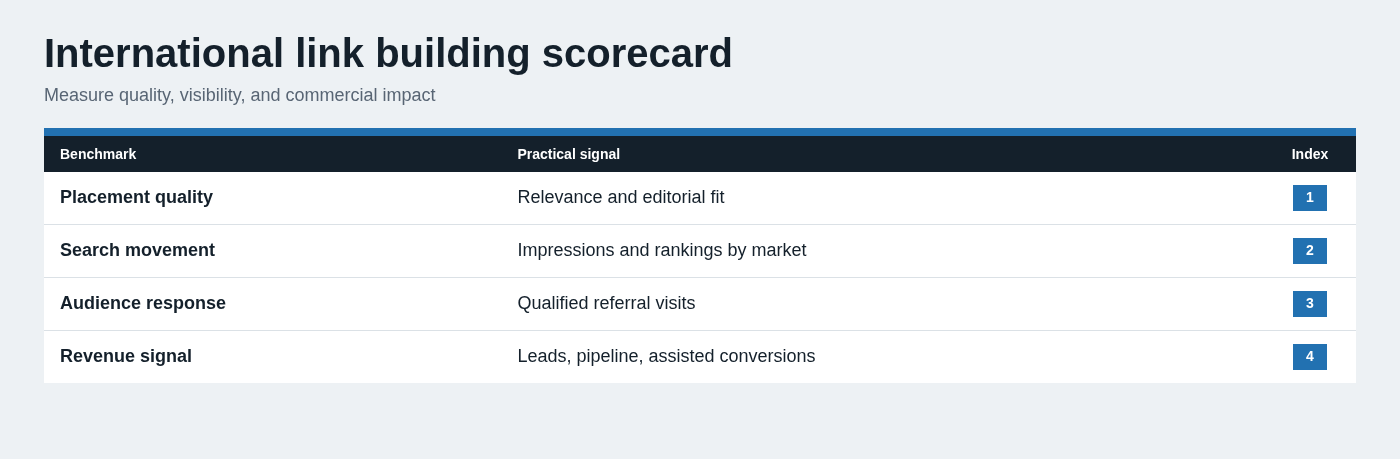
Links delivered are a delivery metric, not the outcome. International programs should be measured across placement quality, search visibility, qualified referral traffic, assisted conversions, pipeline influence, and market-level growth.
Leading indicators appear first: approved prospects, placements published, relevant page impressions, improved keyword coverage, and referral visits. Lagging indicators take longer: stronger rankings, qualified leads, sales conversations, opportunities, and revenue. New localized pages often need time to be crawled, understood, and trusted, particularly in competitive markets.
Maintain a placement log that records the publisher URL, live article URL, target page, anchor text, publication date, market, language, placement type, link attribute, visibility indicators, and current status. This becomes essential when evaluating results, identifying gaps, or investigating a removed link months later.
A practical reporting scorecard
A monthly report should answer operational questions, not merely display a list of domains:
- Are placements reaching the priority markets and pages identified at the start of the campaign?
- Is the publisher mix genuinely relevant to the industry, audience, and local language?
- Are anchors diversified and appropriate for each article?
- Which localized pages are gaining impressions, rankings, and qualified referral traffic?
- Are referral visits engaging with the site or contributing to conversions?
- What market, content angle, page, or acquisition model should change next month?
Attribution will never be perfect. A buyer may first encounter a brand through a local publication, return through organic search weeks later, and convert after speaking with sales. That is why B2B teams should review assisted conversions and pipeline influence alongside direct referral conversions.
Work through a B2B SaaS expansion example
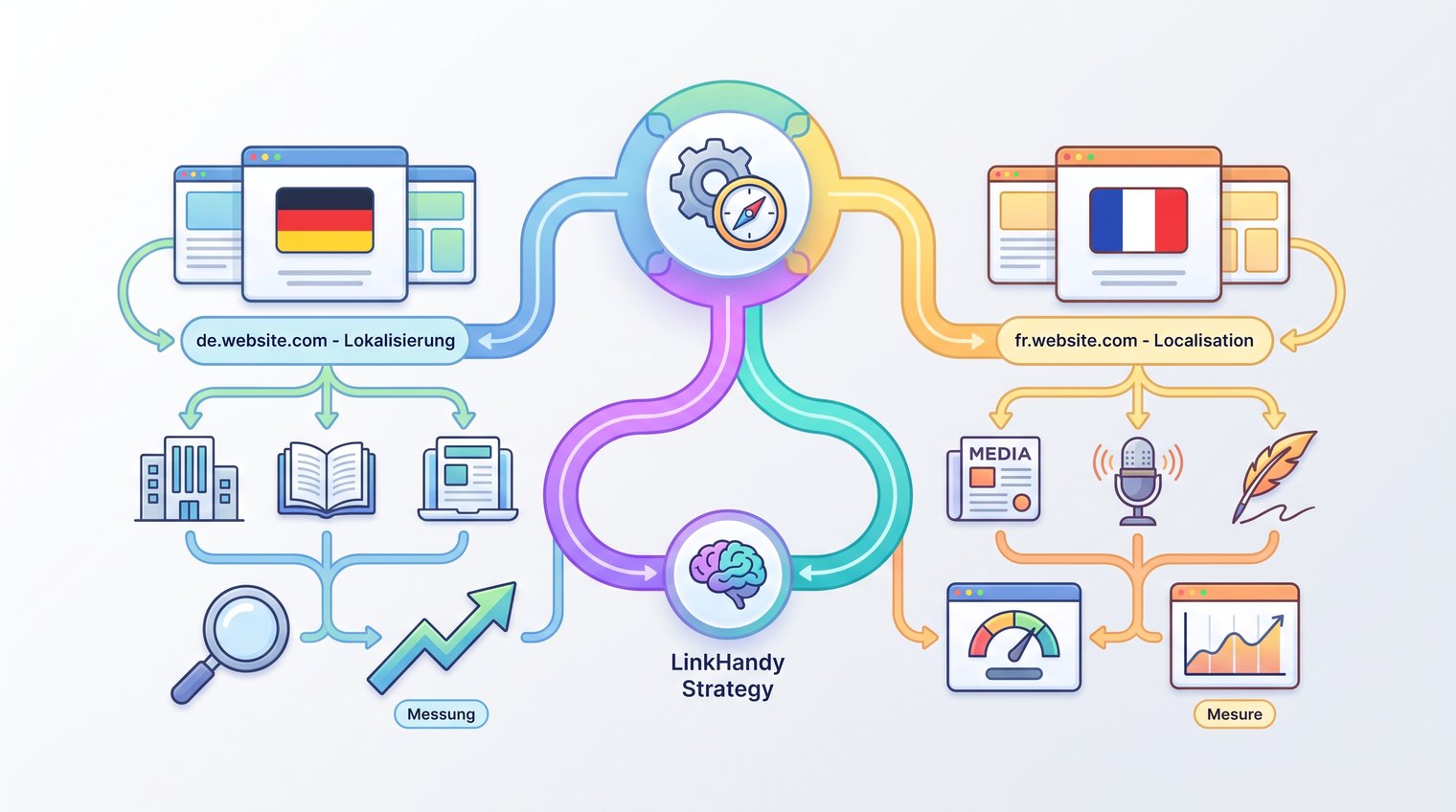
Consider a hypothetical workflow SaaS company that has established traction in English-language markets and is expanding into Germany and France. It has localized core product pages, but those pages have limited visibility and few local citations.
The company should not begin by ordering a fixed number of German and French links. First, it compares the two markets using commercial opportunity, sales readiness, competitor visibility, local search demand, and the strength of its localization. Assume Germany has a dedicated sales motion and stronger demand for the company's primary use case, while France has good interest but less mature local proof. Germany becomes the first focused campaign, with France developed in parallel at a smaller, learning-oriented scale.
The team then reviews search results for its main problem categories. In Germany, buyers search using terminology that emphasizes process reliability and operational coordination. In France, the search language leans more toward team efficiency and project visibility. The English landing page cannot simply be copied; each localized solution page needs its own messaging, examples, and internal links.
From English asset to local linkable story
The company has an English productivity report based on aggregated product usage patterns. A direct translation is unlikely to earn much attention. Instead, it separates the data by country where the sample is meaningful, clearly explains the methodology, and adds commentary from German and French operations leaders.
For Germany, the resulting asset might focus on approval bottlenecks and handoff delays in distributed operations teams. The outreach shortlist includes German operations publications, B2B technology outlets, and practitioner communities that regularly cover process improvement. The destination URLs include the German research page and a German use-case page for operations teams.
For France, the story is adapted around visibility across cross-functional projects, using French terminology and a separate editorial shortlist. The team avoids assuming that the German article, pitch, anchor phrasing, or linked page will transfer unchanged.
The anchor map is deliberately varied. Some mentions use the company name, some cite the local report by title, and others use descriptive phrasing such as "the study of approval workflow delays." A small number point to localized solution pages where the article directly discusses the relevant problem. The homepage receives broad brand mentions but does not absorb every link.
In the first reporting cycle, the team reviews placement quality and early impressions rather than declaring success or failure from rankings alone. If German outreach produces strong editorial fit but the research page receives limited engagement, the team may improve the asset's introduction, add clearer local takeaways, or route future placements to a more conversion-ready solution page. If French editors consistently prefer expert commentary over data reports, the campaign shifts more effort toward contributed insights and local interviews.
The lesson is not that one country must always come first or that a campaign needs a predetermined number of placements. It is that market research, localized assets, destination pages, and reporting should work as one system.
Common mistakes that weaken international campaigns
Most international link building failures are planning failures disguised as outreach failures. The following mistakes are especially costly:
- Treating translation as localization. Correct the language, but also adapt terminology, proof points, search intent, examples, and editorial angles.
- Buying country-code links without relevance. Evaluate the audience, content, and placement context rather than treating a local TLD as a quality guarantee.
- Using the same anchor plan everywhere. Let local language, article context, and destination-page purpose determine natural phrasing.
- Sending English-only pitches. Use native-level outreach and editorial review for the market you want to enter.
- Ignoring technical international SEO. Confirm that hreflang, canonicalization, indexability, and internal linking support the page being promoted.
- Measuring only domain metrics. Review editorial quality, local relevance, organic visibility, referral engagement, and business impact.
- Overloading one commercial page. Build authority across research assets, use-case pages, thought leadership, and the homepage as appropriate.
- Scaling before learning. Run a focused market test, document what publishers and readers respond to, then expand the proven approach.
Launch an international link building program with clear standards
Start with one priority market rather than spreading effort across every country where you could theoretically sell. Validate the localized pages, study the local SERP, define publisher and reporting standards, and run a focused campaign that gives the team usable evidence.
Then scale what proves relevant. Sustainable authority link building services depend on local relevance, editorial judgment, credible content, and transparent measurement - not bulk placements or foreign-domain counts.
B2B teams that need a transparent international outreach and placement strategy can discuss their market priorities with LinkHandy.