
Star ratings can make a link building agency look safer than it is. A five-star review that says "great service, highly recommended" tells you almost nothing about the sites used, the editorial standards applied, or whether the work supported a real SEO goal.
Useful link building services reviews reveal how an agency earns links, how it communicates, and how it protects quality. Use the checklist below to separate credible delivery evidence from polished but empty praise.
Start with the review signals that matter most
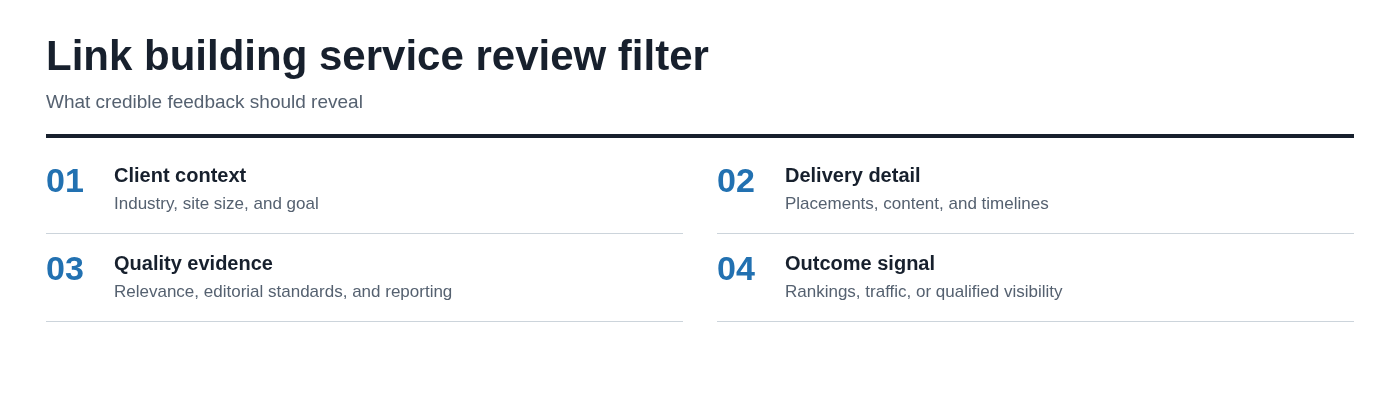
Before comparing agencies, apply a quick filter. The strongest reviews identify who the client is, describe what the agency delivered, and connect the work to an outcome that matters to that business.
Essential: check client context. Look for an identifiable company, role, industry, site type, and objective. A SaaS company trying to build authority for commercial pages has different needs than an affiliate site pursuing volume.
Essential: prefer specifics over praise. A worthwhile review may mention editorial guest posts, contextual insertions, approval workflows, reporting quality, or the relevance of publishers. Generic compliments are not evidence.
Essential: check recency. Link acquisition methods, publisher standards, and account teams can change. Recent feedback is more useful than a testimonial from several years ago.
Essential: match outcomes to your goals. Look for context around rankings, organic visibility, referral traffic, brand mentions, or authority building. Do not treat a star rating as proof that a managed service can deliver the type of links your campaign needs.
Reviews are one input, not a substitute for due diligence. The best agencies make it easy to verify the process behind the positive feedback.
1. Verify who is behind each review
Start by asking whether the reviewer appears to be a real client with a plausible relationship to the provider. A named company, identifiable marketing lead, LinkedIn profile, or matching case study gives you a place to begin validation.
- Check for a recognizable client and role. A review from a head of SEO, growth lead, or founder at a relevant business carries more weight than an anonymous quote with no context.
- Compare the review with published case studies. Names, campaign details, and stated deliverables should not conflict. A credible agency can usually explain the relationship without disclosing confidential campaign details.
- Check dates and wording. Multiple reviews posted at once, repeated phrasing, or uniformly vague praise should prompt more questions.
- Look for businesses like yours. A B2B SaaS buyer should prioritize feedback from companies with comparable sales cycles, content strategies, and target audiences.
Anonymous feedback is not automatically false; some companies cannot publicly disclose their vendors. But it should be treated as a reason to request more proof, not as standalone evidence of quality.
2. Read for evidence of relevant placements, not just domain metrics
A high domain metric is not the same as a valuable link. Third-party metrics can be useful screening data, but they do not tell you whether a site is topically relevant, editorially maintained, or likely to send a meaningful signal to search engines and readers.
- Look for topical relevance. Reviews should indicate that placements aligned with the client's industry, product category, or target audience.
- Ask about editorial context. A contextual link within a useful, relevant article is generally more defensible than an isolated mention on a thin page.
- Check for evidence of real audiences. Good placement discussions often mention established publications, niche sites, credible content, or audience fit rather than metric thresholds alone.
- Review the placement type. Contextual link insertions and editorial guest posts are different services and should be evaluated differently.
For an insertion campaign, ask whether the existing article was genuinely relevant, current, and editorially appropriate for the link. For guest posts, evaluate the publication's standards, topic fit, authorship process, and whether the content adds something useful rather than existing solely to host a backlink. If guest-post outreach is part of the offer, compare the provider's process with this guide to blogger outreach services.
Do not accept "DR 70+" as a complete quality standard. An irrelevant site with weak content can show impressive numbers while adding little strategic value to a B2B campaign.
3. Check whether the agency's process is transparent
Transparent agencies do not need to expose every outreach contact or publisher negotiation. They should, however, clearly explain how opportunities are found, qualified, approved, and documented. A documented SEO outreach strategy can help you assess whether the process is repeatable rather than dependent on vague relationship claims.
- Ask how prospects are sourced. The agency should be able to describe its outreach, editorial relationships, content partnership, or PR process in practical terms.
- Confirm whether you approve sites before placement. Pre-approval helps protect brand fit, relevance standards, and budget.
- Clarify who creates the content. Establish whether the agency, publisher, or your internal team writes and reviews articles or edits.
- Request delivery documentation. You should know what proof will be provided when a placement goes live.
Opaque practices are a risk signal, especially when paired with guaranteed volume, unusually fast delivery promises, or reluctance to explain how publisher relationships work. You do not need a secret list of every prospect; you do need enough visibility to judge whether the method fits your standards.
4. Separate quality-control praise from generic service praise
Fast replies and pleasant account management matter, but they do not prove that an agency delivers sustainable SEO value. A positive customer experience and a strong backlink profile are related, yet they are not the same thing.
- Prioritize comments about relevance checks. Strong reviews may mention that the agency rejected weak sites or found better-aligned alternatives.
- Look for editorial standards. Useful evidence includes review of content quality, publication fit, and natural link placement.
- Confirm anchor-text oversight. Reviews or proposals should show that anchors are planned thoughtfully rather than repeated mechanically.
- Ask about duplicate-site avoidance. Repeated placements on the same domains can reduce campaign breadth unless there is a clear strategic reason for them.
- Clarify replacement handling. A defined policy for removed links, rejected publications, or material placement changes is more meaningful than a vague promise to "make it right."
In short, praise such as "easy to work with" is encouraging. Praise that explains how the provider protected relevance, editorial quality, and campaign standards is far more useful when choosing high quality link building services.

5. Match reviewer outcomes to your actual SEO objective
Not every successful link building campaign should look alike. Before giving extra weight to a testimonial, determine whether the reviewer's objective matches yours.
- Match commercial-page ranking goals. If you need support for solution, product, or comparison pages, seek evidence from companies with similar commercial SEO priorities.
- Match new-domain authority goals. Newer sites may need broad, credible authority building before individual pages can compete consistently.
- Match content-promotion goals. A research report, original data study, or detailed guide may call for outreach and placements designed to earn visibility for a specific asset.
- Match referral and brand visibility goals. Content partnerships and PR mentions can be valuable when qualified audience exposure matters alongside SEO.
A glowing review from an ecommerce store, local business, or affiliate publisher may be legitimate, but it may not predict what a SaaS or B2B company will experience. Consider the site's market, content maturity, competition, and sales cycle.
Credible outcomes also tend to include timing and context. "We improved visibility over several months after building links to priority content" is more believable than a blanket promise of first-page rankings.
6. Inspect the agency's reporting and proof of delivery
Reporting turns a service claim into auditable evidence. Before hiring, request a redacted sample report that shows what completed work looks like in practice.
- Confirm that live URLs are included. You should be able to review the published page, not merely receive a domain name.
- Check for publication dates and placement status. These fields help your team understand delivery timing and monitor live links over time.
- Require target-page and anchor-text details. Reporting should show where the link points and how it is presented.
- Identify placement type. Labeling a link as an insertion, guest post, content partnership, or brand mention makes campaign evaluation easier.
- Ask how replacements and edits are tracked. If a link is removed or changed, the report should reflect the issue and resolution status.
A good report can protect both sides. It gives your SEO team a clean record for performance analysis while giving the agency a clear definition of completed work.
7. Evaluate communication, approvals, and scope control
Link building involves judgment calls. The right process gives you meaningful control without forcing your team to review every minor operational detail.
- Look for feedback on turnaround times. Reviews should distinguish realistic delivery expectations from vague promises.
- Confirm the site-approval workflow. Define whether approval happens one site at a time, in batches, or according to pre-agreed criteria.
- Set rules for content and revisions. Agree on who can request edits, what is included, and how publisher constraints are handled.
- Define campaign ownership. Your internal team should know who approves domains, chooses target pages, and signs off on anchors.
- Document change control. Scope, pricing, and deliverables should not shift after work begins without a written agreement.
Healthy flexibility means an agency can adjust when a prospect is not a fit or a publication declines an angle. It does not mean accepting lower-quality sites or surprise fees because the original scope was poorly defined.
8. Compare pricing against deliverables and risk—not price per link alone
There is no responsible single answer to how much link building costs. Pricing depends on publisher quality, topical fit, content production, outreach labor, editorial requirements, placement type, campaign management, and the level of review required.
Use reviews to confirm whether low-cost offers created tradeoffs in relevance, content quality, transparency, or replacement terms. Compare proposals by what they actually include. For a broader comparison of delivery models, see this guide to a managed link building service.
- Ask whether content is included. Clarify who researches, writes, edits, and approves the article or insertion context.
- Confirm prospecting and outreach coverage. Determine whether this work is included in the quoted fee or billed separately.
- Identify publisher and editorial fees. You need to know whether they are included, capped, or passed through as additional costs.
- Review reporting and strategy support. Campaign planning, target-page recommendations, and reporting may be part of a managed engagement or an extra service.
- Get replacement terms in writing. A lower quote has less value if a removed or unsuitable link becomes your problem immediately after delivery.
Professional link building services should be evaluated as a combination of placement standard, process, proof, and risk management—not as a commodity measured only by link volume.
9. Look for risk signals in negative and mixed reviews
Do not skip lower-rated reviews. They often reveal more about operational reliability than a page full of praise, particularly when you look for repeated patterns rather than reacting to one unhappy customer.
- Watch for recurring missed deadlines. One delay can happen; repeated complaints about unclear timelines deserve attention.
- Investigate relevance concerns. Multiple comments about poor-fit sites or low-quality content may indicate weak qualification standards.
- Note undisclosed placement issues. Surprise domains, unexpected link types, or work delivered without approval point to process problems.
- Check for removal and reporting complaints. Weak follow-through after a link disappears is a practical risk for an ongoing campaign.
- Read the agency's response. A thoughtful response that addresses facts and resolution is a better sign than denial, blame, or silence.
A single complaint is not a verdict. Ask whether the issue appears repeatedly, whether it relates to your own priorities, and whether the provider can explain what changed in its process. Bring recurring concerns directly into the sales conversation before signing.
10. Validate review claims with a short pre-hire audit
The final step is simple: test the claims that matter most before committing budget. You cannot infer every campaign outcome from public metrics, but you can assess whether the agency's process and examples meet your standards.
- Request recent, relevant placement examples. Ask for examples that resemble your industry, audience, and desired placement type where confidentiality permits.
- Review a sample of live pages. Inspect topical fit, editorial quality, surrounding content, and whether the page appears to serve readers.
- Check basic publication health. Confirm that pages are accessible and indexed, while remembering that third-party SEO metrics are only one input.
- Walk through the approval process. Ask how sites, topics, anchors, and target URLs will be proposed and approved.
- Speak to a relevant reference when possible. A short conversation with a client similar to your company can clarify communication, reporting, and delivery realities.
This is the bridge between reading link building services reviews and making a confident hiring decision. Reviews help you form questions; a pre-hire audit tells you whether the answers hold up.
Questions to ask before you hire a link building agency
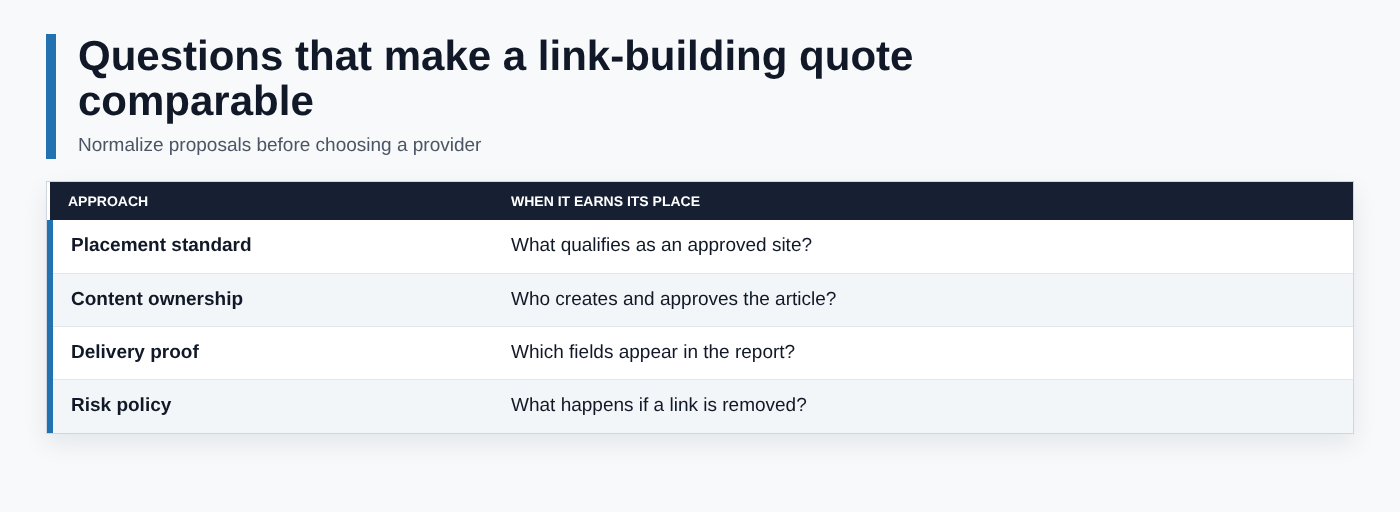
Get answers in writing so every proposal can be compared on the same terms.
- How do you source placements? Ask whether opportunities come from direct outreach, editorial relationships, content partnerships, PR, or a combination of methods.
- What qualifies as an approved site? Request the agency's standards for relevance, editorial quality, audience fit, and site-level screening.
- Can we approve domains before work goes live? Clarify the approval stage and how alternatives are handled when you reject a prospect.
- What is excluded from the quoted scope? Ask specifically about content, publisher fees, revisions, reporting, strategy, and replacement work.
- Who creates and approves content? This is especially important for editorial guest posts and content partnerships, where quality and brand accuracy matter.
- How do you check relevance and editorial quality? Look for a repeatable review process rather than a broad assurance that sites are "high authority."
- What fields will appear in the delivery report? At minimum, expect the live URL, target page, anchor text, publication date, and placement type.
- What happens if a link is removed or materially changed? Ask about monitoring, replacement windows, and the process for resolving issues.
- How do you approach contextual insertions? Confirm that the existing article, surrounding copy, and publisher all support a natural placement.
- How do you plan authority-building campaigns? For broader authority link building services, ask how target pages, content assets, and anchor diversity are prioritized over time.
Use this final checklist to choose a link building service
Use the essentials below as your decision threshold. Nice extras can improve convenience, but they should not outweigh gaps in placement quality or transparency.
- Essential: verifiable reviews. Favor feedback with identifiable client context, relevant detail, and recent delivery evidence.
- Essential: relevant placement proof. Review examples for topical fit, editorial context, and real usefulness beyond a domain metric.
- Essential: a transparent process. You should understand sourcing, qualification, approvals, content responsibilities, and delivery steps.
- Essential: clear reporting. Require live URLs, dates, target pages, anchors, placement types, and documented issue handling.
- Essential: goals aligned to your business. Choose evidence from SaaS or B2B campaigns when your own objectives involve commercial visibility, authority, or qualified reach.
- Essential: documented scope and risk terms. Confirm inclusions, exclusions, revisions, fees, and replacement policies before launch.
- Essential: sensible pricing for the work involved. Compare placement standards and deliverables, not just a headline price per link.
- Nice to have: advanced dashboards. Helpful reporting interfaces are convenient, but they are secondary to accurate, auditable delivery data.
- Nice to have: unusually fast turnaround. Speed is useful only when it does not lower relevance, editorial standards, or approval controls.
Reputable providers make their methods and delivery evidence easier to evaluate, not harder. If you are looking for a transparent outreach partner for SaaS and B2B link acquisition, explore LinkHandy's approach before requesting a proposal.