
A monthly backlink report should do more than count new links. It should show where each placement went live, whether it is still valid and indexed, which target page it supports, and what changed afterward.
The practical answer is a simple spreadsheet with a placement tracker, a stakeholder summary, and target-page performance data. Rankings, traffic, and conversions matter, but they are lagging signals. Treat them as evidence to interpret over time, not proof that one link caused every result.
What should a monthly backlink report include?
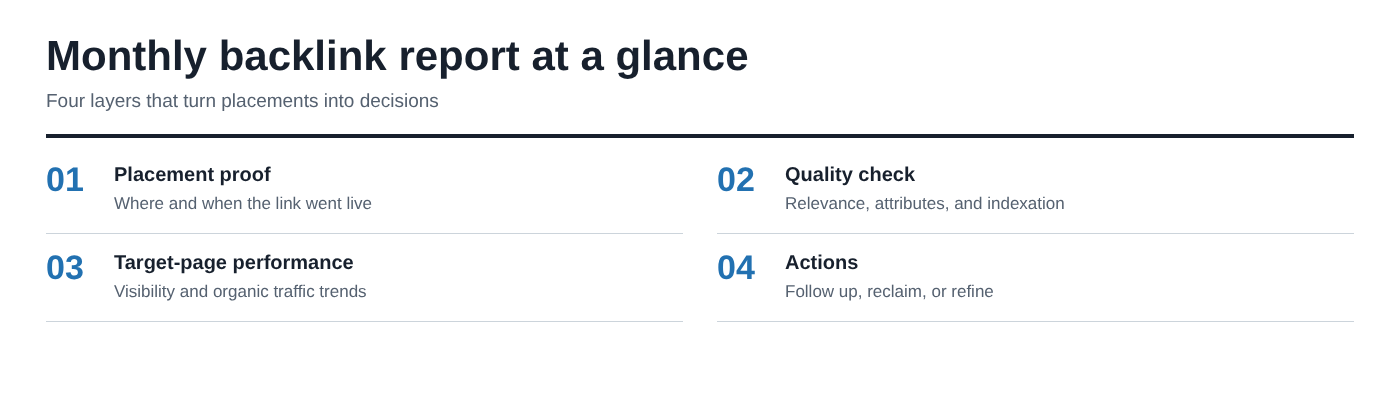
A useful monthly backlink report combines four layers: placement proof, quality checks, target-page performance, and follow-up actions. That makes it an operating document for your SEO team, not a vanity-metric export full of domain scores and totals with no supporting evidence.
At the placement level, record the live URL, destination page, anchor text, attribute, date, and status. Then verify that the page still resolves, the link still points where it should, and the source page can be found in search where appropriate.
At the outcome level, group links by the page they support. A SaaS comparison page, solution page, and educational resource often have very different search intent, conversion paths, and time frames for performance. Looking at all backlinks in one total hides those differences.
Use this monthly backlink report template
This template works in Excel, Google Sheets, or a document that is later exported as a PDF. If stakeholders ask for a monthly backlink report template in Word, keep the detailed tracker in a spreadsheet and use the document only for the summary and decisions. Spreadsheets are better suited to link-level monitoring and historical checks.
Use one row for every acquired or monitored placement. Copy these fields into four spreadsheet tabs:
| Tab | Copy-ready fields |
|---|---|
| Monthly summary | Reporting period; links acquired; links live; indexed linking pages; new referring domains; links by rel attribute (followed, nofollow, sponsored, UGC, or other); links by target URL; notable wins and risks; next-month actions |
| Placement tracker | Source domain; source URL; publisher or topic; target URL; anchor text; rel attribute; placement type; live date; indexation status; last checked date; status; owner |
| Outcome tracker | Target URL; baseline and current organic clicks; impressions; average position; organic sessions; assisted conversions; observation window |
| Action log | Action; owner; due date; expected outcome; status |
Every total should tie back to the placement tracker. If a report says 14 editorial links went live, a reviewer should be able to find all 14 rows, their source URLs, and their current status without asking for a separate file.
Placement tracker tab
Optional fields can add useful context without turning the sheet into clutter: negotiated deliverable, cost or effort, authority metric and its source, estimated source traffic, country or language, and notes. These are helpful when comparing outreach, PR, content partnerships, guest posts, and contextual link insertions.
Use controlled status values rather than free-form notes. A practical set is: pending, live, indexed, changed, removed, and needs follow-up. Consistent statuses make filtering and monthly totals reliable.
Outcome tracker tab
Track outcomes by target page and compare baseline and current organic clicks, impressions, average position across the relevant query set, organic sessions, assisted conversions where available, and the observation window. Interpret new and established pages separately, since they may have very different time frames for visibility.

How to fill out the report each month
The most reliable process is repeatable: update new placements, verify existing ones, refresh indexation and target-page data, then write the actions the team will take next. Do not overwrite old checks. Keep historical rows and timestamped updates so you can see when a placement changed.
1. Add new placements with evidence
Record the exact live source URL, the intended target URL, anchor text, attribute, placement type, and the date the link was found or confirmed. Save enough evidence to reconcile what was delivered by an agency, outreach partner, PR effort, or internal content partnership.
For example, "link placed on example.com" is not enough. The row should identify the specific article, the destination page, whether the link is followed or nofollowed, and whether it appears in the agreed editorial context.
2. Run the backlink placement quality assurance checklist
Check that the linking page resolves, the link appears in the intended editorial context, and the destination matches the correct canonical target. Confirm that the anchor is appropriate and that the rel attribute matches what was agreed.
Flag redirects, broken source pages, sitewide placements, mismatched anchors, irrelevant surrounding copy, and unexpected nofollow or sponsored attributes. Not every nofollow link is a problem, particularly for genuine PR coverage or reputable publications, but it should be correctly reported rather than counted as something it is not.
3. Check whether the linking page is indexed
For a repeatable process, use How to Check if a Backlink Page Is Indexed alongside a site: query with a distinctive title phrase or URL fragment. If the publisher provides access to Google Search Console, that can offer stronger confirmation; third-party crawl and index data can provide another useful signal.
A site: query is directional, not definitive. New pages may take time to appear, and Google does not guarantee that every query exposes every indexed URL. Log the date of the check, then recheck new or temporarily absent pages in a later reporting cycle.
4. Compare target-page performance against a baseline
Use Google Search Console and analytics data to compare the target page before and after placements over a meaningful time window. Look for changes in impressions, clicks, query visibility, organic sessions, and downstream business activity where your analytics setup supports it.
Annotate confounders. A content refresh, internal linking change, seasonal demand shift, technical issue, paid campaign, or broader algorithm movement can affect the same page. The report should describe what happened and what may have contributed, rather than forcing a simplistic cause-and-effect story.
How to monitor backlink changes after placement
A link that was live last month is not automatically live today. Pages can be deleted, redirected, deindexed, moved behind paywalls, or edited in ways that change the anchor, context, or rel attribute.
Check recent and high-value placements monthly. For stable, older placements, a quarterly sample is usually sufficient, unless the source domain is volatile or the link supports a high-priority commercial page.
Track the changes that affect link value
Monitor source URL availability, HTTP status, target destination, anchor text, rel attribute, indexation, canonicalization, and major surrounding-context changes. A page may remain live while the actual link has been changed to a different destination or removed from the relevant paragraph.
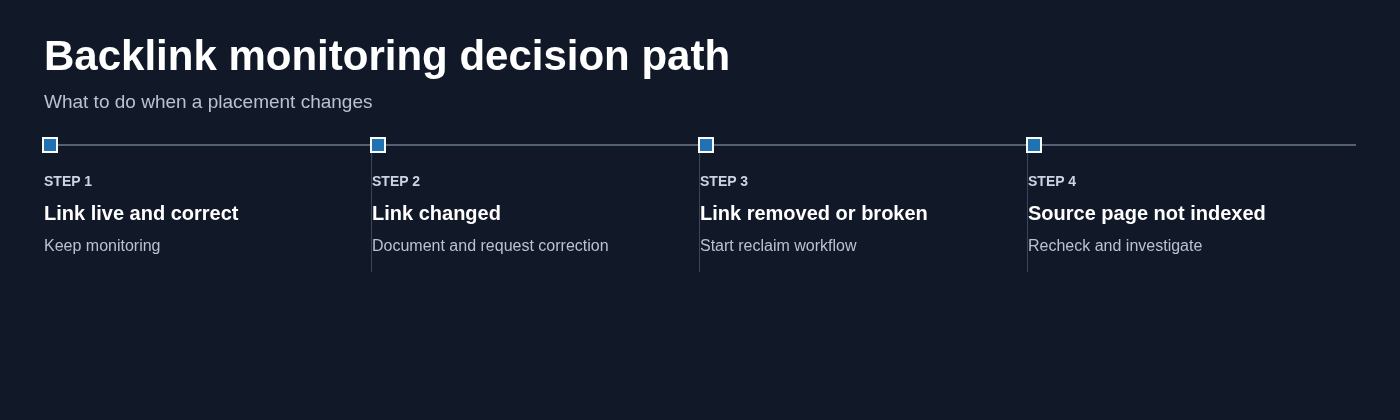
Create clear action rules. Request a correction for an agreed placement that changed unexpectedly. Update an internally redirected target if the redirect is intentional and sound. If a recovery is not possible, mark the placement as lost rather than leaving it in a "live" total indefinitely.
How to track backlink impact by target page
For SaaS and B2B websites, the target URL should be the main unit of outcome analysis. Grouping placements by page quickly exposes overconcentration, neglected priorities, and pages that need more than links to perform. For a practical reporting method, see How to Track Backlink Impact by Target Page.
If eight new placements point to one blog post while a high-value solution page has none, the report should make that imbalance obvious. Likewise, a page receiving relevant links but gaining no visibility may need a stronger content match, clearer internal links, or technical work before more outreach makes sense.
Use a target-page scorecard
For each priority page, track referring domains gained, linking-page relevance, indexation rate, anchor mix, and the organic visibility trend. Add the page's business priority so the team does not default to chasing links for URLs that are easy to promote but commercially unimportant.
Sort the scorecard by opportunity, not just link count. A lightly linked comparison page with strong conversion intent may deserve attention before a resource page that already has broad authority and limited commercial value.
Write observations, not overclaims
Use language that matches the evidence. For example: "Visibility increased during the observation period following three relevant placements to the integration page." That is more credible than saying a single guest post caused a ranking jump.
Also note when movement is not expected yet. A page may be new, weakly aligned to search intent, technically constrained, or competing in a difficult category. A good report identifies those issues instead of using more link volume to hide them.
Metrics to include - and metrics to treat carefully
The most useful backlink metrics are operational: whether a relevant link is live, indexed, retained, and supporting the right page. Third-party authority scores can be useful context, but they are proxies, not the objective.
Core metrics for every month
- Acquired links and currently live links
- New referring domains
- Indexed source pages
- Link retention rate
- Placement relevance and placement type
- Distribution across target pages
- Organic visibility and traffic trend for priority targets
Calculate retention for a defined cohort: live links still valid divided by links expected to remain live. Exclude placements that were clearly time-limited from the expectation, such as a campaign page scheduled for removal, so the rate remains meaningful.
Contextual metrics that need interpretation
Authority metrics, estimated source traffic, followed-link counts, rankings, and conversion data all add context, but none should stand alone as proof of success. A relevant editorial mention on a smaller industry site may be more valuable to a narrow B2B audience than an irrelevant link from a site with a larger authority score.
Do not report raw backlink totals without deduplicating referring domains and reviewing relevance. Hundreds of low-value, repeated, or sitewide links can inflate a chart while doing little for the pages that matter.
Turn the report into next-month link-building actions
The report earns its place when it changes what your team does next. Use it to reclaim valuable lost placements, diversify overused anchors, support underlinked priority pages, and investigate pages receiving relevant links without gaining traction.
Add a short action block to the monthly summary: action, owner, due date, expected outcome, and status. For example, a content lead may refresh a weak solution page before further outreach, while an SEO manager asks a publisher to restore an agreed contextual placement.
For teams working with an external partner, this is also where transparency matters most. Link-building activity should be traceable from prospect and approved placement through to the live URL and ongoing checks, not summarized as an unexplained monthly total.
A monthly backlink report should make every placement accountable
The best monthly backlink report template records what was placed, confirms it remains valuable, and connects the work to target-page outcomes without overstating causality. It gives stakeholders a clean summary while preserving enough placement-level evidence for the SEO team to act.
Teams that need transparent placement records, relevance checks, and sustainable white-hat backlink acquisition can explore LinkHandy's link-building services.