
An unlinked brand mention is often one of the cleanest link-building opportunities available: a publisher has already decided your company, product, founder, or research belongs in the article. The right next step is not a generic backlink request. It is a short, specific email that makes it easy for the editor to help readers reach the source.
The best unlinked brand mention outreach email template identifies the exact article and mention, suggests the most relevant destination page, and leaves editorial control with the publisher. That approach will not turn every mention into a link, but it gives legitimate opportunities a credible reason to be updated.
What is an unlinked brand mention, and when is it worth pursuing?
An unlinked brand mention is a published reference to your company, product, founder, original report, or proprietary asset that does not include a clickable link. For example, a SaaS comparison may name your tool, or an industry article may cite findings from your annual report without linking to the source.
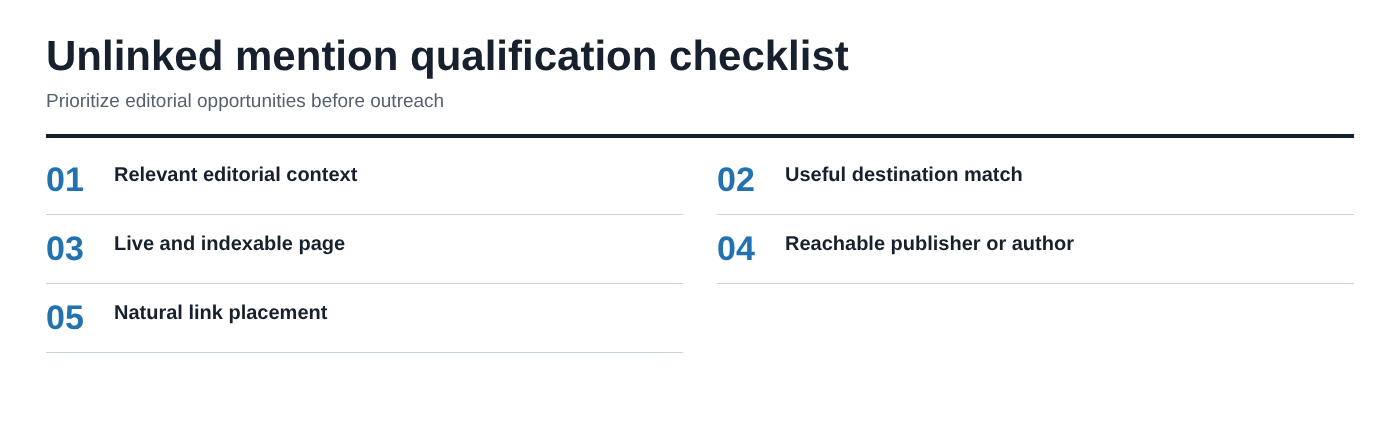
Not every unlinked mention deserves outreach. Prioritize pages with real editorial context, a sensible page on your site to link to, and a reasonable chance that the publisher can still edit the article. The page should also be live and indexable, rather than a deleted post, an archive with no visibility, or a page blocked from search engines.
Legitimate link reclamation is different from asking a publisher to manufacture a backlink. A useful mention gives readers a reason to visit the original product, research, or source page. A passing reference, a negative review, or a list where your brand appears only incidentally may not justify a request at all.
The unlinked brand mention outreach email template
Your email should be easy to understand in one pass. Include the exact article URL, point to the existing mention, and offer a destination that adds useful context for readers. Do not lead with domain authority, rankings, or what the link would do for your SEO.
A simple subject-line formula is: [Article title] - quick link suggestion for [brand mention]. Including the article name or URL makes the request immediately recognizable to a busy editor.
Primary template: straightforward editorial link request
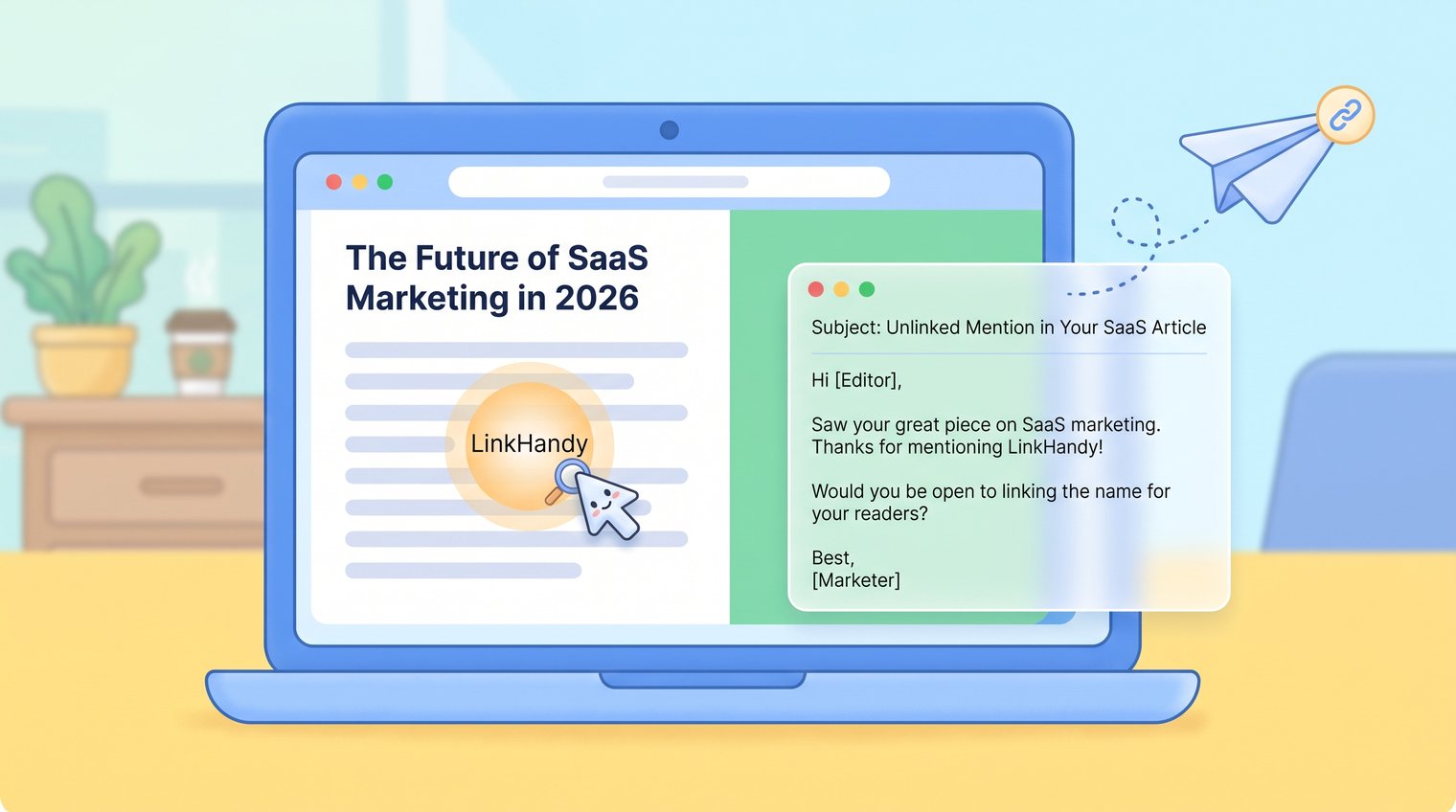
Subject: Quick link suggestion for "[Article Title]"
Hi [Name],
I was reading your article, "[Article Title]" ([Exact Article URL]), and noticed you mentioned [Brand/Product/Report] in the section about [brief context or quoted phrase].
Would you be open to linking [suggested anchor phrase] to [Suggested Destination URL]? It may help readers who want to see the original [product details/research/source material].
Of course, please use whatever wording and destination you feel fits the article best.
Thanks,
[Your Name]
[Company]
The suggested anchor should fit naturally into the existing sentence. For instance, if an article says, "LinkHandy supports B2B teams with backlink acquisition," a reasonable suggestion may be to link "LinkHandy" or "backlink acquisition." Do not insist on an exact-match keyword or dictate the publisher's editorial wording.
Subject lines that make the request recognizable
- Quick link suggestion for your [Article Title] article
- Source link for the [Brand/Report] mention in [Article Title]
- Small update suggestion for [Exact Article URL]
These are direct without being misleading. Avoid fake urgency, vague subjects such as "Important request," or language that hides the fact that you are asking for a link.
How to personalize the template without making it longer
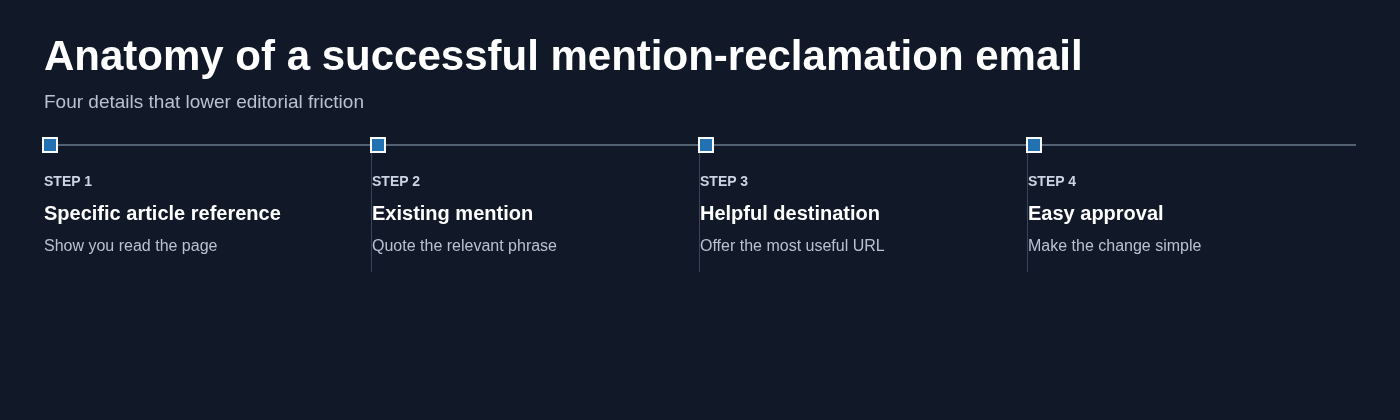
Personalization does not mean writing a paragraph of praise. It means proving that the request is tied to this specific page and that the suggested link serves the reader.
Research four things before sending: the author or editor's name, the exact sentence containing the mention, the reason your destination page adds context, and the best URL for that mention. One accurate sentence does more work than several lines of generic compliments.
For example, instead of writing, "I loved your insightful article," write: "Your section on validating SaaS vendors is especially useful because it distinguishes editorial placements from purchased listing sites." That sentence signals you read the page and understand its purpose.
Do not send every publisher to your homepage. A homepage is occasionally appropriate for a broad company introduction, but it is usually a weak choice for a specific product feature, report, founder quote, or service reference.
Match the link destination to the mention's intent
The destination should answer the reader's likely next question. When it does, the request feels like a practical edit rather than a transactional SEO favor.
- Product mention: Link to the relevant product or feature page.
- Original data citation: Link to the research report, study, or methodology page.
- Founder quote: Link to a credible author, leadership, or company background page.
- Service reference: Link to the tightly relevant service page, not a general navigation page.
A publisher who mentions a company's original survey should not have to link to an unrelated sales page. Matching intent improves editorial fit and reduces the appearance that the request exists only to gain a backlink.
Follow-up email template for no response
Send one polite follow-up after a reasonable interval, such as five to seven business days. The goal is to bring the note back to their attention, not create pressure.
Subject: Re: Quick link suggestion for "[Article Title]"
Hi [Name],
Just following up on my note about the [Brand/Report] mention in "[Article Title]."
If you are updating the page, the original resource is here: [Suggested Destination URL]. It may be useful for readers looking for more detail, but no worries if it is not a fit for the article.
Thanks again,
[Your Name]
For straightforward mention reclamation, one follow-up is usually enough. Continue only if an editor responds, asks for information, or indicates that updates are planned. Repeated nudges can damage a relationship over an opportunity that may have limited value.
When a mention needs a different outreach angle
Some mentions are real opportunities but do not fit the default template. In those cases, change the rationale rather than increasing follow-up volume. The question is always the same: what useful improvement would a link make for this reader?
Your brand is named in a list or comparison
A listicle or comparison can support a link request, but do not ask the publisher to change your rank, rewrite their verdict, or move your brand higher in the article. Ask only whether they would consider linking the existing brand reference to the page that best supports the reader's evaluation.
If the article lists a B2B link-building provider, for example, the appropriate destination may be a relevant service page rather than a homepage. The same principle applies to a contextual link insertion outreach email template: suggest a useful resource, but preserve the publisher's independence over wording, placement, and editorial judgment.
The article cites your original research or PR announcement
When a publisher uses your data, announcement, or original finding, lead with the source. Offer the full report, newsroom page, methodology, or source material so readers can verify the claim and explore the context.
For PR mention quality, do not judge the opportunity by a single authority metric. Look at topical relevance, editorial independence, a real audience, indexability, natural context, and whether the referring domain is credible. A relevant trade publication with a clear editorial audience can be more valuable than a high-metric site with little connection to your market.
The mention is inaccurate, outdated, or negative
Separate factual correction from link acquisition. If pricing, product capabilities, leadership information, or research findings are wrong, lead with verifiable corrections and the most reliable source material. Do not make the correction conditional on receiving a link.
A negative mention also requires restraint. A backlink is not the priority when an article raises a legitimate reputation issue or contains a factual error. Focus first on accuracy, clarity, and a professional response; an editor may choose to add a source link as part of an update.
A practical workflow for finding and qualifying mention opportunities
Effective mention reclamation is a filtering exercise, not a volume game. Start broad, then spend outreach time only on pages where a link would be useful and realistically attainable.
- Search for your company name, products, branded reports, founders, abbreviations, and common misspellings.
- Remove owned pages, social profiles, duplicate results, and pages that already link to you.
- Check whether the article is live, indexable, relevant to your audience, and editorially maintained.
- Read the surrounding paragraph and choose the destination page that best matches the mention.
- Find the author, managing editor, content lead, or listed contact responsible for updates.
- Log the URL, mention type, contact, suggested destination, outreach date, reply status, and outcome.
A documented SEO outreach strategy can make this filtering process more consistent. Prioritize editorial pages with a clear audience and natural placement opportunity. Deprioritize scraped copies, syndicated duplicates, low-quality directories, noindex pages, and articles that are irrelevant to your business even if they happen to include your name.
Common mistakes that make unlinked mention outreach fail
Most failures are preventable. Publishers receive enough outreach to recognize a mass template immediately, especially when the sender has not read the article or suggests a destination unrelated to the mention.
- Writing too much: A short request is easier to review than a multi-paragraph pitch.
- Making a vague ask: Name the article, quote or describe the mention, and include the proposed URL.
- Using an irrelevant homepage link: Send readers to the page that supports the existing claim.
- Using automated flattery: Generic praise adds no credibility and can undermine the request.
- Demanding anchor text: Suggest a natural phrase, but let the editor make the final decision.
- Contacting the wrong person: A general inbox may be necessary sometimes, but a listed author or editor is usually a better first contact.
Most importantly, a publisher is not obligated to add a link simply because they mentioned your brand. Treat the request as a reasonable editorial suggestion, not an entitlement.
Measure success beyond the number of links added
Links added matter, but they are not the only signal that your process is working. Track opportunities found, qualified opportunities, emails delivered, replies, links added, destination pages, referring-page relevance, and time from outreach to placement.
Reply quality is especially useful. A thoughtful decline can reveal that a destination was poorly matched, while a positive response may show that a particular report type or product page consistently helps editors. Those insights are more actionable than sending a larger batch of emails.
Review outcomes by mention type and destination. You may find that original research citations earn more editorial links than generic brand references, or that product mentions perform better when directed to a focused feature page. Use that information to improve future prospecting and site resource strategy.
Turn existing mentions into better-connected brand resources
Strong unlinked brand mention outreach is simple: identify a real editorial reference, recommend the page that genuinely helps the reader, and make the update easy for the publisher to approve. The email should feel like a useful maintenance suggestion, not a disguised demand for SEO value.
For B2B teams that need a repeatable, white-hat approach to mention reclamation and broader authority building, LinkHandy can help develop and execute a transparent outreach strategy.